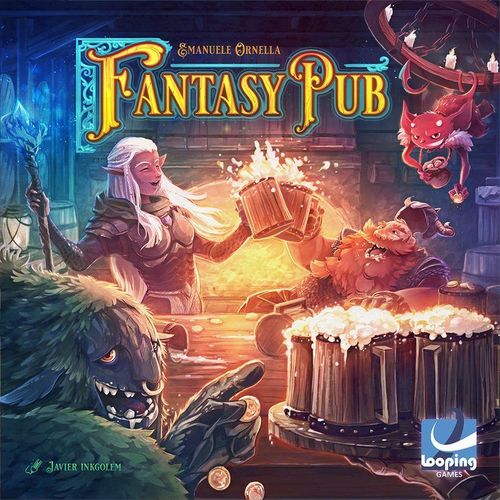
Fantasy Pub (Second Edition)
Fantasy Pub (Second Edition) Rulebook
Table of Contents
Table of Contents
Components
- 28 character cards from 4 clans (northmen, corsairs, savages and thieves)
- 17 event cards
- 4 action summary cards
- 4 cards "+1/-1"
- 1 start player coaster
- 75 coin/beer tokens
- 1 barkeeper
- 1 door
- 6 tables
- 2 dice
Objective of the Game
Each player plays with a clan composed of different families that will enter the pub to spend their loot drinking all they can and make it out on their feet. Characters will go from table to table and toast with other members of their own family or invite and be invited. But, as they drink more and more beers, the movement becomes more and more difficult and reaching the door to go home can be an ordeal.
Setup
-
Arrange the Fantasy Pub tables in a circle, clockwise from 1 to 6. Make sure you leave enough space between them to place the character cards.
-
Place the pub door between table 1 and table 6.
-
Shuffle all the coin tokens (with the beer side down) to create a common pool available to all players.
-
Place one coin from the pool on each of the six tables.
-
Each player chooses one of the clans and receives the seven character cards of that colour which they shuffle face down and place in front of them, together with an action summary card and a card "+1/-1" which they place with the "+1" side face up.
-
Any player rolls a die and places the barkeeper on the table with the same number as the result.
-
Pick a player at random to receive the starting player coaster.
-
From the starting player and going clockwise, each player must place a character inside the tavern. To do this, follow these steps:
- Draw the first card from the deck.
- Roll a die and place that character on the table with the same number. If you get a table that already has a character from another player, roll again until you get an empty table (ignoring the innkeeper).
- Place 4 coins from the pool on the character card.
Note: If you draw a goblin, placing it on the table will activate its ability and it will take the coin there, starting with five coins instead of four (see "The Families" section below).
-
Each player draws four event cards and, after seeing them privately, keeps three. Discarded cards and cards that were not dealt are returned to the box without looking at them.
It's all ready to go!
Illustration caption: "3 players game setup".
How to Play
On your turn, roll both dice. You can perform one of the following actions with each of the results:
- Enter the pub
- Move a character of your clan
- Call the barkeeper
- Exit the pub
- Play an event
You must perform at least one action, but it is not mandatory to perform both. Note also that some of the actions allow you to add up the dice results to improve them.
Enter the Pub
Draw the top card from your deck and place the character at the door. On its card place as many coins from the pool as the value of the used die. You can add both dice together to get a higher result, but remember that you can never place more than 6 coins even if they add up to more.
If there are not enough coins in the pool, just take the remaining coins. If there are no coins left, this action can not be done.
Important: There can only be one character from each clan at the pub door. So, if you already have a character there, you will not be able to take this action.
Move a Character of Your Clan
The circle of tables and the door form a path of seven spaces. The characters move around the pub in a clockwise direction, moving from space to space and can go around the pub one or more times before leaving (see action "Exit the Pub"). The door is also considered a space and players can stop at it either to leave or to continue moving in a later turn.
A character always moves as many spaces as the result of the die minus the number of beers drunk (see below).
Example: Although she uses die 4, the corsair elf moves three tables because she has drunk a beer.
- You cannot move the same character twice in the same turn but you can add the two results together to make the character move further.
- The character must move the full value.
- A character can only end their move at the door, at a table that is empty, at one table occupied by members of his own family, or at a table where all the characters are of different families, including the character being moved. At the tables, the clan of the seated characters does not matter, only their family.
Check if the character drinks one beer when ending their movement:
-
If they end their movement at the door, the character does not drink, because drinking at the door is awkward and uncomfortable. Remember that only one character of your clan can stay at the door.
-
If they end their movement at an empty table, the character does not drink, because drinking alone is very sad.
-
If they end up at a table with characters of the same family, they all toast to celebrate the gathering. Each character at that table flips over one of their coins into beer.
Example: The dwarf arrives at a table with other dwarves and they all toast for the gathering by flipping over one coin to turn it into beer.
Note: Although not common, a table can have more than four characters of the same family.
-
If they end up at a table with one or more characters of a different family than their own, a round of invitations begins. But in this world the size hierarchy must be respected, so the smallest characters should invite the next biggest, and that one the next biggest, and so on. This order must be followed:
Goblin → Dwarf → Dark Elf → Troll
To invite, you must take a coin off your character and give it flipped over (turned into beer) to the next character on the scale. If there is no character of the next immediately largest family at the table, you must invite the next one in the hierarchy.
Example: The goblin arrives to the table and activates an invitation round. They pay a beer to the dwarf, and the dwarf uses their last coin to invite the troll.
So the goblin will never be invited by other families and the troll will never invite anyone.
Call the Barkeeper
You can use a die to send the barkeeper to the table numbered with the die result and choose a character at that table, yours or from another player, to drink a beer.
- The barkeeper always goes directly to a table, does not move space by space, and therefore can never end up at the door.
- You can not sum up the dice results to do this action.
- You can move the barkeeper to an empty table (he has to clean up the tables for the next customers)!
- The barkeeper must move. You cannot use a die with the result of the same table where he is already, but you can send him to another table with the first die and send him back to the original table with the other.
- You can use both actions, one with each die, to move the barkeeper to two different tables and force two characters to drink.
Example: The northern player uses one die to call the barkeeper to table 6 and makes their goblin drink one beer.
Exit the Pub
You may use a die, regardless of its value, to have your own character exit the pub if they are already at the door and already has as many or more beer tokens than coin tokens on them.
Remember: As you can have only one character from your clan at the door, any of your characters at the door waiting for their next action will block your character from leaving the pub.
When you take a character out of the pub, keep the beer tokens as victory points and return any coins they may have left to the pool. Place the character to the side of the playing area in a common row visible to everyone. This row is the end of game timer (see "Last Round Time" section below).
Play an Event
Using any die, regardless of its result, you may play an event card from your hand. Perform the action indicated on the card and discard it.
Banned!
A character is immediately banned from the pub when one of these two conditions is met:
-
They drink their sixth beer, faints and falls on the floor.
-
They must pay for a beer and does not have a single coin. In case they can not pay for a beer from the barkeeper, the character is banned. If they were drinking a toast (at a table with all the characters from the same family), the character is banned and the rest drink normally. If they were in an invitation round (at a table with characters from different families), the character is banned first and the one inviting them passes to invite the next one in hierarchy order.
Example: A troll arrives and sits down at a table with a dwarf and an elf. The invitation round begins and we see that the elf doesn't have a single coin, so they are banned from the pub and the dwarf invites the troll.
When your character is banned, remove all the tokens they have and place them back to the pool with the coin face up. Mix the pool and place the banned character on the bottom of your deck.
Special Beer!
You can find triple fermented beer behind ten coin tokens. Characters enjoy them more, so each one you take out of the pub gives you three points at the end of the game.
The Families
Each family has a special ability that makes it different from the others:
Goblins
Small and skillful. They may never be invited for beers by others, but they know how to get the money to pay for beers themselves.
When you finish your movement with a goblin at a table or the door and there are one or more coins there, take one (and only one) and place it on their character card.
Dwarves
Stubborn as a stubborn dwarf, nobody tells them how they have to move. They don't follow the established path like sheep in a flock.
If you wish, you can choose to move the dwarf counter-clockwise.
Dark Elves
They are sinister practitioners of the enchantments and the dark arts. They can hypnotize the barkeeper to get his help to leave the pub.
If the barkeeper is at the Dark Elf's table, you can perform the "Exit the pub" action (by using a die with any value) as if the barkeeper were the door.
Trolls
Despite their large size, there is not much brain inside these masses of rock and moss.
A troll never pays for a round, but gets very distracted and has clumsy hands. Whenever you make a "Move a character" or "Exit the pub" action with the troll, leave one coin on the table or the door. If they have no coins, you can still do the action.
+1 / -1 Card
You have a card that can help you mitigate bad fortune and that shows the +1 side. During one of your turns, you can add one point to the result of one of the rolled dice (which can never be higher than six).
After doing so, flip the card over and, for the rest of the game, you have the option of using the -1 side to subtract one point from the result of one of the dice rolled (which can never be less than one).
Once both sides have been used, the card is removed from the game. Note that this card gives you points at the end of the game if you do not use it (see "Scoring").
Last Round Time
As soon as a certain number of characters leave the pub, it is time to close the blinds, switch off the lights, and finish the game. The number of characters vary according to the number of players:
- 2 players: 6 characters
- 3 players: 7 characters
- 4 players: 8 characters
As soon as the last character leaves the pub, the end game is triggered. Complete the round to the player to the right of the starting player, so everyone plays the same number of turns. After that, each player gets one final turn.
Important: During the additional turn of the "Last Round Time", your characters can leave the pub by finishing their movement at the door, without using the action "Exit the Pub". Also, any character that was at the door when the Last Round Time is activated will exit automatically if they fulfill the conditions to do so.
Scoring
Add up the points scored at the end of the game:
- 2 points for each beer token.
- 3 points for each triple fermentation beer token.
- If you still have the +1/-1 card, get the points corresponding to the beer token displayed on the visible card face.
- 1 point for each beer token and special beer token on your characters still inside the pub.
- All the players sum up the coins on their characters inside the pub and the player or players with the most earns 3 additional points.
Whoever has the most points is the winner. In the event of a tie, the winner shall be the one who, between them, has exited the most characters. If there is still a tie, a toast is made to a shared victory.