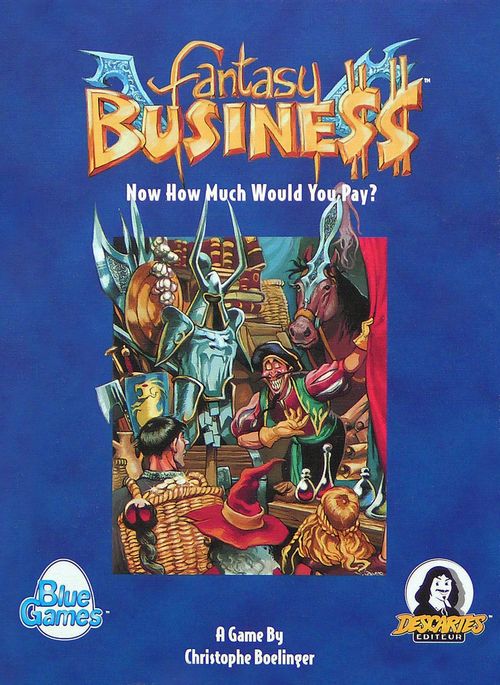
Fantasy Business
Fantasy Business Rulebook
Table of Contents
Table of Contents
Setup
The youngest player is designated the First Buyer. He takes the First Buyer card and places it face up in front of him. The article cards and the special cards are shuffled together into a single deck, which is placed face down in the middle of the table. This is the draw pile. Each player takes 10 gold pieces, a sheet for recording selling prices, and a pencil.
Course of the Game
A game lasts 10 turns.
Each turn consists of 4 phases:
- Auctions
- Setting selling prices
- Distributing income
- Passing the First Buyer card
1) Auctions
The First Buyer takes from the draw pile as many cards as there are players and places them in the centre of the table. Article cards are placed face up; special cards are placed face down. He chooses one of the cards so placed, designates it, and offers it for purchase, announcing the price he is personally prepared to pay to acquire it. The price he offers cannot be less than the base price shown on the card if it is an article card, nor less than 1 gold piece if it is a special card. He may also announce no price at all. All prices must be expressed in whole gold pieces (there are no fractions of a gold piece...).
The player to his left may then raise the bid by offering a price higher than the one announced. The next player may raise the bid or pass, and so on. The card is taken by the player whose bid was not followed by any further raise during one complete round of the table. He pays the price, takes the card, and places it in front of him: face up if it is an article card, or face down, after having looked at it, if it is a special card.
There is no upper limit on the price a player may offer during the auction.
Any player who has acquired a card during a turn may no longer take part in the auctions for the other cards of that turn.
The First Buyer then chooses and designates another card from the centre of the table and, if he has not yet acquired a card during the current turn, announces the price he is prepared to pay to acquire it. (If he has already acquired a card, he may not announce a price, and it is then up to the player on his left, if he can and wishes to acquire that card, to do so.) The player on his left, if he has not already acquired a card during the turn, may raise the bid, and so on...
If a card receives no price offer at all, it is simply discarded.
For the last card on the table, only one player is still able to make an offer. That player, if he wishes to acquire it, acquires it at the base price if it is an article card, or for 1 gold piece if it is a special card.
Acquired article cards remain permanently laid out in front of the players who acquired them, unless the play of a special card allows them to be dislodged.
Example: Dominique won the auction with a price of 5 gold pieces for a Medicinal Plants card (base value 2). She takes this card and places it face up in front of her, next to the Medicinal Plants card she acquired during the second turn.
2) Setting Selling Prices
During this phase, the players set their selling price for each article they own (whose cards are laid out in front of them). This price must lie between the base price and double the base price of that article.
Obviously, when setting their selling prices, the players have every interest in reaching an understanding with one another, or in finding out what their competitors intend to set as prices, because the income that is received depends on the prices that are set (see the next phase).
Once the discussions are over, each player secretly writes the price of each article in the column corresponding to the turn, on his price-setting sheet.
Example: During the fifth turn of the game, Dominique owns 2 Medicinal Plants cards (base value 2). She sets her selling price as low as possible, that is 2. On her price-setting sheet she writes 2 in the column for the fifth turn, on the Medicinal Plants line. The price she sets in this way applies, obviously, to both of her Medicinal Plants cards. During the preliminary discussions, she had managed to convince the other players who own Medicinal Plants that it was in everyone's common interest to charge a price of 4. All of them, it seems, agreed with her...
3) Distributing Income
All players place their price-setting sheet in front of them, face up.
The First Buyer, using his own price-setting sheet, asks those who can sell the article for the price they are asking for the first article (the Medicinal Plants). He awards the income from this sale according to the following rules:
- Players who asked the lowest price receive, for each card of the article concerned that they own (laid out in front of them), the price in gold pieces plus 2 gold pieces. The lowest price is the price below which no other player has set his selling price.
- Players who charge the highest price receive nothing. The highest price is the price above which no other player has set his price.
- In all other cases, players receive, for each card of the article concerned that they own, a number of gold pieces equal to the price they have set.
- If all players have set the same price, that price is considered the "lowest" price on the market, and all of them benefit from the bonus of 2 gold pieces.
Even after receiving the corresponding income, players keep their article cards in front of them, from turn to turn. The cards represent a capacity to sell the article they depict, by means of the article itself. Only special cards can force certain players to give up their article cards.
The First Buyer then asks for the prices set by the players for the second article on the list, and awards the income to the players, and so on up to the eighth and last article.
Example: Christophe is the First Buyer for the fifth turn. Once all the players have turned their price-setting sheets face up, he asks them for the price they have set for the first article (Medicinal Plants) for the current turn.
- Henri announces 3. (He has clearly not done as Dominique proposed, hoping with this price to obtain 3 + 2 = 5 gold pieces for his card, while hoping that his opponents, with their "agreed" price of 4, would receive absolutely nothing, since they would be charging the highest price on the market.)
- Dominique announces 2. (That really was not what had been agreed with the other players.)
- Jacques announces 4. (He is the only one who decided to respect the agreements reached during the discussion.)
- Christophe announces 2. (He was right to be wary of Dominique...)
- Mathilde and Eloïse have no Medicinal Plants to sell and therefore abstain from naming a price.
After checking the prices on the sheets of Henri, Dominique and Jacques, Christophe distributes the income as follows:
- 8 gold pieces to Dominique. Dominique has 2 Medicinal Plants cards in front of her. As she announced the lowest price (2), she receives this price (2 gold pieces) increased by 2 gold pieces for each Medicinal Plants card she owns, so 4 x 2 = 8 gold pieces.
- 4 gold pieces to himself. Christophe also proposed the lowest price on the market, but he owns only one Medicinal Plants card.
- Henri, because with his price of 3 he proposed neither the lowest price (2 players, Dominique and Christophe, charge a lower price than his) nor the highest price (one player, Jacques, charges a higher price than his), receives 3 gold pieces (he has only one Medicinal Plants card).
- Jacques, who charges the highest price on the market (no player charges a price above his), receives nothing.
Christophe then asks for the prices for the second article on the list, the Bows and Arrows.
4) Passing the First Buyer Card
The First Buyer passes the First Buyer card to his neighbour on the left.
End of the Game
A game with a maximum of 6 players ends at the end of the 10th turn. A game with 7 or 8 players ends at the end of the 8th turn. It is of course possible to play shorter games by agreeing on a smaller number of turns.
Each player counts the gold pieces he owns and adds the base value of the article cards he has laid out in front of him. The player with the highest total is declared the winner of the game. In case of a tie, the youngest of the tied players is declared the winner.
Clarifications
Special cards are meant to disrupt business somewhat. They clearly indicate when they may be played and the effects they have on the game. Some of them are very powerful, and many are very interesting to play at particular moments. They are often a real threat that can be brandished during negotiations...
All negotiations between players are always possible during the game. Nothing prevents them, for example, from selling or exchanging cards on whatever terms suit them.
Variants: Selling prices below an article's base value may be allowed (but never below 1 gold piece). A player may thus offer a selling price of 1 gold piece for an article whose base value is higher. He is then certain to offer the lowest price on the market (since it is impossible to offer a lower price) and to obtain the bonus of 2 gold pieces, that is 3 gold pieces for certain. When distributing income, one may also consider that the bonus of 2 gold pieces granted for the lowest price on the market will be granted only on condition that this lowest price is charged by a single player only.