Fantastory
Fantastory Rulebook
Table of Contents
Table of Contents
Components
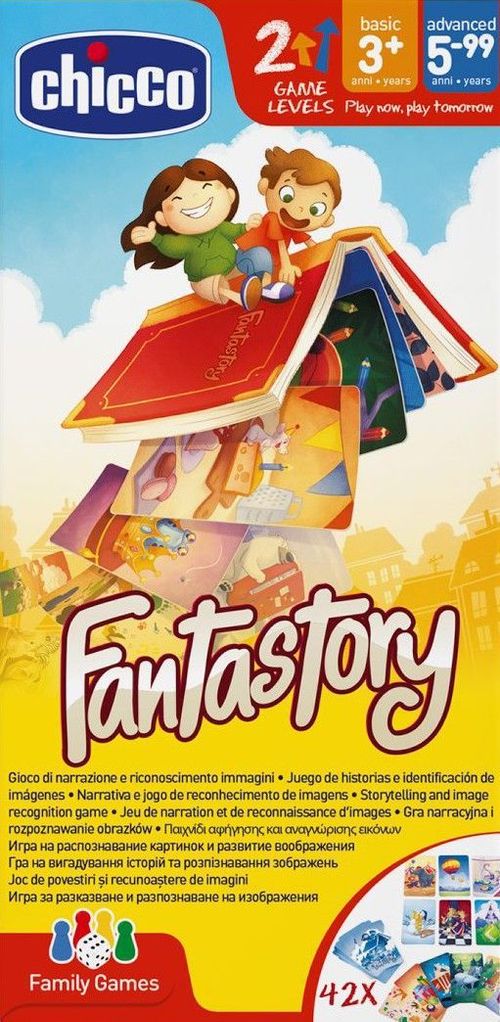
The game includes 42 story cards.
Safety Warning
Do not leave your child unattended. These instructions are for future use. To prevent suffocation, remove the plastic packaging before use and keep it out of reach of children. Use of this product is to be supervised by an adult.
Basic Level (Age 3+)
Players: 1 to 4 players, plus an adult who acts as the Storyteller.
Goal of the game: Recognize the pictures and build a narrative story.
First, have fun with your child while discovering and revealing the picture cards. Look at the cards together and try to understand what they show.
The goal of the basic game is to learn the pictures and to understand that the cards are a starting point for creating a changing and developing story.
In the basic game, you can play as a single player plus an adult, or with up to 4 children and an adult, where everyone sits and listens to the story at the same time and plays together.
The Storyteller tells a short story, and the players need to remember the details and reconstruct the story according to the pictures.
Setup
- Shuffle the cards and place the deck face down on the table.
- Take the top 10 cards from the deck and turn them face up in a row, so that all players can see them.
How to Play
Step 1: Let's Tell a Story
The Storyteller tells a short story inspired by the cards that are face up.
It is possible to start creating stories with 5 or 6 cards, and then, as the child gets to know the game, to gradually increase the number of cards.
The Storyteller tells part of a story that refers to a specific card. The players must identify the matching card and point to it. If the players cannot identify the correct card, the Storyteller can help them by giving additional details.
When a player identifies the correct card, that card is taken from its place and placed in front of the Storyteller. As the story continues, the sequence of cards grows.
Step 2: Can We Reconstruct the Story?
When the Storyteller has finished telling the story and all the cards have been identified by the players, the Storyteller takes all the cards for the story (the ones that were chosen, and the ones that were not among the first 10), shuffles them, and places them face up on the table so that all players can see them. (Note: it is recommended to write the story down on paper, in case you think you will not remember the story sequence.)
The Storyteller takes the card that started the story and places it in front of the players. At this point of the game, the Storyteller asks a player to point to the next card in the story:
- If the player points to the correct card, the Storyteller takes that card and places it next to the first card.
- If the player points to a card that is not correct, the Storyteller may help them, or may decide to ask another player.
Ending the Game
The game ends when the correct sequence of the story has been reconstructed.
Once the players know the game, they can try to create longer stories that are more challenging to remember and reconstruct.
Advanced Level (Age 5+)
Players: 1 to 4 players.
Goal of the game: Cooperation and building a narrative story.
Each player in turn takes part in telling the story with the help of the cards. At the end of the story, the players must remember the correct sequence of the cards that made up the story.
Setup
- Shuffle the cards and place the deck face down on the table.
- Take the top 4 cards from the deck and turn them face up so that all players can see them.
How to Play
The youngest player decides who starts the game. Each player in turn is the Storyteller, who tells a short story inspired by the face-up cards.
Step 1: Let's Tell a Story
Each player in turn takes on the role of the Storyteller. The Storyteller chooses one card from the 4 face-up cards and tells part of the story inspired by the picture on that card. This will be the first card of the sequence. The Storyteller role then passes to the next player, who takes a card from the deck and places it among the four face-up cards, so that there are again 4 cards to choose from.
From these, the Storyteller chooses one card and continues the story that was started by the previous player in a consistent way. The chosen card is placed next to the face-up cards.
Continue the game until 10 cards have been chosen.
Step 2: Can We Reconstruct the Story?
Turn over the 10 cards that form the sequence of the story. The 3 remaining cards that were not chosen to tell the story are bonus cards, which will help the players complete the second step of the game successfully.
The player who chose the last card of the story's sequence starts the round. The players must try to reconstruct the part of the story that relates to the first card, when it is face down, or at least reconstruct the picture on that card. After that, turn over and reveal the card.
Is This the Right Card?
- Yes: Excellent. The turn passes to the next player, who must try to guess the next card in the story sequence.
- No: What a pity! The players must turn over 1 of the bonus cards. After that, the turn passes to the next player, who must try to guess the next card in the story sequence.
Winning and Losing
- Winner: If the players remember the whole story, or at least manage to reconstruct the correct sequence of pictures, everyone wins!
- Loser: If a player makes a mistake and there are no more bonus cards to turn over, close the book, and you can start a new story!
Raising the Difficulty
Once the players have learned the cards, the difficulty of the game can be increased by creating longer stories, or by placing the cards face down from the start of step 2 of the game, and not face up as suggested in step 2.
Ending the Game
The game ends when the correct sequence of the story has been reconstructed.