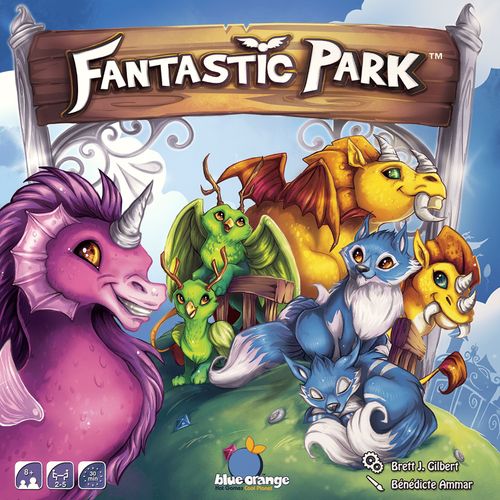
Fantastic Park
Fantastic Park Rulebook
Table of Contents
Table of Contents
Components
- 1 rulebook
- 66 rectangular tiles
- 1 first player token
- 1 scoring track
- 5 wooden player pawns (blue, pink, green, yellow, orange)
Goal of the Game
Your task is to get the park in order before the visitors arrive. Place the animals wisely! The last tile in your hand shows an animal (or animals) that is in greatest demand among visitors and will bring you victory points!
Setup
- Place the box as shown in the picture.
- Each player takes:
- 5 tiles in a 2-player game.
- 4 tiles in a 3-, 4- or 5-player game.
- Players either place their tiles face down on the table in front of them, or hold them in hand without showing them to opponents.
Set the remaining tiles aside; they will be needed in the following rounds.
Place the scoring track at the edge of the table. Each player chooses a player pawn and places it on the starting mark of the scoring track.
The oldest player starts the game. They take the first player token and put it in front of themselves.
Game Play
Play passes clockwise.
The first player chooses one of their tiles and places it in the center of the table.
The second player attaches one of their tiles to the tile already placed. Then the players take turns placing tiles according to the placement rules, until every player has only one tile left in hand.
Tile Placement Rules
- All placed tiles must either be joined by at least one side to another tile, or lie across 2 other tiles.
- All tiles are placed flat and must lie exactly relative to the tiles adjacent to them or the tiles beneath them. Half of a tile may not overhang the table.
- A tile placed on top may not completely cover another tile. It may only lie across 2 tiles.
(Illustrations show correct placements: tiles joined side to side, and a tile lying across two tiles; and incorrect placements: a tile covering one tile entirely, and a tile not lying squarely across two tiles.)
As soon as every player has only one tile left in hand, they show it to the others. Now each player conducts a tour of the park for visitors. The last tile of each player shows the animals that are most popular with visitors.
Scoring
The number of points a player receives depends on the last tile in their hand.
Find in the park the animals shown on your last tile in hand.
Find the largest group of each of these animals: you receive 1 point for each animal in that group that is joined at a right angle (not diagonally).
Points
- If your last tile shows 2 different animals, find the largest group of each of these animals and count the points.
- If your last tile shows 2 identical animals, find the largest group of that animal, count the points and multiply the resulting sum by 2.
If your last tile shows an animal that is not on the last tile of any of your opponents, multiply by 2 only the points received for the largest group of that animal.
End of the Round
Move your player pawn on the scoring track by as many spaces as the points you received.
Leave the tiles placed in the center of the table as they are.
Keep your last tile for yourself and draw from the supply the needed number of tiles into your hand.
The first player passes the first player token to their neighbor on the left.
A new round begins. Players continue to build the park.
End of the Game
The game ends as soon as the supply has fewer tiles than are needed for the next round.
- 2 players: 8 rounds; at the end of the game no tiles remain.
- 3 players: 6 rounds; at the end of the game 11 tiles remain.
- 4 players: 5 rounds; at the end of the game 6 tiles remain.
- 5 players: 4 rounds; at the end of the game 1 tile remains.
The player who has the most points after all rounds becomes the winner.
Example: End of the Second Round in a 4-Player Game
Nastya has the first player token in front of her. She adds one of her two tiles to the park in the center of the table. Egor, Andrey and Nikita each add one of their two remaining tiles to the park.
All players show the others their last tile and proceed to scoring.
-
Nastya has a tile with a blue and a green animal left in hand. The largest group of blue animals in the park consists of 4 animals, and the largest group of green animals consists of 6 (4+6=10). Nastya moves her pawn 10 spaces on the scoring track.
-
Egor has a tile with two yellow animals left in hand. The largest group of yellow animals in the park consists of 6 animals. Since the tile shows two identical animals, Egor receives twice as many points (6x2=12). He moves his pawn 12 spaces on the scoring track.
-
Andrey has a tile with a green and a pink animal left in hand. The largest group of green animals in the park consists of 6 animals, and the largest group of pink animals consists of 4. Andrey should have received 10 points, but since the pink animal appeared only on his tile, he receives 2 times more points for the largest group of animals of this color (6+(4x2)=14). Andrey moves his pawn 14 spaces on the scoring track.
-
Nikita has a tile with a yellow and a blue animal left in hand. The largest group of blue animals in the park consists of 4 animals, and the largest group of yellow animals consists of 6 (4+6=10). Nikita moves his pawn 10 spaces on the scoring track.
In this round Andrey scored the most points, but who will be the winner at the end of the game?