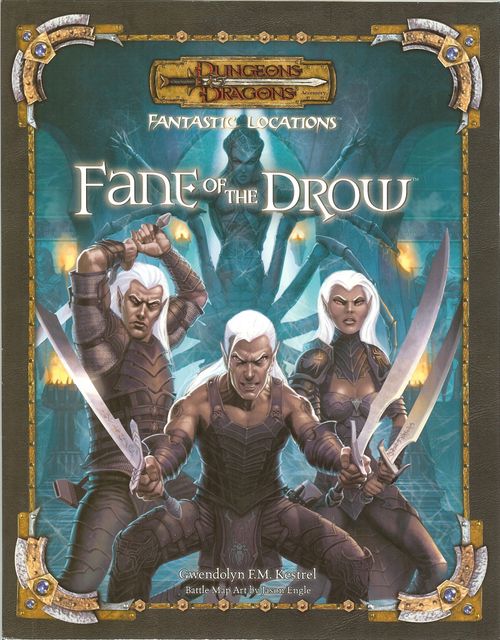
Dungeons & Dragons Fantastic Locations: Fane of the Drow
Dungeons & Dragons Fantastic Locations: Fane of the Drow Rulebook
Table of Contents
Table of Contents
Using the Battle Maps for Skirmish Play
The battle maps in Fantastic Locations: Fane of the Drow, in addition to their usefulness for the Dungeons & Dragons roleplaying game, were designed to allow exciting battles using the Dungeons & Dragons Miniatures skirmish rules. Essentially, using one of these maps replaces the terrain setup step for your skirmish battle. To use the maps in this way, follow the rules below.
For Skirmish Play: The maps in this product are carefully designed for fast and exciting D&D miniatures play. You can use these maps for any D&D Miniatures games. Starting in 2006, you will be able to use Fantastic Locations maps in sanctioned miniatures tournaments.
Sacred Circles: Any creature that stands on a sacred circle (wholly or partly) gains a +2 bonus on attack rolls. In addition, that creature's attacks are considered magic for the purpose of overcoming damage reduction.
Warband Construction
Warband construction occurs normally, with one exception. Instead of bringing four terrain tiles to the skirmish, each player brings one battle map.
Terrain Initiative
Players first reveal their warbands, then determine terrain initiative.
Choose a Map: Each player rolls 1d20 for terrain initiative, adding the Commander rating of his or her best commander to the roll. The winner chooses which map (his or her own or the opponent's) will be used for the skirmish.
Choose a Side: After the map has been chosen, each player rolls 1d20 for start area initiative, adding the Commander rating of his or her best commander to the roll. The winner chooses in which start area his or her warband will set up and places the entire warband there. If a map has multiple start areas with the same designator (such as Start Area A), the warband can occupy squares in any or all of those areas.
Warband Placement
The player who picked the first start area sets his or her warband up first, using the chosen starting area.
Victory Areas
The victory areas on each battle map are important for the Assault scenario, described below.
Assault: When playing the Assault scenario on a battle map, you score 10 victory points at the end of each round in which at least one of your creatures occupies a space in a corresponding victory area. The player whose warband sets up in Start Area A scores victory points at the end of each round that at least one of his creatures occupies a square in a space marked as Victory Area A; similarly, the opponent scores victory points at the end of each round for occupying a square in a space marked as Victory Area B.
Scout
The Scout special ability works slightly differently when using a battle map. Instead of placing this creature on your starting area at the start of the skirmish, you may place it on any victory area that is located on the half of the map closest to your starting area. Two creatures with Scout can't set up on the same victory area. If a creature with Scout enters play after the first round, it enters like any other creature.
Terrain
Different types of terrain have various effects on play. The terrain described below is new to the maps in Fantastic Locations: Fane of the Drow.
Doors
Ignore doors marked on the maps. They are included on the maps to facilitate using the maps in the Dungeons & Dragons roleplaying game, and have no effect on skirmish play.
Risky Terrain
A creature on a square marked as risky terrain gets melee damage +5. In addition, when a creature activates in risky terrain, the controlling player rolls 1d20. On a result of 1-5, the creature takes 10 damage. On a result of 6-20, there is no effect. In either case, the creature continues with its turn normally (assuming it has not been destroyed).
Summoning Circle
When a creature summons another creature using a summon spell of any kind, its controller can have the summoned creature enter play on a summoning circle within range (any square containing part of a summoning circle is eligible). If it does, the summoned creature can activate on the round that it enters play. The summoned creature's activation counts as one of its controller's normal activations.
Scenarios
The following scenarios are provided to introduce variety in casual one-on-one games, and should not be used in tournament play. For more such scenarios, see the Miniatures Handbook.
Summoning Circle: Any creature that can cast spells can use a special action when adjacent to a summoning circle. This ability replaces the creature's attacks and allows that creature to summon a Spider of Lolth (Underdark 57/60) to join your warband. The Spider of Lolth joins the summoning creature's warband, and follows all the rules for summoned creatures. This scenario can be used only on the Drow Enclave map.
Drow Defenses: This scenario uses special warband building rules. One player is designated as the drow player. The drow player gains 20% more points with which to construct his or her warband, but can only use CE miniatures that are Drow, Spiders, Bugbears, Ogres, or Trolls. This scenario can only be used on the Fane of Lolth map.
Prisoner Release: This scenario uses special warband building rules. One player is designated as the drow player. The drow player gains 20% more points with which to construct his or her warband, but 40% of that warband's points must start in the prisoner cells (area 20 on the Fane of Lolth map). In order to release the prisoners, a creature outside the cells must spend its entire turn opening the door. This special action can be taken only when the creature is adjacent to the cell door.