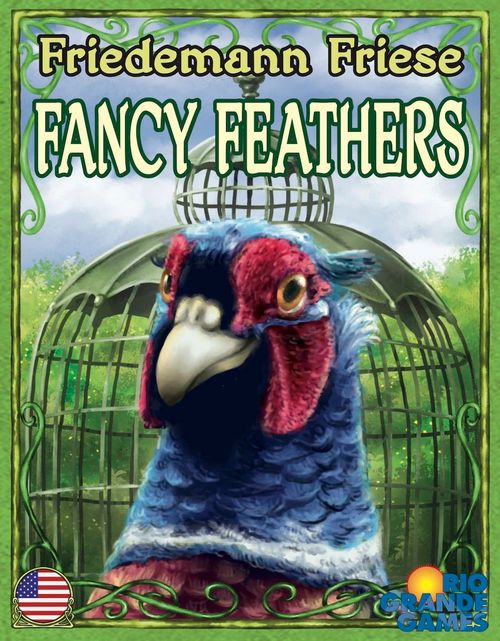
Fancy Feathers
Fancy Feathers Rulebook
Table of Contents
Table of Contents
Game Components
- 72 animal cards (12 animal types, each with 2 sets of 3 cards) and 6 servant cards
- 2 wooden discs
- Sticker sheet with 6 servants
Why do we write "2* players"? With each copy of Fancy Feathers, you can play with 2. The game is also great fun with up to 6 players. For that purpose, you will need 1 or 2 additional copies of the game to provide additional animal cards and wooden discs.
Before Starting the First Game
The sticker sheet includes 6 stickers. Choose 2 of them and stick 1 each on both discs, so you can play with your own servants during the game. If you are playing with multiple copies, each disc should have a different sticker.
Let Us Introduce Ronald...
Fancy Feathers is easy to learn. Even so, you may have questions. As you will see, Ronald already asked most of them. And if Ronald understands how to play this game, then everybody will understand it.
Game Preparation
Always play with 6 animal types. For your first game use the following animal types (each type has their own colored frame): Golden Pheasant, Pheasant Fart, Lady Amherst's Pheasant, Blood Pheasant, Reeves's Pheasant, Green Pheasant. In all following games choose 6 of the 12 animal types.
Yes, Ronald, Pheasant Fart, Nest, Mirror, and Trap are regarded as animals, too (please check "The 12 Animal Types").
For each chosen animal type, use all 6 cards (both sets). Return the 6 unused animal types (total 36 cards) back to the box. Shuffle the chosen 36 cards and place them in a facedown card stack (1). Place the topmost 6 cards from the stack back in the box without looking at them, so you do not know exactly which animals will show up during the game.
Each player chooses a servant, takes the disc and places the matching card in front of them. Place the chosen discs in random order in a stack (2). Draw 5 cards from the card stack and place them face up to create the Path in front of the discs (3).
You can now start collecting the animals!
How to Play
In Fancy Feathers, you try to collect the most precious animals. During the game, more and more animals show up on the Path. At the end of the game, score your collected animals. Each animal type has their own effects to score points or lose points. Easy to remember: for the crown icon you score points, for the chest icon you lose points.
The most important rule: if the discs are on the same space, for example at the start of the game in front of the Path, or on the same card during the game, place them in a stack on top of each other.
The player whose disc is furthest behind on the Path always takes their turn; they may take more than one turn in a row. A disc on top of another disc is considered behind the other. Follow these 2 steps:
Step 1. At the start of your turn, if your disc is behind and alone on a card, place the disc briefly aside. Collect this card and all cards behind that in reverse order: first take the card at the start of the Path and last take this card. Place the cards facedown below your servant card. You may look at these cards any time, but do not show them to your opponent. If your disc is on top of the other disc, do not take cards and instead continue directly to Step 2.
Yes, Ronald, you must take all these cards, even if they hurt you. It was your own decision to move to that card.
Step 2. Look at the cards further up on the Path. Move your disc forward to the desired card, and place your disc either on the empty card or on top of the other disc. If your disc is foremost on the Path, draw cards and place them face up at the front of the Path, until there are again 5 face up cards in front of your disc.
If there are not enough cards left in the stack, place as many as possible. The Path is thereby finished and the game soon, too.
Example: At the start of Hedwig's turn her disc is alone on the Lady Amherst's Pheasant (1). From the start of the Path up to her disc, she collects the Green Pheasant, the Pheasant Fart, and the Lady Amherst's Pheasant (2). Hedwig moves her disc forward to Reeves's Pheasant (3). At the end of her turn, she draws 2 new cards from the stack and places them face up at the front of the Path, so that there are again 5 cards in front of her foremost disc (4). Angelika takes her turn and first collects the Blood Pheasant and Golden Pheasant, before thinking about how far she moves forward on the Path.
The End of the Pheasant Search
Once all animal cards are placed on the Path and the stack is depleted, during Step 2 you may leave the Path and place your disc in front of you. The pheasant search ends for you!
If your opponent left the Path, you may either collect some or all of the remaining cards in front of your disc. Just follow the rules and move forward to the desired card to collect that card and all cards behind your disc. If you do not like the cards at the end of the Path, of course you may also leave the Path and ignore these last cards.
No, Ronald, you cannot pick your desired cards at the end of the Path. You still collect them all in uninterrupted groups.
Scoring
After you both leave the Path, score your collected animals. Please check the following list of cards for the points of each of the 12 animal types. If you collected the most points, you win Fancy Feathers! In the case of a tie, the player who left the Path earlier wins among the tied players.
The 12 Animal Types
You always play with 6 of the 12 animal types. Each animal type has its own effects how you score or lose points. For the crown icon you score points, for the chest icon you lose points. For some animal types, your amount of collected cards is important, for other types you count every single card.
Thank you for the reminder, Ronald: Pheasant Fart, Nest, Mirror, and Trap are animals, too.
Golden Pheasant: The set of Golden Pheasants consists of 3 different cards. For each Golden Pheasant score the stated 1, 2, or 3 points.
Pheasant Fart: The set of Pheasant Farts consists of 3 different cards. For each Pheasant Fart lose the stated 1, 2, or 3 points.
Lady Amherst's Pheasant: For each Lady Amherst's Pheasant score 0 points. Only if you collected the fewest total number of cards of all animal types (this can be both of you), score 5 points for each Lady Amherst's Pheasant.
Example: Angelika collected 13 animals including 2 of these pheasants. Hedwig collected 15 animals including 3 of these pheasants. Angelika scores 10 points for her Lady Amherst's Pheasants (2x 5 points), while Hedwig scores 0 points for hers.
Blood Pheasant: For 1 Blood Pheasant score 3 points, for 2 score 6 points. For each additional Blood Pheasant subtract 3 points from that. To simplify matters, on the cards we already calculated the points for the first five Blood Pheasants.
Green Pheasant: For every Green Pheasant pair score 5 points. For an unmatched Green Pheasant lose 2 points.
Example: With 5 Green Pheasants, Hedwig scores 8 points (2x 5 points minus 1x 2 points).
Peacock: For 1 Peacock, lose 10 points. Starting with 2 Peacocks, instead score 2 points each: For 2 Peacocks score 4 points, for 3 score 6 points, for 4 score 8 points and so on.
Nest: For each Nest score as many points as your total number of collected Nests, with a maximum of 5 Nests.
Example: Angelika scores 9 points for 3 Nests (3x 3 points).
Reeves's Pheasant: For 1 Reeves's Pheasant lose 5 points, for 2 lose 4 points. Starting with 3 Reeves's Pheasants instead score points: For 3 Reeves's Pheasants score 3 points, for 4 score 8 points and for 5 score a maximum of 15 points. You do not score additional points for further Reeves's Pheasants.
Trap: If you collect a Trap, place it briefly aside. After moving your disc, give the Trap to the player who is taking the next turn. This can be yourself. For each Trap lose 1 point.
Mirror: For each Mirror, score as many points as you collected other animal types. If you do not have any other animal types, your mirrors score 0 points.
Example: Besides 2 Mirrors Hedwig also collected Golden and Green Pheasants. She scores a total of 4 points for the Mirrors (2x 2 points).
Monal: The set of Monals consists of 3 different cards. You only score points for your smallest Monals! Depending on their size, score the stated 3, 5, or 7 points! If you collect Monals of different sizes, you score 0 points for your bigger Monals!
Example: Angelika collected 1 Monal for 7 points and 2 Monals for 3 points. She scores a total of 6 points for the small Monals (2x 3 points). The big Monal does not score points.
Fox: If you collect a Fox, immediately lose 1 of your collected cards of your choice and place it facedown back into the game box. This can be a card you collected this turn on the Path before the Fox, or a card below your servant card. For each Fox collect 2 points.
Pheasantry with 3-6 Players
If you want to play Fancy Feathers with 3-6 players, you need 2 to 3 copies of this game to have additional sets of animal cards and discs for all players. Please make sure to use different stickers for all wooden discs.
Game preparation: for each chosen animal type, use 1 set of 3 cards per player (54 cards for 3 players, 72 cards for 4 players and so on). After shuffling the chosen cards, remove 3 cards per player from the top of the card stack without looking at them and place them in the box. Place all the discs in random order in a stack. Then, draw 5 cards and place them face up to create the Path in front of the discs.
How to play: all other game rules are the same. If your disc is furthest behind on the Path, either alone on a card or on top of the rearmost stack of discs, it is your turn. If your disc is foremost on the Path at the end of your turn, draw as many cards as necessary and place them face up at the front of the Path, so that there are 5 face up cards in front of your foremost disc. You win a tie during scoring if you left the Path earlier than your tied opponents.
With 3 to 6 players, you can make more tactical decisions how far forward you move on the Path. Sometimes it pays to move on top of another disc, so you force a straggler to pass your disc on the Path (as you will see in the following example). Thus, you can evade undesired cards on the Path and still have your next turn before the players whose discs are below your disc in the stack.
Example: Angelika takes the Blood Pheasant (1). Then, she moves forward to the Mirror and places her disc on top of Hedwig's disc (2). As Nichole is last, she will eventually need to pass Angelika's and Hedwig's discs before they move again (3). Thus, after collecting the Golden Pheasant she can either move first to collect the Peacock (4), and then to or past the Fox, or immediately to or past the Fox (5).