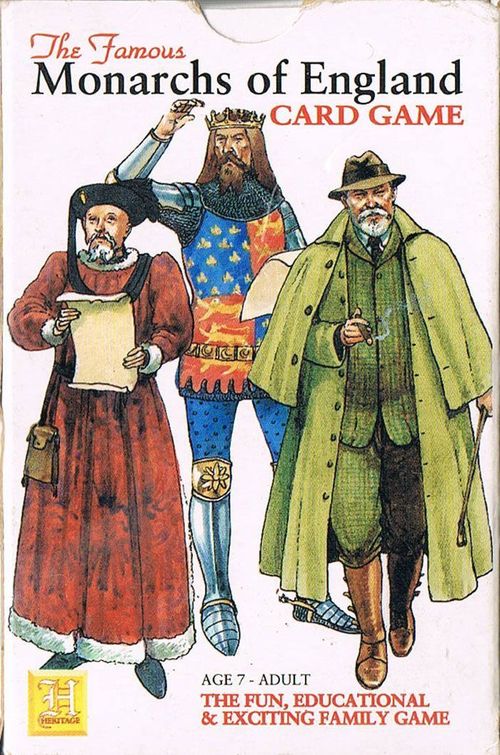
The Famous Monarchs of England Card Game
The Famous Monarchs of England Card Game Rulebook
Table of Contents
Table of Contents
Object of the Game
Players try to form sets of Monarchs; they may form two sets, one of three cards and one of 4 cards or one set of 7 cards. A set may be in date order' , ie monarchs in the consecutive order of their reign, or in name and number order' ie monarchs with the same name whose name numbers follow on.
Game Set Up
Shuffle the cards and deal 7 cards to each player. Place the remainder face down in a pack. Turn the top card and place it next to the pack to start the discard pile. Make sure the Reference cards are handy to help players check Monarchs and Dates.
Game Play
On his go a player takes the top card of the pack OR the top card of the discard pile. He then discards one card and places it face up on the discard pile. Play continues in a clockwise direction until one player declares a winning hand which, if correct, is then scored. If the main pack runs out, shuffled the discard pile to form a new pack, and continue to play as before. All 57 cards must be shuffled at the beginning of each new round.
Scoring
We suggest players' scores are written down. Only cards in the winning hamd are scored, each card according to the monarch's name number, eg Henry 6 = 6 points. Monarchs with no number, e g Victoria, score one point. Cromwell used as a substitute has no value but adds 10 points to the winner's total if held by another player, who must declare it.
Winning the Game
Players should agree a target score at the start of each game, or agree to play a set number of rounds. The player who first reaches the target or who has the highest score after so many rounds is the winner. Try 60 points or 5 rounds.
Special Cards
William 3 and Mary 2
This king and queen rules England jointly on equal terms. For this reason the card may be used normally in its date sequence (using Mary 2) and also part of a name sequence (using William 3). Because it may be used twice in one hand it is possible to form a set of 3 and a set of 4 with only 6 cards. Alternately, for a higher score, 2 sets of 4 cards may be made with 7 cards. This is because you are allowed to score the card twice if used in this way. This is the ONLY card which yoy may use in this way.
Oliver Cromwell
Oliver Cromwell challenged the idea of the Divine Right of Kings and caused a Civil War in England. Ultimately Parliaments's Army defeated the King and Charles 1st was executed in 1649. Eventually after Cromwell's death Parliament re-instated the monarchy in 1660. In the game Cromwell can be used in a winning hand as a substitute for any monarch a player wishes. However, if a winning hand is declared and any other player is holding Cromwell at that point, 10 points are added to the winner's score for that round. You have been warned!
Examples of Winning Hands
- Name & number order - Edward 4, 5, 6 and 7
- Date Order George 5, Edward 8, George 6 - total score 41 points
- Name & number order - Henry 2, 3, Cromwell as Henry 4, Henry 5
- Date order Edward 6, Mary 1, Eleizabeth 1 - 18 points score
- Name & number order also date order - George 2, 3, 4
- Date Order Harold 2, William 1, 2, Henry 1 - score 15points
- Date order - Athelstan, Edmund 1, Edred, Edwy, Edgar, Edward Martyr, Ethelred - score 7 points.
Rulers of England and Dates of Their Reigns
Alfred the Great, 871-899; Edward the Elder, 899-924; Athelstan, 924-939; Edmund 1sr (the elder), 939-946; Edred, 946-955; Edwy, 955-959; Edgar, 959-975; Edward the Martyr, 975-978; Ethelred the Unready, 978-1016; Edmund 2nd (Ironside), 1016; Cnut, 1016-1035; Harold 1st, 1035-1040; Harthacnut, 1040-1042; Edward the Confessor, 1042-1066; Harold 2nd, 1066; William 1st (the Conqueror), 1066-1087; William 2nd (Rufus), 1087-110; Henry 1st, 110-1135; Stephen, 1135-1154; Henry 2nd, 1154-1189; Richard 1st (the Lionheart), 1189-1199; John, 1199-1216; Henry 3rd, 1216-1272; Edward 1st, 1272-1307; Edward 2nd, 1307-1327; Edward 3rd, 1327-1377; Richard 2nd, 1377-1399; Henry 4th, 1399-1413; Henry 5th 1413-1422; Henry 6th 1422-1461 & 1470-1471; Edward 4th, 1461-1470 & 1471-1483; Edward 5th, 1483; Richard 3rd, 1483-1485; Henry 7th, 1487-1509; Henry 8th, 1509-1547; Edward 6th, 1547-1553; Mary 1st (Tudor), 1553-1558; Elizabeth 1st, 1558-1603; James 1st, 1603-1625; Charles 1st, 1625-1649; Oliver Cromwell, Lord Protector, 1649-1658; Charles 2nd, 1660-1685; James 2nd, 1685-1688; William 3rd and Mary 2nd, 1688-1702; Anne, 1702-1714; George 1st, 1714-1727; George 2nd, 1727-1760; George 3rd, 1760-1820; George 4th, 1820-1830; William 4th, 1830-1837; Victoria, 1837-1901; Edward 7th, 1901-1910; George 5th, 1910-1936; Edward 8th, 1936; George 6th 1936-1952; Elizabeth 2nd, 1952 - ; Charles, Prince of Wales.
Monarchs of England by Number and Name Order
- EDWARD the Eleder, the Martyr, the Confessor, 1st to 8th
- WILLIAM, 1st to 4th
- HENRY, 1st to 8th
- RICHARD, 1st to 3rd
- CHARLES, 1st, 2nd and Prince of Wales
- GEORGE 1st to 6th