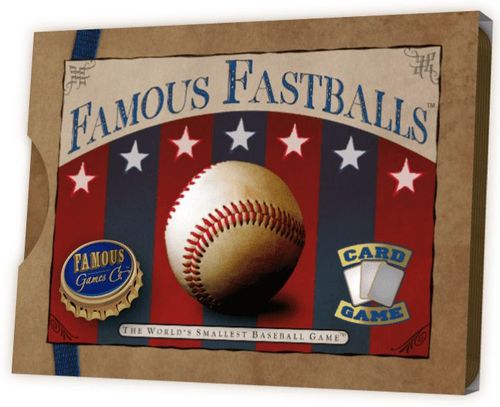
Famous Fastballs: The World's Smallest Baseball Game
Famous Fastballs: The World's Smallest Baseball Game Rulebook
Table of Contents
Table of Contents
Setup
Baseball's all about statistics. We use pennies to track some stats on these four cards.
Another four pennies track your baserunners on the infield card.
As you can see, it's the top of the first inning, with zero outs.
The Home team is on the pitching mound and the Visitors have the bat.
Congratulations! You're ready to play.
Pitching and Batting
Now, baseball's a bluffing game, champ, particularly between the pitcher and the batter. The pitcher has to throw either a ball or a strike.
And the batter? Well he's either going to swing or he ain't.
If you can get inside your opponent's head, you'll be playing the big leagues in no time!
Outs and Walks
If the batter's hand signal doesn't match the pitcher's, he's out! See how we tracked it on the Outs card?
However, if the pitcher throws a ball and the batter chooses not to swing, the batter earns a free walk to first base. Move his penny on the Infield card and bring in the next batter.
Hits and Hit Placement
On the other hand, if the pitcher throws a strike and the batter chooses to swing, we've got a hit on our hands.
Now a good hit's all about placement. The batter's got some control over that but so does the pitcher and his fielding team.
Hit placement is determined by each player drawing 0-3 fingers from behind their back and then adding up the results.
The batter wants the black results and will often play high numbers to achieve them. The pitcher wants the white results so he'll often play low numbers.
Typical Results
The typical result? A single base for the batter.
But the pitcher won't let that go on forever. At some point he'll want to switch strategies, lure the batter into a big triple play, and put an end to that half of the inning.
But what if the batter sees it coming and signals with two fingers instead of three to take the home run?
It's a head game, see?
And both players are going to be doing their best to keep each other on their toes.
Innings
In the meantime, keep batting and hitting and scoring those runs until the pitcher finally gets his third out to end this half of the inning.
After the third out, advance the penny to the next half-inning on the inning card, clear the baserunners from the Infield, reset the Outs to zero, and swap Pitcher and Batter cards with the other player.
Because the penny's in the red column of the first row on the Inning card, that means we're in the bottom of the first inning.
The color of the column indicates whose turn it is to bat.
Each inning lasts about five minutes.
If you're new at this, try the first five innings to get a taste for the game.
For a longer game, just flip over the inning card and play the full nine.
Winning
Winning isn't everything champ, but you won't make it to the World Series without it.
If you scored the most runs over the course of the game, congratulations! You've earned it.
I promised I'd make a famous baseball player out of you so thanks for letting me show you around the grounds.
Now that you know the game, it's time to get a league together and play ball.
Go on and make me proud!