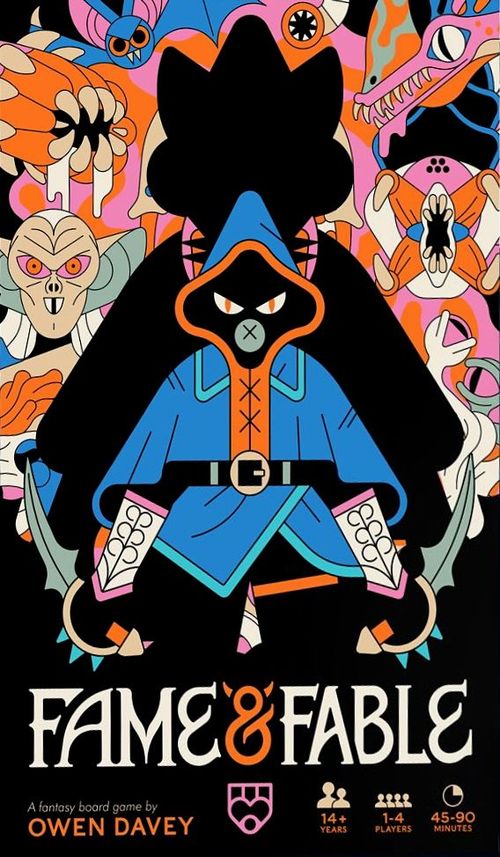
Fame & Fable
Fame & Fable Rulebook
Table of Contents
Table of Contents
Introduction
Fame and Fable is for two to four players. Use your actions to recruit allies and items from the market. Deploy these to defeat monsters, complete contracts or disrupt other players. Gain fame through your exploits to move your player token around the fame track. The player with the highest fame at the end of the game wins.
For the solo game, you will need the solo rule book, but read this rule book first.
An Overview
This page introduces key concepts, but the following pages contain more detail.
Actions
Players start each turn with three actions. This chart shows some common choices players can make and the associated cost.
| Action | Cost |
|---|---|
| Recruit an ally or item from the market (cost displayed on card). | 1-3 |
| Choose to combat a monster or legend card. | 1 |
| Deploy an ally or use an item. | 0 |
| Use the basic attack of a deployed ally. | 0 |
| Use the trait of a deployed ally (cost displayed on card). | 0-3 |
| During dawn, discard one moon token to ready all your exhausted allies. | 1 |
Dawn | Day | Dusk
Each player's turn has three phases called dawn, day and dusk, then play continues clockwise. Phases are performed in order. Dawn and dusk actions must be performed in order. Day actions may be performed in any order and repeated multiple times.
Dawn - Refresh the board, ready allies and set your actions for the turn. (see p.11)
Day - Recruit cards from the market, use traits and combat monsters. (see p.8)
Dusk - Score contracts and resolve events triggered by the board. (see p.10)
Market
The market features allies, items and contracts and is refilled at dawn, the start of a turn. Spend actions equal to the pips on the card's top right corner to recruit allies or items into your hand. Contracts are not gained using actions—they score during dusk when the criteria are met.
Deploying allies from your hand into your personal play area is always free (see p.6). Items are free to use. The top right pips show the cost to recruit, not use. Allies can freely use basic attacks to combat monsters. After use, allies are exhausted and items discarded.
As you navigate the rulebook, keep an eye out for pink tabs like this one to the right. Pink tabs highlight important information that might be harder to remember in your future games of Fame and Fable.
Setup
Players can use the double-sided quick reference cards or the back page of the solo rule book to help with turn phases and icon meanings during the game.
On the multiplayer side of the board, place one moon token on each moon space (every 10 spaces up to 90). Place the champion token on the champion space on the track or for a shorter game, place it at 50. Legend tokens are for solo mode only.
Separate the ally, item, monster, legend, contract and moon decks. Put the fate deck back in the box. For your first game, do not use the moon deck—introduce these cards when you know the game better (see p.10). Locate the four hero cards (with coloured borders) in the ally deck, the four backstory cards, and the four new market cards, then set them aside. Shuffle all decks individually and place them face down on the board as the draw decks.
Deal one hero and one new market card to each player, returning extras to the box. Locate the player token that links to your hero (see p.5) and place it on the board. Each player should also take their own backstory card (this does not affect gameplay, and is purely thematic).
Deal each player two cards from the ally deck and one from the item deck to form their starting hand.
Place the top three cards from the monster deck face up on the board.
Then reveal three cards from each of the ally, item, and contract decks to fill the market.
Components
- Ally deck (75)
- Item deck (27)
- Monster deck (43)
- Legend deck (16)
- Player tokens (4)
- Contract deck (30)
- Moon deck (20)
- Fate deck (70)
- New market cards (4)
- Quick reference cards (4)
- Solo quick reference card (1)
- Backstory cards (4)
- Action cost reference cards (5)
- Action tokens (20)
- Moon tokens (9)
- Champion token (1)
- Legend tokens (10)
Action trackers (4) are only included in the Deluxe Edition of Fame and Fable.
First Player
To decide the first player, count the pips (small circles) in the top right corner of all cards in your starting hand. The player with fewest pips becomes the first player.
In case of a tie, tied players add up the basic attack for all their allies. The player with the lowest overall basic attack score in their starting hand becomes the first player. If players are still tied, flip a coin.
Your Hand
You can hold a maximum of six cards in your hand. You cannot add cards to your hand if you already hold six, but you may choose to discard any cards from your hand during your turn.
Allies
Allies usually make up the bulk of your hand. Deploying an ally is a free action. An ally may be used for its basic attack or its trait—never both at the same time. After using an ally, it is exhausted and cannot be used again until readied (see below).
Deploy
To use an ally from your hand, you must first deploy them by placing them in front of you. Deployed allies are ready to be used immediately. Deployed cards cannot return to your hand.
Basic Attacks
Each ally has a basic attack between zero and five. Using a basic attack is a free action but exhausts that ally card.
Each basic attack has at least one attack type. An ally with multiple attack types may only use one at a time, but you may choose which type they use. The attack types are elemental, magic, poison, power and weapons, but only the icons are used in the game.
Traits
Most allies have special abilities known as traits. Using a trait exhausts that ally card. The number of pips above a trait (ranging from zero to three) indicates the number of actions that must be spent to perform that trait.
The Assassin costs three actions to recruit to your hand from the market. It has a basic attack of two against a monster or legend. You may choose to use either the poison or weapons attack type when attacking.
For one action you may instead choose to use the trait to discard one ally from another player's exhausted cards.
Exhaust / Ready
To use an ally for its basic attack or trait, exhaust the card by rotating it 90 degrees. Exhausted allies remain deployed, but cannot be used until you ready them again. Certain cards and moon tokens are used to ready allies.
Allies are exhausted the moment they are used, so cards like The Elixir allow you to ready an ally and use the ally again, even in the same combat.
Discard
When an ally or item card is discarded, place it face up on its respective discard pile adjacent to its draw deck. Discarded cards cannot be used unless brought back into play by a special trait.
Deployed Limit
You can have a maximum of six deployed allies at any time, regardless of whether they are ready or exhausted.
You may discard deployed allies at any time during day on your turn. For example, if you have six deployed allies and want to deploy a new one from your hand, you may discard any ready or exhausted ally in order to make space.
Heroes
Heroes are special ally cards that every player receives in their starting hand. They are identified by the coloured border and the hero icon. Heroes, like all other allies, can be exhausted, discarded, stolen or even turned into monsters (see the back of the rulebook). Traits that reference heroes are only talking about these cards.
Items
Items are single use cards. Discard an item directly from your hand to use it. This is a free action. Items count toward your hand limit, but not your deployed limit. You can also combat using only items.
Day
Each turn begins with dawn, but to better understand the game we will start with day, then dusk. During day, you can recruit from the market and use items and ally traits, even during combat. All day actions may be performed multiple times and in any order.
Combat
Combat is often the best way to gain fame. During day, you can choose to spend one action to call one monster or legend into your personal play area. This initiates combat. You may choose one of the face-up monsters on the board or take the top card of either the monster or legend deck.
Monsters and legends have a number on the top left—its fame—and to defeat the card, you must attack it with an amount equal to or higher than that number. Defeating a card moves your player token along the fame track by the number shown.
Monsters usually have fame between 1 and 10, while legends usually have fame between 11 and 20 often with more difficult traits. Defeated monsters are discarded face up on the discard pile adjacent to the monster deck. Defeated legends are placed in your personal play area for end of game scoring (see p.10).
When you combat a card, place it in front of you. Any instant actions on the card trigger immediately and must be fully completed before continuing your turn, even if the initial instant action triggers another. The forced-attack icon forces you to take the top card of the monster deck and add it to combat. This does not cost any actions.
Combat resolves when you choose. Even after taking a monster or legend, you can continue to recruit from the market, use traits or deploy new cards. However, you cannot choose to combat any new monsters or legends until the current combat is resolved.
You can only attack monsters or legends with your deployed and ready allies or items in your hand. Each monster and legend is fought separately and attacks do not carry over. For example, if you attack a 2 monster with 3, the spare 1 attack will be wasted.
You may attack monsters and legends using as many different attack types as needed. Many monsters and legends are immune and/or vulnerable to specific attack types. If immune, attacks of that type have no effect. If vulnerable, attacks of that type are doubled.
Example: The Multipede is 8 fame. You must attack this card with 8 or more to defeat it.
Example 1: At first glance you may think the 8 from your basic attacks is enough to defeat The Multipede, but it is immune to the poison and weapons attacks of The Alchemist and The Knight. You could deploy and use the basic attack of The Witch to attack with 3 elemental or magic (poison cannot be used) but this is not enough to defeat The Multipede. It remains undefeated, so you must choose any one ally to discard. You earn 0 fame.
Example 2: The Multipede is vulnerable to power attacks. The 3 basic attack of The Berserker would double to 6, but if you look at the card's trait, her attack becomes 6 when she is the only ally attacking a monster. If you deploy The Berserker and use her trait, she attacks with 6 x2 (for vulnerability), totalling 12. This is enough to defeat The Multipede and would earn you 8 fame.
Undefeated
Monsters or legends must be defeated this turn. If any card cannot be defeated, do not gain their fame. The undefeated card is shuffled back into its draw deck.
You must then discard any one ally of your choice for each undefeated monster or legend. The ally you choose does not need to be ready or deployed.
The discard-forced icon forces you to discard any card. It may be an item or an ally, including any in your hand, deployed and ready, or even exhausted. If multiple icons are shown, multiple cards must be discarded.
Dusk
Contracts
Scoring contracts earns you fame equal to the number shown on the card. At the start of dusk, score any contracts achieved during your current turn. You may choose to score as many as you like, even if there are duplicates. Discard scored contracts face up on the discard pile adjacent to the contract deck.
Example contract, The Garrison: Have THREE weapons allies deployed and ready during dusk.
If you have three allies with a weapons basic attack deployed and ready during dusk, you can score 4 fame for this card. If an ally has other attack types, they still count for this card—they may even help to achieve multiple cards like this during the same turn.
Follow the will of the commonfolk and you shall see your fame spread like wildfire.
End of Turn
Player tokens cannot share a space with another player token on the fame track, so if you finish your turn in an occupied space, move to the next available space instead.
Moon Tokens
If you landed on or passed any moon tokens, take the closest one behind or directly beneath your token. Leave all other moon tokens on the board.
When you collect a moon token, all other players ready all their exhausted allies. You do not! On a future turn, you have the option to spend your moon token to ready your own exhausted allies (see p.11).
Legend Space
If your player token moved this turn and finished on a space marked with the legend icon, you must take the top card of the legend deck and place it face down in your play area. Do not look at it yet. You must reveal and combat this legend card at the start of the day phase during your next turn.
Moon Deck
Moon cards adjust gameplay or provide unique one-time events. Do not use this expansion for your first game.
When a moon token is taken, reveal the top card of the moon deck and place it face up on the discard pile adjacent to the moon deck. The moon card is triggered after the moon token, so other players will have already readied exhausted cards. A moon card affects all players until a new moon card replaces it. Any effects from previous moons are then ignored.
Instant action events happen only once, when first revealed.
Example moon card, The Fresh Start: Refresh ALL contract, ally and item cards in the market.
Dawn
At the start of each turn, complete these steps in number order.
1. Refresh
In dawn, you must refresh all empty monster and market spaces on the board. If any draw deck is empty, shuffle the relevant discard pile and place it face down as the new draw deck.
2. Set Actions
Start each turn with three actions. During dawn, each empty moon space between you and the leading player's token grants a bonus action for your turn. Players can have a maximum of six actions on a single turn. If any moon space is occupied by any token, a bonus action is not gained for that space. The leading player will only ever have three actions on their turn.
In this example, there is only one empty moon space between the blue player and the red leading player. Space 1 is empty and grants a bonus action but the leading player is blocking space 2. The trailing player has three actions plus one bonus action, totalling four actions for their turn.
Anonymity brings freedom. Enjoy your days unencumbered by the weight of expectation. But it does not do to dwell in the shadows too long, for you will fade into obscurity.
Deluxe Edition: Set the action tracker to the number of actions you can take this turn. Rotate it to show your remaining actions as you use them. When you spend your last action, place it on its side on 0 (shown here) to signal you have no actions left.
Standard Edition: Take action tokens equal to the number of actions you can take this turn. Discard one token each time you use an action.
3. Choices at Dawn
Moon Token
If you have collected a moon token, you may spend one action during dawn to discard it. This readies all your exhausted allies. Store discarded moons in the top left area marked on the board.
New Market
Once per game, during dawn a player can use their new market card. This discards and refreshes all the cards in one row of the market. Each row is from separate decks, so you can refresh all contracts, all allies or all items.
4. End of Dawn
After all other dawn actions, check if any revealed monsters display the spotted icon. All cards with this icon must be moved to your personal play area. Do not draw new monsters to replace them on the board. Taking these cards is a free action. You must combat these cards during day. No new monsters can be taken before resolving combat with these cards.
End of Game
Landing on or passing the champion token triggers the end of the game. When the champion token is collected, all other players have one final turn to collect as much fame as possible.
When the champion token is taken, no moon tokens are taken. The champion token does not ready exhausted cards and the empty space does not grant bonus actions to other players.
Players track fame beyond the champion token space. Empty moon spaces beyond the champion token space do not grant bonus actions to other players.
Legend Bonus
The player who has defeated the most legend cards gains a bonus 10 fame after all players have finished their final turns. If any players are tied for the number of defeated legends, no bonus is given.
Who Wins?
The player with the highest total fame wins. Player tokens can never share a space, so if a player would finish the game on an occupied space, they must move to the next available space instead.
When the dust settles, only one among you will be named Champion. Do whatever you must to ensure this title is bestowed on you.
Rule Clarifications
If you can't fulfil a trait's requirements, do as much as possible and ignore the rest. For instance, if you cannot discard two allies because you only have one, discard the ally you have, then continue as usual.
When an ally becomes a monster (due to a monster trait), combat the card using the basic attack as fame. You must defeat it like any other monster, but ignore any traits it has. After combat, it must always be discarded to the ally discard pile.
If an ally's basic attack includes an attack type, the ally counts as that attack type. For example, an ally with both magic and weapons basic attack types is both a magic ally and a weapons ally.
If a trait boosts a specific attack type, it only applies to cards using that attack type. Other attacks remain unaffected.
Cards are played one at a time, but you can stack effects. For example, you may use a trait to add 1 to a basic attack before doubling that attack with another trait.
You do not need to combat monsters or legends without any fame. They are defeated automatically, and can count toward fulfilling certain contracts.
Using a reaction trait on a card is not mandatory. Ally reactions are a trait so can only trigger if the card is deployed and ready. Forced reactions always trigger.
Deployed and ready means both conditions must be met.