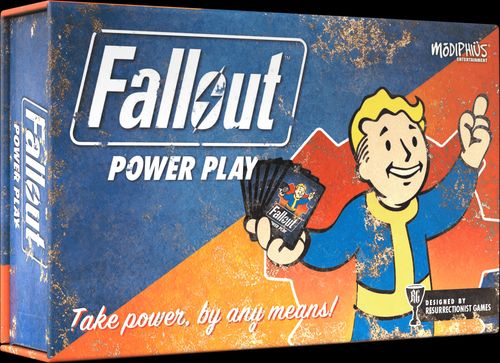
Fallout: Power Play
Fallout: Power Play Rulebook
Table of Contents
Table of Contents
Aim of the Game
Welcome to Fallout: Power Play! In this 2-4 player card game you control one of the infamous Factions from the Fallout universe vying for control of the Wasteland. Each round, players deploy a variety of Agents and Quests into the various locales, complete missions, force each other out of territories, and compete to see who can claim Dominance. To win Power Play you will spend your turns attempting to gain the most Influence in the Locations on the board, winning Victory Points at the end of each Round for each Location you have the most Influence. The first player to gain 10 Victory Points wins!
To gain Influence, play Agents into Locations to amass the highest Power there at the end of the Round, as well as playing and completing Quests—which will also earn you other rewards. As you play, you'll use Power Play cards to respond to other players' actions and struggle against the Wasteland itself as it throws wrenches into everyone's plans with Wasteland Events.
Build and break alliances, crush and outwit your foes to ensure that you come out on top in Fallout: Power Play.
How to Play
Power Play is split into a series of Turns and Rounds. Play begins as each player will play one card per turn from their hands until they are forced—or choose—to pass. After which the end of Round steps occur and you check for a victor of the game. If no victor is declared, a new Round begins; each player draws cards until they have at least four cards in hand and the player with the most victory points starts play.
If a player cannot draw cards from their Faction deck at any point in the game, they continue to play and must rely on the cards already in play and the special abilities they have access to in order to aim for victory!
The Scrapheap
After a Power Play has been used, an Agent killed, or a Quest completed or destroyed, that card goes to the owning player's Scrapheap. The Scrapheap is a face-up pile of cards that are kept next to its owner's Faction Deck. When a card is put in the Scrapheap, it sits at the top of the Scrapheap in clear view. Any player may look at or through any other player's Scrapheap, but may not change the order of it unless a card or rules states they may.
Turn Order
To begin a game of Power Play, start by completing Set-up and then determine who will be the first to play; you can decide this in any way, such as who lost the last game of Power Play, or simply by each rolling a die and the highest roller going first.
Once you have determined who is playing first, they take their first Turn.
Turn
Each Turn, a player will perform one of the following Actions:
Deploy a Card
Deploy an Agent or Quest into an Open Slot in a Location of your choice, or Attack an Enemy.
- Deploy: Place the Agent or Quest into an Open Slot on any Location.
- Attack: Place an Agent onto any Enemy in play, if this Agent has more Power than the Enemy, kill the Enemy and this Agent takes its Slot. If this Agent has equal Power, both are killed. If this Agent has less Power, it is killed.
Activate a Faction Rule
Use the Faction Rule on your Faction Card, if it requires activation.
Activate a Location Ability
Use the Ability on a Location, you must have Influence in a Location to use its Ability.
After performing an Action, the player ends their Turn and passes play to the player to their left. A player who cannot play any cards in their hand must Pass, meaning they no longer have an active Turn this Round. A player may also choose to Pass during their Turn.
Once a player has passed, they can still play Power Plays and use Card abilities that do not require an Action, but their Turns are skipped until the next Round. Once each player has passed, the Round ends.
End of Round & Ending the Game
When a Round ends, the players undertake five Steps:
- Wasteland Event
- End of Round Effects
- Check Influence
- Degradation
- Check for Victor
1. Wasteland Event
Draw the top card of the Wasteland Event deck and resolve the effects of the card. This may be a Creature or Event, both of which are noted more in Card Types and Keywords.
2. End of Round Effects
Check each card in play and resolve any End of Round effects or Quest Completion requirements. All effects happen simultaneously. if two or more effects are in conflict, then the effect controlled by the player with the least Victory Points occurs first.
3. Check Influence
Check each Location, increasing the Influence of the Faction that has the highest total Agent Power in that Location by 1. Then, the player with the highest Influence in that Location gains a Victory point. A player with the most Influence in a Location is Dominating that Location.
4. Degradation
Each player loses 1 Influence in each Location that they do not control an Agent in. Your Influence cannot go below 1 due to Degradation.
5. Check for a Victor
After completing the above steps, check each player's Victory Points, if a player has 10 or more Victory Points—they win the game. If not, then a new Round begins.
Beginning a New Round
To start a new Round, each player draws cards until they have at least four in hand. If any player has run out of cards in their Faction deck, they instead draw as many cards as they can and must continue to play with the cards and abilities they have access to.
The player with the most Victory Points takes the first Turn of the new Round, and then play continues as usual.
Ending the Game
During the Check for a Victor step of the End of Round sequence, if a player has 10 or more Victory Points, they are declared the victor and the game ends with them as the winner. If two or more players have 10 or more, then the player who has the highest total Victory points wins; if two or more have the same number of Victory Points over 10, then they draw!
At this point, the game is over!
Set-Up
Setting up a game of Power Play is done in five quick steps.
- Each player selects a Faction Deck and the Faction Tokens for that Faction.
- Place the Trading Post and Wasteland Location cards into the center of the playspace. Players then add the Foothold Location Cards noted on their Faction Card to the playspace.
- Each player separates their Faction Card from their Faction Deck and shuffles their decks, placing them onto the playspace afterwards.
- Shuffle the Wasteland Encounter Deck and place it in the center of the playspace.
- Each player places one of their Faction Tokens onto the 1 space of the Influence Track of their Foothold Location.
- Place all remaining tokens within easy reach of all players.
- Each player draws the top four cards from their Faction Deck. Before the game starts, each player may discard their hand, draw a new hand of four cards, and then shuffle the discarded cards back into their deck.
The game is now set-up!
Token Types:
- Faction Tokens
- Radiation Tokens
- Ghoul Tokens
- Tracking Tokens (use them as effect reminders as you see fit).
Card Types
There are seven card types in Power Play:
- Faction Cards
- Location Cards
- Agent Cards
- Quest Cards
- Power Play Cards
- Wasteland Encounters (Wasteland Events and Wasteland Creatures)
Faction Cards
A Faction card identifies each faction's identity, hosting three primary pieces of information. That Factions Unique Rule, Victory Point Track and Foothold. Faction cards are never included in your deck and should be left on the playspace in clear view.
- Unique Rule — Each Faction's unique rule and how to use it.
- Victory Point Track — A space to place a Faction Token to identify how many Victory Points you have gained.
- Foothold — Which Location Card you add to the playspace in Set-up and begin the game with 1 Influence in.
Location Cards
Location cards show the areas in the Wasteland that the players are fighting over. Each Location is made up of four Open Slots, an Influence Track, and a Location ability.
- Open Slots — Each Location has four Open Slots where Agents and Quests can be played. No player may have more than one Quest on each individual Location, but may have as many Agents as there is room for. If there are no Open Slots on a Location, cards cannot be played onto that Location unless it is an Enemy, or an Agent being replaced by a Quest.
- Influence Track — A numbered track from 1 to 10, where Faction Tokens can be placed to distinguish Influence.
- Location Ability — An Ability that can be Activated with the use of a player's Activation for the Turn.
Agent Cards
Agent cards represent the forces under your Faction's control. Agent cards can be Deployed to Open Slots or to Attack Enemies as an Action. Each Agent is made up of its Faction Icon, Power and Rules.
- Faction Icon — Which Faction this Agent is part of.
- Power — This Agent's Power rating.
- Rules — This Agent's specific rules, detailing how its unique rules operate.
Quest Cards
Quest cards represent specific missions that your Faction aims to undertake across the Wasteland to further its goals. Quests can be Deployed to Open Slots as an Action. You can play a Quest onto one of your Agents, which will cause the Agent to Retreat and the Quest to replace it in the Slot. A Quest is made up of a Deploy Effect, Objective and Reward.
- Deploy Effect — The Quest's effect after Deployment.
- Quest — What the player who deployed the Quest must achieve to complete the Quest and gain its rewards.
- Reward — What the player gains from completing the Quest.
Power Play Cards
Power Play cards are special cards that can be played without using an Action. Power Plays have specific stipulations in their rules that say when they can be played; as long as that stipulation is met, the card can be used. A Power Play is made up of a Stipulation and Effect.
- Stipulation — When the card can be played.
- Effect — What the card does.
Wasteland Encounters
Wasteland cards are special cards that no player controls, instead representing the wild Wasteland itself. There are two types of Wasteland cards; Events and Creatures.
- Wasteland Events — One time effects that state how they work on the card.
- Wasteland Creatures — Wasteland Creatures are similar to Agents: they possess a Power rating, and they Deploy and Attack in the same way. Most Creatures are represented as single cards, but some are Tokens. Many Creatures also have a special effect that will be noted on the card.
Keywords
Many cards in Power Play will have one or more of the following Keywords:
- Attack: Deploying onto an Enemy with an Agent.
- Cancel: Stop the noted effect. If it is a Deployment, the card is returned to the owner's hand unless specified otherwise.
- Deploy: Play an Agent or Quest from your Hand.
- Deployed: An Agent or Quest currently in play.
- Discard: Put a card directly from your Hand into your Scrapheap.
- Dominate: A player with more Influence in a Location than any other player Dominates that Location.
- Draw: Put the top card of your Faction deck into your Hand.
- Enemy: An Agent or Creature that does not belong to you.
- Free Play: Playing this card does not count as your card play on your turn.
- Hand: The cards you can use.
- Kill/Destroy: Remove the affected card from the board and add it to its owner's Scrapheap.
- Irradiate: Place a Radiation Token on a Location. Agents in a Location with a Radiation Token suffer -1 Power. Agents with 0 Power are Killed. (Locations with multiple Radiation Tokens cause Agents to suffer -1 Power per Token).