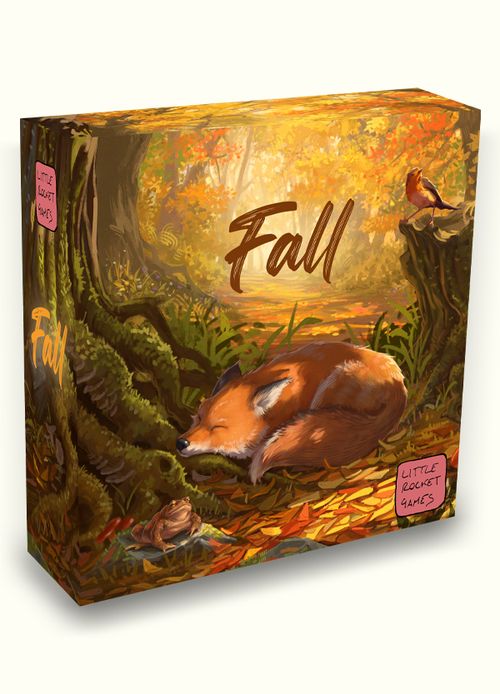
Fall
Fall Rulebook
Table of Contents
Table of Contents
Components
- 18 Scoring cards (6 Fox, 6 Bird, and 6 Flower cards)
- 1 Season board
- 1 Scoring pad
- 54 Leaf tiles
- 16 Mushroom markers (8 of each color)
- 1 Week marker
- 1 Do-not-place marker
- 64 Fauna and fungi tokens (14 mushrooms, 18 foxes, 12 hoopoes, 12 robins, and 8 toads)
- 1 Cloth bag
- 1 Starting leaf tile
Setup
- Shuffle the Bird, Fox, and Flower scoring cards separately. Each player randomly takes one card of each type, without showing them to their opponent. These cards show how players can score victory points (VP) at the end of the game, based on the Fox tokens, Bird tokens, and Flowers in the ecosystem. Players may consult their own scoring cards at any time. At the end of the game, both players reveal their scoring cards and score VP if they have met their conditions.
- Each player takes the eight mushroom markers of one color, which will be used to claim mushroom tiles in the ecosystem.
- Put all the fauna and fungi tokens in the bag and mix them.
- Shuffle the leaf tiles and stack them face down (any number of stacks) within reach of both players.
- Place the Season board to one side of the play area, clearly visible to both players. Agree together on which side of the board to play. Place the Week marker on the first space. This marks the flow of the game and indicates which fauna and fungi tokens cannot be placed in the ecosystem during that week.
- Reveal 4 leaf tiles from the stacks and place them face up in the center of the play area, within reach of both players.
- Draw 4 fauna and fungi tokens from the bag and pair them, from left to right, with each revealed leaf tile, to form 4 tile-and-token combinations.
- Place the starting leaf tile in the center of the table.
The player who most recently saw a fox in real life is the first player. If no one has seen a fox, you may choose the first player at random. You are now ready to start the game.
Game Mechanics
The game is played over 12 weeks. Each week, the first player takes two turns, taking one tile-and-token combination each, alternating with a single turn by the second player, who takes two tile-and-token combinations. Each week, the first player role alternates between the two players, so one player is the first player on odd weeks and the other on even weeks.
Example: On her first turn, Norma, who is the first player, chooses and takes the leaf tile and Robin token combination. On his turn, Amedeo takes the combinations with the Fox and the Toad. Then Norma takes the remaining combination.
The leaf tile or tiles taken during your turn must be placed immediately in the ecosystem. Leaf tiles must always be placed adjacent to or on top of tiles already in the ecosystem. During the first week, the first tile must be placed adjacent to the starting leaf tile (not on top of it).
You can place fauna and fungi tokens during the turn in which you take them, on leaf tiles that allow it (not necessarily the one you just placed), or you can keep them aside for later turns.
You can hold a maximum of 2 tokens aside at the end of your turn. If you have more than 2, you must remove tokens until you have 2, and put them back in the game box (they will not be used again during the game). During your turn, you can place any tokens you just took or any you are holding aside, as long as there are leaf tiles that allow it. Important: except for the Toad token, it is never mandatory to place a token, even if there are leaf tiles available to do so.
Example: On her first turn, Norma takes the leaf tile and the Robin token. She places the tile next to the starting leaf tile, but she cannot place the Robin token on it because, during the first week, that is not allowed (as shown on the Season board). On his turn, Amedeo places his two leaf tiles and, on top of one of them, places the Fox token, while he places the Toad token on top of the tile placed previously by Norma. Then Norma places the last tile and sets aside the Hoopoe token, since there are no available tiles to place it on. At the end of the week, Norma has two unused tokens, while Amedeo has none.
After the 4 leaf tiles and any fauna and fungi tokens have been placed in the ecosystem, the current week ends and a new one begins. Reveal 4 new leaf tiles and draw 4 new fauna and fungi tokens, pairing them, from left to right, with each revealed tile. Move the Week marker to the next space, following the increasing week number; this also indicates which fauna and fungi tokens cannot be placed in the ecosystem during the new week. Reverse the first-player order and begin the new week.
Beside: during the first week, the red marker indicates that Robin tokens cannot be placed on tiles. At the end of the first week, the marker moves to the second week. During this week, Robin tokens still cannot be placed; they can only be placed starting in the third week, when Mushroom tokens cannot be placed. So any Robin token taken during the first two weeks can be set aside and possibly placed in the third week, or during any other week that allows it.
Note: during each week there is one type of fauna and fungi token that cannot be placed in the ecosystem. However, these tokens can be set aside for following weeks, when placing them is allowed, or discarded if in excess, at the end of your turn. You may choose to discard any of your set-aside tokens, not only the ones you took on the current turn.
Tile Placement Rules
Each leaf tile has 1 or 2 leaf colors. There are 3 colors in total: yellow, red, and green. Leaf tiles must always be placed adjacent to or on top of tiles already in the ecosystem, rotated in any direction, following a couple of simple rules. Remember: during the first turn, the first tile must be placed adjacent to the starting leaf tile. Apply one of the following rules when placing a leaf tile:
-
The leaf tile must be placed next to at least one already-placed tile, with at least one edge adjacent to an edge of another tile of the same color, even if they are on different layers (a stack of up to 3 tiles is allowed).
Above: the red-green leaf tile can be stacked on the second layer, on top of the yellow leaf tile, because one edge of the tile is adjacent to a first-layer tile of the same color (red edge to red edge).
-
A leaf tile can be placed on top of another tile that contains at least one of the same colors, rotated in any direction, even if it is not adjacent to the same color. When placed, the token on the tile underneath must be removed from the game, except for Mushroom and Toad tokens, which can never be removed from the game; therefore, you cannot stack a tile on top of tiles bearing these tokens.
No more than 3 tiles can be stacked; therefore, any tile placed on a third-layer tile can never be removed from the game.
On the side: the green-yellow leaf tile can be stacked on the second layer because the tile underneath (on the first layer) contains the color green; as a result, the Fox token on top of the first-layer tile is removed from the game. The yellow tile can be stacked on the third layer because the second-layer tile contains the color yellow. The yellow-green tile cannot be stacked on the fourth layer, even though the tile below contains the color yellow. It is never possible to stack beyond the third layer.
Important: you can never stack a tile on top of the starting leaf tile, nor place a fauna or fungi token on it.
Fauna and Fungi Tokens
Players can place fauna and fungi tokens on top of leaf tiles. Leaf tiles have 1 or 2 icons that indicate which type of token can be placed on them. These can be Fox, Mushroom, or Bird, although there are 2 different types of Bird tokens (Hoopoe and Robin); these share only one icon type on the tiles. So, on a leaf tile with the Bird icon, you can place either a Hoopoe or a Robin token. Bird and Fox tokens grant VP according to the players' scoring cards.
Toad token: there are no leaf tiles with the Toad icon, but this token can be placed on top of any empty tile (except the starting leaf tile). It is also the only token that must be placed during the turn in which you take it, and it can never be set aside. Leaf tiles cannot be stacked on top of a tile bearing this token. The Toad token can never be removed.
Mushroom token: when you place a Mushroom token, immediately place one of your Mushroom markers from your reserve on top of it. Mushroom tiles, unlike other tokens, grant VP at the end of the game to the players who placed their markers on them. Leaf tiles cannot be stacked on top of a tile bearing a Mushroom marker. Mushroom tiles and markers can never be removed. At the end of the game, each Mushroom tile grants VP to the player who placed the markers on it, according to the layer it is on: 1 VP on the first layer, 3 VP on the second layer, and 6 VP on the third layer.
Important: each leaf tile can only hold 1 token.
Note: there are 8 Mushroom markers available per player. If a player runs out, they can keep placing Mushroom tokens, but cannot claim them. However, they will remain available to their opponent, who can claim them on their turn.
Flowers
All leaf tiles have 1 or more Flower segments on their corners. There are 3 different types of flowers: Autumn Crocus, Daffodil, and Cosmos. Completing a Flower with 3 adjacent segments of the same type can grant VP to both players at the end of the game, according to their Flower scoring cards. A Flower is only considered complete if it has all 3 adjacent segments of the same type, even if they are on different layers. Incomplete Flowers grant no VP at the end of the game. Note: Flowers do not affect any leaf tile placement rule.
End of Game
At the end of week 12, each player will have played the same number of turns and will have placed a total of 48 leaf tiles in the ecosystem.
Both players reveal their scoring cards and record their scores on the scoring pad. Each player scores VP from the completed Flowers in the ecosystem and from the Fauna and Mushroom tiles they claimed.
The player with the most VP wins. In case of a tie, the player with the most points from Mushroom markers wins. If the tie persists, the player with the most points from Flowers wins. If the tie still persists, the win is shared.
Scoring Card Details
- Flower cards: grant VP for completing Flowers (of the 3 segments) in the ecosystem. For example, the sample card grants 3 VP for each completed Daffodil, 1 VP for each Cosmos, and no VP for the Autumn Crocus.
- Fox cards: grant or subtract VP for each separate group of adjacent Fox tokens in the ecosystem. For example, the sample card subtracts 1 VP for each solitary Fox (not adjacent to other Foxes), grants 4 VP for each group of 3 or more Foxes, and 8 VP for each group of 6 or more Foxes (groups not adjacent to each other).
- Bird cards: grant or subtract VP for each Bird token in the ecosystem. For example, one sample card grants 2 VP for each Hoopoe token, 1 VP for each Robin, and, if there are more Hoopoes than Robins, grants 3 VP; if there are more Robins than Hoopoes, subtracts 3 VP. Another sample card grants 2 VP for each Bird token (Hoopoe or Robin), 1 VP for each Toad token adjacent to each Bird, and subtracts 1 VP for each Fox token adjacent to each Bird (each Toad or Fox token can count for different Bird tokens). Another sample card grants VP based on the number of Bird tokens in the ecosystem: Hoopoes score 1 VP for 1 Hoopoe, 6 VP for 2, 8 VP for 3, and 3 VP for 4 or more Hoopoes; Robins score 4 VP for 1 Robin, -2 VP for 2 or 3, and 4 VP for 4 or more Robins.