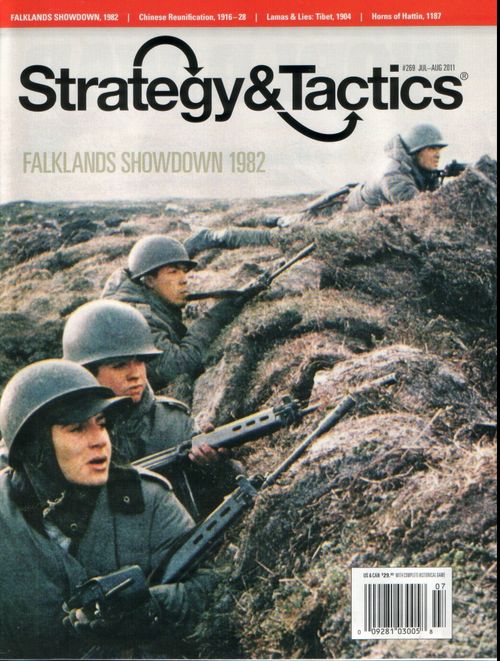
Falklands Showdown: The 1982 Anglo-Argentine War
Falklands Showdown: The 1982 Anglo-Argentine War Rulebook
Table of Contents
Table of Contents
1.0 Introduction
1.1 Falklands Showdown: The 1982 Anglo-Argentine War (FS) is a strategic/operational simulation of the war fought between Argentina (AR) and the United Kingdom (UK) in 1982. It is a two-player wargame of intermediate complexity. It begins with Argentina controlling the Falkland Islands and British forces approaching to try to retake them.
1.2 Scale.
Air counters generally represent one of four particular types of aircraft. Land unit counters represent infantry battalions (500 to 600 men), armored reconnaissance squadrons (8 to 12 vehicles with their crews), a heavy machine gun company (120 men with heavy machine guns) and special forces groups (25 to 50 men). Each ship and submarine counter represents one vessel. Note that, to fit the game system, many of the smaller vessels that took part historically on each side have been combined with the larger vessels of the same types. Each turn represents one to three days, depending on the operational tempo of the moment.
2.0 Components
2.1 A complete game of FS includes these rules, the map and 141 counters. Players must obtain a six-sided die to resolve combat and other game events.
2.2 Maps.
The complete game map consists of two maps, with limited areas shown in this way to delineate the sea and land areas across the South Atlantic region and within the Falkland Islands. The Strategic Map is used to track the movement and location of ships and their cargo, as well as aircraft, when they are not within the immediate area of the Falkland Islands. Sea areas 6 and 7, together with the Falkland Islands sea area itself, constitute the "Total Exclusion Zone" or "TEZ"; see 4.4(1) and 4.4(2) for their meaning. The Argentine range line marks the farthest distance that various land-based Argentine aircraft can reach when departing from Argentina (see 9.4). The Argentine mainland land area constitutes an unassailable air and naval base for the aircraft and ships of that nation. The Tactical Map is nothing more than an enlargement of the Falkland Islands sea area of the Strategic Map. It enlarges the water and land immediately around Port Stanley, which is the strategic nexus of the game. On the Tactical Map all water is considered one continuous sea area despite the irregularity of the coastlines of the different islands. Units in the Falkland Islands sea area of the Strategic Map are considered deployed simultaneously on the Tactical Map, and vice versa. Forces move within this area and between the two maps to facilitate play while the various operations are carried out.
2.3 Counters.
There are 141 counters in the game, representing many units and various military ships. Others are provided as mementos and informational markers. Each combat counter provides different informational elements: nationality, type, combat factors and historical identification.
2.4 The forces of both nations are identified by background color. Argentine units: blue background. British units: red background.
2.5 Identification of units.
Each unit is identified by its number and/or historical name. Each surface ship and submarine is identified by its name. Where feasible, the full name of the unit is shown. Where it is not feasible, the following abbreviations have been used.
Argentine ship names: 25dM – 25 de Mayo; Bel – General Belgrano; CSA – Cabo San Antonio; Grn – Granville; HB – Hipólito Bouchard; PB – Piedra Buena; Seg – Comodoro Seguí; SL – San Luís; Trn – Trinidad; ADG – Almirante Domecq García; CP – Comodoro Py; Drm – Drummond; Guer – Guerrico; Her – Hércules; Sal – Salta; SF – Santa Fe; SNT – Santiago.
British ship names: Act – Active; Alc – Alacrity; Amb – Ambuscade; Ant – Antrim; Arg – Argonaut; Avn – Avenger; Brs – Bristol; Cnb – Canberra; Cor – Courageous; Crd – Cardiff; Frl – Fearless; Gls – Glasgow; Invn – Invincible; Min – Minerva; Onx – Onyx; Plm – Plymouth; Shf – Sheffield; Spr – Spartan; Val – Valiant; ACn – Atlantic Conveyor; Alp – Antelope; And – Andromeda; Ard – Ardent; Aro – Arrow; Brl – Brilliant; Bsd – Broadsword; Cnq – Conqueror; Cov – Coventry; Ex – Exeter; Glam – Glamorgan; Herm – Hermes; Int – Intrepid; Nor – Norland; Pen – Penelope; QEZ – Queen Elizabeth II; Spl – Splendid; Str – Stromness; Yar – Yarmouth.
(Corrections in-file: the source's abbreviation lists print "Shefield", "Minverva" and "Broadsward"; these are rendered as Sheffield, Minerva and Broadsword.)
Argentine land units: M – Marines.
British land units: B&R – Blues & Royals; Gr – Gurkha; SG – Scots Guards; C – Commando; P – Paras; WG – Welsh Guards.
2.6 Unit types.
All combat units have a unit-type icon or symbol in their central part. This identifies what type of unit it is: ship, aircraft or ground unit. The right side of a ground unit indicates the historical identification of the unit. The upper right of air counters shows the type of aircraft it represents. Each ship has its name to the right of its image. Ship counters, besides their names and icons, also carry the following abbreviations to identify their general type:
Ship types: A – Amphibious assault; CVL – Light aircraft carrier; S – Submarine; CA – Cruiser; D – Destroyer, frigate or corvette; T – Transport.
Ground unit types: Infantry; Armored reconnaissance; Special forces; Heavy machine gun.
Aircraft types: Cnbra – Canberra; Spr Ent – Super Étendard; Dgr – Dagger (Mirage 5); Puc – IA 58 Pucará.
2.7 Combat factors.
Combat units have four different combat factors: anti-ground (upper left), anti-air (upper right), anti-submarine (lower left) and anti-surface (lower right). The "anti-ground" factor of a unit is used by that unit when it fires on an enemy ground unit. The "anti-air" factor is used when that unit fires on an enemy air unit. The "anti-submarine" factor is used when that unit fires on an enemy submarine. The "anti-surface" factor is used when that unit fires on an enemy surface ship. The combat factors of a unit are, in essence, "hit numbers." That is, if a given unit with, say, a combat factor of two attacks an enemy unit (of the type appropriate to the combat factor), that enemy unit is "hit" on a die roll of one or two (the hit number or less). For more detail see section 10.0.
2.8 Step strength.
A "step" describes the ability of a given unit to absorb a certain amount of punishment (hits) in combat before being eliminated from the game. All Argentine units contain only one step. All British units other than special forces have two steps. British special forces units have only one step. Note that damaged British units ("reduced" or "hit") can recover their full two-step strength during the course of the game through the deliberate choice of an operation. This does not happen with Argentine units, nor with British units that have been fully eliminated. When a British two-step unit suffers a hit, it shows this fact by placing a "Hit" marker on it.
2.9 Other counters.
The use of the following counters is explained at the appropriate points in the rest of the rules: UK operations remaining (see section 5.0); Operation Black Buck marker; Hit marker (see 2.7 and section 10.0); UK and AR decisive leadership markers (see 11.3, events 4-1, 4-2 and 4-3); remaining AR Stealth missions (see 10.5); Exocet marker with land base (see 11.3, event 6-4); VP marker (see section 4.0).
3.0 Placement and Control
3.1 After deciding who will command each side, both players classify and separate all the units of their side. Both the Argentine and British units have their initial deployments printed on their reverse side. The Argentine player places the forces of his side first.
3.2 Argentine placement.
All Argentine units with placement areas printed on their reverse sides are stacked in those locations on the map (AR = mainland Argentina).
3.3 British placement.
The initial British force is placed in naval area 4 with the special forces (SF) unit embarked on Hermes. The two British submarines, Spartan and Splendid, are placed in one or two of the three areas within the TEZ on the Strategic Map.
3.4 Reinforcements.
British units that do not appear in the initial placement are reinforcements. There are six British reinforcement groups (designated "R1" through "R6" on their reverse side; see 7.1, op. 6 for details on their entry into play). British land reinforcements enter the map embarked on specific ships, as noted on the reverse of the land unit counters. There are only three possible Argentine reinforcement units. See 7.1, op. 2 for details on their entry into play.
3.5 Initial placement of markers.
The British operations remaining marker is placed on space "30" of this track. The victory point (VP) marker (positive side up) is placed on space "8" of the VP track. All other markers are set aside for future use.
3.6 Area control.
The sea areas of both maps are never "controlled" by either side; units of both sides may co-occupy the same area at the same time and even move through one another. All land areas of the Falkland Islands begin the game under Argentine control, as does the South Georgia box. The control status of the different land areas of the Tactical Map serves to determine the winner of the game (see section 4.0) and the use of the airfields located in them. Each land area of the Tactical Map is said to be "controlled" by the Argentine or British side, or may be "contested." A land area is contested if both sides simultaneously have one or more land units in it. A contested or enemy-controlled land area comes under your control at the moment your side is the only one with one or more land units in it. The control status of a given land area may change any number of times during the game. The control status of the land areas of the Tactical Map does not in any way affect the status of the sea areas or the operability of the Falkland Islands sea area of the Strategic Map. Note also that although sea areas cannot be controlled, the concept of "contested" does apply to them. At the start of the game the Argentine player controls all land areas on the map.
Designer's note: there are no "zones of control" in this game (if you do not know what this term means, do not worry about it).
3.7 South Georgia box.
The South Georgia box of the Strategic Map represents the South Georgia islands and their surrounding waters, located 700 miles SE of the Falklands (via sea area 5). At the start of the game they are under Argentine control; however, no Argentine unit may be moved to or from this box, except submarines. If/when South Georgia is captured by the British, the British player may thereafter use it as a ship-repair facility for the rest of the game. Note that this box is neither a sea area nor a land area; it is a box with its own special rules. For more details see rule 7.1, op. 4 and 5, rules 4.4(2), rule 9.1 and rule 9.7.
4.0 How to Win
4.1 Throughout the game, both players will keep, jointly and openly, a record of the number of victory points (VP) on this marker on the map. When the Argentine player earns VP (always positive), he adds them to the total shown on the record. When the British player earns VP (always negative), he subtracts them from the total shown on the record. At the end of the game, the final VP total shown on the record (positive, zero or negative) determines the winner of the game.
4.2 Precondition for British victory.
To win the war, and possibly also the game, the British player must control the Port Stanley area when he completes his last operation (exception: see 4.5 below). When this final British operation has been completed, the game stops and a "competitive game victory" is calculated according to victory points (VP). That is, since Port Stanley is the only location in the Falklands through which an occupation force can be kept supplied over the following winter, by securing it the British player has in fact won the war. Both players then use the VP system to measure their skill as commanders and to determine which of them has won the game in this sense. Of course, except as indicated in 4.5, if the British player cannot control Port Stanley there is no VP calculation: in that case the Argentine player wins both the war and the game.
4.3 Surrender.
If at any point you see that continuing the fight is useless, you may concede the victory of the game and the war to your opponent.
4.4 Gain and loss of VP.
The game begins with 8 positive VP recorded on the marker printed on the map. VP are recorded instantly according to the following list.
-
The Argentine player adds 1 positive VP to the total each time a British operation is completed and, at that instant, there are no British surface ships in any of the three sea areas within the Total Exclusion Zone. This is one point in total for all British surface ships outside the three areas simultaneously. These VP can potentially be recorded at the end of each British operation during the game. Submarines do not count for this rule.
-
The Argentine player adds one or two positive VP to the overall VP total for each Argentine ship sunk in any sea area that is not within the Total Exclusion Zone and in the South Georgia box. Note, however, that these VP are not earned during the operation in which events 4-1, 4-2 and 4-3 are in effect. The Argentine ships 25 de Mayo and Belgrano each give 2 VP; all other Argentine ships give 1 VP.
-
The British player subtracts one or two negative VP from the VP total for each Argentine ship sunk within the Total Exclusion Zone or in the South Georgia box. The Argentine ships 25 de Mayo and Belgrano each give 2 VP; all other Argentine ships give 1 VP.
-
The Argentine player adds 2 positive VP to the overall VP total whenever he sinks any of the following British ships: Hermes, Invincible, Fearless, Intrepid, Canberra, QE2 and Atlantic Conveyor. Note, however, that the Conveyor's points are earned only if this ship is sunk before it has joined Hermes and Invincible (see 10.9). He earns 1 positive VP for each of the other British ships and submarines on the list above that are sunk.
-
The British player adds 4 negative VP to the overall VP total when he takes control of the Port Stanley area. Likewise, he adds 1 negative VP, each time, when he takes control of any of the following areas: Goose Green, Fox Bay, Port Howard and Pebble Island. If the Argentine player manages to recover any of these VP areas, he immediately adds the corresponding number (one or four) of positive VP to the overall total. These points awarded for territorial control may be added or subtracted any number of times during the game.
-
For further VP entries, see rule 7.1, op. 2.
4.5 Sudden death victory.
If the total VP count ever reaches +20, the game stops immediately and the Argentine player is declared the winner of the war and the game at that moment. If the total VP count ever reaches -5, the game stops immediately and the British player is declared the winner of the war and the game at that moment. Note that this rule is subject to the prior condition of the capture of Port Stanley stated in rule 4.2.
4.6 Determining the competitive "game victory."
When the British player has completed his last operation, on condition that he controls Port Stanley at that moment, the game stops and the players determine who has made the better overall war effort. If the VP total is zero or negative, the British player wins the competitive game. If the VP total is positive, the Argentine player is the winner.
4.7 Game balance.
The typical reaction of those approaching the game for the first time is that the Argentine has no chance of winning when played between opponents of similar skill. If you believe this is the case, use this method to determine who will command the British side: before starting placement, both players secretly write on a piece of paper a number from 1 to 30. Once this is done, both players reveal their numbers simultaneously. These represent the number of operations each player is willing to use as the starting number if they command the British. Thus, for example, if one player writes "27" and the other "25," the player who wrote the lower number will command the British. The game then begins, and victory is calculated when the British player has completed 25 operations, instead of the normal 30. If both players write the same number, a coin is tossed to break the tie.
5.0 Turn Sequence
5.1 Each turn of FS is divided into a sequence of five steps (or "phases"). At the end of Phase V of each turn the turn sequence starts again. When the British player has completed his last operation, the game immediately stops and the victory is determined, as described in section 4.0. Each operation carried out by a player must be carried out during the appropriate part of the turn sequence given below. Once a player has finished a particular operation or other activity, he may not rectify it unless his opponent allows him to.
5.2 Turn sequence.
The turn sequence is set out below, and is also printed on the map. Each turn is divided into the following phases: I. British operations phase. II. Argentine operations phase. III. British submarine phase. IV. Argentine submarine phase. V. Events phase.
5.3 Each time the British player completes an operation (see section 7.0), the "UK Op. Remaining" marker is moved to the next lower numbered space on the track on the map. When this has been done, the Argentine player then carries out his own operations phase. Note that no marker records the number of Argentine operations carried out. The turns continue to be played according to the list above until the British player has completed his last operation. At that point the game stops; the game ends and the victory is determined. Note that this means the last turn will be truncated, ending immediately at the end of its first phase.
5.4 Event 1-1/1-5 is in effect at the start of the first turn.
6.0 Stacking, Bases and Transport of Units
6.1 "Stacking" is the term used to describe the piling up of more than one unit of your own side in a given area or in an air base within a given area, at the same time. In some cases there is no limit to the number of units you may stack in one location at the same time. There is never a limit to the number of ships (surface and/or submarine) that may be located in the same sea area at once. Nor is there a limit to the number of land units that may be in the land area at one time.
6.2 Limits on naval transport and air bases.
-
Each surface ship has the capacity to carry one friendly SF unit. The British submarine Onyx may carry the SBS special forces unit; no other submarine of either side may carry land units.
-
Both players may transport friendly units aboard the transport and amphibious assault ships of their own side. The maximum these ships can carry is shown on their counters in terms of steps for the British and in whole units for the Argentine. Note that the ships Elk, Fearless and Intrepid have an oval armor symbol on them. This means they are capable of carrying the mechanized B&R unit and are the only ones able to carry it. The amphibious assault ships Fearless and Intrepid can each carry up to five steps. The Argentine amphibious assault ship Cabo San Antonio can carry up to two units (infantry, heavy machine guns and SF only). The Atlantic Conveyor, although a transport, can never carry units; see 10.9 for details.
-
The Port Stanley air base may hold a total of three Argentine air counters.
-
The Goose Green and Pebble Island air bases may hold a total of two Argentine air counters each.
6.3 Falkland Islands air bases.
On the Tactical Map, the Argentine player may place the air units of his side from the bases there up to the limits specified on the counter. If an area with an air base becomes contested, the base may continue to be used until the moment the area comes under British control. At that moment the Argentine player must carry out an emergency base change (see 9.6). The complete Tactical Map constitutes the range of all air units based anywhere on it.
6.4 South Georgia box stacking limit.
The British player may stack any number of any type of unit in the South Georgia box. The Argentine player may have only submarines (unlimited) in the box.
6.5 Transport of units by ship.
Land units may generally go to sea only in transport ("A" or "T") ships of their own side. For exceptions, see 6.2(1) above. Each transport unit has its transport capacity printed on its counter as described in 6.2(2). To show that a unit is being transported, the transported unit is placed beneath the ship counter. While at sea, transported units are considered for all purposes as an inseparable part of the unit that carries them. That is, if their transport unit is attacked, no separate attacks are made against the transported units; they simply suffer the same fate as the unit carrying them. Transported units may remain at sea for as long as they wish. If/when a ship is used to carry land units into an amphibious invasion (that is, into a land area contested or controlled by the enemy), that ship is not subject to fire from the enemy units defending there during this action. See also 6.2(1) and 6.2(2) above and 10.4.
Note that British units that arrive have their initial transport ship printed on their reverse sides (although see also Op. 12).
6.6 No fog of war.
Both players are free to examine all units of both sides on both maps, including reinforcements that have not yet entered play.
Designer's note: in accordance with rule 6.6, there is still controversy about how much each side knew of the other and from whom they received information. Some authors claim that the United States (and/or a mysterious "private" security firm based in Norway) kept the British fully informed, while others say the Soviets generously helped the Argentines in this matter. Depending on which claims you agree with, you are completely free to experiment with any combination of "hidden units" and "limited intelligence" rules you wish.
7.0 Operations Phases
7.1 "Operation" (or "Op") is the term used to describe the obligation of a specific force to move and/or fight and, for the British side, also provides the measure of time passing in the game. There are a total of 25 operations ("ops") in the game. Some may be carried out by only one of the players, while most may be carried out by both. The list of available actions is given below. Each time a player begins an operations phase of his own side, he announces exactly which operation he will carry out at that time. Each player will normally carry out only one operation in each of his operations phases, although there are exceptions. Certain events give one player or the other the ability to carry out two operations in a single phase. Unless otherwise indicated in the explanation of an operation, both players may take the same action any number of times during the game and/or in succession. The 25 available operations are described below.
Op. 1 (AR only). Strategic air bridge.
The Argentine player may move up to two land units from Argentina to the Port Stanley airfield. This movement cannot be intercepted by British op. 11 (see below).
Op. 2 (AR only). Mobilization of additional ground forces.
The Argentine player activates, at his choice, one of the following units: 3M, 2 or SF Anf. This operation may be carried out up to three times per game, once for each of these units. Each unit so activated counts as an operation and is placed in Argentina when activated, from where it may potentially be transported to the Falklands during other operations. The British player adds 1 negative VP to the overall VP total each time this event is put into effect by the Argentine player.
Op. 3 (AR). Relocation of aircraft.
You may move any number of friendly aircraft from one land area (friendly or contested) to another friendly (uncontested) land area that can serve as a base for those aircraft. Aircraft, other than Pucarás and Stealth, moved in this way are subject to interception. The change of base may be made within the Falklands, as well as between these islands and mainland Argentina.
Op. 4 (UK only). Seizure of South Georgia.
The British player moves a force consisting of three surface ships of any kind, one submarine and two special forces units to the South Georgia box, thereby automatically gaining control of it. Any Argentine submarine(s) that flee from there at the time of this operation are automatically eliminated. The box is thus permanently available to the British player as a location for repairing ships and as an entry point for reinforcements. The capturing force does not land land units within the box and may move out of it normally, whole or in parts, in later operations. This operation may be carried out only once per game. Argentine submarines that may enter the box after its capture by the British are not automatically eliminated; however, they may be treated normally in combat. Note, however, that such later Argentine entries into the box cannot recapture it for the Argentine side.
Op. 5 (UK only). Repair of damaged ships.
The British player may repair (remove the hit marker from) any damaged British surface ship or submarine. A damaged ship must be in the South Georgia box to be repaired, and this movement may not be part of this same operation. This operation may not be carried out until after operation 4 has been carried out. Note that sunk ships cannot be recovered from the dead pile by this or any other operation.
Op. 6 (UK only). Entry of a reinforcement group.
The British player may introduce the reinforcement group with the lowest number (from R1 to R6) either through sea area 4 or, if it is British-controlled, through the South Georgia box, at his own decision and ship by ship (transported units must arrive on their designated ships). The reinforcement group with the higher number may not enter, in whole or in part, until all groups with lower numbers have entered. No unit of a group that has entered may be left behind. This operation may not be chosen as one of the first two operations of the game, nor may it be chosen twice in a row. The entry of a group ends this operation; it may not move freely, although it may be chosen to do so in any later operation. Groups need not keep the original organizational structure of their force once they have entered.
Op. 7 (UK only). SF attack on the Falklands air base.
The British player designates any SF unit, which may be aboard any ship or in any controlled and uncontested land area at that time, for this mission (they may not move). The result is that it eliminates any one Argentine air unit from any airfield on the Tactical Map. Immediately after removing the Argentine aircraft, one die is rolled. On a result of 6, the British SF unit involved is eliminated. This operation may not be chosen more than once per game.
Op. 8 (UK only). Regrouping of land units.
The British player may "regroup" (remove the hit marker from) one damaged land unit. The regrouped unit must be on a British ship or in a friendly controlled or uncontested land area. Note that fully eliminated units cannot be recovered from the dead pile by this or any other operation.
Op. 9 (UK only). Execution of Operation Black Buck.
The British carry out a strategic air attack with Vulcan bombers against Argentine air bases in the Falklands. All Argentine aircraft, other than Pucarás, at any Falklands air base at that time are returned to Argentina. This evacuation counts as an operation for the Argentine player. Pucará aircraft are not affected. This operation may be chosen only once per game; however, once it has been chosen, the only aircraft that may use the Falklands as a base from then on are the Pucarás.
Op. 10 (UK only). Temporarily expanded TEZ.
When chosen, this event is in effect added freely to any other combat event that the British player may choose simultaneously (at a total cost of one operation expended). With it, the British player may attack any Argentine surface ship and/or submarines in any sea area anywhere on the map, without generating positive VP where/if these attacks produce sinkings (see 4.4/2). Instead, during the attack operation in which this TEZ expansion is in effect, all Argentine sinkings, regardless of the sea area in which they occur, generate the negative VP described in 4.4/3. This TEZ expansion may be chosen only once per game. This operation does not permit attacks on mainland Argentina.
Op. 11 (UK only). Air interception of an Argentine air operation.
This action may be carried out only by the British player and may be done any number of times per game, bearing in mind only that the Argentine action currently under way is 3, 17, 18, 19 or 20, and only the land-based Argentine air component within operation 20 may be intercepted. If the movement of these Argentine aircraft takes place at or adjacent to one or more sea areas containing British aircraft carriers, or to any area of the Tactical Map provided the British carriers are within range of that map, these British units may interrupt the Argentine operation to make an attack on these Argentine aircraft. The British interception is fully resolved before the Argentine aircraft continue and carry out their planned movement and/or attack. Pucará and Stealth aircraft, as well as attacks by the Argentine aircraft carrier, cannot be intercepted; however, their presence in an Argentine group containing aircraft eligible for interception does not inhibit the interception of those eligible units.
Op. 12 (UK only). Changing decks.
You may move land units from one ship to another ship in the same sea area. Forces may be shifted and stored as desired, while observing the loading limits of all the ships carrying them.
Op. 13 (UK only). Air attack on an enemy Falklands air base.
You may use one or both of your aircraft carriers within range to attack Argentine aircraft on the ground at any air base in the Falkland Islands. The attacking ships use their anti-air combat factor. There is no Argentine return fire.
Op. 14 (Both). Surface attack on enemy surface ships.
You may use surface ships and/or submarines to attack enemy surface ships (but not enemy submarines) that are co-located with them in any sea area.
Op. 15 (Both). Ground attack.
A friendly land force already in a contested land area is used, together with any aircraft or aircraft carrier (Argentine carrier only) within its range that could also contribute to the effort, to attack the enemy land force in that area.
Op. 16 (Both). Amphibious landing in an enemy or contested area.
You may land one, some or all of the friendly land units being transported by your ships within the Falkland Islands sea area, in any controlled friendly land area of the Tactical Map, or in one that is at that time already contested, or alternatively in a land area devoid of land units of both sides. The sea area from which the landing is made may be contested. Even if the land area is contested, there is no immediate combat as part of this operation.
Op. 17 (Both). Amphibious assault.
To carry out this operation, you must have one or more assault ships (Intrepid and Fearless for the British, and Cabo San Antonio for the Argentines) in the Falkland Islands sea area. Friendly ships in this same sea area may conduct a naval bombardment of the landing area before the amphibious assault, which is carried out as part of this assault operation. The assault may be against a land area controlled by the enemy. No more than five steps may be landed from Fearless and from Intrepid (each) in the first wave, while from Cabo San Antonio no more than two units may be landed. The units landed from these ships are the only ones that may fight in this land area during this operation. When they attack, their hit numbers are reduced by one (in addition to other applicable modifiers). In a British operation, provided at least one unit of the first wave survives this combat, from 1 to 10 additional steps may be landed immediately (still part of this same operation). These additional troops must already be located in the Falkland Islands sea area aboard any transport ship.
Op. 18 (Both). Air-to-sea attack.
You may move a force of friendly aircraft from a land area to a sea area within their range and attack the enemy surface ships there. If you have one or more aircraft carriers within range of that same sea area, they may be assigned to the same attack, or they may attack without the participation of land-based aircraft. When this operation is carried out by the Argentine player, its land-based air component is subject to British interception (but not the Argentine aircraft carrier, if it is involved).
Op. 19 (Both). Air-to-ground attack.
You may move a force from a friendly airfield in one land area to another land area within its range and attack the enemy land units there. If you have one or more aircraft carriers within range of that same land area, they may be assigned to the same attack, or they may attack without the participation of any land-based aircraft. When this operation is carried out by the Argentine player, its land-based air component is subject to British interception (but not the Argentine aircraft carrier, if it is involved in the action). No SF unit of either side may be the target of an air-to-ground attack.
Op. 20 (Both). Naval movement and/or combat.
You may move one, some or all of your surface ships and/or submarines from one sea area to another sea area on either map. Argentine ships may also begin or end this operation "in port" in mainland Argentina. If enemy surface ships or submarines are in the final sea area to which you have moved your force, they may be attacked as part of this same operation, and other friendly ships already present in that final sea area may also take part in the attack. In addition, land-based aircraft within their range and/or aircraft carriers in adjacent sea areas may also take part in the attack. Moreover, if all the ships and submarines you want to take part in your attack are already in the contested sea area where you want to attack, you may do so using this same operation without any movement taking place (and, yes, in such a situation your land-based aircraft within range and/or carrier aircraft could take part).
Op. 21 (Both). Naval bombardment of land.
You may use a force of friendly surface ships already in the Falkland Islands sea area to attack enemy land units and/or land-based enemy aircraft in any land area of the Tactical Map. There is no defensive return fire. No SF unit of either side may be the target of this kind of fire.
Op. 22 (Both). Helicopter movement of land units.
The British player may move up to two units (in total) of infantry and/or SF from a British-controlled friendly land area in the Falklands to any friendly controlled or contested land area of the Falklands. The Argentine player may do the same, but his limit is one infantry or SF unit per operation. This operation, when carried out by the Argentine player, is not subject to interception. If they move into a contested area, the helicopter-borne units may end their movement by attacking, alone or together with other friendly land units already present; however, these helicopter-borne units would suffer a reduction of minus one to their hit number during this attack.
Op. 23 (Both). Loading onto ships.
You may load land units from a land area onto ships in the Falkland Islands sea area or (Argentine player only) in mainland Argentina. The loading limits of all ships involved must be observed.
Op. 24 (Both). Land movement and/or attack.
You may move a force of land units from any land area of the Falklands to any adjacent land area of the Falklands. (To be considered "adjacent," both land areas must touch, at least partially, along a land border; for example, the Lafonia area is adjacent only to the Goose Green area.) If enemy land units are in the land area to which the force has been moved, they may be attacked as part of this same operation, although this is not mandatory. Other friendly land units already present in the land area to which you have moved may also take part in the attack as part of this same operation. If only land-based air units are in the area to which you have moved, they may carry out an emergency base change (see 9.7; see note below). As an alternative to the above, if the friendly land force is already located in the contested area where you want to carry out your attack, you may simply do so without having to make any prior movement.
Note: the source's cross-reference here reads "9.7"; the emergency base change rule is 9.6, and 9.7 covers the status of mainland Argentina. Transcribed as printed.
Op. 25 (Both). SF combat against SF.
You may use all the SF units you have in a Falklands land area to attack enemy SF units located there. All other units are ignored, no naval or air support is available, and no die roll modifiers apply.
8.0 Submarine Movement Phases
8.1 During the submarine movement phases of your own side, you may choose to move none, one or all of your submarines, as you wish. These movements do not use operations.
8.2 No attacks are made during these phases; only submarine movement takes place.
8.3 Note that submarine movement made during these phases does not prevent those same ships from moving and/or fighting in the regular operations phases. Note also, however, that submarine activities in the regular operations phases count as the use of operations.
9.0 Movement
9.1 Naval movement.
Whenever you carry out an operation that involves the movement of one or more surface ships and/or submarines, you simply take these units and move them to the naval area you want as their destination. There is no limit to the number of ships that may be moved as part of any force in any operation. For ships traveling to or from the South Georgia box (which is permitted for all British ships, but only for Argentine submarines), they leave and enter through sea area 5.
9.2 Land movement.
Land units in one area may move to another land area with which the original area shares at least a partial land border. There is no limit to the number of units you may move as part of a land force in an operation. The maximum movement of a land unit is normally one area per operation, although see Op. 22 for the exception.
9.3 Aircraft carrier range.
All aircraft carriers have an attack range of one sea area. That is, attacking a sea area adjacent to the one where the carrier is located is considered a range of one. There is no reduction in attack strength for attacking at this distance. All land areas of the Tactical Map are considered to be within the Falkland Islands sea area of the Strategic Map.
9.4 Movement and range of Argentine aircraft from Argentina.
All Argentine aircraft flying from mainland Argentina, except the A-4s, may operate up to the range line on the map. The A-4s operating from Argentina have sufficient range to reach sea areas 1, 2, 3 and 6. Note, however, that in any operation in which they are involved, up to four A-4 units based in Argentina may be used as receiving aerial refueling and may thus extend their range to include the Falkland Islands sea area.
9.5 Movement and range of Argentine aircraft from the Falklands.
All Argentine aircraft flying from Falklands bases have unlimited range, except that they may not enter the South Georgia box.
9.6 Argentine emergency base change.
When the only units in a land area of the Falkland Islands sea area are Argentine aircraft and the British player has one or more land units there, an "emergency base change" must be made immediately. The Argentine player moves the units to another friendly controlled or contested base or to Argentina. The emergency base change does not count as an operation, but aircraft other than Pucarás and Stealth may be subject to interception. The Argentine player may decide the destinations aircraft by aircraft.
9.7 Special status of mainland Argentina.
Located on the western side of the Strategic Map, mainland Argentina ("Argentina") has a unique status in the game. That is, no British movement or combat may take place in this area. In addition, the only ships in the game considered to be "in port" are Argentine ships located in the Argentina area. Such ships are simply placed within the mainland mass to show this situation. Nothing special is needed for Argentine ships to move to or from Argentina; they simply move as if going from one sea area to another. Argentina's capacity to maintain aircraft or ships is unlimited.
9.8 No unit already in play on the map may leave it except if it is eliminated in combat (the South Georgia box is considered to be "on the map" for this purpose).
9.9 Whenever you move a "force" of units from an area, you do not need to include in it all the friendly units that are there. Once a force has begun to move, you may not leave units along its path of movement. Note also that certain operations allow friendly units that begin an operation in areas other than the one from which you are moving (and/or attacking) the originating force to join the operation.
10.0 Combat
10.1 Combat is voluntary, except when operation 15 is chosen or when any other operation is declared that consists simply of attacking (do not declare such an operation unless you want to attack). In general, it can be said that combat occurs only between enemy units in the same area; however, aircraft carriers may project their combat factors to a land or sea area adjacent to their location.
10.2 Procedure.
Units take part in combat, offensively or defensively, by "firing" on enemy units. If a unit does not have the capacity to engage a given type of target, it may not fire on that type of unit. For example, a submarine with a printed anti-air combat factor of "0" may not fire, either offensively or defensively, against any aircraft. Note, however, that this inability does not prevent an aircraft with a printed anti-submarine combat factor of "1" or more from attacking this submarine, which has a zero defense. A die is rolled for each firing unit. If the result is equal to or less than the combat factor being used, it is a "hit." Each hit causes the loss of one step in the target unit. Any Argentine unit that is hit is therefore eliminated and permanently removed from the game. All British units, except SF, have two steps. A British two-step unit that suffers a hit receives a "Hit!" marker on it. A unit that has already received a hit (and has thereby been "reduced" to one step) and that suffers a second hit while carrying a "Hit!" marker is eliminated and permanently removed from the game.
In each combat, all of your participating units may fire (roll a die) on any enemy unit involved. In turn, all of your units that fire may be attacked by one or more enemy units in this same battle. A unit is never obliged, on offense or defense, to return fire on the same unit that attacked it. In general, units located within the area of a battle may not be hidden from it; however, note the important exception described in 10.4. All the fire in a battle is considered to occur simultaneously, both within and between the two sides. There is no advantage in rolling the die to resolve your combat before the other player. All die rolls for combat are made before any hits take effect. For reasons of form, the player carrying out the operation will make all of his shots first. Within the limits of the protected targets rule (10.4), you may assign more than one unit to attack the same enemy unit. In general, however, if your first hit, or one of your first hits, succeeds and eliminates a unit that is the target of several of yours, you may not reassign your "excess" units; they have simply been wasted in the course of the battle. Note also that there are never "multi-round" battles. In general, each unit of both sides involved in a battle may fire only once, and then the battle ends. For an important exception, see 10.9.
10.3 Zeros, ones and sixes.
Regardless of the modifiers that may apply in a given battle, a printed hit number of zero can never be changed to another number, and a printed hit number of one or more can never be reduced to zero. Likewise, no hit number from one to five can ever be modified to six. That is, one is never completely "sure" of what will happen with a die roll in this game.
10.4 Protected targets.
The ships Hermes, Invincible, 25 de Mayo, Fearless, Intrepid and Cabo San Antonio, and all British "T" transports, are considered "protected targets" when they enter combat. No protected target may be attacked unless all other unprotected surface ships in the same area are being attacked by at least one of your units. To remind players of their status, protected ships have their names underlined on the counters. Note also that certain events create exceptions to this.
10.5 Argentine Stealth aircraft.
The Argentine Super Étendard air unit is identified as stealthy ("STL"). This means that whenever it is attacked by British units of any type, the hit numbers of those attacking British units are reduced to "1." Note: the hit number is not reduced by one; it is reduced to one. Likewise, this unit can never be intercepted. In addition, this air unit may never make more than five attacks per game, after which it is simply removed. A record of these attacks is kept on the British operations remaining track using the marker provided for this purpose.
10.6 Mountains.
Units of either side, of any type, that are attacking in an area containing mountains do so with their hit numbers reduced by one point. This does not apply to units that are conducting defensive fire.
10.7 Argentine entrenchments.
The Port Stanley and Goose Green areas have been fortified with entrenchments. British units that attack these areas do so with their hit numbers reduced by one point. Note, however, that these entrenchments never benefit the British units defending in these areas.
10.8 Special forces operations.
SF units of both sides may move as part of a force involved in a conventional land operation, or may move as part of a force made up entirely of SF units. You may conduct a land attack or defense with a force that contains SF units and other land units; and if your side is the only one with SF units in the combat, all of your combat units in this battle have their hit numbers increased by one point (cumulative with all other applicable modifiers). In such combined combats, the SF units do not fire by themselves, although they suffer the fate of your last conventional land unit in the battle. SF units can be eliminated only through SF-versus-SF combat in operation 25, through operation 7, or through event 2-4. Whenever an operation 25 is carried out, the SF units involved fire on each other as if they were regular units, but no air or naval support is possible, and no die roll modifiers for mountainous terrain or entrenchments apply. The presence of only SF units in a land area occupied by the enemy makes that area "contested." The anti-ground combat factors of SF units are marked with asterisks as a reminder of these unique characteristics.
10.9 Multiple fire of Hermes and Invincible.
Before joining the Atlantic Conveyor, each time an aircraft carrier fires, offensively or defensively, at any target other than a submarine, it may fire three times. Once they have joined up with the Conveyor (which is defined as the three ships in the same sea area at the end of any British operation), this number of shots increases from three to four and the Conveyor is removed from the game (without providing any VP). Note that when they make their multiple shots, the carriers need not all fire at the same target in a given battle, and need not pre-assign each shot. All shots must nevertheless be made against enemy units in the same battle area. When firing at submarines, no carrier fires more than once per battle.
Example of interception. Suppose two British aircraft carriers are in the Falkland Islands sea area. The Atlantic Conveyor has not yet appeared. The Argentine player is in his operations phase and chooses to launch several of his air units from his base in Argentina against these British carriers. As these aircraft enter a sea area adjacent to the Falkland Islands naval area, the possibility of British interception arises. The British player declares an interception, which temporarily halts the movement of the Argentine air strike in this sea area adjacent to the Falkland Islands naval area. The British player then makes six die rolls: that is, three per carrier, with a hit number of "3" for each roll, using the combat factors of these ships. Whenever the British player achieves a hit, one Argentine aircraft is eliminated from the attacking force. This ends the interception. The surviving British air force then enters the area where the British carriers are located, where another battle takes place with these carriers; however, this time both sides roll their dice simultaneously, so the hits of both sides do not take effect, again simultaneously, until all dice have been rolled.
10.10 Armor in combat.
There are three armored units in the game: the British B&R and the Argentine 10th and 181st. Whenever a non-armored land unit fires on an armored unit, the hit number of the firing unit is reduced by one.
10.11 Hits.
When an Argentine unit receives a hit, it is eliminated. When a British two-step unit receives a hit, a marker is placed on it. If it is hit again while carrying this marker, it is eliminated. Apart from this, hit markers do not affect the normal movement or combat capabilities of British units.
11.0 Events
11.1 Event phases are used to provide the game with fictional and opportunistic elements. These situations cannot be planned. Each event listed may or may not happen.
11.2 Procedure.
At the end of each turn, both players, with the British player always going first, roll a die and consult the list given below. The first die rolled (British) is the first digit of the event and the second (Argentine) is the second digit of the event. Thus, if the British player rolls a 2 and the Argentine a 4, the result would put event 2-4 into effect. Each event may take effect any number of times, unless otherwise indicated in its explanation. If a result of "no effect" is obtained, the die is not rolled again. Unless the circumstances allow otherwise, players may not decline any event that has been activated.
11.3 List of events.
All the events listed below are shown in the order of the dice rolled.
1-1, 1-2, 1-3, 1-4 and 1-5: British operational superiority.
The British player may carry out two operations for the price of one. He need not announce his second operation in advance. This event is considered to be in effect at the start of the first turn.
1-6: British staff error.
The British player may not make any air, naval or land movement during his next operations phase. Combat may occur in areas already contested, and the British submarine movement phase is not affected.
2-1, 2-2 and 2-3: British surface ship detection advantage.
The British player may immediately carry out an attack on Argentine ship(s) in any contested sea area. Any VP gain or loss produced by each sinking applies. This attack does not count as a British operation. Normal defensive fire is conducted.
2-4: Special forces team in danger.
The British player rolls another die: on a result of 1 to 3, his side is the one affected; on a result of 4 to 6, the Argentine side is affected. The unaffected player chooses one enemy SF unit located in any contested land area. The affected player must permanently remove this unit from the game. If there are no SF units in such a situation, the result is "no effect."
2-5, 2-6 and 3-1: British submarine detection advantage.
The British player may immediately carry out an attack on Argentine submarine(s) in any contested sea area. Aircraft carriers may take part only if they are in the same area as the attacked submarines. The VP pertinent to each sinking are gained or lost. This attack does not count as a normal British operation. Normal defensive fire is conducted.
3-2 and 3-3: Argentine target of opportunity.
As his next operation, the Argentine player may choose to attack a protected British surface ship without also having to face unprotected targets in the same area. The normal VP are earned for a sinking, and the target ship conducts normal defensive fire.
3-4, 3-5 and 3-6: British surprise submarine attack.
The British player may attack an Argentine surface ship, protected or not, that is at that time located in any sea area with one or more British submarines. The Argentine player may not respond with defensive fire. The VP pertinent to any sinking apply. This does not count as an operation for the British player.
4-1 and 4-2: British decisive leadership.
The British player takes the "UK Decisive Leader" marker to record that this event has been activated. He may play this marker after any die roll by any player that he does not like. The effect is to make, or allow, the player who rolled the die to roll it again. If the Argentine player has the Argentine decisive leader marker in his possession when this event is activated, the effect is to remove this marker from the Argentine player; however, both markers are then out of the game until they are again in effect for one or the other player. See event 4-3.
4-3: Argentine decisive leadership.
The Argentine player takes the "AR Decisive Leader" marker to record that this event has been activated. He may play this marker after any die roll by either player that he (the Argentine player) does not like. The effect is to make, or allow, the die to be rolled again. If the British player has the British decisive leader marker in his possession when this event is activated, the effect is to remove this marker from the British player; however, both markers are then out of the game until they are again in effect for one or the other player. See events 4-1 and 4-2.
4-4: Argentine surface ship detection advantage.
The Argentine player may immediately carry out an attack on British surface ship(s) in any contested sea area. Aircraft within range of the target may fly to assist this attack, and the 25 de Mayo may also take part if it is within its range. The VP pertinent to each sinking are earned. This attack does not count as an Argentine operations phase. Normal defensive fire is conducted.
4-5: British political pressure to make a decision.
The British player must carry out an amphibious landing and/or a land attack at some point during his next three operations, or the Argentine player earns 2 VP at the end of the third British operation.
4-6: Argentine air force mechanical problems.
The Argentine player may not move or fight air units during his next operations phase.
5-1 and 5-2: Argentine logistical shortage.
The Argentine player may not carry out any type of attack during his next operations phase.
5-3, 5-4 and 5-5: Severe weather.
A British operation is marked as carried out without any effect. This does not cancel the British player's next operations phase; in exchange, however, the bad weather has doubled the cost in time and resources expended.
5-6, 6-1 and 6-2: Style of the Argentine air force.
The Argentine player may carry out two operations instead of one during his next operations phase, provided both operations involve only the movement and/or combat of aircraft (operation 1 is permitted).
6-3: Argentina receives replacement aircraft from its ally Peru.
The British player may instantly and freely replace one eliminated non-stealth air counter. It appears in mainland Argentina. This placement does not count as an Argentine operation.
6-4: Land-launched Exocet availability.
The Argentine player immediately carries out an attack with land-launched Exocet missiles. He selects a British surface ship in the Falkland Islands naval area as its target. If no target is available, he may simply keep the counter for later use. If this attack is made now, it does not count as an Argentine operation. If the attack is kept and made later, then it will count as an operation. This event may occur only once per game; if it is rolled again it is treated as "no event." The Argentine hit number is 3.
6-5: Argentine submarine detection advantage.
The Argentine player may immediately carry out an attack on British submarine(s) in a contested sea area. Aircraft within range may fly to assist this attack, but the 25 de Mayo may take part only if it is in the same area as the British submarine. The VP pertinent to each sinking are earned. This attack does not count as an Argentine operation. Normal defensive fire is conducted.
6-6: Argentine surprise submarine attack.
The Argentine player may attack a British surface ship, protected or not, that is present in any sea area with one or more of his Argentine submarines. The British player may not respond to this attack with defensive fire. The VP pertinent to each sinking are earned. This does not count as an operation for the Argentine player.