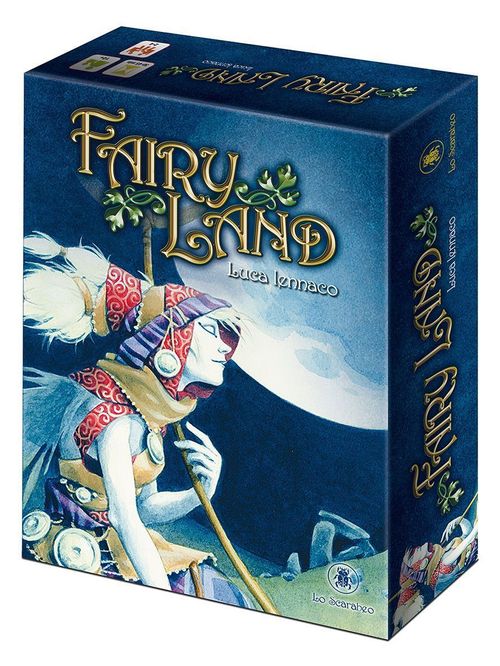
Fairy Land
Fairy Land Rulebook
Table of Contents
Table of Contents
Goal of the Game
To score the most points by collecting sets of cards.
Setup
- First, separate the cards into three groups (by the card backs): 32 House cards, 19 Queen's Court cards, 84 Forest cards.
- Divide the House cards by color. Give each player a set of 8 matching House cards (7 Fairies valued 1 to 7 plus a Fairy Crest). Keep your Fairy cards in hand, hidden from the other players, and place your Fairy Crest face up in front of you. If there are only 2 players, each player takes a second Fairy Crest card (of an unused color) and places it face up in front of him. Any leftover House cards are returned to the box (they will not be used during the game).
- Keep the box nearby. If any cards are discarded during the game, they are returned to the box. No player may examine the cards in the box at any time (including any discards).
- Randomly determine a starting player to take the first turn.
- Shuffle the Queen's Court cards and randomly pick 9 cards. Place these cards in a stack face down to form the Queen's Court deck. Return the rest of the Queen's Court cards to the box without looking at them (they will not be used during the game). Playing Hint: If this is your first game, we recommend that you use the 9 Queen's Court cards marked with a small star in the upper right corner instead of drawing them randomly.
- Shuffle the Forest cards. Take the top 9 cards and place them in a stack face down to form the Druid deck. Place the Druid deck near the Queen's Court deck.
- The rest of the Forest cards are placed face down nearby, forming the Forest deck.
- Turn over the top 3 cards of the Forest deck and place them face up in the middle of the table, clearly apart from each other. These are the 3 "Clearings" of the forest. Important: During the game, there will always be exactly 3 Clearings. A Clearing may be empty (with no cards in it), but the Clearing is still there.
What is in the Forest?
The Forest deck includes:
- 35 Animals (collect them to score points)
- 25 Flowers (collect them to score points)
- 6 Fairies (get them to have more options)
- 14 Goblins (avoid them if possible)
- 3 Ogres (avoid them if possible)
- 1 Item (may score points if combined with a special item from the Queen's Court)
For a detailed explanation of each kind of Forest card, see "Forest Cards Explained" at the end of these rules.
The Polyglot Queen
There are two sets of Queen's Court cards, each with text in a different language. You should simply ignore the cards in the language you are not using (return them to the box). Only use 1 copy of each Item in the game (each Item is unique).
The Queen has also kindly provided you with player aids in 2 languages, which you may use to help you during the game (use either one you can understand!).
How to Play
The starting player takes his turn, followed by the player to his left and so on.
Your turn is divided into 3 phases. You must complete all 3 phases in the order below:
- Dawn (something new appears in the Clearings)
- Day (you get to take 1 action)
- Sunset (overcrowded clearings are emptied)
During the game, you will gather face up cards in front of you, including Fairy cards from your hand and cards you collect. You should separate these cards by type (partly overlapping to save space if needed) so all players can easily see the cards in play. All face up cards may be examined by any player at any time. Face down cards may not be examined, but the number of cards in each deck and player's hand may be counted.
Phase 1 - Dawn
Draw the top 2 cards from the Forest deck and place them face up in 2 different Clearings (you may never place both cards in the same clearing). You may add these cards to any Clearing you wish, unless they are "evil creatures" (Goblins or Ogres). These creatures do not like their own kind, so they must be placed in the Clearings that currently host the fewest evil creatures. If there is a tie for the fewest evil creatures, you may choose which Clearing to add to.
Example: The first clearing has 1 Racoon, the second 2 Flowers, and the third has a Flower and a Goblin. Puck turns over a Deer and an Ogre. The Ogre can only go in one of the first two clearings, because the third Clearing has the most evil creatures (the Goblin). The Deer can go in any clearing, except the one that the Ogre is placed in (since the 2 cards drawn must go to different Clearings). Puck decides to put the Ogre in the clearing with the Racoon, and adds the Deer to the one with 2 Flowers.
Important: if you draw 2 "evil creatures", you must place them in different clearings, even if that means that you have to place one of them in a clearing that does not have the fewest evil creatures.
Phase 2 - Day
You must choose one of the following actions:
- Explore 1 Clearing
- Ask for an audience with the Queen
- Visit the Druids
- Use 1 Item
Explore 1 Clearing
Choose 1 of the 3 Clearings to explore.
The player to your left must now bid Fairies from his hand for the right to explore the Clearing (minimum 1) or say that he will not explore it ("pass").
The other players, in order, must either offer up more valuable Fairies or pass. Each player gets one chance to bid on the clearing. When it is your turn, you get to bid Fairies last. You may never bid more Fairies than you have available (including cards in your hand and any bonuses from items).
Note: When you bid Fairies, you bid the total value of Fairy cards, not the total number of cards.
The player who offered the highest value of Fairies gets to explore the clearing. You must play cards from your hand face up in front of you with a combined value equal to or greater than the amount that you bid (adding their values together). You may use any combination of cards from your hand. Then, take all of the cards in that Clearing and place them face up in front of you also (exception: special Fairies are added to your hand, while Ogres are immediately discarded - see "Forest Cards Explained").
Example: After each player has had a chance to bid, Puck had the highest offer with "7". He plays his "3" and "4" Fairy cards from his hand face up in front of him, and takes all of the cards from the Clearing.
Only the player that actually explores the Clearing plays any Fairy cards.
If all players choose not to explore the Clearing, all the cards from that Clearing are discarded from the game.
Ask for an audience with the Queen
The Queen of the Fairies will help those who gain an audience. To gain an audience, play any number of Fairy cards from your hand face up in front of you. Add together the value of the Fairy cards you play. Then, draw a number of cards from the top of the Queen's Court deck equal to one less than the total value of the Fairy cards played. Examine the cards (without showing them to the other players), then choose one card to place face up in front of you. Any other cards you examined are returned to the bottom of the Queen's Court deck, in any order you choose.
Each Queen's Court card is an Item that gives you a special ability. Some Items say "Permanent". The effect of these cards applies for the rest of the game. Other cards say "Usable" and can be used only once (see "Use 1 Item").
If the value of the cards you played is higher than the cards left in the Queen's Court deck, you get to examine all of them but you still only pick 1 card to take.
If the palace is empty (no more cards in the deck), you cannot choose this action on your turn.
Visit the Druids
Play any number of Fairy cards from your hand face up in front of you. Add together the value of the Fairy cards you play. Then, draw a number of cards from the top of the Druid deck equal to one less than the total value of the Fairy cards played. Examine the cards (without showing them to the other players), then choose one card to place face up in front of you. Any other cards you examined are returned to the bottom of the Druid deck, in any order you choose.
Cards you receive from the Druids are treated the same as cards gained by exploring a Clearing (see "Forest Cards Explained").
If you gain a Fairy card, you must show it to the other players, then add it to your hand. If it is an Ogre, you must immediately apply the effects.
If the value of the cards you played is higher than the cards left in the Druid deck, you get to examine all of them but you still only pick 1 card to take.
If all of the Druids have been visited (no more cards in the deck), you cannot choose this action on your turn.
Use 1 Item
You may play your Fairy Crest (given to you during setup) or any Item you received from the Queen's Court that is marked "Usable". Follow the instructions on the card, then discard it from the game. This counts as your action for the turn.
Phase 3 - Sunset
All Clearings that have 6 cards in them are emptied. Those cards are discarded from the game.
End of the Game
When the Forest deck runs out of cards, the King returns. Continue playing until the end of the current turn, then the game ends.
Each player adds up his final score. The player with the highest total points is the winner!
If there is a tie, the tied players add up the value of all the Fairy cards still in their hands and the player with the highest total wins. If they are still tied, the tied player who played last wins!
Scoring
You score points for the following:
Animals: The player who has the most of each kind of animal scores points based on the type of animal:
| Majority of... | Squirrels | Foxes | Racoons | Deer | Bears | Unicorns | Turtles |
|---|---|---|---|---|---|---|---|
| Points | 10 | 8 | 6 | 4 | 2 | 1 | 4 (7) |
If 2 players tie for the most, they each score half the points. If 3 or 4 players tie, no one gets any points for that type of animal. Special: If you have exactly 3 Turtles, you get 3 bonus points (for a total of 7).
Flowers: You score points for each color of flower that you collect more than 1 of:
| Number of Matching flowers | 2 | 3 | 4 | 5 |
|---|---|---|---|---|
| Points | 2 | 5 | 10 | 15 |
Variety Bonus: In addition, you score points based on the number of different flowers you collect:
| Flowers of Different Colors | 0 | 1 | 2 | 3 | 4 | 5 |
|---|---|---|---|---|---|---|
| Points | -5 | 1 | 3 | 6 | 10 | 15 |
Goblins: The player who collects the most Goblins loses 2 points for each Goblin he has. If there is a tie for the most Goblins, each tied player loses 1 point for each Goblin he has.
Items: Some items award points, as described on the card.
Fairies: The Fairies in your hand applaud the King, which amuses him. Each player adds together the value of all Fairy cards still in hand. The player with the highest total scores 3 points. If 2 players tie for the highest total, they each score 2 points. If 3 players tie for the highest total, they each score 1 point. If 4 players tie for the highest total, no one gets any points for their Fairies.
Example: At the end of a 3 player game, Puck has 4 Squirrels, while Oberon has 3 and Morgana has 1. Puck scores 10 points for having the most Squirrels. He has 3 Foxes, but Morgana has 4, so he gets no points for Foxes. He has 2 Raccoons, which is tied with Oberon. They each get 3 points for sharing the Racoons. He has 1 Deer, but so do Oberon and Morgana. Since it is a 3-way tie, nobody gets any points for Deer.
He has no Bears, Unicorns, or Turtles, so he gets no points for those Animals.
Puck has collected 8 Flowers: 3 yellow, 2 white, 2 violet, and 1 pink. He gets 5 points for the yellow flowers, and 2 points each for the white and violet ones. He gets 10 points for variety (4 colors).
Sadly, Puck also has 3 Goblins, which is more than Oberon or Morgana. He loses 6 points (2 per Goblin).
Puck has no Items that score points.
The Fairies in Puck's hand have a total value of 7. Oberon has Fairies worth 9, and Morgana has Fairies worth 3. Since Oberon has more, Puck gets no points for his Fairy cards.
Puck's final score is 26: 10 (Squirrels) + 3 (Racoons) + 9 (Flowers) + 10 (Variety) - 6 (Goblins).
Forest Cards Explained
Animals are collected to score points at the end of the game. The number on each card shows the number of copies of that card in the Forest deck as well as the points you earn if you have the most of that animal. The Turtles award 3 bonus points if you have exactly three of them (7 points total).
Flowers are collected to score points at the end of the game.
Goblins are an evil creature that should be avoided. But, only the player who ends up with the most Goblins will lose points. The symbol on the Goblin card is a reminder that it could be worth negative 2 points.
Ogres are clumsy evil creatures that will scare animals and carelessly trample flowers. They often do quite a bit of damage before the Fairies can chase them away. If you get an Ogre, you must immediately discard it along with 2 Animal or Flower cards that you own (2 Animals, 2 Flowers, or 1 of each). You may discard cards gained from the clearing that you just explored. Goblins, Fairies, and Items cannot be discarded to satisfy an Ogre.
If you have only 1 Flower and no Animals or 1 Animal and no Flowers, you must discard it, but there is no other penalty. If you have no Animals or Flowers, nothing happens. Either way, the Ogre is still discarded.
The Royal Pendant was a gift from the King to the Queen, but it broke while the Queen was away from the palace. The Queen retains one half, but the other half was lost somewhere in the forest...
Note: The Retained Half of the Royal Pendant will not always be in the game! You should remember this when you decide how valuable the Lost Half is.
Fairies can be gained when you successfully explore a Clearing or when you visit the Druids. These cards are added to your hand and may be used just like your House card Fairies. Like other Fairies, they are returned to your hand when you use your Fairy Crest, and count towards your applause for the King at the end of the game.
Each of these Fairies has a special ability that you may use when you play them:
- Warrior Fairy: She has a value of 1, but if you use her to explore a Clearing, you may discard all Ogres and Goblins in that Clearing and ignore their effects.
- Explorer Fairy: If you use her to explore a Clearing, she has a value equal to the number of cards in that Clearing. Otherwise, she is worth 1.
- Fairy of the Fauna: If you use her to explore a Clearing with at least 2 Animals, she has a value of 3. Otherwise, she is worth 1.
- Fairy of the Flora: If you use her to explore a Clearing with at least 2 Flowers, she has a value of 4. Otherwise, she is worth 1.
- Herald Fairy: If you use her to ask for an audience with the Queen or visit the Druids, she has a value of 5. Otherwise, she is worth 1.
- Fairy of the Wind: She has a value of 1, but if you have 3 or less cards in your hand after you play her, you may immediately take her back into your hand to use again.