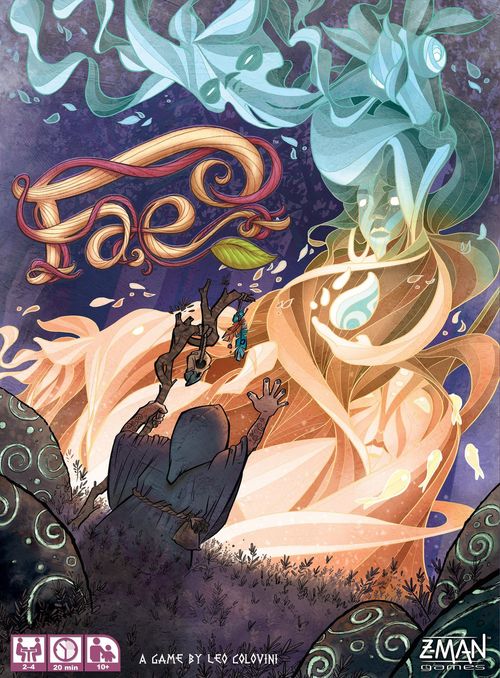
Fae
Fae Rulebook
Table of Contents
Table of Contents
Components
- 1 Game Board
- 60 Druids (5 Colors, 12 of each)
- 5 Scoring Markers
- 12 Ritual Cards
- 5 Spirit Cards
Key Concepts
Spaces and Regions
The game board is divided into 60 spaces and 12 regions. A space consists of a single terrain type (shown by its illustration and color). A group of five spaces forms a region, which is separated from other regions by water (a combination of rivers and lakes).
During the game, players move druids between these spaces, isolating groups of druids to score points.
Hidden Identities
During setup, you are dealt a spirit card whose color matches one of the druid and scoring marker colors. Your color is known only to you until it is revealed at the end of the game.
During the game, scoring occurs anonymously by color. When points are scored, any player can physically move any of the scoring markers, but you will not know who benefited from those points (other than yourself).
All five colors are present in every game; one or more of the colors is not dealt to any player. These "neutral colors" can still score points.
As the game progresses, by paying careful attention to what the other players do on their turns, you might gain insight into which color they have and use that to your advantage.
Setup
-
Place the game board in the middle of the table. Place all scoring markers (regardless of the number of players) on the starting space of the scoring track, located in the top-left corner of the board.
-
Randomly place all 60 druids on the board. Each space must have only one druid in it, and each region must have exactly one druid of each color in its five spaces. Note that druid colors are not tied to terrain type.
-
Shuffle the five spirit cards and deal one facedown to each player. Return any undealt spirit cards to the box without looking at them.
Each player secretly looks at his or her card without showing it to any other player; the front of the card shows that player's influence color and spirit.
-
Sort the ritual cards into piles by the value shown on the front of each card. Place these piles near the board, from left to right, in ascending order from "1" to "5" (x4, x3, x2, x2, x1).
Playing the Game
In Fae, you move druids around the board into spaces containing other druids. When one or more druids are surrounded by empty spaces, a ritual is initiated, and certain colors might score points.
Player Turns
The game is played over a series of turns starting with the oldest player at the table and proceeding clockwise. During your turn, you choose a space containing one or more druids and move all of those druids into an adjacent space also containing one or more druids.
Moving Druids
There are a few rules to keep in mind when moving druids:
- You must move all of the druids out of the chosen space.
- The space you move the druids out of and the space you move them into can contain any combination of druid colors, including or not including your own.
- You cannot move druids into an empty space.
- If a space contains seven or more druids, you cannot move the druids out of that space (but you can still move other druids into it).
- You can move druids across rivers, but not across lakes.
After you move druids, if a space containing one or more druids becomes isolated (all of its adjacent spaces contain no other druids), a ritual occurs.
A player moves druids. The newly formed group of druids is now isolated, initiating a ritual.
Note that it is possible for a single move to isolate multiple spaces with druids. If this happens, you resolve all rituals one at a time in the order of your choice.
Rituals
When you isolate one or more druids and initiate a ritual, take the top ritual card of the leftmost pile. Ritual cards represent the ever-changing flow of magic within the realm, shown by the two terrain types on each card.
The top of the card shows blessed terrain, which increases the number of points scored for the ritual by the value shown on the card. The bottom of the card shows cursed terrain, which is one way that a ritual can be disrupted.
Ritual Card — top: Blessed Terrain / Increased Ritual Value; bottom: Cursed Terrain.
To resolve a ritual, first check to see if the ritual is disrupted, then score it.
Disruption
A disruption in the ritual causes druids in the ritual space to vanish, which reduces how many points the ritual is worth.
There are two ways that disruption can occur:
-
If a ritual occurs on cursed terrain, return all of the druids on that space to the box. No colors score any points for this ritual.
The ritual occurs on cursed terrain, so all druids are removed.
-
If all five colors are present, return any lone druids of each color to the box.
Scoring
After resolving disruption (and removing druids), players check the ritual's final value. Each remaining druid (regardless of color) in the ritual space is worth one point. If the ritual occurs on blessed terrain, the ritual is worth additional points as shown on the card.
After checking the ritual's final value, advance each of the scoring markers matching the druid colors in the ritual by that value. All of those colors score the same amount regardless of how many druids of each color were present for the ritual.
Scoring Example 1: There are 4 druids in the ritual, which does not occur on blessed terrain. Blue and red each score 4 points. (Ritual card value "3", terrain not blessed.)
Scoring Example 2: There are 5 druids in the ritual, which occurs on blessed terrain (value "4"). Blue, yellow, purple, and black each score (5 + 4 =) 9 points.
After scoring a ritual (even if it was disrupted), the player who initiated the ritual keeps the ritual card facedown in front of him or her. At the end of the game, each ritual card a player has is worth one point.
Note that the final ritual card (value "5") has no cursed terrain. Instead, all terrain types are blessed for that final ritual.
End of the Game
There are two ways that the game can end:
- The 12th ritual (the last card) has been resolved.
- A player cannot take his or her turn (i.e., no druid moves are possible).
When the game ends, players reveal their spirit cards. Then, each player counts the number of ritual cards he or she has, scoring one point in his or her color for each.
Then, players compare scores. The player with the most points wins! If there is a tie, the tied player with the fewest ritual cards wins. If there is still a tie, those tied players share the victory.