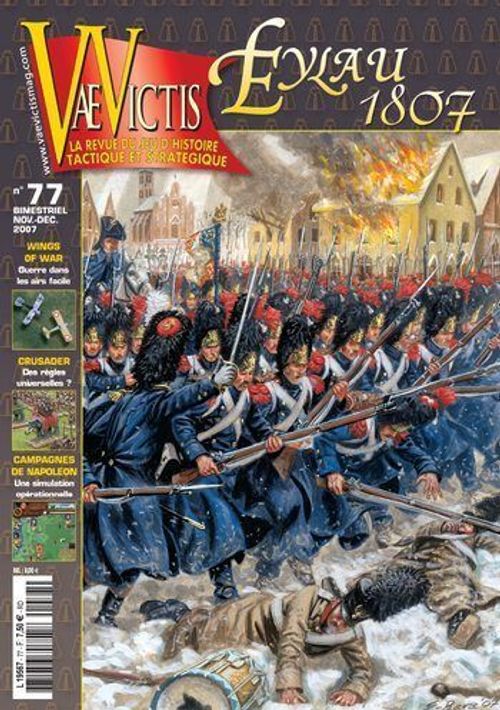
Eylau 1807
Eylau 1807 Rulebook
Table of Contents
Table of Contents
0.1 - Scale
Each turn covers 1 h 45 of real time. The scale of the map is of the order of 500 meters per hex.
0.2 – The Map
Only the numbered hexes are playable.
0.3 – The Units of Combat
Note: The fire values of the artillery have been lowered in comparison to other games in the series because of the weather which was particularly bad on the day of the battle.
The French artillery units have the name of their division commander (exception: "Parc", for the French reserve artillery park of each corps).
The Russo-Prussian artillery units have either the name of the grand battery to which they were attached (ex: Grande Batterie Centre), or the name of their commander (ex: Revzoï). The Prussian artillery units have the name of the battery (ex: Bredow).
All horse artillery units are indicated by having the head of a horse on the counter.
The term PF refers to the strength points of the unit, located on the bottom left of the counter.
Abbreviations for the French:
The Corps numbers use Roman numerals (ex. III), the division numbers use Arabic numerals (ex: 1-III). RC stands for Cavalry Reserve.
Abbreviations for the Russo-Prussians:
AD = Right wing, C = Center, AG = Left wing, R = Reserve, GBD = Grand battery of the right, GBC = Grand battery of the center and GBG = Grand battery of the left. The divisions are indicated in Arabic numerals (ex.: 5e).
Cavalry Brigades: T = Tschaplitz and K = Korpf.
Infantry Brigades: B = Barclay
2.1.1 Standard Activation Markers (MA)
Exception: The following three Russian formations, the Grand Battery of the Left, the Grand Battery of the Center and the Grand Battery of the Right have only a single activation marker (MA) each.
2.1.2 Combined Activation Markers (MAC)
Each of the following MAC counters may be used only once per scenario and only when it is listed as being available. Just place the MAC counter in the MA cup in phase C during the turn you wish to use it OR when it is indicated by the scenario. It is removed from the game at the end of the turn, even if it is the last counter in the cup (see 2.2) and is therefore not used.
- Grande Charge: When this MAC is pulled from the cup, the French player, places it on the map in a hex of his choice (even if it is occupied by friendly or enemy units). He may activate all French cavalry units that are under Orders Received markers and that are within 5 hexes (include, in counting the 5 hexes, the hex where the MAC is located);
- Ney: When this maker is pulled, the French player may activate 4 units in NEY's formation of his choice;
- La victoire avant tout ! (Victory is before us): When this MAC is pulled from the cup, the French player may activate up to 5 cavalry units of his choice, even if they are in different formations, under the condition that they make an immediate attack (either shock or charge);
- Grande Batterie (2): When this MAC is pulled from the cup, the Russian player can activate two of the three GRAND BATTERIES (LEFT, CENTER or RIGHT), as if an MA of each of the batteries had been pulled.
- Lestocq: This MAC cannot be placed in the cup by the Russo-Prussian, until LESTOCQ's formation, has entered the map on a previous turn. When the MAC is pulled, the Russo-Prussian player is able to activate 4 units of his choice in LESTOCQ's formation.
For all MACs, the units chosen for the additional activation may have already have been activated once or twice without any detriment. The exception is the MAC for the Grande Charge, that permits an activation only by units under Orders Received. (see above), and those that are under No Orders Received which the player wishes to try and activate. Whether a unit is under Orders Received or No Orders Received is determined the moment the MAC is pulled. If any of the units are under No Orders Received., the player must try to place them under Orders Received. by using the initiative value of the MAC. This in effect is the initiative test for that unit. If it fails the test, the unit can do nothing.
The two following MACs are placed in the cup during phase C of each turn of the game.
-
Tempête de neige (2) (Snow Storm): When a "Tempête de neige" MAC is drawn from the cup, the player corresponding to the flag on the back of the MAC throws a d10. If the result is 1 or 2, he then places the marker in a hex of his choice on the map (even if it is occupied by one or more units, either friendly or enemy). The player can then change the facing of any enemy units situated within 2 hexes of the marker (in counting the number of hexes, include the one with the MAC), up to a maximum number of hex-sides, determined by rolling a d10 divided by 3 and rounding up.
Example: The MAC "Tempête de neige", with a Russian flag on the back, is drawn from the cup. The Russian player throws a d10 and gets a 2 as the result. He then is able to place the MAC on the map. He then throws a second d10. The result obtained is an 8; 8/3=2,66, which is rounded up to 3. The Russian player can then change by up to 3 hex-sides maximum, the facing of all the French units situated within a 2 hex radius. The 2 hex radius' includes the hex where the MAC is located.
2.2 – Utilisation of the MA
Exception: For the first turn of each of the scenarios, the 3 MA of the three formations GRAND BATTERY of the LEFT, GRAND BATTERY of the CENTER and GRAND BATTERY of the RIGHT are not placed in the cup during phase C of the game turn. In phase D, the turn commences by the use of these three MA, in any order desired by the Russian player, before the use of the MA determined during the strategic initiative phase, be it either French or Russian.
2.3.2 Distribution of Orders
Exception: Bennigsen, who has 4 orders, must spend at least one each turn on one of the three "Grand Battery" formations. If cannot use it for a Grand Battery, the order is lost.
5.1.1 Stacking Constraints
There are two exceptions to the normal stacking rules in Eylau 1807:
- It is possible to stack one artillery piece above the normal limit, providing the total number of artillery in the hex does not exceed 7 PF. It is therefore possible to stack 2 artillery counters with 2 infantry counters, 2 artillery counters with one cavalry counter or 3 artillery counters alone, under the condition that they do not exceed 7 PF of artillery in the hex. (Exception: the limit of 7 PF is ignored if the 2 or 3 artillery counters are attached to a single and unique formation of one of the three grand batteries);
- It is not possible to have more than 20 PF of infantry stacked in the same hex.
Note: If the rally of a disorganized infantry unit will cause the stack to exceed 20 PF, the unit may not be rallied (first the unit would need to be moved out of the stack).
12.1 Night
Important Point: The 1, 8, 9 and 10 turns of the game are considered Night turns (with all the effects described in the rules).
During phase C. of game turn n° 8, the French player and the Russian player must each select 2 MA (not MAC) of their side, amongst the ones available, and leave them out of the cup. The 2 MA are not available during the turn.
During phase C. of game turn n° 9 and 10, the French player and the Russian player must each select 3 MA (not MAC) of their side, amongst the ones available, and leave them out of the cup. The 3 MA are not available during the turn.
Terrain Effects Table
- The château (hex. 1112) and the cemetery of Eylau (hex. 1213) are purely decorative, they have no effect on the game;
- Streams and Frozen Ponds: The frozen ponds that form the hex-side borders. (Ex: between 2211 and 2212) are simulated with the same effects as a stream for game purposes. Only the frozen pond situated in hex 1115 is sufficiently big enough to be considered as a real frozen pond on the Terrain Effects Table;
- Difficult Terrain: those hexes that correspond in Eylau to the hexes of frozen marsh. All the effect of terrain "difficult/rough/vines/dry lake" are applicable, except for note "[e]: Charge movement and cavalry charge are not allowed into or across this type of hex or hex-side terrain." which is ignored. Squares are also allowed in these difficult terrain hexes, as if they were clear terrain (exception to 4.2).
Scenarios
See Vae Victis #77.