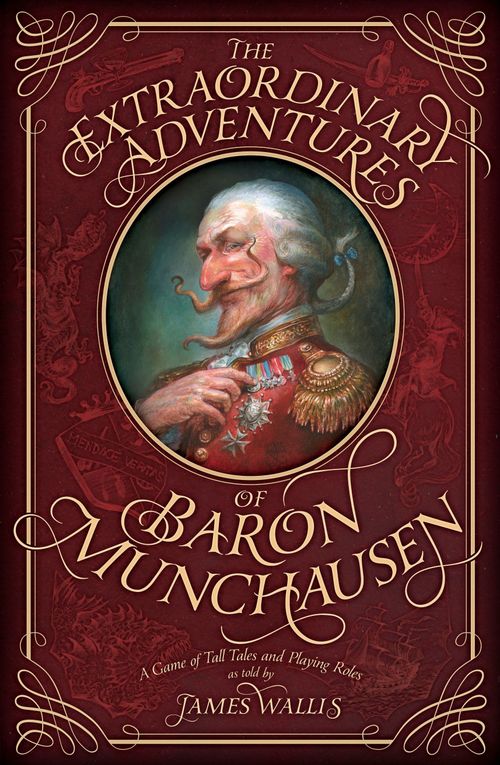
The Extraordinary Adventures of Baron Munchausen
The Extraordinary Adventures of Baron Munchausen Rulebook
Table of Contents
Table of Contents
- Preface
- Introduction
- The Play of the Game
- Equipment
- Starting the Game
- Character Generation
- Beginning the Play
- If the Story-Teller Should Pull Up
- Objections & Wagers
- Objections & Wagers, continued
- On Being Noble
- Companions
- Duelling
- Duelling for Cowards
- The Result of a Duel
- Finishing a Story
- Determining a Winner
- Ending the Game
- A Word on Tactics
- Setting
- Appendix One: Story Subjects
- Appendix Two: The Rules in Brief
Preface
The name of Baron Munchausen is one which scarcely needs any introduction at any level of society: all England — nay, all the world — has resounded to the telling and re-telling of the stories of his adventures and deeds of great heroism. Some regard his tales as exaggerations or as boasts; some see them as fables or metaphors; but there are some still who believe them to be nothing less than the unvarnished truth, and I number myself among that company.
It was my great fortune to meet the Baron a handful of years before his untimely death, in the port of Dover. He had, he claimed, ridden over from France on the back of a sea-horse in order to visit Lord K—, whom a few years previously he had saved from a sudden death at the rim of the volcano Ætna during a military campaign against the fire-sprites which had recently laid waste to so much of Italy. (The Baron contended that it was these sprites, and not the barbarian hordes, which had caused the fall of the Roman Empire). He professed to a great love of our capital city and an unfortunate shortage of capital wealth, and accordingly I suggested to him that after he had visited the noble lord, he should spend a few days in London to enjoy the hospitality of my brother and myself, and where he could create a new game for us, based on his famous travels and adventures.
It had been the Baron's scheme to proceed from Lord K—'s estate in H—shire to Scotland, where he proposed to harness a carriage to a flock of golden eagles and fly them to the Sun, as a gift for his friend the King of that sphere. However, he agreed to honour us with his presence in London, and duly arrived with us a few weeks later, where we began to essay the creation of his game.
Perhaps it was my fault for an excess of zeal at the prospect of publishing the design of so august a nobleman; or perhaps it was a mistake to leave him under the sole editorship of my son Edward, who had of late been spending much time visiting gin-shops and dens of ill-repute in the company of younger designers of games from the Americas. Whatever the problem, and whereinsoever lay the blame, the manuscript which the two of them produced had, I discovered soon after the Baron's departure, captured altogether too much of the Baron's style as a raconteur and bon viveur, and little of the rigour which must inform great designs, such as Edward can produce when not under the influence of foreigners and other undesirables. (I recommend his game An Arithmetical Pastime, published this year, as a fine example of his work. He is not a bad lad.) A game of such a radical type would, I know, have no success in the London of the eighteenth century nor, I believe, of the nineteenth century neither.
It is therefore my intention to seal this valuable — and, I should add, expensive; the Baron being a man accustomed to the grandest living, and the finest wines and liqueurs, of which he completely emptied my cellar — manuscript, together with this letter, in a place wherein one of my descendants may find it and, recognising that the fashion in games has changed sufficiently for a curiosity such as this to find its audience at last, may publish it to the acclaim it deserves.
John Wallis, publisher of games of quality No. 42 Skinner Street, Snow Hill, London this year 1798.
What he said.
James Wallis, director of Hogshead Publishing Ltd June, 1998.
Introduction
In which the Baron explains the reasons for his game
As I am a man who is known as much for his scrupulous honesty in the telling of his tales as for my amazing adventures around, across and in some cases through the circumference of the globe, I am constantly asked by my friends why I should wish to put my name — an old and most distinguished name: according to my family records there was a Munchausen stowed away upon the Ark — to a game for the telling of extraordinary tales and unlikely anecdotes.
My answer is simple. My reputation, and with it the retelling of several of my astounding adventures, have spread throughout the civilised world, across oceans, to deepest Afrique and farthest Nippon, to the twin worlds of the Sun and the Moon and the strange peoples who live there, and even into France. Therefore, wherever I travel I find myself constantly prevailed upon to tell once again the tale of how my companions and I were swallowed by a whale, or how I rode a cannonball through the sky over Constantinople. And often I am rewarded with nothing but a small glass of the roughest brandy, or even nothing at all! Am I some story-teller to act for their amusement? No! I am a nobleman, a soldier and an adventurer, while they are ninnies and I will have naught more to do with them, or be damned.
With the publication of this game (which I here humbly dedicate to the two people most important in its writing: viz. myself and the Empress of Russia) I mean to provide those who would prevail upon me with the means to tell astounding stories to each other out of my presence. This, not solely a great boon to civilization and a source of minor income to myself — which reason, I assure my diligent readers, was hindmost in my mind during the composition of this work — will also mean that I am able to spend more time with those to whom my presence and charisma is more desirable: to wit, the ladies of the company. I believe that this may be the greatest innovation in game design since the Collectible Tarot Deck, which I invented while incarcerated in the Bastille on a spurious charge of importing quinces on a Sunday. But I digress.
I shall begin to describe the game presently, but first I must remind my readers of one important fact. This is a game of telling stories, and each of those stories will be based on the astounding adventures I have had — in their style, if not in their content. But, while the stories you tell are fictions, my adventures are all true in every detail. To say otherwise is to call me a liar, and to pretend your fancies happened to me is to call me a charlatan, and sirrah, if you do either I shall take you outside and give you such a show of swordsmanship that will dazzle you so greatly that you will be blinded by its sparks for a month. I am a nobleman, sir, and I am not to be trifled with.
Now pass the cognac. No, clockwise, you oaf.
The Play of the Game
My game is a simple one, based upon a ritual I observed in the tribes of the remote Amazon, which they practise while preparing food. I was able to study the ritual in some depth since I had undergone the misfortune of being captured and was indeed the food in preparation. The ritual is used to purify and entertain the food, and to dedicate it to their barbarous gods; and once I had escaped by convincing them I was in sooth one of those gods — ah, but I am meandering again.
The game is simple. The players sit around a table, preferably with a bottle of an interesting liqueur or a decent wine to moisten their throats, and each takes a turn to tell a story of an astonishing exploit or adventure. The telling of the tale is prompted by one of the others, and the rest of the company may interrupt with questions and observations, as they see fit, and which it is the job of the tale's teller to rebut or avoid. When all are done, he who has told the best story buys drinks for his companions and, the players being suitably fortified, the game may begin again.
I well remember one evening in a coaching-inn outside St. Petersburg, in the early spring of 17—. Myself and several other travellers, many of us adventurers and soldiers of great renown, were caught there by a sudden blizzard and forced to spend the night there. However, the inn had a startling lack of rooms. Having agreed firstly to allow the ladies of the company to retire to bed, the gentlemen agreed to a contest to see who would receive the remaining unoccupied rooms, and who would be forced to be bed down in the stables or — an even worse prospect — with the servants.
Accordingly we agreed to a contest or wager, and when it was discovered that none of the company had cards, dice, teetotums or backgammon board about them, we agreed to a contest of stories. Each member of the company took a turn at asking his neighbour to recount one of his most extraordinary adventures; and the others of us then tested the tale on the wheels of veracity, credibility and laudability. When all were done a vote was taken and I, by sheer cunning, came third — which position exiled me to a tiny attic garret, the location of which allowed me to sneak out when all were asleep and enjoy a most remarkable night warmed by the caresses of the Duke of Normandy's daughter, whose beauty and room I had noted before the game began. In truth, I tell you, it counts not whether you win or lose, but how you play the game.
This game itself follows in similar fashion, but without the presence of the noble Duke's aforementioned daughter. More's the pity.
Equipment
To play my game, you will require three or more stout friends, preferably of noble or at least gentle birth; a table; several chairs; a copious supply of drink, preferably with a charming wench to serve it; and some coins to serve as stakes and to pay the reckoning when all is done. If you have such things to hand, then some parchment, pens and ink, a cold night, a roaring fire and a good supply of food are also advised, and it is always provident to have a manservant or two in attendance. You will need naught else, save for a few trifles such as I shall set forth hereto.
Starting the Game
Gather the company and count its members. If it is late in the evening then ask a manservant or pot-boy to do it for you. Make sure that each player has a purse of coins before them equal to the total number of players — do not ask a servant to do this, servants being by nature a shifty and feckless lot who will as soon rob a man blind as help him out of a ditch, and I have been robbed in enough ditches to know. If your company numbers less than five, then give each man five coins. If it numbers more than twenty, then I advise you to pool your purses, hire some mercenaries and plan an invasion of Belgium.
The exact sort of coin you use is not important but I will make a few salient observations on the subject, drawn from my experiences of testing this game in the courts of the Orient where, despite the fact that I spoke none of their language and they none of mine, it played tolerably well. Firstly, all the coins should be of the same value, to save on arguments. Secondly, they need not actually be coins — I have played with coloured glass baubles in darkest Afrique, where the natives possess such things in abundance — they are given them by missionaries and, having eaten the missionaries, have no use for the beads. Thirdly, anyone who proposes playing with paper money — fit for nothing more than wiping one's a—e — is clearly no gentleman and should be drummed out of your company and your club forthwith.
If the company are not too drunk, tired or bored, then you should move to Character Generation. Otherwise you may omit it. Or simply omit it altogether.
Character Generation
My publisher claims that he has consulted with the greatest living authorities on such matters, and tells me that it is necessary for games such as mine to have a section of this ilk. I am hoping that these few lines will suffice, and that my publisher will have been so far in his cups last night that he will recognise the heading above and will not notice, his eyes still befuddled by cheap gin, that I have merely made a few pointed observations to my readers on the perils of dealing with such Grub Street types.
No. It is scarcely credible that a man who has drunk so much gin could form even one syllable, let alone the stream of foul oaths which are pouring forth from his blistered lips, but it seems that my game will be forced to include some words on character generation after all.
To the matter then. To essay the business of character generation you will require a piece of parchment and a pen — I assume that, having received a proper education, you are able to read and write; in Latin if not. If not, it is my experience that passing priests will often agree to perform this service for you. If no priest or clerk is handy, summon one. If one is not to be found, or you are unable to procure the services of one through pecuniary difficulties, say by having lost your fortune in an unwise bet on the growth of an asparagus-spear with the King of the Moon, then I advise you to pass this section without a second thought.
Write, or ask your companion to write, your name at the top of the paper, with the prefix 'Baron' — or 'Count', 'Lord', 'Duke' or whatsoever honorific is appropriate. If your company includes those of foreign extraction, you may instead wish to use a title such as 'Graaf', 'Don', 'Sultan', 'Sheikh', 'Amir' or, as I gather is the fashion in the Americas, 'Chief Executive Officer'. In this age of universal suffrage, now that they have finally won the right they have gainsaid for generations, we must not forget the frailer sex too: 'Baroness', 'Countess' and so forth are equally permissible. If you must.
If you were not born to such rank, since this is naught but a game, you may write whatever takes your fancy — but sirrah, I warn you that should I meet a man who claims to be of noble blood but who is not — and with my age, experience and prodigious nose, together with the art of scent-scrying as taught to me by an Esquimau in reward for saving him from a herd of walruses, I can smell them, sirrah, I can smell them — then I shall so dizzy him with my rapier that he will be unable to remember his own name and the direction he faces, much less the noble title he pretends to.
Underline your name. Nay, underline it again, for its importance is uttermost.
Below your name, add the place of your birth (and, I presume, your estate), and its country. Medals and other decorations are best left unrecorded at this stage.
Beneath this, write whatsoever takes your fancy. I have found it most useful for recording the calling-addresses and pedigree of any young ladies who catch my eye during the evening.
So much for character generation.
Beginning the Play
Once all the company have generated characters, or not — and I recommend not — then you are ready to commence the play of the game itself. The player to start is the member of the company with the highest rank in society (standard protocol applies: religious titles are always deemed greater than hereditary titles, and those higher than military titles; if of similar rank then compare subsidiary titles, number of estates or centuries that the title has been in the family; youth defers to age; when in doubt the highest military decoration takes seniority; and for the rest I refer you to the works of Messrs Debretts or Burkes).
If by some mischance of birth or the poor organisation of your host you are all commoners then the first player shall be he who was wise enough to purchase this game. If several have, then I thank them all; if none have then I worry if you possess sufficient altitude of attitude to play a game such as this, which relies on nobility, generosity of spirit and purse, and not being a miser. If this manner of beginning is not agreeable, then the player to start should be he who was last to refill the company's glasses.
However you do so, once the person to start has been determined, he must begin the game. To do that, he must turn to the person sitting at his right hand and ask him to tell the company the tale of one of his famous adventures. By way of example, therefore: "Dear Baron, entertain us with your recollections of the war of 17—, which you fought single-handed against the French and won," or: "Most honoured and noble prince, if you could refrain from the gracious compliments you are paying to my sister for a moment, mayhap you might satisfy my curiosity on the matter of how it was that you escaped from the prison of Akkra after you had been hanged there two days earlier?"
For those unable to think of a sufficiently extraordinary and humorous topic for a story, I have included in an appendix some two hundred of the subjects of my own exploits, a mere fraction of the total, which the less quick-witted player may use for inspiration. Whether you choose to use one of my examples or one of your own mind, remember at all times that the subject of the story to be told should only be revealed to the person who must tell it a few seconds before they start their narrative. Through this surprise, much good humour may be gained.
The player thus surprised must now recount the story — perhaps basing it on an adventure of his own, or creating it from the whole cloth of his imaginings. He may, however, pause for a moment of thought before commencing his tale by exclaiming, "Ah!" and then perhaps adding, "Yes!" Any further prevarication is unseemly. Throw a bread-roll at the fellow to hurry him along.
Tales should be short, of around five minutes, and told at a good pace without hesitation or undue pausings for thought. Inflections, gestures, mimes, props and strange voices may all be used, although the narrator is warned not to go too far: he is, after all, born to the aristocracy — or pretending to be so.
I well remember playing this game with the Grand Seignior of Turkey while he held me for ransom in Constantinople. For one story he hired a troupe of actors, a band of tumblers, conjurors and dancing girls, and six elephants. The tale lasted three days and four nights, and when the company did not elect it the best, preferring my own anecdote on how I discovered the seedless grape, he had us all beheaded . . . but enough of that for now.
If the Story-Teller Should Pull Up
If a player is unwilling to tell his story to the company, or falters in the recounting, then he may plead that his throat is too dry to tell the tale: and good manners demand that the company must let him retire honourably. However, good manners also demand that he must obtain a drink to wet his throat, and in doing so it would be greatly impolite not to furnish the rest of the company with refreshment also. In short, a player may decline to tell a story, but must stand each member of the company a drink if he does so.
Having so declined, and the drinks having been ordered, the player in question should turn to the player on their right hand and, as is the form, propose the subject of a tale for them to tell.
Objections & Wagers
For the benefit of my duller readers I should point out that this section on challenges and wagers is the cleverest part of my game — although due to the ridiculously rigid structure imposed on me by my diligent but perhaps over-strict publisher I must wait until later to explain exactly why this is the clever part.
The course of a narrative never shall run smooth, for the other players of the game may at any point interrupt the story-teller with a wager or an objection. This is accomplished by the player pushing forward one (and never more than one) of the coins before him — we shall call it the stake — and breaking into the flow of the tale. A wager would be cast in the manner of these examples:
"I'll wager, Baron, that beyond the door you mentioned was an entire dragoon of fusiliers waiting in ambush," or:
"I'll wager, Count, that the Empress was not impressed with your gift of two giraffes and ordered you out of her bedchamber immediately."
Objections, by contrast, are cast thus:
"But Count, it is well known that the Empress has a hatred of giraffes after her lap-dog was eaten by one"; or
"But Duchess, at the time of which you speak the Colossus of Rhodes had been a fallen ruin for fifty years, so you could not possibly have climbed it"; or any of a thousand thousand other possibilities.
If the interrupter's wager or objection is correct — in other words, if the teller of the story decides to build this detail into his anecdote — then he must agree with his fellow and may keep his coin. However, he must then perforce explain how the events introduced in his fellow's interruption did not impede him in the adventure he is describing.
If, however, the interruption is deemed incorrect — if the teller of the story does not wish to build the wager or objection into his story — then he may push his fellow's stake away along with a coin of his own, and inform the other that he is a dolt who clearly knows nothing of what he speaks and gets his information from the tittle-tattle of old maids in gin-houses. If the one who interrupted is not prepared to stand this insult to his honour, he may add another coin to the pile and return it to the story-teller, making his case for the wager more forcefully and returning the insult with interest. The story-teller may again turn the wager away with another coin and insult; and so on until one side withdraws his objection and accepts the insult (thus keeping the entire stake), or one party has exhausted his funds but will not stand down — in which case a duel must be fought. (See 'Duelling', a section I believe I shall enjoy writing.)
(The rulebook illustrates this exchange with an extended worked example: two nobles trading an increasingly elaborate tall tale, each topping the other's claim and raising the stake coin by coin, until one side's purse runs dry and the insult must be accepted. That example is omitted here as illustrative narrative rather than a rule; the mechanical procedure it demonstrates is the escalating-stake exchange described above — an objection is raised, the story-teller either builds it into the tale or pushes back with an extra coin and an insult, and this repeats, coin by coin, until one side withdraws or funds run out and a duel becomes the only recourse.)
Objections & Wagers, continued
As all those of truly noble blood are aware, there are a handful of wagers and objections that should never be made. Firstly, no listener may ask the question, "But my dear Baron, were you not killed?" It is palpably obvious to even the most slack-jawed nitwit that the story-teller has not been killed, for he is here telling the story, and if such an objection be made then the story-teller may pocket the objector's coin, and all the company stare at the dull chap with undisguised contempt. Throwing bread rolls may be called for; but setting dogs on such a fellow is generally thought uncouth.
Secondly, in the round of insults, no nobleman would ever insult another's breeding and pedigree, or his veracity, directly. In plain terms, you may not directly call another player a liar (although you may safely question his accuracy or remind him of facts he may have forgot), doubt his claim to noble rank, or insult his mother. Indeed I lie: you may do any of these things, but to do so is proof of your utter caddishness, and the person you have insulted is at liberty to challenge you at once to a duel (see "Duelling", below).
It may seem strange that if the wagerer loses his bet then he recovers his stake, or if he wins then his stake is lost. This is so, but when the wagerer makes his claim, he is in truth saying, "Ha, my fine fellow, here is a pretty tid-bit that I wager you cannot make a part of your story." It is therefore clear that, since money is the way that the game is won or lost, and making wagers is the only way that the money on the table may be moved around, a wagerer should essay to make wagers which he can win — that is to say, which the story-teller cannot build into his tale, and must turn away. Meanwhile a great story-teller will construct a tale so that it invites the greatest possible number of wagers, which the teller has with great cunning already anticipated.
On Being Noble
To play the game, each player must pretend to be nobly born and, in telling the story of an adventure he claims to have had, must portray himself and his actions as noble in thought and deed. No nobleman has any truck with magic, on the grounds that it does not exist — a story's wonders are grand deeds, exaggerations and coincidences, never literal sorcery.
Companions
Companions are the men and women who accompany a nobleman and help him in his adventures. Should a story require a person of great ability to help the teller out of a scrape, the player may introduce such a companion as he wishes. However, a story should not draw on the services of more than one companion, as to do so would be considered greedy. Companions are not the same as servants.
Duelling
If, in the course of an objection or a wager, a player insults another's veracity, title or pedigree, the injured party has the right — nay, the obligation — to challenge his insulter to a duel. This causes an interruption in the normal flow of the game's stories, but so be it: where the honour of a nobleman is concerned, everything else must stand aside while he defends himself.
The rule for fighting a duel is simplicity itself. Once the insult has been made and the injured party has issued the challenge, the two duellists must choose friends or companions to be their seconds, agree on a weapon (rapiers are traditional and come easily to hand at most gatherings of the genteel, though pistols have become popular in some quarters of late), and then go outside to a convenient courtyard or colonnade to fight. The duel need only progress until first blood or incapacitation, as this is naught but a friendly disagreement, though duels have been fought to dismemberment or death over matters as slight as a carelessly split infinitive.
Duelling for Cowards
A player who is unwilling to fight a duel "in the proper fashion" — whether from squeamishness, a wish to finish the game quickly, or the presence of ladies who would be shocked at the sight of blood — may instead resolve a challenge with a simpler contest devised for that purpose.
Knife-Stone-Paper is the game. On a count of three, each duellist forms his hand into the shape of a blade, a stone, or a piece of paper. Knife beats paper (it cuts it); paper beats stone (it wraps it); and stone beats knife (it blunts it). The faint-hearted duellists play three hands of it, discounting draws, and whoever wins two or more hands is declared the victor.
The Result of a Duel
The results of a duel can be deadly, even for those who lack the taste for it in the proper fashion. Assuming that both parties are still alive, the upshot of a duel is as follows: the loser must make over his entire purse to the victor, and must retire from the game. If one of the two parties has lost his life in the conflict, then his second should carry out these instructions in his place. However, his bounty — if he has any — remains untouched.
A final word on duelling: it is considered unsporting to provoke a duel or issue a challenge once all the stories are finished and the bounty is being dispensed and received.
Finishing a Story
A good tale should last no more than five minutes. The story-teller should bring his tale to its natural conclusion at the proper length and in a way that brings the greatest enjoyment and astonishment to his listeners. At this point the audience should respond with a few hearty "Huzzah!"s and exclamations of "By my oath, Baron, that is the most remarkable story I have ever heard, and I drink to it. More wine!"
If a story-teller finishes his tale and there is none to cry "Huzzah!" — because the company are all asleep or otherwise occupied — then he should signify to the company that he has come to an end by standing and loudly proclaiming: "That is my story, true in every word, and if any man doubts it I'll make him drink a barrel of brandy in a single swallow." This serves as a signal to the company, by its volume if not by its words, that they should rouse themselves and muster a few token "Huzzah!"s to tell the story-teller that they have understood his tale is over.
However a tale ends, once the usual toasts have been drunk (to the story, the story-teller, the host, the monarch, the most attractive woman present, the most attractive woman in the story, absent friends, et cetera), the one who has just finished his narration must turn to the person sitting at his right hand and, as at the start of the game, say, "So, Baron, tell us the story of . . ." describing a suitable adventure — whether from the appendix, from his own experiences, or from his imagination. The person thus addressed should pick up the tale and proceed as described above, with the other players preparing wagers, interruptions and duels as before to put off the stride of his description.
If a story-teller becomes so wrapped up in his narrative that the company has lost interest and has drifted off into some other diversion, then any of his fellows may interrupt at a suitable juncture with the words, "That reminds me of the story I heard told of Baron N—M— (naming the player sitting to the right of the present story-teller), in which he . . ." and names an adventure, putting forward one coin as he does so. If others of the company agree, they should add coins of their own; and if fully half the company is in agreement that the mantle of story-teller should pass, then Baron N—M— commences the tale of the new adventure. The previous story-teller, overcome by shame and disgrace, may add his own money to his purse by way of recompense. If fewer than half the company pledge coins to the cause, the accumulation is given to the pot-boy to pay for more wine.
Determining a Winner
When all are done with their stories, count up the coins you have left in your purse. These become the tokens with which each player shall decide whose story is the finest, the most outstanding, the most memorable, and the most heroic. In common parlance, you shall each vote for a winner.
Commencing with the person who began the game, and in rotation and in turn, each player must take his stack of coins and, with words such as, "Gentlemen, I have never heard such a surprising collection of stories, but upon my honour the tale of Baron — is the most astonishing tale I have encountered in my life," place his entire purse in front of the fellow whose story he has just named. It must be all of his coins; it does not befit a gentleman to split his bets or spread his favours too widely. Nor should the recipient add the coins to his own purse; simply leave them where they lie. These are called the player's "bounty."
Once every player has said his piece and distributed his bounty (no true nobleman would even consider the idea of voting for himself), then each player should count out the number of coins cast for him and his story.
In the final round of the game, if your company has admitted women to the play, it is not recommended that you vote for your paramour, or for the member of the company who has taken your fancy. This rarely leads to success, and your fellows will notice and make fun of your noble gesture for some weeks.
Ending the Game
The player with the greatest bounty is declared to have won the game. All give a rousing "Huzzah!" and more wine is ordered to drink to the health of the victor. It is accepted as a point of etiquette that the victor shall pay for this wine, even though the money accumulated as bounty may not — nay, is never — sufficient to cover the cost.
At this point the game is over. Should the majority of the company wish, and not be so out of pocket or in its cups that it cannot continue, another round of the game may be played. The victor of the previous round — being the person who has most recently recharged the company's glasses — shall commence the play.
A Word on Tactics
There are two ways to play this game. Firstly, one may play with ultimate strategy and guile, in order to relieve as many of the company of as much of their wealth as is strategically possible, to amass the greatest stake. Secondly, one may tell the finest story one is able. Naturally all players should aim to tell the finest story, for that is the only way that they may win the contest. If you play strategically so that you gain the greatest stake, it is practically definite that you will lose the game — partly because your stake must be given to someone else, and partly because you will have aroused such enmity in the company that none of them will cast their vote for you. Yet by this tactic you can give yourself the honour of being the one who shall decide which player wins the game.
Although it is poor play to empty your purse before the end of the game, it is worse play to spend it all before you have your turn at story-telling. Without coins you cannot interrupt a comrade, rebut interruptions to your own tale, or cast a vote for the winner. And, since it is beneath a nobleman to either beg or steal, once you have no funds the only way to accrue more is to tell a fine story that attracts many interruptions from your fellows, and turn those interruptions aside with the dexterity of your tongue.
Setting
The game assumes an eighteenth-century Europe of noblemen, wars, revolutions and new inventions (the Montgolfier brothers' hot-air balloon chief among them). Historical and geographical accuracy is deliberately beside the point: the measure of a good tale is its audacity, not its fidelity to fact.
Appendix One: Story Subjects
For those unable to think of a sufficiently extraordinary and humorous topic for a story, the following subjects are provided for inspiration. As described under "Beginning the Play", the subject of a story should only be revealed to the person who must tell it, a few seconds before he starts his narrative — not shared with the whole company in advance.
Tell us, Baron, the story of . . .
- How you discovered the source of the Nile by accident.
- Your discovery of the efficacy of swallowing frogs as a cure for leprosy.
- How you survived the attack of a lion and a crocodile at the same time.
- How your hunting-dog Beauty caught seven hares at once.
- How you circumnavigated the world without leaving your house.
- How you cured the Empress of France's hiccoughs from the other side of the English Channel.
- How you carried the news from Aix to Ghent.
- How you survived being swallowed by a whale; and what you encountered inside its mighty belly.
- How you were able to reach the Moon using only twenty feet of rope — and how you returned.
- The time that your fur coat attacked you on the road to Cologne.
- How you accidentally started the Americas' war of independence.
- How you escaped from the dungeons of the Grand Seignior of Turkey, with the help of a pound of Dutch cheese.
- How you convinced the King of Sardinia to become your footservant.
- The occasion on which you gave birth to an elephant.
- Your encounter with a floating island in the Sargasso Sea.
- The occasion on which you duelled all the members of a regiment of French hussars simultaneously.
- How it was that you met Helen of Troy.
- How you saved the life of a man who had died fifty years ago.
- Your invention of the hot-air balloon, and how two Frenchmen took the credit.
- How you survived your fall from the Sun to the earth.
Appendix Two: The Rules in Brief
A synopsis for those who have not been paying attention.
It is the eighteenth century. A group of nobles are gathered in a location where there is a good stock of wine, and pass the long evening by entertaining each other with tales of their travels and surprising adventures. Little respect is paid to historical details, scientific facts or the bounds of credibility.
Each player begins the game with a number of coins equal to the number of players. This is their "purse." The person who last filled the party's glasses turns to the noble on their right hand, and asks them to tell a story on a particular theme by saying, "So, Baron, tell us the story of . . ."
The player must respond with "Yes," in which case he must tell the story, or "No, my throat is too dry for that story," in which case he is allowed to forfeit his turn but must buy a round of drinks for the assembled company. Thus becoming the person who last filled the party's glasses, he turns to the person on his right and gives them a subject for a story in the same way.
In telling a story, each player should try to outdo the previous story-teller, with a story that is bigger, wilder and brings more glory upon themselves. Stories should be told in the first person and not be too long — about five minutes is good.
Other players may interrupt the story-teller with objections or elaborations to points of their story. This is done by pushing a coin from their purse — the "stake" — to them and saying, "But Baron . . ." followed by the relevant objection, to put amusing obstacles in the way of the Baron's story, not to nit-pick.
The story-teller may either accept the interruption (and the stake) and explain it or build it into his story, or he may disagree with it. If he disagrees, he may add one of his own coins to the stake, and dismiss the interruption out of hand. He is also allowed to ridicule the asker for believing anything so stupid and for doubting his word. The interrupting player may counter by adding another coin to the stake and another insult, and so on. The player who first admits that they are wrong claims the entire stake; if it is the story-teller then they must build the interruption into their story.
The only interruption that is not allowed is "But Baron, weren't you killed?" or anything else suggesting that the story-teller should have died, because the response to that has to be "No."
Direct insults to any player's truthfulness, parentage or claims to noble rank may be answered by a challenge to a duel, which is settled by three rounds of rock-scissors-paper. The winner receives the loser's purse; the loser must drop out of the game.
A story finishes in one of two ways. Either the story-teller concludes it with a vow as to the truthfulness of the matter or an offer to duel anyone who does not believe his word; or one of the other players drinks a toast to the Baron's health and his story. The story-teller then challenges the person on his right to tell a new story, as described above. There are other ways to end a story in an emergency: see the main text.
Once all the players have told one story, the player who began announces that he must retire to check on his horses, or some such. "But, by my word," he says, "I declare that the story about — , told by Baron — , was the most extraordinary story I have ever heard," and pushes his purse over to that player. (The coins are not added to that player's purse, but become part of his "bounty.") Each player takes a turn to pledge his purse to his favourite story, and the one with the largest bounty at the end is declared the winner and must buy a final round of drinks. However, he is also allowed to pose the question for the first story of the next game, whenever that may be played.