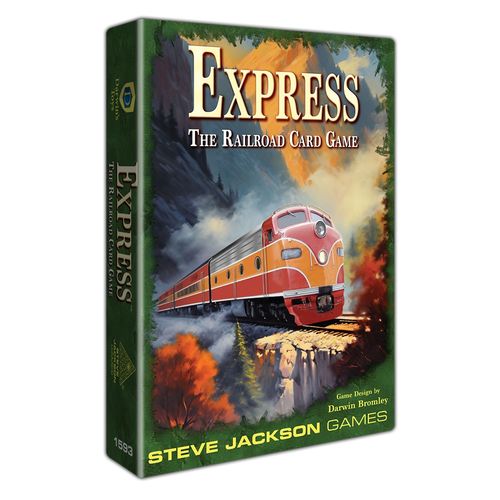
Express
Express Rulebook
Table of Contents
Table of Contents
Components
This game includes 132 game cards, one Direction of Play card, a player reference card, a plastic tray, and a rules sheet.
90 Freight Cars:
- 12 Box (1 point)
- 11 Hopper (2 points)
- 11 Tank (2 points)
- 10 Coal (3 points)
- 10 Coil Steel (3 points)
- 10 Gondola (3 points)
- 9 Commuter (4 points)
- 9 Piggyback (4 points)
- 8 Auto Carrier (5 points)
(Note that the quantity of each freight car is equal to 13 minus the card's value.)
7 Special Rolling Stock:
- 2 Diesel Engine
- 3 Caboose
- 2 Wild Car
10 Way Cars:
- 2 Heavy Crane
- 2 Office Car
- 2 Light Crane
- 2 Boom
- 2 Transfer Car
14 Passenger Cars:
- 2 Mail/Baggage
- 2 Sleeper
- 6 Coach
- 2 Observation
- 2 Dome
11 Disaster and Turntable Cards:
- 2 Broken Car
- 2 Derailment
- 2 Steal
- 1 Switch Engine
- 3 Turntable
- 1 Wreck
A "Loco" card is any card placed face down.
Objective
The object of the game is to score points by completing trains.
Decide in advance whether you will play one hand, multiple hands, or to a particular score (50 points is suggested).
Playing one hand will give you a fine game.
Setup
You will need enough space for each player to lay out several rows of cards. Remove the Direction of Play card and put it in the center of the table with the "To The Left" side up.
If you are playing with two or three players, remove one Turntable card and place it in the box, out of play.
Choose a dealer. Shuffle the deck thoroughly, especially if you have just finished a hand, and deal 10 cards to each player. The rest of the cards go into one side of the tray, face down. This is the Draw deck.
The other side of the tray will be empty at the start of the game. Discarded cards go here, face-up (except those lost to Disasters, which go into the Disaster slot).
The player to the dealer's left will take the first turn.
If you are dealt a hand such that you are unable to play and discard down to the five-card minimum, display your hand and draw a new hand, setting your original cards aside. After each player has played once, those cards are shuffled back into the Draw deck.
If a card must be drawn but the Draw deck is empty, reshuffle the Discards (but not the Disaster slot) to form a new Draw deck. Leave the last card discarded in the Discard tray. This takes place at the time a new card is needed to be drawn, and not before.
Turn Sequence
On your turn, take the following actions in order.
1. Draw. You must draw either the top discard, which is face up, or the top two cards of the Draw deck.
2. Change Locos. Move your face-down Loco cards (see Legal Trains) back into your hand.
3. Play Cards. Play cards to the table to create new legal trains, add cars to the end of existing trains, and/or set out new Way Cars above your layout. You do not have to play any cards during this phase.
4. Discard or Disaster. Either discard one card from your hand, or play a Disaster card, or play a Turntable card to give yourself a new turn. Note that when you play a Disaster or Turntable card for its printed effect, it goes to the Disaster slot and not the discard pile. But in the unlikely event that you choose such a card for your regular discard, it has no effect and goes to the discard pile.
5. Six or more cards left in your hand. If you still have more than five cards in your hand, you must take back your discard and play additional cards to the table until your discard gets you down to five or fewer.
6. Pass the Turn. Pass the turn to the next player. Play proceeds to the left when the hand begins, but may be reversed by a Turntable.
If you accidentally play all your cards and therefore have nothing to discard, you must recover cards you played during the turn and re-play them in a way that leaves a Loco on every train and one discard.
When you are finished playing cards, you must have a card in your hand to discard. You must have five or fewer cards in your hand after you discard. Note that you do not have to play any cards at all, unless it is necessary to meet these requirements.
After your discard, all your trains must be legal, with your Way Cars, if any, lined up at the top.
Locos
A legal train must be led by a "Loco," represented by any card turned face-down to show the steam locomotive picture on the back. Other players cannot see what you are using for Locos.
The exception to this is the Diesel Engine card. There are only two in the deck. A Diesel can be played face up to pull a passenger train, where it gives a bonus. Once played face up, a Diesel is not taken into your hand again.
When these rules use the term "Engine," it means any train leader, either a Diesel or a Loco.
But note that the Switch Engines card does not affect Diesels.
Legal Trains
The minimum legal train is one Loco and one car. You may not play a Loco by itself – it must be followed by at least one car. You may not play an ordinary car by itself. The special Way Cars are played by themselves, in a row at the top of your area. They are not part of any train.
The minimum scoring train is one Loco plus three cars of the same type, OR two cars of the same type plus a Caboose.
The cars in a train must all be of the same type (either all passenger cars, or all freight cars of the same color) unless a Wild Card or Caboose is used.
By overlapping the first three cars of a train, you may remind yourself that their total score is only the score shown on one card. See Scoring.
Examples of Legal Trains
- A Loco with one car.
- A Loco with two cars.
- A Loco with three cars. The minimum scoring train.
- A Loco with three passenger cars. Passenger cars (see Passenger Train Scoring) may all be played in one train even though they are of different varieties, and the proper choice of varieties can give big bonuses to score.
- A Loco with (at least) two cars plus a Caboose (see Special Cars). This is also a scoring train.
- A Loco with (at least) two of one car type, and (at least) one of another type, joined by a Wild Card (see Special Cars).
- A Loco with four regular cars and a Wild Card, which in this case counts as the same type as the regular cars (see Scoring).
Illegal Trains
The following are examples of illegal trains:
- A train with no cars.
- A train with no Loco.
- A train with two Locos.
- A train with the Loco in the wrong place.
- A train with a car following a Caboose.
- A train with no cars except a Caboose.
- A train with different car types, but no Wild Card to join them.
- A train with a Way Car in it. Way Cars do not participate in trains.
- A train with a special card in it. Just . . . no!
- A train with only one car and a Caboose.
- A train that uses a Wild Card as a transition after only one car.
Special Cars
Caboose. A Caboose may be played on any train, but then no further cars may be added. A Caboose protects against "Steal" and "Broken Car" Disasters, but if it is played on a passenger train, that train gets no bonuses.
Two identical cars and a Caboose make a legal train, worth the value of the car that began the train. Otherwise, a Caboose is worth 1 point.
Wild Cards. There are only two Wild Cards in the deck. A Wild Card can be played in either of two ways:
-
It may substitute for any specific type of car to make a legal train, in which case it will be scored as that type of car. A Wild Card may also be played as a Caboose or any specific passenger car. A Wild Card may not be played as the only car on a train, or as a Diesel, Disaster, Turntable, or Way Car.
-
It may be placed after two or more cars of one type, usually to change the type of cars in the train. Any type may be played after the Wild Card. A Wild Card played this way does not score. If you place both Wild Cards in a single train, it may legally have three types of car.
Removing Cars
You may not remove a car or Diesel Engine from the table once it is played, unless you are forced to by a Disaster. Cards, once played, must stay in the same order within their trains.
The face-down cards representing Locos may be freely removed from the table during your turn, after you have drawn, and replaced by others. You may not look at them or move them at other times.
Disasters
There are five types of Disaster cards. Each one is blocked by a specific Way Car. You may not play a Disaster on your first turn.
The rule for each Disaster is on the card, along with the name of the Way Car that blocks it. In all Disaster card text, the "player" is the one who plays the card. The "target" is the one affected. The player chooses the target, and may choose themselves as the target. The player must state the details of the proposed Disaster when the card is played, so that if the target has a Way Car in hand they may choose whether to use it. A Disaster card, when played, is discarded to the special Disaster slot, along with any cards that it causes to be lost.
You may use a Disaster as a regular discard, without effect, if you wish.
If a Broken Car or Steal reduces one of your trains to a bare Engine, you must immediately return that Engine to your hand. This may temporarily cause your hand to exceed the five-card limit until your next turn. Playing a Steal card when your hand is already full will make your hand exceed 5 cards. This is also legal.
Disaster Types
Broken Car. Choose any train and discard its last car to the Disaster slot. A Caboose may not be chosen. Blocked by a Light Crane.
Derailment. The target player loses their next turn. Blocked by a Boom car.
Steal. Choose any train, take its last car, and either place it in your hand or add it, in a legal manner, to one of your own trains. A Caboose may not be chosen. Blocked by an Office Car.
Switch Engines. Exchange any or all of your Locos with a like number of Locos belonging to the target player. Diesels are not affected. Neither player may look at these cards until after they draw cards on their next turn. Blocked by a Transfer Car.
Wreck. Choose any train and discard it completely, with its Engine, in the Disaster slot. Blocked by a Heavy Crane.
Way Cars
There are five types of Way Cars. Each can block a specific Disaster. At the end of the game, each Way Car still in play is worth 5 points.
If you are the target of a Disaster:
If you already have the right Way Car in face-up play, then the Disaster and Way Car must both be discarded. You do not suffer the printed effect of the Disaster.
If you do not have the right Way Car in play, but have it in your hand, you may choose to play it immediately. The Disaster is discarded. You do not suffer its printed effect. Play the Way Car oriented vertically to show that you are immune to that type of Disaster for the rest of the hand.
If you played the Disaster on yourself, though, you may not then play the appropriate Way Car to lock in 5 points!
If you have the Way Car as a face-down Loco, it is not affected and does not help you. You suffer the effect of the Disaster.
Turntables
Played as your discard, a Turntable card immediately gives you a new turn. Discard it to the Disaster slot. You must still end your first turn normally, with all trains in play being legal and your hand down to five cards or fewer. Following your extra turn, direction of play is reversed. Flip the Direction card to indicate this.
You may play another Turntable at the end of an extra turn!
You may use a Turntable as a regular discard, without effect, if you wish.
You may not play a Turntable on your first turn.
Going Out
The hand ends when one player "goes out" by discarding their last card. You may not go out on your first turn!
You may only go out if these conditions are met:
-
You have at least one train of at least five cars (plus a Loco, of course) and one train of at least four cars.
-
All your trains are scoring. You cannot go out if you have any trains with only one or two cars!
-
Having met the above requirements, you discard your last card. This must be a regular discard; if you discard a Disaster or Turntable, it does not have its normal game effect.
-
All players then score their points. The player who went out scores an additional +10 points.
Scoring
The player who went out gets 10 bonus points.
Trains of one or two cars count zero points.
A train of three cars counts for the point value of a single car. Each additional car adds its point value. Example: three tank cars (2) have a total score of 2. But a train of four tank cars counts 4, a train of five counts 6, and so on.
Each Way Car you have on the table counts 5 points. If you are not the one who went out, any cards in your hand count their negative value. Cards without numbers count as zero.
Special Scoring Cases
-
If a Caboose is the third car of a three-car train, the value of that train is the value of one of the other cars. So two tank cars and a Caboose have a total value of 2 points.
-
If played as the fourth or later car of a train, the Caboose is worth 1 point.
-
If a Wild Card is played as part of a line of identical cars, it is treated as one of those cars.
-
If a Wild Card is played as a transition between two types of cars, then the first set is scored normally (whether or not the Wild Card is the third car), and each other car counts its point value.
Passenger Car Scoring
The base value of a passenger train is figured like any other train. The point value of a passenger car is 1, so the first three cars of a passenger train have a total value of 1, and the fourth and later cars are worth 1 point each.
This base value is doubled, cumulatively, for each of the following conditions:
a. Diesel bonus: The Engine is a face-up Diesel.
b. Consist bonus: The train includes at least two types of passenger cars, in the following order, left to right: Mail-Baggage(s) + Coach(es) + Dome(s) + Sleeper(s) + Observation(s).
c. Complete bonus: The train includes at least one of each of the five types of passenger cars above.
d. Daylight Express bonus: The train includes six or more Coaches.
All cars must be passenger cars. Wild Cards can be counted as any specific passenger car type for bonus purposes. No bonuses apply if the train has a Caboose, or if there are other types of car connected by a Wild Card.
Partnership Play
With four or six players, Express can be played as a partnership game with the following rules modifications:
- Partners sit across the table from each other.
- Deal eight cards to each player.
- Partners play on common trains and share Locos.
- Before going out, a player may ask their partner if they may go out. The partner must answer "Yes" or "No," and that answer must be honored. But a player may also go out without asking their partner's permission!
Notes on the Partnership Game
- The most intriguing element of partnership Express is the shared trains and Locos.
- Partners may develop a simple (or highly sophisticated) set of signals that can be sent back and forth via the shared Locos.
- It is legitimate for signals to be sent by the actual cards played as Locos as well as via the train on which they are placed.
- Partners may not send signals by the way in which the cards are played (slammed on the table vs. gently, for instance), by altering the orientation of the Locos (closer to the train, at an angle, etc.), or by any other method outside of standard game play.