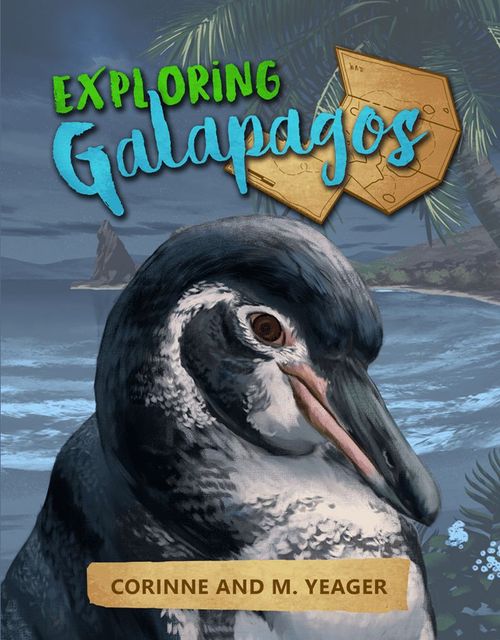
Exploring Galapagos
Exploring Galapagos Rulebook
Table of Contents
Table of Contents
Components
18 habitat cards (Provide your own way to keep score.)
Each card depicts all three habitat zones, but at different times and with different animals.
Card anatomy:
- Card value (1-18)
- Scoring method (time, color, or zone)
- Time of day (morning, day, or night)
- Animals (gray birds, blue fish, orange mammals, and green reptiles)
- Ecological impact icons (0-2)
- Zones (sky, sea, and land)
Gameplay
The game takes place over three rounds. Each round begins with setup, then includes up to three turns followed by scoring. Every round, each player tries to maximize their score by drafting cards and/or locking in one of three scoring methods. Each player's round score is determined using their scoring method, their hand, and the face-up shared hand in the center of the table.
The player who most recently photographed an animal begins the game as the "lead photographer." Each draft gives players a chance to become (or remain) the lead photographer.
Setup (Every Round)
The lead photographer shuffles all 18 cards together to form the deck, then deals a face-down hand to each player.
- 2-3 players: 4 cards each
- 4-5 players: 3 cards each
Finally, they place the deck in front of them to indicate they are currently the lead photographer. Reserve space in the center of the table for the shared hand of cards, and a separate space for cards to be drafted.
Turn Structure
Step 1: Add To Draft or Lock In
Starting with the lead photographer and proceeding clockwise, each player who has not locked in a scoring method chooses one of the following actions:
Add To Draft: The player places one card from their hand face down in the middle of the table.
Lock In: The player places one card from their hand face up in front of them. This indicates the scoring method they will use this round and prevents them from drafting further this round.
After everyone has chosen, if every player has locked in, the round ends (proceed to Scoring). Otherwise, continue to Step 2.
Step 2: Draft
Gather the cards added to the draft in Step 1 and add 1 card from the deck. Shuffle all of these cards together, and place them back in the middle of the table, arranging them face up in a row.
Starting with the lead photographer and proceeding clockwise, each player who has not locked in chooses a card from the row and slides it closer to them.
After the last player chooses a card, compare the values of the chosen cards. The player who chose the lowest-valued card becomes the lead photographer and places the deck in front of them. Each player then adds their chosen card to their hand and the unchosen card is placed face up in the shared hand.
If every player has locked in or if the shared hand contains 3 cards, the round ends (proceed to Scoring). Otherwise, begin a new turn starting at Step 1.
Scoring
Determining the Scoring Method
Each player who locked in will score using the scoring method indicated on their locked-in card.
Each player who did not lock in will use the scoring method that appears most often in the shared hand. If the shared hand shows all three methods, these players score 0 points this round.
Each player may only use each scoring method once per game. If a player's scoring method (determined by either a locked-in card or the shared hand) matches what they used in a previous round, that player scores 0 points this round.
Score Calculation
Using their determined scoring method, each player earns points from the cards in their hand, their locked-in card (if any), and the cards in the shared hand.
- Time: Choose Morning, Day, or Night. Score 1 point for each animal at that time.
- Color: Choose Gray Birds, Blue Fish, Orange Mammals, or Green Reptiles. Score 1 point for each animal of that color.
- Zone: Choose Sky, Sea, or Land. Score 1 point for each animal in that zone.
Ecological Impact
Each player adjusts their score using the ecological impact icons as follows: If there are an odd number of ecological impact icons between a player's cards (their hand and any locked-in card) and the shared hand, they add 1 point for each ecological impact icon in their cards but not in the shared hand. If there are an even number of ecological impact icons, subtract points for each ecological impact icon instead. If this penalty would reduce their round score below 0, they score 0 points this round.
Recording Scores
Record each player's score and scoring method for this round. After the third round, the game ends. Otherwise, the lead photographer starts the next round by repeating Setup. (The lead photographer does not change between rounds.)
Example
The shared hand holds three cards; the player has one locked-in card and two cards in hand.
Example: This player locked-in the Time scoring method this round. (If they hadn't locked in any method, they would score by Color instead.)
Across these six cards, there are 9 Day, 3 Morning, and 0 Night animals. To maximize their score, they choose to score Day animals for 9 points.
There are 4 ecological impact icons on these cards, so they must subtract 2 points for the icons on their own cards. They end up with a final round score of 7 points.
Winning the Game
The player with the highest total score after three rounds wins the game! If players tie for first place, all tied players share the victory.
Reference
- Time: morning, day, night (clock symbol)
- Color: gray birds, blue fish, orange mammals, green reptiles (palette symbol)
- Zone: sky, sea, land (globe symbol)