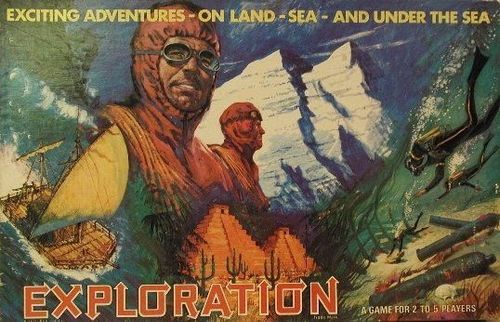
Exploration (1967)
Exploration (1967) Rulebook
Table of Contents
Table of Contents
Winning and Money
The winner is the one who makes the most profit from his expedition.
Money can be obtained in the following ways —
- each player receives a sum from the Bank to start with.
- from other players by selling equipment.
- in special awards from the Exploration Club.
- by reaching objectives during the expedition.
- by returning to Base first, second or third.
A Short Game for beginners is explained on page 5.
Contents
Playing board; 16 Personnel (Men and Shop) cards; 16 Equipment cards; 14 Exploration Club cards; 4 pawn tokens; 4 model playing pieces; 1 standard dice; 1 Diradice; paper money.
Preparation
Place the different types of Equipment cards (Diving, Sailing, Archaeology, Mountaineering) in four separate piles — and the Exploration Club cards — all face down in the central part of the board.
Personnel cards. This pack consists of Men cards and Shop cards. Shuffle the pack and deal to each player a number of cards, face down, as follows —
(a) for two or three players — four cards each.
(b) for four players — three cards each.
Players should not show which Men cards they hold except when they are claiming Equipment cards.
Place the remaining cards face down in a pile near the Equipment cards.
Money. Appoint one player to be Banker. Give each player two £500 notes, three £100 notes and four £50 notes.
Playing pieces. Each player selects one of the pawn tokens. The model playing pieces are not used until expeditions are ready to set off.
Place the tokens in the "Preparations Start" square.
Decide by throwing the dice which player shall start.
The main object in this part of the game is to obtain Men and Equipment cards, all of which belong to the same expedition.
The outer track only is used. Each player has one throw of the standard dice at his turn, and he moves the exact number of spaces shown unless a 6 is thrown. In this case the player can move either 1, 2, 3, 4, 5 or 6 spaces.
Obtaining Equipment
Buying equipment. When a player finishes his move on a square marked Diving, Sailing, Archaeology or Mountaineering, he may (if he wishes) buy one item of equipment for that expedition — but he must show a Man card of the same expedition. He then takes the top card from the correct pile of Equipment cards.
Payment for equipment. Payment must be made to the player who has the Shop card which contains that item of equipment. The owner of the Shop card shows it and collects payment immediately. If the player buying the equipment has the Shop card himself, no payment is made. If the Shop card is still in the pile, payment is made to the Prize Fund. This is money collected in various ways and it is paid to the first player back from his expedition. Keep this money separate from the rest.
Buying equipment for two or more expeditions. Equipment can be bought for more than one expedition provided the player has the correct Man card each time he buys, but he can only use equipment for one expedition when he is ready to set off.
Unwanted Equipment cards. At his turn, a player may exchange one or more items of equipment with any other player — or he may offer them for sale.
When a player starts his expedition he must return all unwanted equipment to the correct Equipment card pile — without repayment.
Personnel and Men Cards
Personnel cards. The pack contains 12 Men cards and 4 Shop cards. Every time a player lands on a corner square he may take the top card from the pile of Personnel cards, and he must return any one Personnel card from his hand to the bottom of the pile.
Personnel cards may never be exchanged between players.
Use of the Men cards. These are used during the expeditions to obtain prizes when certain objectives are reached, or to overcome hazards. Only men of the same expedition can be used by one player.
Exploration Club cards. When a player lands on an Exploration Club space he must take the top card and follow the instructions. After use, cards must be returned to the bottom of the pile. Any payments that have to be made are added to the Prize Fund.
Starting the Expeditions
Starting the expeditions. The first player who is ready to begin his expedition must have at least two Equipment cards and two Men cards of the same expedition. One of these Men cards must be the main objective card.
He must continue round the outer track until he reaches the Preparations Start — an exact throw is not necessary.
When a player is ready to start his expedition he must return all unwanted equipment to the correct Equipment card pile. He must also return all Men cards of any other expedition to the bottom of the Personnel card pile. He may keep any Shop cards and continue to collect payments for equipment.
He then takes the correct model playing piece and places it on Base. The ship is for Diving — the lorry for Archaeology — the tent for Mountaineering — the yacht for Sailing.
After returning all unwanted cards he must place all those for his expedition, in front of him face upwards, for all to see.
Following players do not require two Equipment cards and two Men cards — they may start with only one of each if they wish, but they must hold the main objective Man card. If they have not so far succeeded in getting it, they must continue round the board.
When two players have started their expeditions (or are on Base, ready to start) any following players, when they land on a grey corner square may select any one Man card and move immediately to the Base Start square.
Any player who has still not obtained his main objective card, when next he reaches the Preparations Start square may select it from the pile and move immediately to the Base Start square.
When everyone has started on the expeditions, return all surplus cards and the standard dice to the box.
The Expeditions
Expeditions. Each player's Men and Equipment cards must be placed face up in front of him for all to see.
Archaeology and Mountaineering expeditions keep to the land, and cannot go on to the sea nor cross lakes. However, they can go over streams and rivers.
Sailing and Diving keep to the sea and cannot go on to nor cut across any square which is completely land. The only exception is when landing on a coastline objective. These are the "Island," "Wine Jars" and "Idol."
Objectives. All objectives are enclosed by a thick black line. They represent one "square" and can be entered or left at any part.
The Main Objectives are:
- Lost City (top left corner) — Archaeology
- Summit (top right corner) — Mountaineering
- Island (with sandy beach) — Sailing
- Sunken Galleon (bottom left corner) — Diving
(a) A player must visit his Main Objective, and then return to Base. He may visit Lesser Objectives going or returning. The Lesser Objectives are: Prehistoric Skeleton; Idol; Rare Flower; Pearls; Treasure Chest; Rare Fish.
Details of payments for reaching objectives are given on the Men cards.
(b) Payments for reaching objectives are made only once, and the money comes from the Bank.
Hazards. All hazards are enclosed by dotted black lines.
(a) A player cannot go on to nor over a hazard unless he has the correct Man. The hazards and correct men are:
- Whirlpool: Marine Engineer — Diving
- Strong Currents: Navigator — Sailing
- Precipice: Guide — Mountaineering
Movement of the Playing Pieces.
(a) A player cannot go on to nor over any square already occupied by someone else.
(b) A player cannot go on to nor over a square on which there is an equipment symbol unless he has that item of equipment. There are matching symbols on the Equipment cards.
(c) At his turn a player may stay where he is, if it is not to his advantage to move.
The Diradice. Only the Diradice is used to move expedition playing pieces. It is thrown once by each player in his turn, just as with the standard dice, but it controls direction as well as distance. Examine the symbols carefully and the meanings explained at the end of these instructions.
Returning to base. The first player to return receives £1000 and also the Prize Fund — the second player receives £500 and the third player, £200.
With only two players, play stops when one has returned; with three players play stops when two have returned, and with four players, when three have returned.
The Short Game for Beginners
In this game the outer track is not used.
Preparation. Give each player two £500 notes, three £100 notes and four £50 notes.
Separate the Equipment cards into the different expeditions, face downwards. Take the four Shop cards from the Personnel pack. Separate the Men cards into the different expeditions.
Players now choose which expedition they will take. Use the standard dice to decide who makes the first choice.
Each player then takes the three Men cards of his expedition and the top three Equipment cards that belong to it. Put the unused cards back in the box.
Shuffle the four Shop cards and deal one to each player.
Each player must now pay for his equipment to the player who has the appropriate Shop card. If he himself owns the shop that sells his equipment, he gets it, of course, for nothing. If there are only two or three players there will be one or two Shop cards over. Money due to these undealt shops goes into the Prize Fund, which is given to the player who is first back from the expedition.
Place all the Men and Equipment cards face up for all to see. Put the model playing pieces on the Base square. The ship is for Diving — the lorry for Archaeology — the tent for Mountaineering, and the yacht for Sailing.
Players start in the reverse order from that which was used in choosing the expeditions.
Only the Diradice is used. The rules for the expeditions are exactly the same as for the longer game.
Only the Diradice is used to move the expeditions. Examine the symbols and their meanings carefully — they are explained on the last page.
Diradice Movement Diagrams
In the diagrams below, the playing piece on square X can be moved to any of the squares Z.
- Diagram numbered 1 (a square with a diamond around it) — 4 possible moves. Move ONE square forwards or sideways or backwards.
- Diagram with four arrowed points numbered 1 and 2 — 8 possible moves. Move ONE or TWO squares forwards or sideways or backwards.
- Diagram with an eight-pointed star numbered 1 — 8 possible moves. Move ONE square in any direction.
- Diagram with arrows pointing diagonally numbered 1 and 2 — 8 possible moves. Move ONE or TWO squares in a diagonal direction.
- Diagram with a flower-like eight-point figure (no numeral) — 8 possible moves. Move from X to any square Z (see examples below).
Examples. There are TWO routes from X to any square Z.
(1) Move from X to a, then to Z; or (2) Move from X to b, then to Z.
Play Examples
Play examples — for the Archaeology expedition near the Idol and the Skeleton.
If the player throws symbol No. 2 (straight move — 1 or 2 squares) he can go to either — D3, or E3 if he has the Mule card — C2 or C1 if he has the Netting card — B3 — C4 or C5 if he has the Tool card.
If he throws symbol No. 4 (diagonal move — 1 or 2 squares) he can go to either — D2, E1 (Skeleton) B2, A1, B4, D4 or E5 if he has the Netting card.
If he throws symbol No. 5 ("Bent" move — 2 squares) he can go to either E2, or D1 if he has the Tool card — A2, or B5 via B4, D5 or E4. He cannot go to B1 because it is blocked by Porters (Mountaineering equipment).