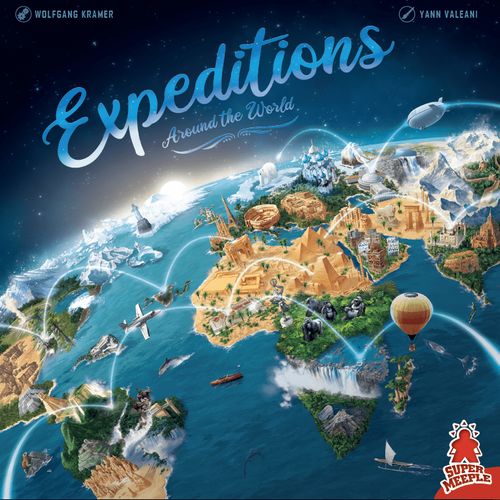
Expeditions: Around the World
Expeditions: Around the World Rulebook
Table of Contents
Table of Contents
Contents
- 1 map
- 80 Expedition cards
- 135 arrows in 3 colors
- 40 tickets
- 24 tokens in 6 colors + 6 big tokens
- 4 player aids (double sided)
Setup and Game Concepts
(4-player examples)
- Place the map in the middle of the table.
- The starting point in Northern Europe is the compass rose; all expeditions will depart from this point.
- The green circles indicate the 80 locations for which there is a corresponding Expedition card.
The blue square and red star are intermediate steps between those destinations.
All locations are linked to others via dashed lines; these are the routes the expeditions can follow, and thus on which you will place arrows during the game.
1 Shuffle the Expedition cards and deal this many to each player:
- 12 cards (in a 2- or 3-player game)
- 9 cards (in a 4-, 5-, or 6-player game)
Keep these cards secret; these are your objectives, the destinations the expeditions must reach.
2 Form a deck with the rest of the cards; place it beside the map face down.
Then flip 6 cards face up beside the deck. These 6 cards are common objectives for all players.
Try to be the first to reach these, in addition to your personal objectives.
Important: During setup, each common objective must be at least 3 steps away from the starting point. If this is not the case, tuck each offending card under the deck and draw a new card.
3 Each player chooses a color and takes the big token and 4 other tokens of this color (the big token is just a reminder of your player color), as well as 3 tickets. Return the tokens of unused colors to the box.
4 Sort the arrows by color and pile them beside the board along with the remaining tickets.
The player who traveled abroad most recently is the first player.
Note: There is only one card per location (green circle) on the board. There are no cards for the red stars and blue squares.
Preparation: Marking Key Locations
Each player secretly identifies the different locations on their cards; these are their objectives for the game. You will need to guide the various expeditions to these locations to fulfill your objectives.
Expedition Card Anatomy
- Name of the card (it could be the name of a city, a building, a tourist destination....)
- Illustration
- We can also learn while we play
- Where it is on the map
Then, starting with the first player, each player must choose 4 of their locations, and place their token on the corresponding green circle on the map: These are the key locations. The first player marks 1 key location by placing a token on it, then the next player (in clockwise order), and then the next, until everyone has placed their 4 tokens.
Important: Because there is only one card per location, there can only be one token per location.
Your key locations must be at least 3 segments from the starting point (compass rose).
Note: This process means that you each must reveal 4 of your 9 or 12 (depending on the player count) objectives to become key locations.
Playing the Game
Each player performs an action, then it's the next player's turn (in clockwise order). The game continues this way until one of the endgame conditions is met (see p. 7).
Expedition Progress
There are 3 different expeditions; each is a different color, and is represented by the arrows.
The expeditions do not belong to any one player; rather, they are shared by all players. They all start from the compass rose.
On your turn, you must progress any one expedition.
If the expedition you choose has not yet started (i.e. no arrows of its color are on the map yet), you must take an arrow and place it on a segment such that it is departing from the starting point (compass rose), headed toward one of the 6 connected spots.
Note: We use the term «spot» to mean any green circle, red star, or blue square. The term «location» is used only for green circles.
(Example of starting an expedition)
If the expedition has already begun, take an arrow and place it on a segment such that it starts from the point of the previous arrow, and goes to a connected spot (even if the two spots are on different continents).
Important: Always extend an expedition with an arrow of the same color.
An expedition always continues from the last spot it visited, and thus from the point of the last arrow placed for this expedition.
The new arrow is not allowed to simply backtrack the previous arrow (see illustration below). All 3 expeditions are independent, they do not interfere with each other; so, the same segment might have arrows of different colors (and perhaps in different directions).
If all of the arrows of one expedition have been placed, then you must progress one of the other expeditions, instead.
Note: There are 3 waypoints between the left and right edges of the map, represented by red half stars, to indicate that they are two halves of the same star on the edges of the map.
This allows an expedition to continue, for example, from the left edge of the map to the right edge. Just make sure the expedition enters the other edge at the same "height" it left!
Expedition Arrival
Your progression of the expedition will result in 1 of 3 possibilities:
- If it is a location (green circle), it may match an objective in someone's hand. If this is the case, that player must announce it and place it face up in front of them (even if it is not their turn).
If the location was marked with a token on the map, its owner also collects the token and places it in front of them on the card.
Note: If someone notices on a later turn that an expedition reached one of their objectives, it is too late; they can't reveal their card! Instead, they must try to direct an expedition to that location again. Stay alert so you don't have to do this!
If the location matches a common objective, take the card and place it face up in front of you (you can only do this on your own turn).
Then reveal a new card from the Expedition deck so there are always 6 common objectives.
Note: A common objective can only be claimed by progressing an expedition. If a newly revealed card indicates a location that has already been visited, no one can collect it until an expedition reaches that location again.
- If it is a blue square spot, you can immediately add another arrow to any expedition, and apply the effect of the new spot it points to.
- If it is a red star spot, you collect a ticket. This is also true for the waypoints that connect the edges of the map.
Using Tickets
You can use up to 2 tickets on your turn. You can use each ticket before and/or after you progress an expedition.
Each ticket allows you to perform one of the following additional actions:
Add an additional arrow to an expedition of your choice
Progress any expedition you like (same ability as the blue squares).
Remove the last arrow from an expedition of your choice
Remove the last arrow from any expedition. If this new end of the expedition allows someone to complete an objective, they can announce it and place the card face up in front of them. If the new end of the expedition now points at a blue or red spot, take the bonus (add an arrow or collect a ticket).
Swap an Expedition card
Swap one of your Expedition cards for one from the deck. To do this, draw 2 cards from the deck, choose 1 to keep in your hand, then tuck the other card under the deck along with the card you wish to discard from your hand.
Note: You can discard a card for a key location, but leave the token on the map location. You can also simply discard both cards you draw, rather than discarding one that was already in your hand.
If an Expedition Ends in a Loop
If you place an arrow that forms a loop in an expedition, immediately place a new arrow for this expedition from any spot this expedition has visited, which then becomes the new base for the rest of the expedition, following the usual rules to progress the expedition.
Note: It's possible that using a ticket to remove an arrow from an expedition causes the expedition to end in a loop again (see p. 5).
If you form a loop by pointing to a blue square, you therefore get to place 2 additional arrows.
First place a new arrow from any spot the expedition has visited (because you formed a loop), then add an arrow to any expedition (because of the blue square).
When an expedition "wraps" to the other edge of the board, a loop might be difficult to notice.
If the expedition has no "free arrowhead", there is a loop.
A free arrowhead is an arrow pointing somewhere the expedition has not previously visited.
Note: There is no limit to how many times you can cause an expedition to end in a loop each turn.
This expedition ends in a loop.
The expedition "restarts" from any spot it's visited (here, Iguazú Falls); but it could have restarted from any other spot the expedition had visited, such as Angel Falls, which is not part of the loop, or the red star before it.
End of the Game and Final Scoring
The game ends when someone has placed the last Expedition card from their hand, or when all the arrows are on the map. Finish the round so everyone gets the same number of turns (just pass if you can't do anything on your turn).
You each count your own points:
- +1 point for each card in front of you (objective completed)
- +1 point per token collected (key location visited)
- -1 point per Expedition card still in your hand
- -1 point per token of your color still on the map
The player with the most points wins. If it's a tie, the tied player with the most tickets wins. If it's still a tie, the tied players share the victory.
Example from the Beginning of the Game
1st Step
Philippe is the first player. He decides to start the yellow expedition. He takes a yellow arrow and places it on the segment between the compass rose and Rome.
2nd Step
It's Morgane's turn to play (after Philippe). She could continue the yellow expedition from Rome, but she prefers to start the red expedition. She takes a red arrow, and places it on the segment that leads to the blue square; this lets her immediately go again. She decides to continue the red expedition, and places a new arrow from the blue square to the Caspian Sea. Morgane is happy.
3rd Step
Bernard is even happier. It's his turn to play. He decides to extend the red expedition. He places an arrow from the Caspian Sea toward Babylon.
Because he has a token on Harappa and doesn't want to miss the opportunity to go there, he uses a ticket to add another arrow. He places a red arrow from Babylon to Harappa.
He announces that he has achieved one of his objectives, places the Harappa card in front of him, takes the token from the map location, and places it on the Harappa card.
4th Step
It's Charles' turn. He decides to start the blue expedition toward the blue square, which lets him add another arrow. He decides to go to Zagorsk. The Putorana Plateau is one of the common objectives. Because he doesn't want Philippe to claim this objective on his turn, Charles spends a ticket to extend the blue expedition to the Putorana Plateau.
He claims the card, places it in front of him, and reveals a new card from the deck.
5th Step
Philippe is miffed with Bernard, who steered the red expedition away from Petra, one of Bernard's secret objectives.
Rather than succumbing to despair, he spends a ticket to remove the last arrow from the red expedition (the one Bernard placed from Babylon to Harappa). Now Philippe can progress the red expedition anew, going from Babylon to Petra, completing his objective. He places his Petra card face up in front of him.