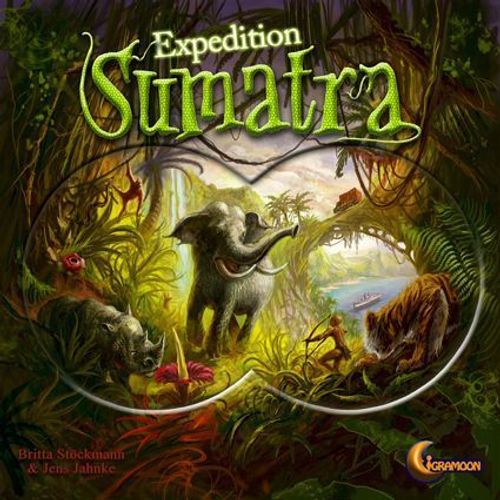
Expedition Sumatra
Expedition Sumatra Rulebook
Table of Contents
Table of Contents
1 Components
- 1 square game board (with starter fields for the ships and imprinted paths: permanent paths in the jungle)
- 50 double-sided path tiles
- 18 cargo holds (each 6x bow, centrepiece and stern)
- 4 ships (one per colour)
- 4 trucks with large loading space (one per colour)
- 4 trucks with divided loading space (one per colour)
- 38 animal markers (2 muntjacs, 6 elephants, 8 rhinoceroses, 10 tigers, 12 orang-utans)
- 4 action markers
Path tiles (examples)
The top side of each tile is a bifurcation. The reverse side shows, for example: bifurcation with orang-utan, junction with tiger, bend with elephant, straight with rhinoceros, blind alley with muntjac.
Different combinable cargo holds
- Bow (small order)
- Centre (black market)
- Stern (big order)
Action markers
4 action markers are used to mark the number of actions already executed by the player.
Per colour
- 1 ship each.
- 2 trucks (stickers on wooden tiles):
- 1 truck with large loading space for one big animal (elephant or rhinoceros) or two small ones of the same kind (for example 2 tigers).
- 1 truck with divided loading space for two small animals of any kind (for example 2 tigers, or 1 tiger and 1 muntjac, or 1 orang-utan and 1 tiger etc.).
Animal markers
2 x muntjac, 6 x elephant, 8 x rhinoceros, 10 x tiger, 12 x orang-utan.
2 Aim of the Game and Preparation
Aim of the game
The aim of the game is to find and catch animals in the jungles of Sumatra to gather victory points at the end of the game. Each player tries to find a way through the dense thicket with two trucks, track down animals and bring them on board ship. There are bonus points for fully accomplished orders and - as the case may be - also for those players whose ships completely circumnavigate the island. One central element is the movement of the path tiles which are used to build routes, explore the island and discover animals.
Preparation
A ship always covers two squares, so generally the trucks have two ways of boarding or disembarking.
- The game board is placed in the middle of the table. The 50 path tiles are shuffled with the top of the tile (= bifurcation) upwards and 25 of them are randomly placed on the imprinted paths on the game board. The remaining tiles form the drawing pile.
- Each player blindly draws 3 cargo holds (1 bow, 1 centre, 1 stern) from the corresponding piles and puts them together to form a complete ship. The cargo holds indicate how many and which kinds of animals are to be caught. Of the drawn cargo holds, each player is allowed to exchange one at most if the combination of orders seems too difficult to accomplish.
- Each player gets 2 trucks and the ship in their colour. The ship is placed on the starter field on the coast of the island closest to the player, and the truck with the divided loading space is placed onto the ship. The truck with the large loading space starts on the central square in the jungle.
- The animal markers and the action markers are placed next to the game board.
The player who was last in the jungle or owns the most houseplants begins the game.
3 How to Play - Actions and Ship Rule
Course of the game
Choose 4 out of 5 possible actions which can be used in any combination. When it is a player's turn they can 4x choose one of five actions in any order. A certain action can be used more than once per turn.
-
Move a tile: Either flipping or rotating a tile.
- a) Flip a tile over one of its edges onto a free adjacent square where there are no tiles or markers (paths that are imprinted on the board may be covered). A tile with a truck on it cannot be flipped. When flipping a tile it must not be rotated.
- b) Rotate a tile through 90, 180 or 270 degrees on the same square. Trucks and animals can stand on the rotated tile.
Pushing a tile to an adjacent square is not allowed!
-
Drive a truck through the jungle (also on or off the ship) as far as the path permits.
-
Load an animal which shares a square on the game board with one's truck onto that truck.
-
Steal an animal (on the same square) from an opponent's truck. Costs 2 actions!
-
Move one's own ship 1 square forward or backward.
The action markers are used for counting the actions performed by the player. Once they are all used up, the player's ship is moved according to the ship rule. After that it is the next player's turn (clockwise).
At the end of a player's turn: Ship rule (after completing the 4 actions)
Number of path ends (of the tile or square with the truck with the large loading space) = number of sea squares the ship advances.
When a player has completed his 4 actions, he checks where his truck with the large loading space is currently standing. If it is situated on a path tile or a path square in the jungle, the path ends on this tile or square are counted (2 for a bend or a straight, 3 for a bifurcation or 1 for a blind alley) and the ship is moved forward accordingly - that means 1 sea square for each path end (not a ship's length, which would be 2 water squares!). If the truck with the large loading space happens to be on board the ship, the ship moves 1 square forward.
All ships move clockwise along the inner sea track. BUT: If a ship reaches the ship sailing in front of it, it can overtake it. A ship that is overtaking another cannot be loaded, though. It is not possible to steal animals from an opponent's ship.
Explanation of the cargo holds (example)
- Cargo hold for the small order in the bow.
- Cargo hold for the big order in the stern.
- For each completely filled cargo hold at the end of the game the player receives the bonus points shown on the corresponding book. [The maximum number of points for a completed order is given on the right side.]
- The centre is a cargo hold for a maximum of 4 animals (partly prescribed) which are hunted for the black market. Any kind of animal can be placed on the +1-squares. Occupied +1-squares give an extra point at the end - no matter if the central cargo hold is completely filled or not. On black market squares with prescribed animals only the corresponding type can be placed (e.g. rhinoceros). Each of these squares gives 2 extra points when occupied at the end.
- The squares may be filled in any order.
4 Moving Through the Jungle, Catching and Loading Animals, Stealing
Moving through the jungle
The trucks only move on the jungle paths and can drive on or off the player's own ship. A truck can move as far through the jungle as an existing path allows. Other trucks or animal markers do not block the way. The go ends in any case, if a truck boards the ship or stops to catch an animal.
Catching an animal (with the right truck)
To catch an animal, the truck has to stop on a square on which an animal marker is situated. The animal is caught by placing the marker on the truck.
The truck with the large loading space can transport 1 elephant or 1 rhinoceros or up to 2 tigers or up to 2 orang-utans or up to 2 muntjacs at a time.
The truck with the divided loading space can carry per half 1 orang-utan, 1 tiger or 1 muntjac each. This truck can transport up to 2 smaller animals of the same or different types.
After loading, the animal can (in a new action) be moved through the jungle together with the truck. As soon as all trucks and markers have left the animal square, the tile is removed from the game and replaced by a new one from the drawing pile. The player whose truck has left that tile last (with or without animal) can decide in which direction the bifurcation may face.
In the jungle, animals can also be unloaded from the truck, onto the square where it is stopping. This does not count as an action.
Loading animals onto one's ship
When a truck with 1 or 2 animals arrives on board, the player immediately has to decide into which cargo holds he wishes to place the animals (bow, centre, stern) - animals cannot be moved around later on. Particularly in games with 3 or 4 players, in which it is hardly ever possible to fill all the cargo holds, it is essential to decide early enough which order one wishes to focus on.
Stealing an animal
It is possible to steal an animal from an opponent's truck, as long as it is still in the jungle. The active player may already be carrying one animal as long as it does not break the transport rule. A theft takes 2 actions. If a player wants to steal an elephant or rhinoceros he has to use the truck with the large loading space.
If the drawing pile is used up, the game ends. The round is still finished though. If on these last turns an animal tile is emptied and removed from the game, it is not replaced.
5 Explanation of the Tiles
The top side always shows an empty bifurcation. To explore the reverse side (and so the jungle) path tiles are always flipped over one of their four edges onto an adjacent empty jungle square (where there is no other tile, truck or animal). When flipping a tile, it is not allowed to rotate it as well (that would be a separate action).
If a tile is flipped, and there is an empty path, nothing happens, but if there
a) is an animal, an animal marker of the corresponding kind is placed on the tile. If the tile is flipped again, the animal escapes into the jungle, which means the marker returns to the stockpile. (A tile with an animal marker can be rotated.)
(2x) Special rule muntjac: As the Sumatra muntjac has already been considered extinct it is very rare and precious. It is not hunted by order but can function as a joker and replace any animal in any order. In that case it takes over that animal's worth. On its own a muntjac in the centre cargo hold counts 5 points. It is not allowed to place a muntjac into the trap (see below).
b) (2x) is a trap, the active player places an animal marker of his choice from the stockpile there (with exception of the muntjac). The player whose truck leaves that tile last (with or without animal) replaces the tile with a new one from the drawing pile.
c) (2x) is a native, each player (including the active player) returns an animal of their choice from the centre cargo hold (if one is present) to the stock. If a player (other than the active player) has already completed an order (in bow or stern), he must return 1 more animal for each completed order to the stock, however, he can choose freely from the three cargo holds. The active player is not affected. The native-tile is replaced by a new tile from the pile, while the native-tile itself is not removed from the game, but shuffled into the top 5 tiles of the pile (as long as there are at least 5 tiles left).
d) (3x) are binoculars, the player can look under two tiles of his choice on the game board. The binoculars are removed and replaced. The player who discovered the binoculars decides how to place the bifurcation on the square onto which the binocular-tile was turned.
e) (each 1x) is a storm, all tiles in the direction of the arrow in this row are moved towards the coast. Afterwards the tiles which have been moved (including the storm-tile) are counted and all ships move that number of squares forward (green arrow) or backward (red arrow). (If a ship moving backwards crosses over its own starter field it does not mean that the game ends when the ship crosses the starter field again in the normal sailing direction, because it has not sailed around the island.) The storm-tile is removed and replaced. The active player can decide how to place the bifurcation on the square on which the storm has come to a halt.
Example: all ships have to move 4 squares backwards. If there is a truck on the board in that row it is placed onto the tile that pushes it (which might also move the truck further along).
Decorative elements have no function.
6 End of the Game and Scoring
End of the game
The game ends either as soon as
- the drawing pile is used up, or
- if one player has managed to fill all his cargo holds completely, or
- when the first ship has surrounded the island and either stopped on its starter field or crossed it.
The current round is still played to its end, and then the victory points are counted.
The winner is the one with the highest score. In case of a draw, the player who has gone further round the island wins.
Scoring
a) for animals
- 4 points for each elephant onboard ship
- 3 points for each rhinoceros onboard ship
- 2 points for each tiger onboard ship
- 1 point for each orang-utan onboard ship
Special rule muntjac: A muntjac counts 5 points, but it can also be used as a joker and replace any other animal. Then it scores correspondingly - for example 2 points for replacing a tiger etc., which might be useful to get the bonus points for completing an order (see example below).
b) bonus points
- 5 points for the player whose ship circumnavigates the island first.
- 2 points for each other player who manages to circumnavigate the island during the final round.
- 7 points for completing the big order (that is all squares in the right cargo hold (stern) are covered with the corresponding animal markers).
- 5 points for completing the small order (that is all squares in the left cargo hold (bow) are covered with the corresponding animal markers).
- 1 or 2 additional points for animals in the centre cargo hold and a variable bonus (black book) if it is completely full.
Completed big and small orders have the same total value (big orders 15 points, small orders 11 points). This does not apply for the centre cargo hold, though.
Example for the value of a cargo
Example a) 24 points. The animals on this ship score 24 points:
- bow: completed small order = individual value of each animal plus 5 bonus points (3+3+5=11).
- centre: muntjac plus bonus point (5+1=6).
- stern: individual value of each animal in the not completed big order (3+2+1+1=7). [To complete the big order and get the bonus the player would have needed another orang-utan.]
Example b) 26 points. If the muntjac had not been placed in the centre cargo hold, but used as a joker in the stern, the score would have been 26:
- bow: completed small order = individual value of each animal plus 5 bonus points (3+3+5=11).
- stern: completed big order = individual value of each animal plus 7 bonus points (3+2+1+1+1+7=15). [The muntjac takes on the value of the orang-utan which it replaces.]
(Total value of a completed order is shown on the bow and stern cargo holds.)
Summary of the Rules
AIM OF THE GAME - To get the highest amount of points by catching animals in the jungle and loading them into the cargo holds and, if possible, by circumnavigating the island with one's ship.
GAME PREPARATION - Put tiles with the bifurcation side up onto the printed squares of the game board, ships onto their starter fields, the trucks with the large loading space onto the central jungle square, the trucks with the divided loading space onto the respective ships.
HOW TO PLAY THE GAME - Clockwise, each player has 4 actions (during a turn they might have to deal with storms, natives etc.), at the end of the turn the active player moves his ship according to the ship rule. New tiles are always placed with the bifurcation on top.
POSSIBLE ACTIONS (4 out of 5)
- flip or rotate tiles (No flipping if there is a truck on the tile)
- move truck through the jungle (or onto the ship)
- load animal from the jungle onto a truck
- steal animal from another player's truck (2 actions!)
- move one's own ship 1 square forward or backward
SHIP RULE - Depending on where the truck with the large loading space is at the end of a player's turn, his ship is moved forward:
- 1 square if the truck is on a blind alley or on board the ship
- 2 squares if it is on a bend or a straight road
- 3 squares if it is on a bifurcation
- 4 squares if it is on a junction
END OF THE GAME - As soon as 1) the drawing pile is used up, or 2) if one player has managed to fill all his cargo holds completely, or 3) when the first ship has circumnavigated the island completely, the game ends with the current round. Finally, the players count their points - for the animals in the cargo holds, for the completed orders and, as the case may be, for circumnavigating the island. In case of a draw the player who has travelled the furthest around the island wins.