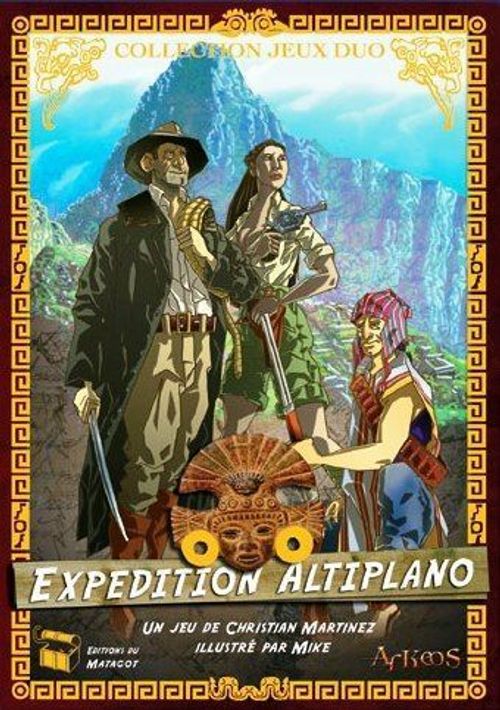
Expedition Altiplano
Expedition Altiplano Rulebook
Table of Contents
Table of Contents
- Overview
- Objective
- The Cards
- The Boards
- Definitions
- Game Setup
- Playing the Game
- Anatomy of a Card
- Special Cards: The Adventurer and The Rogue
- Drawing and Discarding Cards
- Playing a Card
- Playing an Action
- Placing a Character, a Location or a Treasure in the Camp
- Game End
- Advanced Rule: Expedition Assembly
- A Few Hints
- The Icons
Overview
Two archaeological expeditions are tied in a race to discover ancient Inca Treasures. These expeditions are composed of Characters who can be either Archaeologists or Raiders.
To discover a Treasure, an expedition must be at an archaeological site (a Location card). But there are only 5 Locations and 3 Treasures in the game... So you'd better use your characters' abilities wisely while throwing obstacles at your opponent...
The two Special cards, The Adventurer and The Rogue are also important. They allow players to steer the game toward exploration or aggression. Moreover, the most powerful Action cards can only be played if a player has one of these Special cards.
Objective
The first player who has two Treasures in his Camp wins the game.
The Cards
- 17 Character cards (3 types): Archaeologist, Raider, Neutral
- 34 Exploration cards (4 types): Location, Treasure, Action, Reaction
- 2 Special cards: The Adventurer, The Rogue
The Boards
The central board is placed between the two players. It has spaces for the Exploration cards draw pile and discard pile, the Character cards draw pile and discard pile, The Adventurer card space and The Rogue card space.
Each player has an individual board, which represents their Camp. It has 5 Character card spaces, a Location card space, a Treasure card space, a space for The Rogue card (left of the Camp) and a space for The Adventurer card (right of the Camp).
Definitions
- Character: Most of the Characters are Archaeologists or Raiders. Some are none, and one is both. Characters each have abilities.
- Action: Three kinds of card allow players to carry out Actions: Action cards, Character cards and Special cards. Note: Some Action cards bear a Beast icon or a Trap icon, allowing other cards to refer to them.
- Reaction: Reaction cards are the only cards that can be played during your opponent's turn. The text in purple tells precisely when these cards can be played. Some Characters have an ability which is used as a Reaction.
- Camp: Each player places a Camp board in front of him. The cards on and around this board constitute his Camp. The Camp can contain, at most:
- 5 Character cards
- 1 Location card
- 2 Special cards
- and 2 Treasures (the second one meaning victory).
- Exploration Cards: Action, Reaction, Location, Treasure. These are collectively called Exploration cards. They make up the Exploration draw pile.
Game Setup
- Place one Camp board in front of each player.
- Place the central board between the two players.
- Shuffle the two Players' Turn cards and deal one to each player. The player with the "First Turn" card begins the game. The "First Character" refers to the Expedition Assembly rule (explained below).
Character Cards Setup
- Shuffle the 17 Characters and deal 3 to each player to form the starting expeditions. These are put in the Camps, face up, in 3 of the 5 Character spaces.
- The rest of the Characters form the face down Character draw pile. This pile is placed on the Character draw pile space on the central board.
After your first game, it's more interesting to use the Expedition Assembly rule, located at the end of this booklet.
Special Cards
- Put the two Special cards, The Adventurer and The Rogue, face up on the central board. Assign them if necessary (depending on who has the most Archaeologists or Raiders, see Special Cards below).
Exploration Cards Setup
- Put aside the three Treasure cards.
- Shuffle the 31 remaining Exploration cards, deal 5 face down to each player; these are the starting hand. Hands can be viewed now.
- Build the Exploration draw pile (face down): set aside 5 Exploration cards face down, shuffle the 3 Treasures with the remaining Exploration cards, then put the 5 cards which were set aside on top of this deck. Place the deck on the Exploration draw pile space of the central board.
Playing the Game
Each player takes a full turn, then his opponent does, etc. On his turn, a player must proceed through the four phases in order. Phases 1 and 4 are mandatory. Phases 2 and 3 are optional.
Phase 1 (Draw - Mandatory)
You must draw a card. You may draw from the Exploration pile or from the Character pile.
Phase 2 (Action - Optional)
You may play one Action, choosing one of these three options:
- Play and then discard an Action card from your hand
- Use the Action (ability) of a Character in your Camp
- Use the Action of a Special card in your Camp (The Adventurer or The Rogue)
Phase 3 (Action or Place in Camp - Optional)
You may, if you wish:
- Play an Action again (as in Phase 2)
- or Place from your hand into your Camp: a Character, or a Location, or a Treasure.
Phase 4 (Check - Mandatory)
You must not have more than 5 cards in your hand at this moment. If you do, you must discard in order to keep only 5 cards.
Note: it is possible to play the same action in Phase 2 and in Phase 3, provided the card was not discarded after use.
Examples
- A player can use the Adventurer (Special card) Action to draw a card in phase 2, then use the same Action again in phase 3 to draw another card.
- A player can use Ohio Bob's Action to look for a Treasure in phase 2, and do the same Action in phase 3.
- A player cannot use the Storm card in phase 2 then again in phase 3, because Action cards are discarded after having been played.
- Likewise, Che Madera's Action can only be used once, because this card is discarded as part of its effect.
Anatomy of a Card
- Card's name
- Card's type icon: Character, Action, Reaction, Location, Treasure
- Character's ability
- Action or Reaction icon
- Condition text in purple: this card's ability can only be played when the text in purple allows it.
- Canceled beast or trap icon
Special Cards: The Adventurer and The Rogue
These two Special cards are not given permanently; their owner will change constantly during the game. Each player can have none, one or both cards in his Camp.
The Adventurer
At any time (even after Setup), if a player has more Archaeologists than his opponent in his Camp, he puts the card The Adventurer in his Camp. He can now use this card's Action during his turn. When a player becomes The Adventurer, he places the card in front of the blue space to the right of his camp.
The Rogue
The same rule applies to the player having the most Raiders and the card The Rogue. When a player becomes The Rogue, he places the card in front of the red space to the left of his camp.
Please note that these cards do not provide an additional Action, they merely give an additional option that can be used during Phase 2 and/or Phase 3. Example: a player is The Adventurer. He draws his phase 1 card, then he chooses to draw a card in phase 2 using The Adventurer card's Action, then he places a Character in his Camp in phase 3.
Lastly, these cards allow players to play Action cards requiring them to "be The Adventurer" or to "be The Rogue".
Drawing and Discarding Cards
- There are two distinct draw piles: one containing the Exploration cards (Action, Location and Treasure cards) and one containing the Character cards.
- The cards in the discard piles are face up.
- When a draw pile is empty, the discard pile is shuffled to build a new draw pile.
- Players can look in the discard piles at any time, but card order must not be changed.
- When a card says "I draw x cards" with no clarification about the drawn cards, the player chooses what he wants to draw (Exploration or Character cards). He can also draw some from each pile.
- When a card says "I reveal x cards", these are taken from the draw pile and put on the appropriate discard pile.
Playing a Card
- Cards are written in the first person: "I" is the player playing the card, and "you" his opponent. For example a player plays the Storm card and says: "Storm. I discard 2 random cards from your hand". He then takes 2 random cards from his opponent's hand and discards them.
- At least in the first few games, players should name the cards they play and read their text aloud, for clarity.
- Some cards bear a prerequisite icon followed by some red text. Prerequisites must be met in order to play the card.
- The player playing a card makes all the decisions required by the card. For example a player plays "Surprise attack. I discard one Character from your Camp". This player then chooses which Character is discarded from his opponent's Camp.
- Some Characters have abilities that are not Actions. Such abilities are self explanatory. Example: "Sir Allistair. I can keep in my hand 3 more cards in my phase 4".
- Reaction cards: Some cards or abilities can be played during your opponent's turn, when a specific event happens. This is signaled by purple text stating when the card can be played. Example: "I can use this ability when you play a Trap".
Playing an Action
- To play an Action or Reaction card, the player does the action described on the card and then discards the card.
- To play a Character Action, the Character must be present in the Camp and bear the Action icon followed by the Action text. Example: If I draw Ohio Bob, who can look for Treasures, I can only put him in my camp during Phase 3. This means that I will not be able to use his Action until next turn during Phase 2 or 3 ... if nothing bad happens to Bob before then ...
Placing a Character, a Location or a Treasure in the Camp
- These cards are put into play during Phase 3.
- A player cannot have more than 5 Characters in his Camp. If a player places a sixth Character in his Camp, he must first discard one of the 5 Characters present and discard him.
- To place a Location into play, you must not already have one (this is noted on the Location cards).
- To put a Treasure into play, you must have both an Archaeologist and a Location in your Camp. Then you must discard the Location (this is noted on the Treasure cards).
Game End
The game ends immediately when a player places his second Treasure in his Camp. This player wins the game.
Advanced Rule: Expedition Assembly
This optional rule can be used when both players know the Characters and their abilities.
Instead of dealing three Characters at random to each player, assemble the Expeditions in this way:
- The player who has been dealt the Player's Turn card noted "First Character" takes the 3 first Characters from the Character draw pile.
- He chooses one of these 3 Character cards and places it in his Camp, face down. He gives the 2 remaining Character cards to his opponent, who draws one more Character.
- This player chooses one of these 3 Character cards and places it face down in his Camp. Then he gives the 2 remaining cards to his opponent, who draws another Character again, etc.
- This process ends when each player has 3 Character cards in his Camp face down.
- The 2 remaining Character cards are shuffled in the Character draw pile.
- The 3 Character cards in front of each player are turned face up.
- If necessary distribute The Rogue and The Adventurer Special cards.
A Few Hints
Expedition Altiplano is a pulp adventure game. That means action, tension, plot twists, and also good and bad surprises... a mix of luck, tactics and strategy. Expedition Altiplano rules are only an engine for the game. In order to understand these tactical and strategic aspects you have to play a few games and know the cards.
Painting with very broad strokes, you can expect your first few games to look like this: 1st game: luck is prominent... 2nd game: more tactics... 3rd game: more strategy... 4th game: time to bluff!
Get the most of your two actions. Whatever you do, you only have two actions during your turn. Use them wisely and avoid losing one! The best way is to have a lot of characters in your camp: this alone gives you a wider array of possibilities. A lot of cards in your hand doesn't hurt either. Good preparation (drawing, placing in the camp) will help you sustain your actions in the long run and will give you an edge in reacting to different situations. But you must know when it's time for action and don't miss opportunities to outrun your opponent. So you only have two actions, but that means that you can always have two actions... Even if your opponent is leading, even when he's got a treasure in his hand, a comeback is always possible. Never despair in the face of adversity, that's what makes a hero!
Be creative. At the tactical level, you must look for opportunities and for possibilities. Without spoiling anything, even after many games, you will continue to discover new ways to use your cards, new combinations. Draw from the right pile: Exploration or Character? It's important to come back fast after serious character depletion, if only to keep your opponent from having both Special cards ... You must be able to tell a real offensive move from a mere "aggressive" one. In Expedition Altiplano, a move can be aggressive (for instance the elimination of a character), and yet not push you toward victory, or even be defensive.
Plan and adjust. The tactics must not hide the most important thing: strategy. It's always good to have a plan as soon as the very first turns begin, even if it's going to change. Considering the situation (yours and your opponent's), how can you find a treasure? What are the strengths and weaknesses of both players now? What is required for a decisive action and how to get it? It is necessary to answer these questions and it becomes easier when you know the cards well and when you have a good perception of the rhythm of the game.
Treasure in sight! One more for the trail: when two treasures have been discovered (one in each camp), you must know where the third one is at every moment! Is it in the draw pile, in the discard pile, in your opponent's hand? Never let it hide!
The Icons
- Character icons: Archaeologist; Raider; Archaeologist and Raider; Neutral (neither Archaeologist nor Raider)
- Action icons: Action; Beast Action; Trap Action; Canceled Beast Action; Canceled Trap Action; Reaction
- Location and Treasure icons: Location; Treasure
- Other icons: Prerequisite; The Rogue; The Adventurer