Exodus Trading Card Game: Converging Chasms
Exodus Trading Card Game: Converging Chasms Rulebook
Table of Contents
Table of Contents
Card Rulings
Roxanne the Final Paladin
- When Roxanne attacks, she deals damage equal to her energy to EVERY other creature on the field at once (both yours and your opponent's); her damage is NOT split up;
- When Roxanne attacks your opponent directly, she still deals and receives damage from your own creatures (if any are in play). The amount of energy she has when she declares the attack is the amount she deals to your opponent's Life Points;
- [NEW] In Multiplayer free-for-all format, Roxanne can attack an opponent directly that is wide open as her attack target, but she will still battle all other creatures in play (both yours and any opponent's);
- In a Multiplayer duel, Roxanne will attack and receive damage from every opponent's creature on the field, as well as your own;
- If Roxanne the Final Paladin attacks while the opponent has a Mistrai Driftwood on the field, and the player controlling Mistrai Driftwood activates its "Evanescent Hollow" Ability to let the attack pass through, Roxanne hits the opponent's Life Points directly and all other creatures in play, and takes damage from those other creatures (except Mistrai Driftwood, which survives);
- If multiple opponents have Mistrai Driftwood in play and they are all attacked by Roxanne, she deals damage to each opponent that chooses to let the attack pass through, while also battling any other creatures in play;
- When Roxanne attacks while a Victory, Keeper of the Order is on the field, Roxanne will hit Victory, and all non-Order type creatures, including your own creatures. Due to Victory's Ability, Roxanne cannot hit other Order type creatures;
- If the opponent has 2 Victory, Keeper of the Order when Roxanne attacks, Roxanne will only hit non-Order type creatures, as well as your own creatures;
Paladin's Parable
- When Paladin's Parable attacks another Paladin's Parable, the turn player / attacking player chooses which Parable's Ability resolves first;
- Due to the timing of both Abilities attempting to switch energy at the same time, the turn player decides the order of resolution—similar to how the turn player may choose the order of resolution of symmetry cards that unfreeze at the end of their turn.
Planetary Crag of the Cosmos
- Your other Shardfolk are considered "targeted" when your opponent uses an effect or Ability that lets them "choose" or "select";
- You cannot use this Ability against an effect or Ability that affects all other creatures in play (i.e. Roxanne the Final Paladin or Chaos Chasm, Eeventide Awoken);
- This Ability can be used to interrupt a symmetry because the text specifically says, "effect or Ability" and a symmetry is a type of effect;
- This Ability can be activated and used at any time as long as Planetary Crag of the Cosmos is on your field;
- If this Ability was used to redirect a target, it can still be responded to, however, it can continue to interrupt those new responses via Playback;
- This Ability can be activated and used at any time as long as Planetary Crag of the Cosmos is on your field;
- This Ability prohibits the opponent from choosing a new target by normal means, such as through Playback, because the text specifically states, "The target cannot be changed afterwards";
- If Planetary Crag of the Cosmos is already frozen and its Ability is used to redirect a freeze target to itself, the freeze will fizzle out due to Planetary Crag already being frozen;
Mistrai Driftwood
- If Roxanne the Final Paladin attacks while the opponent has a Mistrai Driftwood on the field, and the player controlling Mistrai Driftwood activates its "Evanescent Hollow" Ability to let the attack pass through, Roxanne hits the opponent's Life Points directly and all other creatures in play, and takes damage from those other creatures (except Mistrai Driftwood, which survives);
- If Drangel is on the field when a Common Dragon or Angel attacks Mistrai Driftwood, the Common Dragon or Angel still gains 1 energy from Drangel's Ability, even if Mistrai Driftwood's controller lets the attack pass through due to the original target being a Rare creature;
- When you declare a direct attack using Mistrai Driftwood's Ability while you have Howling Synthesis active on the field, resulting in you revealing a creature, and you switch Mistrai Driftwood with the revealed creature, the revealed creature comes into play & replaces Mistrai Driftwood "just before the attack hits". Any "enter play", "put into play" or "summon" Abilities on the new creature will trigger and resolve, and then that creature will continue on the same attack path originally declared by Mistrai Driftwood. The new creature will be destroyed along with all energy attached after the attack, since the entirety of Driftwood's Ability is implied (and Driftwood is no longer in play);
Amethyst Voidcap
- This creature's Ability will fail to resolve if it is activated in response to a Symmetry that causes a Deck Recycle (i.e. Starborn Outbreak). This is due to the fact that Symmetry speed is faster than speed of Creature Abilities;
- You can activate this Ability before or after card drawing occurs, but not during; (Example: if you need to draw 3 cards from Vortex or your Draw Phase, you can't draw 1 card, trigger Voidcap's Ability, and then draw the other 2);
Tanglewood Snag
- This creature's Ability can be activated at any time during your turn. But, if activated in response to a Symmetry, the Symmetry will still resolve first. This is due to the fact that Symmetry speed is faster than speed of Creature Abilities;
- If this creature's Ability is on the stack, and it leaves play, the Ability will fizzle when it comes time to resolve, since Tanglewood is no longer in play;
Embershard Siren
- This creature's Ability states, "When this creature WOULD be discarded from your hand, you may put it into play onto an existing blank pile of energy INSTEAD". Any discard effect such as Vortex, Cloudburst Spiral, Thoughts of Progress, Dimensional Destruction, Reevaluate, etc., will easily trigger its Ability and let you put it into play and destroy an energy. But since it is never actually discarded, it doesn't count as a discarded card. You wouldn't count it in the case of Reevaluate, and you would need to choose and discard a different card after its Ability resolves in the case of Dimensional Destruction or Thoughts of Progress;
Horncrest Cloudgorger
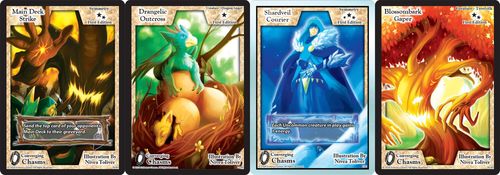
- [NEW] When this creature attacks and its Ability resolves, you or any player on your team may send the top card of the Main Deck to the graveyard to fulfill its requirement during Multiplayer or 2v2 format;
Ephemra the Star Shield
- If a 2nd Ephemra is drawn from this creature's "Guard Glare" Ability, it is still part of the starting hand during the start of the game, so the 2nd Ephemra's Ability will trigger, allowing you to draw an additional 2 cards from each deck;
- [NEW] Ephemra's Ability doesn't activate until after mulligans are completed in 2v2 format;
Turbine Apparatus
- Turbine Apparatus' "Reforge Parts" Ability is an all-or-nothing type of effect;
- Because its effect is broken up into 2 sentences, the first effect can't happen unless the second is possible and vice-versa;
- You must have at least 1 Machine-type creature in your graveyard to use this creature's Ability, otherwise, nothing happens when it is summoned;
- You may draw the 1 card from either the Main Deck or Energy Deck;
Starborn Outbreak
- Due to the wording, "Each player performs an immediate Deck Recycle", both players (or all in a Multiplayer game) MUST shuffle their Main Deck regardless of whether or not that player has any cards in their graveyard;
- This effect does not say "may" or "if possible", it simply instructs each player to do so. As such, this card should be treated as a "do as much as possible" type of effect;
Starsleet Downpour
- Once played, this card may only leave the field once the condition of "until one of your Rare creatures leaves play" is met. You may not discard it if there are no Rare creatures on your field that leave play;
Harmonized
- ALL of your creatures in play must share a type (even if they are multiple types) to use its effect;
Dragonis Warden
- You MUST have a creature in play to send to the bottom of the Main Deck in order to use this card effect;
Advanced Rules: Card Targeting and Playback
The following is reproduced from the publisher's Exodus TCG Advanced Rules Document. It is general to the game, not specific to this set, and is the rule set that Ability creatures use for their Pay costs and target changes.
Card Targeting + Timing
Card effects (both symmetry and creature) that have the key words: Pay, Select, or Freeze, require a legal target to be present on the field or hand in order to be played.
Key Word: Pay (+ Timing of Costs Paid)
The key word Pay refers to paying a cost before resolving the effect of a symmetry or creature Ability. The phrasing of Pay costs will be in form of "Pay X Energy" where "Energy" refers to energy cards that the activating player controls on their field or has in their hand. "X" refers to the amount of energy required for the cost. In order to activate the symmetry effect or creature Ability, the required number of energy must be present on the field or hand. Once a player activates an effect or Ability that requires energy as payment, the player must declare which energy is to be used (either from hand or field).
The requirements for Pay effects are discarded when the symmetry effect or creature Ability is being resolved. If the original payment target is no longer on the field upon resolution, the player must select another legal target to fulfill the required payment. If there are no legal targets to fulfill the Pay cost, then the symmetry effect or creature Ability does not resolve. (If a symmetry fails to resolve, the symmetry is placed in the graveyard.)
Cost(s) are not paid unless the card will definitely resolve; the cost is paid only after each player's priority window to respond has fully passed.
Key Word: Select
The key word Select refers to choosing a specific card before resolving the effect of a symmetry or creature Ability. The phrasing of Select will be in form of "Select one (creature/energy/card) on the (field/hand)", where "Creature/Energy/Card" refers to the card type or, in the case of "Card", any card given. "Field/Hand" refers to the location of the Selected card. Once a player activates a symmetry effect or creature Ability that requires a card to be Selected, the player must select a legal target from the given location.
If the original payment target is no longer on the field upon resolution, the player must choose another legal target to fulfill the required Selection. If there are no legal targets to fulfill Selection, then the symmetry effect or creature Ability does not resolve. (If a symmetry fails to resolve, the symmetry is placed in the graveyard.)
Select/Choose/Target are interchangeable terms and each definition is treated identically.
Playback Rule
The Playback Rule is a unique rule that triggers due to the game state being altered, allowing an action or effect/Ability to re-select or change targets following the resolution of a stack or response chain.
When a symmetry effect or creature Ability is played in response to your own action or symmetry effect or creature Ability involving targets, the card played most recently (on top of the stack) happens first. Then, any remaining cards that must resolve experience Playback and may change targets if the owner chooses.
Playback also occurs when a creature is attacking and another card effect interrupts or causes a target to change (or the state of the game to change). In this instance, Playback takes place and the attacking creature may change targets or stop attacking all together.