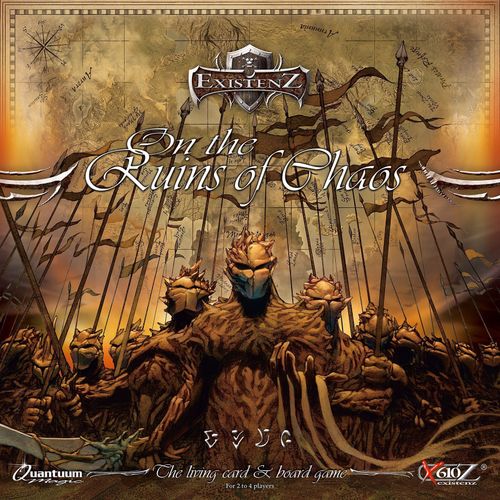
Existenz: On the Ruins of Chaos
Existenz: On the Ruins of Chaos Rulebook
Table of Contents
Table of Contents
Section I - Introduction
Living card & board game
X610Z: On the Ruins of Chaos can be played by up to 4 players in various challenging ways. Future expansions will add even more ways to play.
Book of rules
This book of rules is divided into five different sections: introduction, basics, playing the game, timing and resolving, and the glossary. These rules are all you need to know to start playing X610Z immediately. You can reference the different sections or the glossary whenever you wish. For comprehensive rules, visit www.x610z.com
What's in the box?
This game includes the following components:
- Book of rules
- Game board
- 4 Ready-to-play decks
- Quick reference sheet
- 4 Sets of playing pieces and counters
Game board: Besides showing you where to move your playing pieces, the game board also presents a map of the X610Z game world to track your adventures.
Cards: Each of the four card decks represents a different faction within the world of X610Z and offers you a unique corresponding playing style, so choose wisely! Each deck contains 50 cards, + 1 life base card.
Playing pieces: These represent specific cards, also known as 'summons': powerful monsters, constructs or warriors to aid you in your fight. Use one set of playing pieces of the same color for each player.
Counters: Use counters to keep track of certain playing conditions. For example, the amount of damage your summons have been dealt. Further use of counters will be explained in the glossary.
The story
Arnunnian librarians tell of an ancient time when forgotten science and technological wonder ruled the minds of man. Their unrelenting quest for progress eventually became their own undoing. A dangerous experiment involving unstable component X-6-10-Z resulted in the Chaos virus, causing strange mutations and destroying most forms of technology. Within a few years, the virus had plummeted the world into a new dark age.
Centuries have passed, this is the New Era. We rebuilt civilization on the ruins of Chaos. However, our constant struggle for survival and precious energy crystals soon divided us into factions. This conflict was centered on the slopes of Mount Vargah, prime harvesting ground of magical resources. To our surprise and dismay, this hostile volcanic land has now exploded in protest. Furious lava creatures rise from the molten stone to fight each faction, forcing them to flee and seek refuge in their homelands beyond the outer regions.
During the Great Flight, old feuds are settled between the factions... The Arnunnian Alliance has mastered magic and strikes with lightning speed, the Red Barbarian Brotherhood pursues with brutal and unrelenting force, the Pirate Confederacy cunningly sneaks past their opponents, while the Undead Legion's growing numbers threaten to overwhelm all that stand in their way.
We have to reach safety, or die trying.
Muljanii, high magistrate of the Arnunnian Alliance
Welcome to your existenz!
Map of the world
Choose your faction
Arnunnian Alliance: As a proud Sky Captain of the Arnunnian Alliance, your superior knowledge of magic enables you to outrun enemies and counter any attack. Nothing will block your path to victory as you use powerful fluxes to deny your opponent any hope of winning this battle. Are you up for glory?
Undead Legion: As a sinister Mystagogue to the King of the Undead, you recruit minions from the graves of the battlefield using necrotic energy. The stench of rotting flesh preceding your troops is a warning to all that lack the courage and stomach to face the horrors that you have unleashed. To you, each casualty is a reinforcement. Dig it?
Pirate Confederacy: As a cunning Pirate Prince of the Confederacy, you are a master of manipulation. Using stealth and deception, you surprise your enemy at every turn. By stealing from your enemies, and using their resources against them, you keep the opponent occupied while you escape to victory. Pirates make their own rules...savvy?
Red Barbarian Brotherhood: As a brutish Red Barbarian warlord you lead a brotherhood of battle-hardened madmen and fierce monstrous creatures. You invoke scorching fluxes to incinerate all that would bring you dishonor, while your berserkers set themselves aflame with rage and fire. Can you stand the heat?
Section II - The Basics
Even a brave Sky Captain starts his training with the basics. Luckily, the basic game mechanics of X610Z are simple. Once you know how to use the cards, you are almost ready to start playing!
Summons and playing pieces
In the world of X610Z you use energy crystals to fuel arcane rituals and newly discovered technomancy. This energy allows you to control creatures of tremendous power, such as dragons, and constructs of awe-inspiring size, such as magical airships.
The product of these rituals is called a 'summon'. Each player may only have one summon of the six different types in play at any one time.
Life base summon: You start the game with your life base, and its corresponding card, already in play. This is your most important summon as it represents your moving seat of power. From here you call forth non-life base summons (NLB summons) to protect your life base, or obliterate the life base of your enemy.
Non-life base summons: To destroy your opponent's life base and protect your own, you are able to call upon five different types of summons to aid in your battle: dragons, vessels, armies, berserkers, and beasts. These are collectively called 'non-life base summons' (NLB summons) and each is represented by its own unique playing piece.
Dragon: The Sky Captains of Arnunnia used energy crystals to create a powerful race of dragons. While this secret has been lost ever since, those with sufficient knowledge and power are still able to call upon these majestic creatures.
Vessel: The world below is a dangerous place filled with natural hazards and hungry predators. Therefore, the factions use flying airships or magically altered creatures to travel by air. As most routes are contended, air battles are a common sight.
Army: Whether it be the mutated warriors of the Red Barbarian Brotherhood or the flesh eating zombies of the Undead Legion, the world trembles with the sound of advancing armies. Marching, singing, doing their duty until death.
Berserker: Frenzied carriers of the Chaos spark: a lingering residue of the Chaos virus granting tremendous physical strength at the cost of sanity. Berserkers use the energy from crystals to fuel their spark, or risk being consumed by their rage.
Beast: Mutated animals of enormous size that are used as working animals, assault weapons and walking artillery. Some are so gigantic that entire villages have grown on their backs.
Game board and dots
The game board is filled with all manner of dots. Move and attack with your summons, following the lines that connect these dots. Each dot counts as 1 step. Dots cannot be occupied by more than one summon.
Type of dots: The different dots on the game board represent the heroic waymarks on your travels through the world of X610Z. They allow the controller of a life base, such as yourself, to navigate from the dangers of Mount Vargah to the safety of the outer regions, while marking the locations of warpstorms and future quests.
- Start dot: Your life base begins play on one of the start dots. Any NLB summon you cast can also be placed here. Only summons you yourself control can be moved to, or placed on, your start dot. Finally, start dots also count as "no-attack dots" and "warp dots".
- End dot: Win the game by being the first player to move a life base summon to one of the end dots. At the end of each turn, destroy all NLB summons standing on an end dot.
- No-attack dot: A summon placed on this dot can't attack or be attacked by other summons. However, they can be dealt damage as the result of a card effect or an ability.
- Warp dot: Any NLB summon you cast can also be placed here. You may warp your NLB summon directly from your start dot to any of the warp dots, or from any of the warp dots to your own start dot.
- Quest dot: Some card effects and abilities affect quest dots. In the future we will introduce quest cards, offering new game mechanics and alternative game objectives involving these dots.
- White dot: Normal movement dots without additional rules.
The cards
Your cards represent the magical arsenal you use to manipulate the course of the game. Not all cards remain in play after casting. This depends on whether it's a permanent or a non-permanent card.
Non-permanent: You can cast non-permanent cards during any player's turn. Non-permanent cards are put into the discard pile after they resolve.
Permanent: You can only cast permanent cards during your own turn. After a permanent card resolves, it is put into play. From that moment on you can activate and use it. Permanents remain in play until sacrificed, forced to be taken back into hand or destroyed by any game or card effect.
Card types
- Flux (non-permanent)
- Catalyst (permanent)
- Energy crystal (permanent)
- Summon (permanent)
Flux cards represent magical formulae that normally have effects of short duration. You cast a flux card from hand, resolve its effects, and then place it in your discard pile.
Catalyst cards represent stable rituals of arcane power that have effects of longer duration. A catalyst can have three different kinds of effects: activated, triggered or continuous. (Explained on page 25.) Most catalysts can be in play by themselves, just like summons.
Focus: A catalyst with the word "focus" in its specification box can only be in play if focused on (attached to) other permanents. This focus also tells you what kind of targets a cast catalyst can be attached to. For example, "Focus: Summon", means you can target any summon in play. Place the focused catalyst so that it is touching the card it is focused on.
A catalyst that is focused on another permanent card is destroyed (put into the discard pile) if the card it is focused on leaves play.
Energy crystal cards represent the wild and dangerous flows of energy you need in order to move summons, cast cards and activate effects or abilities. There are 4 different types of energy crystals: quickening boost, entrancing mystic, addictive robiumm and maddening halos. Each turn, you can only bring one energy crystal card into play.
Summon cards represent fearsome dragons, lumbering arcane constructs and monstrous undead creations, examples of the forces at your disposal. You can only have one summon of each type in your control. (Control is explained on page 16.) Each summon has its own basic stats:
- Attack power: The amount of damage a summon does with a single attack.
- Defense: The amount of damage a summon can sustain before being destroyed.
- Speed: The maximum distance in dots a summon can move in a single movement.
- Range: The maximum distance in dots from which a summon is able to declare an attack on another summon.
Ability: Summons can have abilities. An example of an ability: "[Move and attack in all directions]". (Abilities are explained on page 24.)
Note: No basic stat can ever decrease below 0. A summon that doesn't show a particular basic stat symbol cannot use that stat, nor will it ever be able to.
Card anatomy
- Card name: The name of a card.
- Casting cost: These symbols tell you the energy cost to cast a card. You use energy crystals to release the appropriate energy needed to pay the casting cost of a card. If the casting cost is C1 M2, you pay 1 energy of any type, plus 2 mystic energy.
- Specifications box: This box tells you the type and deck restriction of a card. If the card has a summon type, element, crew or focus, it will be listed in this space.
- Card type: There are four different card types: energy crystals, fluxes, catalysts and summons.
- Summon type: There are six summon types: life bases, beasts, dragons, vessels, armies and berserkers. You can never have more than one summon of each type in your control.
- Element: Each summon has an affinity with one or more alchemical elements: fire, water, earth, air and electricity. A summon can have one or more elements. Life bases can never have an element.
- Crew: Some effects or abilities only affect cards of a specific crew type. However, for the purposes of X610Z: On the Ruins of Chaos, this function can be ignored.
- Focus: Catalysts with a focus require a specific target to attach themselves to. For example, if a card states "Focus: NLB summon", you can only target a NLB summon.
- Deck restriction: When expanding or modifying your deck, this number tells you how many copies of a card you may include in your deck.
- Action panel: Here you will find a card's effect explained and any costs needed to activate or use it. It also shows you the basic stats and energy cost to move a summon card.
The toolbox
How to activate a card: A card enters play in a reactivated state (as shown on the right). To use one of your cards in play showing a R symbol, turn it 90 degrees to indicate its activated state. You cannot use a card until it returns to a reactivated state, which you may normally do at the start of your turn.
When a card becomes deactivated, it is put into an activated state but without using its effect.
How to use energy crystals: The energy released by energy crystals is the prime resource of X610Z. Nearly every action in the game, from casting cards to moving your summons, requires an energy cost. You may release energy by activating energy crystals in order to pay for these costs. This released energy is stored in your energy pool. Any unused energy remains in your energy pool until end of turn.
In each of your turns you can place one energy crystal from your hand into your control.
Casting cost: The energy required to cast a card is stated in the top right corner of the card. Different types and specific amounts of energy may be required. For example, a card stating C2 B2 M1 R1, requires 2 energy of any type, 2 boost energy, 1 mystic energy and 1 robiumm energy to cast. A colorless energy requirement can be paid with any type of energy. However, colorless energy can only be used to pay colorless energy costs.
Other costs: Other actions may also have a cost, like activating an activated effect, using a summon's ability or moving a summon. This activation cost, ability cost and movement cost is stated in the card's action panel. Examples of the most common costs are: paying energy, discarding cards, sacrificing cards or activating (R) the card.
How to cast a card: Casting a card takes place in the following sequence:
- Take the card from your hand and show it to the other player(s).
- If the card has a target, you choose a target. You decide if you want to use any additional effects.
- Activate the energy crystals you need in order to pay the cost.
- Other player(s) may respond.
- The card resolves. If the card is a flux (non-permanent) it now takes effect and is put in the discard pile afterwards. If the card is a summon or catalyst (permanents) you place the card face up on the table in front of you. In case of a summon you also place the corresponding playing piece on either your own start dot or one of the warp dots. This dot must be unoccupied.
How to activate an effect: This works almost the same as casting a card:
- Activate the permanent with an activated effect you want to use.
- You might have a few choices to make (see point 2 of casting a card).
- Pay the cost (see point 3 of casting a card).
- Other player(s) may respond.
- The effect resolves.
How to target something: If an effect or ability tells you to choose one or more targets, choose one or more targets that are in play and follow the target requirements. A few examples of target requirements:
- target player: you can target any player (including yourself)
- target summon: you can target any summon, including a life base
- target NLB summon: you can target any summon that is not also a life base
- target energy crystal: you can target any energy crystal
- target catalyst: you can target any catalyst
You announce a card's target the moment you cast it. You announce the target of an ability or effect the moment you activate them. If there is no legal target, the effect or ability can't take place.
If a card's target becomes illegal during play, it is put in the discard pile in case of a non-permanent, and remains in play in case of a permanent.
Game zones
During a game of X610Z, your cards can be in any one of the six game zones:
- Deck: Each player has his own deck to draw cards from. Keep your deck face down with the cards staying in the order they were in at the start of the game. You may not look at the cards in other player's decks, but are allowed to know how many cards are in each deck.
- Hand: Each player has his own hand of cards. Only you may look at these cards. When you draw cards, you take them into your hand. At the start of the game you draw seven cards. Your maximum hand size is seven: you can have more than seven cards in your hand, but must discard down to seven at the end of your turn. Finally, cards are cast from your hand.
- Stack: This zone is shared by all players. When you declare an action, the card used in this action is put on the stack. Here it waits to be resolved. All players may respond with their own actions in a clockwise order. When all players pass in a row, the last action on the stack resolves.
- Play: Each player has his own play zone. You start the game with your life base already in play. In each turn you may place one energy crystal card which directly enters play. Your catalysts and summons enter play after resolving and are then ready for use. All cards in play are called permanents. You may arrange your permanents however you want, as long as they are in view of your opponent.
- Discard pile: Each player has a discard pile. Your cards go here when a game or card effect causes them to be destroyed, sacrificed, discarded, canceled or prevented. Fluxes go to your discard pile immediately after resolving. Always place cards face up in your discard pile. Any player may look at these cards at any time.
- Removed-from-game: Place a card here if an effect removes it from the game. Cards in this zone remain there for the duration of the game, unless a card effect is able to bring it back.
Owner / controller: You are considered the owner of any card from your deck. If another player takes control of one of your permanents, you are still its owner, but no longer its controller. Any card in your control is in your play zone. You are the player that gets to make decisions regarding that card. Your opponent can take control of a card in your play zone with a card effect. In that case the card is moved to your opponent's play zone. However, if any of your cards (controlled by your opponent) are sent to the discard pile, or returned to hand or deck, they are always returned to the hand or deck of the card's owner.
Section III - Playing the Game
Setup of a game
At the start of the game each player chooses one of the four decks.
You can enhance your deck with powerful booster packs available at your friendly local gaming store, but for now you should stick with these decks. Use the handy quick reference sheet included in the box to help you along in your first few games. Make sure the counters are within hand's reach of every player.
- Randomly determine the starting player by a die roll, coin flip or fight to the death.
- Each player takes the life base from his or her deck and places it on the game board, along with its corresponding playing piece as shown in the visual below. When playing 2 vs 2, the players of the starting team place their life base playing pieces at A. The players of the other team place their life base playing pieces at B.
- Each player shuffles his deck, places it face down and draws seven cards from the top. Everyone is free to cut each others deck after shuffling.
- If you are not satisfied with your starting hand, you can use Murphy's Law: shuffle your hand into your deck and draw 7 new cards. This first use of Murphy's Law is free, but each subsequent use forces you to draw one fewer card.
- The battle begins when all players decide to keep their starting hand. The first player starts his turn with the draw phase. (The phases of a turn are explained further on page 20.) During the game, the player whose turn it is, is called the active player. The other players are called reactive players.
The setup diagrams in the book show four layouts: 1vs1, Free for all 3, Team 2vs2 and Free for all 4.
Game objectives
In a game of X610Z, you and your opponents are engaged in a hard-fought battle for the survival of your faction. There are several ways to achieve victory on the battlefield:
- Escape Victory: Be the first to move your life base to one of the end dots on the game board and leave your opponents cowering in your wake.
- Destruction Victory: Destroy your opponent's life base. Your opponent loses the game when his life base sustains damage equal to or exceeding its defense basic stat. Be the last man standing!
- Depletion Victory: When your opponent has no cards left in his deck to draw, he is immediately eliminated from the game.
Multiplayer variants
There are several ways to play X610Z with more than two players.
- Free-for-all: Every man for himself!
- Team Play: 2 vs 2
If any player meets any of the objectives in Team Play, his team wins. The same applies to meeting any of the losing conditions.
Future expansions will add even more exciting ways to play!
Phases of a turn
X610Z is played over a series of turns. Players take turns in a clockwise order. Each turn follows four phases:
-
Reactivation phase: You reactivate (turn upright) all cards in your control.
-
Draw phase: You draw a card from your deck.
-
Action phase: You have priority and may take the following actions in any order:
- Place one energy crystal card into play.
- Cast any number of summons, catalysts and fluxes.
- Move and/or attack with your summons.
- Activate effects and abilities.
During the action phase your opponent may respond to your actions with fluxes or by activating effects and abilities. When no player declares another action, the action phase ends.
-
End phase: Your opponent has priority. All players may cast fluxes and activate effects and abilities. When no player takes another action, your turn ends and the next player starts his turn. (becomes the active player)
Action table
This table shows you which actions can be taken in which phase by the Active player (A) and Reactive player(s) (R).
Columns, in order: Reactivation (A, R), Draw (A, R), Action (A, R), End (A, R). Mark = the action may be taken by that player in that phase.
- Priority
- Who gets priority first: Draw (A), Action (A), End (R)
- Stackable actions
- Attack with summons: Action (A)
- Move summons: Action (A)
- Cast permanents: Action (A)
- Cast non-permanents: Action (A, R), End (A, R)
- Activate effects: Action (A, R), End (A, R)
- Activate abilities: Action (A, R), End (A, R)
- Use paid abilities: Action (A, R), End (A, R)
- Triggered effects: Draw (A, R), Action (A, R), End (A, R)
- Triggered abilities: Draw (A, R), Action (A, R), End (A, R)
- Non-stackable actions
- Place one energy crystal: Action (A)
- Activate energy crystals to produce energy: Draw (A, R), Action (A, R), End (A, R)
- Use energy to pay costs: Draw (A, R), Action (A, R), End (A, R)
Combat: moving and attacking
Since combat is the likely outcome of every conflict in the world of X610Z, you should know how to move and attack with your summons.
How to move a summon: Most summons require the use of energy crystals to move. This is stated in the summon card's action panel as "R cost: Move". During your action phase, you may move all your summons, as long as you are able to pay the cost.
- Pay the movement cost and activate the corresponding summon card.
- Declare to which dot you want to move.
- The movement is now on the stack.
- The movement resolves.
Movement rules
Speed: For each 1 speed a summon has, you can move it 1 dot. A summon with speed 3 can move either 1, 2 or 3 dots. You can move a summon passed another summon as long as it has enough speed to do so.
Some summons have the ability "[Block rate X]": for each X block rate it has, the dot it occupies counts as X more dots. Block rate affects a summon's range in the same manner.
Direction: You can't move a summon around sharp corners (corners of less than 90 degrees). If your summon has already attacked in one direction this turn, your movement must follow the path of the attack.
Warping: Through powerful warpstorms you can move a NLB summon from your start dot directly to one of the warp dots, or from one of the warp dots directly to your start dot. This is called "warping". Warping a summon counts as moving 1 dot.
How to attack with a summon: During your turn, you may attack once with each summon you control. This doesn't require any energy, nor the activation of the summon card. You may attack before or after moving the summon.
- Declare which of your summons is going to attack.
- Declare the target of the attack.
- The attack is now on the stack.
- The attack resolves.
Attack rules
Range: You can declare an attack if an opponent's summon is within range of your attacking summon. To determine this, count the dots between your summon and the target, including the dot the target is placed on.
Direction: A summon can't attack around sharp corners. If your summon has already moved in one direction this turn, your attack must follow the path of the previous movement.
No-attack dots and warp dots: A summon on a no-attack dot can't attack or be attacked. A summon cannot attack through warp dots.
Attack power and dealing damage: When an attack resolves, the target is dealt an amount of damage equal to the attack power of the attacking summon. To indicate the damage done to a summon, place damage counters on the card. Dealt damage is permanent, although it can be healed by certain card effects.
Destroying a summon: A summon is destroyed when its total damage equals or exceeds its defense. Remove the playing piece from the game board and put the summon card into the discard pile.
Summon abilities
As you use summons on the battlefield, you will find that their different abilities greatly influence the course of the game. A summon can have four different kinds of abilities, each used in a different manner. Only activated and paid abilities can be used whenever you choose to.
Activated ability: These abilities need to be activated in order to use them. They can be used whenever you want, as long as the summon is in a reactivated state and you are able to pay the cost. These are stated as "[R cost: Ability]" or "[R: Ability]" if there is no cost.
How to use an activated ability:
- Pay the cost and activate the summon.
- Some abilities require a target. If no target is required, it affects the summon itself.
- The activation of the ability is now on the stack.
Paid ability: A paid ability doesn't require the activation of the summon to use the ability. You just have to pay the cost in order to use it. This is stated as "[Cost: Ability]". A paid ability can be used during any player's turn, but only once until your next turn.
Triggered ability: These abilities happen (are triggered) when a specific game event or game state matches the trigger condition of the ability. They are stated as "[Trigger condition: Ability]".
Continuous ability: These abilities are in effect all the time rather than having to be activated, triggered or paid. They have their effect for as long as the summon is in play.
Card effects
Fluxes, catalysts and even some energy crystals can have effects. Card effects also have a great impact on the game. Let's take a closer look at them.
Effects in general: Some cards have an additional effect that is always optional. The controller decides to use it or not. An additional cost is sometimes required to use this effect. Some cards show more than one effect. In case of such effects, you choose one of the effects you are using. Card effects are divided into two basic categories: non-permanent card effects and permanent card effects.
Non-permanent card effects: These cards are cast from hand, their effects are resolved, and are placed in their owner's discard pile. Most of these effects will apply to the game once, and then be done. For example: "Draw 2 cards". Non-permanents can also have continuous effects. These apply to the game for a longer duration. The effect's text will tell you how long a continuous effect lasts. For example, it might say "until end of turn".
Permanent card effects: These cards enter play when they resolve. Similar to a summon's ability, as long as they remain in play, their effects can be activated, triggered or constantly having an effect on the game.
Activated effect: These effects are used in the same way as activated abilities.
Triggered effect: These effects are used in the same way as triggered abilities.
Continuous effect: These effects are used in the same way as continuous abilities.
Section IV - Timing and Resolving
The stack and priority
Now you know the basics, you must be eager to control your life base, assemble an army and join the fight! However, there is one final rule you should learn. When skillfully applied, it could even give you the upper hand in battle by timing your actions just right: the Stack and Priority.
The stack: The zone where your declared actions, like using your summon's ability or activating an effect, wait to be resolved. When you want to do something after another player takes an action, but before that action affects the game, you make use of the stack. Correspondingly, non-stackable actions take place immediately, meaning players can't respond to them.
Stackable actions (opponents may respond):
- Casting a card
- Activating an activated effect
- Move a summon
- Attacking with a summon
- Using a summon's ability
- A triggered effect or ability
Non-stackable actions (opponents can't respond):
- Place an energy crystal
- Activating an energy crystal to release energy
- Using energy to pay energy costs
Note: Some effects of catalysts, fluxes or the abilities of summons also produce energy. Actions that produce energy, without involving the activation of an energy crystal, are stackable.
Priority: Since you may respond to the actions taken in another player's turn, the priority rule determines which player can declare the next action to go on the stack.
Resolving the stack
During the action phase the active player gets priority when declaring an action or passing (do nothing). After declaring an action or passing, the next player gets priority, and so on. In a multiplayer or team game, players get priority in a clockwise order.
When all players pass in a row, the stack has to be resolved. Start with resolving the last declared action (the one 'on top' of the stack), and work your way down. When the stack is resolved, the active player gets priority again for any new actions.
When all players pass in a row with no actions waiting on the stack, the action phase ends and the end phase begins.
In the end phase the reactive player always gets priority. When all players pass in a row with no actions waiting on the stack, the end phase ends, and the next player takes his turn (becomes the active player).
Example of a stack
- Your opponent declares an attack with his Howling Bogling targeting your Living Waterfall (having only 1 defense left). The attack goes on the stack.
- You respond by casting Healing Elixir on your Living Waterfall. Healing Elixir goes on top of the stack.
- Healing Elixir resolves first, since it entered last and is 'on top' of the stack. It heals your Living Waterfall for 8.
- The attack of Howling Bogling resolves, dealing 3 damage to your Living Waterfall, which is not enough to destroy it.
You and your opponent both pass in a row. No more actions go on the stack. The stack now resolves.
As you can see, the timing of your actions will be very important in the countless battles ahead. It's always good to have a trick up your sleeve!
Section V - Glossary
Activate: The cost to use some abilities or effects. To activate a card, turn it sideways.
Attack power: The amount of damage a summon does with a single attack.
Casting cost symbols:
- B1 stands for 1 boost energy
- M1 stands for 1 mystic energy
- R1 stands for 1 robiumm energy
- H1 stands for 1 halos energy
- C1 stands for 1 colorless energy
Catalyst: Cards that have effects of longer duration. They can be activated, triggered or continuous.
Control: You control all cards in your play zone, including cards and effects that you put on the stack.
Damage: Damage is dealt to summons through combat, effects or abilities.
Deactivate: To put a card into an activated state without using its effect.
Defense: The amount of damage a summon can sustain before being destroyed.
Destroy: Summons are destroyed when they have taken damage equal to or greater than their defense. Effects and abilities can also destroy permanents. When a permanent is destroyed it is put into its owner's discard pile.
Discard: To take a card from your hand and put it into your discard pile.
Enter play: When a card or effect resolves from the stack, it "enters play".
Flux: Cards that normally have effects of short duration. They are cast from hand, resolved, and then placed on your discard pile.
Focus: This tells you what kind of targets a cast catalyst can be attached to.
Heal: When healing damage from a summon, remove the described amount of damage. You can only heal damage that has already been dealt.
Leave play: A card leaves play when it moves from the play zone to any other zone. For example, when it's destroyed, removed from the game, returned to owner's hand or put into the discard pile.
Murphy's Law: At the start of the game you may shuffle your hand into your deck and draw 7 new cards. This first use of Murphy's Law is free, but each subsequent use forces you to draw one fewer card.
Range: The maximum distance in dots from which a summon is able to declare an attack on another summon.
Reactivate: To turn an activated card upright into a reactivated state.
Removed from game: To remove something from the game, take it from its current zone and move it to the removed from game zone.
Resolve: When there are no responses to the last action on the stack, it resolves and has its impact on the game.
Respond: Players can respond to actions on the stack with those of their own. That response will have an impact on the game before the original action.
Sacrifice: If a card's effect instructs a player to sacrifice a permanent, the card is placed in its owner's discard pile. You can only sacrifice permanents you control. You can't sacrifice energy crystals you don't own.
Search: Look through your deck for the described card and shuffle your deck afterward.
Speed: The maximum distance in dots a summon can move in a single movement.
Summon: Your summon cards represent creatures that fight for you. You can only have one summon of each type in your control.
Target: If a card tells you to choose a target, choose a target by following the target requirements. Announce the target of an ability or effect when you activate them. If there is no legal target, the effect or ability can't take place.
The stack: This is where actions go before resolving. You use it to keep track of the order in which actions are added to it.
Counters: Some effects and abilities tell you to put counters on a permanent. There are four different types:
Damage counters: Use damage counters to keep track of the amount of damage your summons have been dealt.
Activation counters: Remove one activation counter every time you activate a permanent with activation counters on it. When you remove the last activation counter from a permanent, it is put into the discard pile after its effect is resolved.
Time counters: In each of your reactivation phases, remove 1 time counter from each permanent that has time counters on it. When you remove the last time counter from a permanent, it is put into the discard pile.
Charge counters: Charge counters have different workings. A card's effect defines the function of the charge counter.
More cards, more glory!
'On the Ruins of Chaos' is a stand-alone version of the X610Z Trading Card & Board Game, presenting a selection of cards from Act I: The New Era, Act II: Spoils of War and Act III: Soul Rage. You can easily add other cards from these Acts to your deck and create an even more challenging playing experience. These are sold in booster packs containing a number of random collectible cards. X610Z booster packs are available at your friendly local gaming store.
You can also look at all available cards on our website: www.X610Z.com
The New Era: In Act 1: The New Era the old gives way to new as four powerful factions rise from the ashes of the Arnunnian Empire. As the Pirate Confederacy, Red Barbarian Brotherhood, Undead Legion and the Arnunnian Alliance do battle, the Catalyst War draws to its world-shattering conclusion.
Spoils of War: In Act 2: Spoils of War new conflicts arise from the discovery of jealously coveted Robiumm energy crystals. The very land itself rises up in protest as Mount Vargah's primordial armies march upon the four factions. Can they survive the elemental onslaught?
Soul Rage: In Act 3: Soul Rage the primordials have decimated the factions, forcing them into an uneasy alliance. Summoning their bravest adventurers, they mount a desperate expedition to free the divine spirits of the Ancient Portal. The fate of a world hangs in the balance.