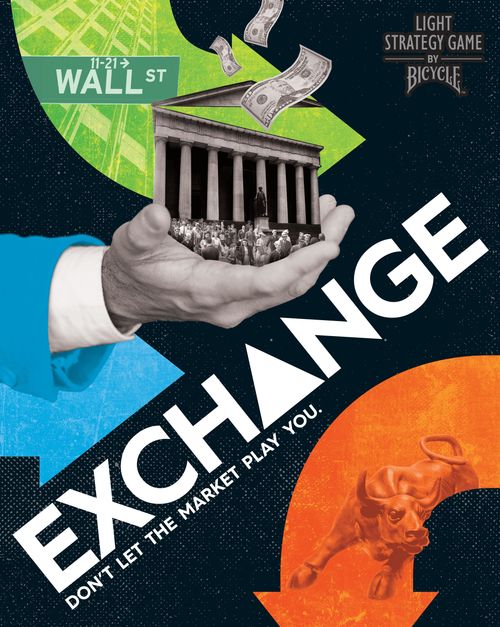
Exchange
Exchange Rulebook
Table of Contents
Table of Contents
Game Setup
Start by placing the Market Value Board in the center of the table. Next, place the 15 Market Forces Cards face down in a stack to the left of the Market Board, and place the Lobbyist sleeve with a set of three Phase 3 cards inside to the right. Then, place the Money Cards in three separate stacks beneath the Market Value Board. Finally, place the tokens for each security (Banks, Insurance, and Bonds) on the board starting at $50 per share and place the triangular Round Token on the 1 space of the bottom of the board.
Next, pass each player a Ledger Board, Phase Cards and 3 Phase Sleeves. Each player should have the following:
- Phase 1 (Banks, Insurance, & Bonds)
- Phase 2 (Cards valued 1-9)
- Phase 3 (Banks +/- 1, Insurance +/- 1, & Bonds +/- 1)
Lastly, randomly deal the Founder Cards to each player until all cards have been dealt. Players then choose which founder they would like to start the game as, discarding the others, and placing a marker on the corresponding number for each security on their Ledger Board, along with the cash listed on the bottom of their Founder Card.
All founders featured on the Founder Cards are actual signers of the Buttonwood Agreement.
Game Play
The game lasts 5 rounds. Each round consists of 3 phases of buying and selling securities and follows this pattern: Phase 1: Security Selection; Phase 2: Buy/Sell; Phase 3: Market Influence; Market Forces Card; Adjust Market; Buy & Sell Securities.
The price of the security is determined by the Market Value board, which ranges in value from $10-90 per share, and the price of the securities will change over the course of the round. Despite making decisions early in phases, players buy or sell based on the price at the end of the round. When buying or selling securities, players trade with the exchange (not with each other).
Each round, players make a series of three decisions.
- Phase 1: Decide which security to trade (Banks, Insurance, Bonds).
- Phase 2: Decide whether to buy or sell, and how many shares to buy or sell. This will not be revealed until the end of the round.
- Phase 3: Influence the market by raising or lowering the value of a chosen security.
During each phase, a player selects the card they would like to play from the available cards in that phase sleeve. After the selection is made, rotate the card to ensure that the desired action is on top. Then place that card in the phase sleeve so that only the top is visible. Place the selection face down on the table, until all players have made their selection, and reveal simultaneously.
Adjusting the Market Value
After all three phases, draw the top Market Forces card. Then, adjust the Market Value Board, by moving each security token up or down the board based on cumulative effect of the Market Influence Phase (Phase 3) with adding the effect of the Market Forces Card into account.
Example: Insurance is decreased by 1 and moves from $70 per share to $60. Bonds is increased by 2 and will go from $20 per share to $40.
After adjusting the market, players reveal the amount of securities being bought or sold (from Phase 2). Players adjust their ledger boards and pay or receive money from the piles in the center of the table.
The Market Bubble
If a security increases above the highest value or drops below the lowest value, the Market Bubble "pops" and the price of that security will flip to the other side of the board, resulting in a huge shift in price.
Example: Banks is increased by 2. The first move pops the bubble and flips to $10 per share. The second move increases the price to $20.
Note: In games with 3 or 4 players, the Market Value board only goes from $20-$80. If the price exceeds either of these values, the bubble pops rather than going to $90 or $10 per share.
Market Intelligence & the Lobbyist
There are two ways to gain an upper hand on opponents. The first is Market Intelligence. Any player may pay $50 at any time to look at the top Market Forces card. Replace on the top of the deck after reading.
The second is the Lobbyist. Whoever controls the Lobbyist uses the Lobbyist Cards to cast a second vote during the Market Influence Phase (Phase 3). Each round, the player with the most cash (not net worth) controls the Lobbyist for that round.
Note: The Lobbyist is not active during Round 1 or the Market Close.
Market Close
The game lasts 5 rounds. After the fifth and final round, each player gets one last chance to influence the market. This is called the Final Influence. Each player casts one final Market Influence (Phase 3 vote) before the final net worth is calculated.
Note: Neither the Lobbyist nor the Market Forces cards is used here.
After the Final Influence, adjust the market one final time. Each player calculates their net worth based on their cash and the value of the securities they own.
Example: the winning player ends with a total net worth of $1,490.
- Banks: 6 shares x $20 / share = $120
- Bonds: 0 shares x $40 / share = $0
- Insurance: 14 shares x $70 / share = $980
- Cash: $40 + $150 + $200 = $390
- Total Net Worth = $1,490
Tips & Tricks
Buy Low & Sell High
This may seem like an obvious strategy. For beginner players, understanding this basic principle is all that is needed to be successful. This means when planning to buy a security, you generally want that price to go down. Therefore, vote to move the price -1 during Phase 3. Likewise, when planning to sell a security it is best to vote the price to go up (+1).
As long as players keep the risk of the Market Bubble in mind, this simple strategy is a safe, consistent way to learn the game and be competitive.
Pop the Bubble
The Market Bubble enhances volatility in the game. It provides the opportunity to either achieve the greatest gains or suffer the worst losses. Playing securities near the bubble can be a great way to buy lots of shares at a low price and quickly flip them for a big reward.
However, this is not without risk. Other players may see this threat and intervene to prevent you from cashing out on your security for a big pay day or making a run on a security at a great price.
Read the Room
Perhaps the greatest unknown in this game is the people who are sitting at the table with you. Pay attention to how others are playing and learn their tactics and tendencies. Take a moment between phases to look at your opponent's decisions, cash position and ledger board. The one who can best predict the actions of their opponents and act accordingly is the player with the best chance at winding up on top.
Frequently Asked Questions
Do I choose all three phases at the same time? No. The selections for each phase are chosen and revealed one at a time. All players choose Phase 1 simultaneously, then reveal, before moving on to choosing Phase 2. This allows players to base their next move on the cards shown by players in previous phases.
Do my Phase 1 and Phase 3 decisions have to be the same? No. Phase 1 decisions have no bearing on Phase 3. Players can make their decision based on what will benefit them most, set them up for future rounds, or foil the plans of an opponent.
What happens if I cannot afford the amount of shares I am trying to buy? If a player cannot pay for the securities they are trying to buy, they must liquidate their existing assets to pay off the debt. When liquidating, a player may sell existing assets at half their current market value. If the final dollar amount doesn't end in a multiple of 10, round up.
Example: if you are liquidating 3 Insurance shares at $70 a share, you get half of $70 ($35) multiplied by 3 shares ($35 x 3 = $105). Then round up for a total of $110 that you can use to pay off the debt.
If even after liquidating all existing assets a player is still unable to purchase their security, that player is eliminated from the game.
Can I sell more shares than I own? No. If a player, whether on purpose or by accident, attempts to sell more shares than they own, that player simply sells the maximum number of shares that they own.
Can the Lobbyist switch hands in the middle of a round? What if there is a tie for the most cash? Technically yes. The Lobbyist always goes to the player with the most cash. However, this will only change mid-round if purchasing Market Intelligence causes the cash leader to drop below another player.
If two players are tied for the most cash, no one gets the Lobbyist. Simply return the Lobbyist card back to the middle of the table until the next round.
Can I hide how much cash I have? No. Both your cash position and the securities you own are public information. The Ledger Board must be visible to all and cash should be stacked into piles based on denomination so players can easily see how much cash you have. Players are allowed to ask each other what they have.
Can I talk and strategize with other players? Yes. Players can talk openly during the game, however, all conversations must be public. No private or secret discussions can take place. The only pieces of information prohibited from discussion are the quantity of shares a player is buying or selling and any Market Intelligence purchased.