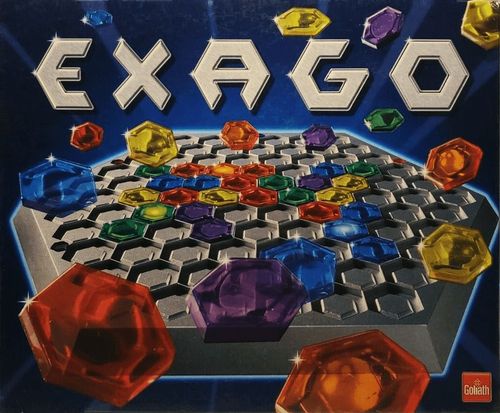
Exago
Exago Rulebook
Table of Contents
Table of Contents
Objective
The goal of the game is to line up 4 pieces of one colour in a straight line in any direction. The player who manages to do this first is the winner. Two examples: A – blue wins; B – red wins.
Number of Players
2 to 6 players, children from age 7. The rules for two players are at the end.
Contents
- 48 game pieces: 12 red, 12 blue, 6 yellow, 6 green, 6 purple, 6 orange.
- 1 game board (2 parts, which fit together easily).
- Coloured plates for the game board.
- Rules of the game.
Assembly
- Insert the coloured plates into the special recesses at the edges of the board (only on first use).
- Join the two parts of the board so that one part fits into the other (see the pictures).
Setup
- Set up the game board so that every player can reach it.
- Each player is assigned a colour: the colour of the plate closest to that player.
- Each player is given 6 pieces of their colour.
Who Starts?
The youngest player starts the game.
Start of the Game
- The first player starts the game by placing a piece of their colour in the centre of the game board, on the spot marked "Start".
- Turns pass clockwise.
- The next player places their piece next to the first piece.
- Pieces must be placed in a row in any of the 6 directions, touching one another.
Continuation of the Game
The game continues, and the players take turns trying to line up a straight row of 4 pieces of their own colour on the board. At the same time, they must try to prevent the other players from doing the same. Any piece placed must touch at least one piece placed earlier.
When All Pieces Have Been Played
- When all pieces have been played and no winner has been determined, players may use the pieces already on the table.
- To do so, a player takes out one piece of their own colour (a piece can be removed by a light push on one of its sides) and inserts it in another suitable place.
- Again, the piece must touch some other piece or pieces.
Separated Pieces
- If a player removes their piece in order to move again, and this isolates one piece or a group of pieces from the main mass, then all of these pieces are removed from the board and distributed among their owners.
- The owners may use them as soon as their turn comes.
- If each group contains the same number of pieces, the player who caused the separation decides which group is to be dissolved. See example C.
End of the Game
The game ends as soon as one player succeeds in lining up 4 pieces of their colour in a straight line on the game board.
Winner
The winner is the player who first succeeds in lining up 4 pieces of their colour in a straight line on the game board.
Two-Player Game
- Each player receives 12 red or blue pieces.
- The game follows the same rules described above, with one difference: the winner is the player who first succeeds in lining up a row of 5 pieces of their colour on the game board.
New Game
- All pieces are removed from the game board.
- The turn order changes. Players may also change their piece colours and their seating positions.
- The winner of the previous round begins the new game.
Special Instructions
Existing and Returned Pieces
- A player may not take their pieces from the board and move them to another place while they still have pieces in hand.
- A player may not take their piece from the board and put it back on the same place.
- If pieces from a dissolved group have returned to a player, that player must play them first, as soon as their turn comes.
If Obstacles Arise
- When a player sees that they must choose which player to obstruct, they must choose the player sitting to their left. In this way it is not possible to help another player.
- Example: Players A, B and C are somewhere in the middle of the game. Player A places a piece so that they have 3 identical pieces in a line. Player B also places a piece and likewise gets 3 identical pieces in a row. Player C cannot win, but must block the path of player A, because A is the next player after C in order. Player C is forbidden to obstruct player B, and so cannot knowingly help player A win.
Strategy
- Before each move, a player must weigh their chances and choose a definite strategy: either they line up a row of 4 of their own pieces, or it is better for them to obstruct another player.
- Each player is most interested in obstructing the player to their left. However, they must carefully watch that the other players do not get the chance to line up a row of 4 twice or even three times.
- In general, the rule is that the winner is the player who obstructs other players the least and concentrates fully on their own game strategy.
Variants
- The players may agree that, even while holding their own pieces, they have the right to remove other pieces placed earlier from the board and move them to a new place. Such a game often has advantages.
- At the start of the game, one or all players have one piece each taken away, to make the game more difficult.
- When one piece is moved from one place to another, first isolating a group of other pieces but then reconnecting them, the group is not dissolved and remains in place. However, it may be agreed in advance by the rules that an isolated group may be dissolved and its pieces handed out to the players in any case, if one of the pieces that caused the separation is moved, no matter to which place.