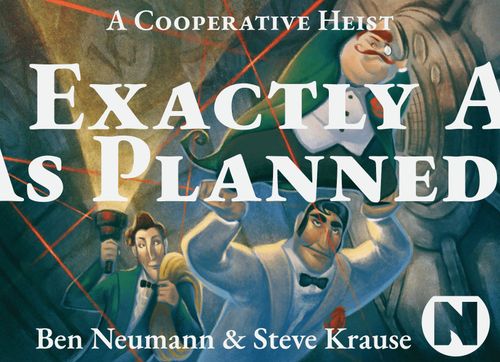
Exactly As Planned
Exactly As Planned Rulebook
Table of Contents
Table of Contents
Components
- 24 Tool cards
- 16 Job cards
- 10+ Backup Plan cards
- 5 oversized Heist setup cards
- 1 timer (not provided)
Double-Blind Scam
You are an intrepid team of thieves. But rather than preying upon the weak, your targets are the evil masterminds of malicious corporations. Your team walks a morally gray line, stealing from the exorbitantly rich and giving to, well, themselves.
Your latest confidence scheme is coming to a close. The target: VonCrul Industries. The plan has been in motion for months, but the final heist occurs now. Perfect timing is necessary for your thieving enterprise to be successful. You must keep both VonCrul and its CEO in the dark.
Scenario
In the Double-Blind Scam, greed and overconfidence may lead to failure. Partners must coordinate their efforts to each collect at least 3 Jobs and the right Tools to sastisfy them.
Setup
Place the Double-Blind Scam Heist card in the middle of the table. The Heist card shows the number of Tool and Job cards needed for setup based on the number of partners in crime, randomly selected from all possible Tools and Jobs. Without looking at them, put any extra cards back in the box. Shuffle the Tools into one deck and the Jobs into a second deck. Deal one Job to each partner, which becomes the first card in your hand. Both decks are placed in the middle of the table in reach of the whole team. A five-minute timer is necessary for the game to begin, and the game is over when the timer ends.
| Partners in crime | 3 | 4 | 5 |
|---|---|---|---|
| Jobs | 12 | 14 | 16 |
| Tools | 16 | 19 | 22 |
Play
The game is timed, leaving the team with only five minutes to complete the Heist. Flip the top card of each deck face up when the game begins. There are no turns. You may take the top card of either deck at any time. When you take a card, add it to your hand, creating your personal collection of Jobs and Tools. You may not give away, trade, or reveal cards in your hand. Immediately flip the next card of the deck over. The game ends when the timer ends.
First Game: In the real Heist, there is no opportunity to see which Jobs and Tools that other partners have collected. Keep your cards in your hand. However, in your first game, you might find it helpful to play with "open" hands.
Note: Success in the Heist requires communication. And, because this is the modern era, the heist team has state-of-the-art two-way earbuds. Discuss the contents of your hand as much as you like.
This Heist also requires a final collection of cards, the Jackpot, which belongs to no one. When grabbing a Tool from the deck, instead of putting it directly in your hand, you can instead choose to put it face down on the Heist scenario card. Once a Tool is put there, it is locked in place and not visible until the game ends. Tools in your hand are absolutely not allowed to later be put in the Jackpot. The Double-Blind Scam requires one of each Tool style in the Jackpot (see Success section).
Jobs & Tools
All Heists use the following rules for Jobs and Tools.
These are Jobs. These are the smaller tasks that must be satisfied for the entire Heist to be successful. Every Job must be picked up by someone, and every partner will need to collect at least 3 Jobs.
These are Tools. These are the items that a partner must have in order to satisfy the requirements of a Job. Tools will be collected by all the partners and assigned to the Jackpot of the Heist, and both can have an unlimited number of tools. Each Tool can help to satisfy the needs of many Jobs at the same time.
Tools are defined by a variety of white icons: names, types, and styles to satisfy Jobs.
- Some tools have names. Examples printed in the rulebook: Blueprints and Escape Plan.
- Tools can have one or more types. The four types are Disguise, Stunt, Recon, and Leverage.
- Tools can have one or more styles. The four styles are Fake, Quick, Bold, and Rough.
- Two Tools have every type.
- Two Tools have every style.
Wild Cards
These 4 Tools are often referred to as "duplicating" or "choose one" cards.
- Two Tools duplicate exactly one other Tool of your choice from the same collection of cards. This card provides all of the types and styles of the duplicated card.
- Two Tools have exactly one type or style of your choice. You do not need to decide which until the end of the game. However, if you decide, for example, that this card is a Leverage Tool for one Job in a collection, then this card may only be a Leverage Tool for other Jobs in the same collection.
Note: Using either of the above cards to duplicate either of the below cards allows the partner to choose again. (You can choose the same or a different type or style.)
Jobs are satisfied by any Tools in the same collection. Hold on to your collection of Jobs and Tools until the end of the game. In order to be a successful partner on the team, your collection must contain at least 3 Jobs and enough Tools to satisfy the requirements for each of your Jobs.
Remember: Tools and their icons are never used up. A Tool can be used for any number of Jobs and is never discarded.
Some Jobs require 2 matching types or styles.
The remaining Jobs offer a choice: Either a specific named Tool or an alternative set of requirements.
These alternative requirements include the following:
- 3 Tools with the same type (symbol in a circle)
- 3 Tools with the same style (word in a rectangle)
- All the types across any number of Tools
- All the styles across any number of Tools
(The color of these icons has been altered for readability.)
Here's how to satisfy the 3 Jobs above with the 3 Tools below:
- The first Job requires a specific named Tool, which we have: Escape Plan.
- The second Job needs 2 Bold Tools, which we have.
- The third Job also requires a named Tool, but we don't have the Crowbar. This Job can instead be satisfied by having 4 unique types, which we have across these 3 Tools.
Note: The first Tool is helping to satisfy the needs of all 3 Jobs at the same time.
Success
When the timer ends, every partner must have at least 3 Jobs, and every Job must be satisfied, otherwise the team loses. (If any Job remains in the deck when the timer ends, the partners lose.) Checking whether Jobs are satisfied only happens at the end of the game, after the timer for the Heist ends.
The Jackpot must also be satisfied. The requirement for the Double Blind Scam is at least one of every Tool style (e.g., Fake, Bold, Rough, and Quick). Neither of the two Tools that have all four styles may be used to satisfy the requirements of this Heist (money doesn't solve everything).
Failure
If the time runs out and any Job or the Jackpot are not satisfied, the partners lose. This means that if even one Job held by one partner is missing one Tool, the Heist is a bust. Tracking where things went wrong is often simple: one partner collected too many Tools, the team forgot which face down cards were assigned to the Heist, or the time ran out. Although running out of time is a possibility, many Heists can also fail because the team spends too little time discussing strategy.
Begin your first Heist now.
Too Hard!
If the team is finding that the game is too difficult, these are a few ways to decrease the challenge.
- Add a minute or more to the timer.
- Start with extra Tools.
- Play with each partner's hand revealed.
Too Easy!
If the team is finding that the game is too simple, these are a few ways to increase the challenge.
- Remove a minute or more from the timer.
- Give everyone a Backup Plan (see below).
- Give the whole team a shared Backup Plan.
Backup Plans
Not every Heist goes smoothly, and these cards represent the ways in which communication capabilities are impeded for each partner-in-crime.
To increase flavor (and difficulty), give each partner a Backup Plan before the game begins. Read the limitations of your Backup Plan to everyone. Throughout the entire game, you must adhere to these limitations. For example, one plan requires you to only say "yes" or "no" during the game.
An alternative use of the Backup Plans is to assign one that the whole team must share. For instance, everyone can be restricted to saying only "yes" or "no".
The team decides how strictly they must adhere to these rules. For an expert heist experience, the team loses if you fail to follow the requirements of your Backup Plan.
Bonnie & Clyde Waltz
Some heists are brought closer to home. Your team of thieves has infiltrated the VonCrul household. The goal: letting the corporate matriarch know that you can get at her wealth no matter where it is hidden. The guards are on hyper alert, forcing the team to dance a three-step waltz around security measures. Then again, three steps may not be enough to perfectly time this heist.
Scenario
In the Bonnie & Clyde Waltz, the team is no longer digging through a deck of cards to find Jobs and Tools. Instead, you are swapping cards to create perfect hands.
Setup
Begin with the correct number of Jobs and Tools based on the chart (see opposite page), similar to Double-Blind Scam. From each deck, deal all of the used cards to each partner as evenly as possible. Do not look at your hand until the timer starts.
| Partners in crime | 3 | 4 | 5 |
|---|---|---|---|
| Jobs | 9 | 12 | 15 |
| Tools | 12 | 16 | 20 |
Note: All Heists use the same rules for Jobs & Tools, Page 5.
Play
There are no turns. When the timer starts, partners begin exchanging Tools and Jobs between them in order to create their final hand of cards before the timer ends. Each Tool must be exchanged for exactly one Tool (and a Job for a Job). You must add the traded card to your hand before you can trade again.
Before time is up, everybody must throw a Tool from their hand into the Jackpot.
Success & Failure
As with Double Blind Scam, to win, you must satisfy all the Jobs in your hand with Tools in your hand. If any partner does not, the team loses.
Additionally, the Heist requires one Tool from each partner. It does not matter which Tool, as long as it is in the Jackpot before the time runs out.
Quiz Show
A mammoth of steel and security. The lynchpin to the defense of some of the biggest, wealthiest banks in the world. Safecracking is an old man's game. Too bad the only thieves available are the members of your team. Unfortunately, simply guessing numbers will not be enough to open this metallic behemoth. Time to rig the game.
Scenario
In Quiz Show, personal awareness is low, and you must rely on your partners for success. You cannot see the cards in your own hand. Only your partners-in-crime can see your cards.
Setup
Begin with the correct number of Jobs and Tools based on the chart (see opposite page), similar to Double-Blind Scam. From each deck, deal all of the used cards to each partner as evenly as possible.
You will never look at your own hand. Instead, when the timer starts, hold your hand of cards so that the rest of the team can see your Jobs and Tools. In other words, hold your hand so that you can only see the backs of your cards.
| Partners in crime | 3 | 4 | 5 |
|---|---|---|---|
| Jobs | 12 | 12 | 15 |
| Tools | 12 | 14 | 17 |
Note: All Heists use the same rules for Jobs & Tools, Page 5.
Play
There are no turns. Each partner is trying to create one collection of cards face down in front of them. You can put a card from your hand face down in front of any partner, including yourself, to contribute to that collection. Once a card is added to a collection, it must remain there until the end of the game. Alternatively, you may add a card to the Jackpot.
You may not touch the cards in anyone else's hand, although you can point to and talk about each card. You are responsible for putting the cards from your hand into a collection or the Jackpot. When the timer ends, add any remaining cards in your hand to the Jackpot.
Success & Failure
When the game ends, everyone examines the collection in front of them, either simultaneously or in a dramatic order, ending with the Jackpot.
As with Double Blind Scam, to win, you must satisfy all the Jobs in your collection with the Tools in your collection. Each collection and the Jackpot must also have at least 2 Jobs. If any Job in the game is not satisfied, the team loses.
Cakewalk (Solo)
Our fearless competitors have gathered here today in the hopes of securing the gold. These aspiring professionals have risen among the ranks, beating their rivals, churning through the competition. In the end, there can be only one cherry on top. Who will discover that thievery is just a piece of cake? Find out right now on Cakewalk.
Scenario
In Cakewalk, you are on your own. Even if you have all the Tools you can't use them all.
Setup
This Heist is intended for one player. Using 12 random face up Jobs, create an outline that leaves an empty 3x3 area (see opposite page). Remove the remaining 4 Jobs from the game. You have access to all 24 Tools.
Play
When the timer starts, begin filling in the empty 3x3 area with any of the Tools, face up. Each row and column is a collection that holds 2 Jobs and 3 Tools.
Note: All Heists use the same rules for Jobs & Tools, Page 5.
Success & Failure
You win if every Job is satisfied by the Tools in its collection. Choices for cards (like which card to duplicate with x2) are made independently in each collection.
Difficulty Levels
The basic game is at 1-star difficulty. Increase the difficulty by adding additional Jobs for each diagonal as shown in the layout. At 4-star difficulty, you may add an additional choose-one wild card to exactly one collection (this collection will have 4 cards). At 5-star difficulty, you may add the other.
Note: The "Scan for playable 1-star difficulty video game on itch.io" promotional text and QR code printed beside the Cakewalk layout are not transcribed.
Three-Ring Monte (Duo)
Take things literally.
Scenario & Setup
This Heist is intended for two partners. The partners will create three collections between them, split into two face down piles: one for Tools, one for Jobs (see opposite page). One partner takes all the Tools, deals 1 face down into each Tool pile, and places the deck next to them. The other partner takes all the Jobs and places the deck next to them.
Each partner can never look at the cards of the other partner. Also, while holding a hand of cards, a partner can never look at their own face down piles.
First Game: Play with any or all of the cards face up.
Play
When the timer starts, the partner with the Jobs draws a hand of 4 cards, puts 1 face down into each Jobs pile, and tosses the remainder into the Jackpot. Then the partner with the Tools draws a hand of 5 cards, puts 1 face down into each Tools pile, and tosses the remainder into the Jackpot.
Repeat until each collection has 4 Tools in the Tools pile and 3 Jobs in the Jobs pile.
Note: While holding drawn cards, a partner can no longer look at any face down cards. When one partner is holding drawn cards, the other is free to look at their face down piles to advise the other player.
Note: All Heists use the same rules for Jobs & Tools, Page 5.
Success & Failure
After the timer ends, players can inspect the cards in each of the 3 collections. If the Jobs in each collection are satisfied by the Tools in the same collection the Heist is a success.
Difficulty Levels: The two-star advanced version has 4 collections instead of 3, with the Tools partner dealing an extra Tool during setup. During play, the Jobs partner will draw 5 Jobs instead of 4, but the Tools partner will not draw any extra.
For even higher levels of difficulty, after playing all of the Jobs and Tools, but before the timer ends, the Tools partner must throw an extra Tool into the Jackpot. This extra Tool can come from any of the Tool piles.
Icons
- 3 Tools with the same type (symbol in a circle)
- 3 Tools with the same style (word in a rectangle)
- 4 different types across any number of Tools (symbol in a circle)
- 4 different styles across any number of Tools (word in a rectangle)
- Choose one style or type
- Duplicate a Tool in the same collection
Remember: Tools and their icons are never used up. A Tool can be used for any number of Jobs and is never discarded.