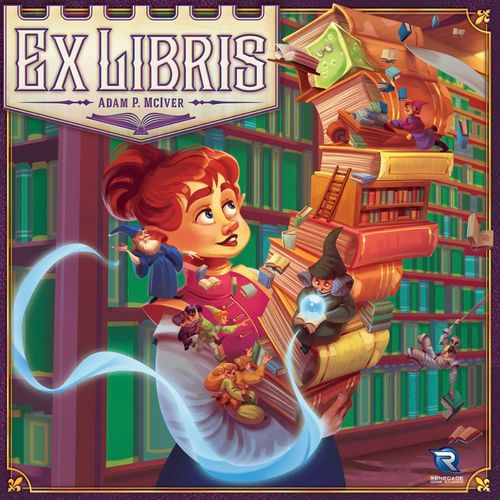
Ex Libris: Revised Edition
Ex Libris: Revised Edition Rulebook
Table of Contents
Table of Contents
- Game Overview
- Components
- Setup
- The Basics
- Book Card Anatomy
- Shelving Cards
- Alphabetical Order
- Shelf Stability
- Prominent Works
- Banned Books
- Categorical Variety
- Library Focus
- Round Overview
- I: The Preparation Phase
- II: The Placement Phase
- III: The Resolution Phase
- IV: The Cleanup Phase
- Final Round & Scoring
- A1 — Alphabetical Order Check
- A2 — Categorical Tally
- B1 — Survey Shelf Stability Bonuses
- B2 — Bestow Prominent Works Awards
- B3 — Assign Banned Books Penalties
- B4 — Assess Categorical Variety Bonuses
- B5 — Reveal & Score Library Focuses
- = Total Individual "Section B" Scores
- Tiebreakers
- Scoring Example
- Standard Mode
- Special Assistants
- Variants
- Solo Mode
- Icon Guide
Game Overview
Ex Libris is played over a series of rounds in which players will take turns sending Assistants to acquire books for their bookshelves. You will attempt to make sure that your books are in alphabetical order, on stable shelves, with more prominent works than your opponents, as few banned books as possible, a well-rounded variety of categories, and as many of your library's focus as you can manage.
There are 2 ways to play Ex Libris:
- Beginner Mode
- Standard Mode
For your first game, we recommend trying Beginner Mode. Once you feel comfortable with Ex Libris, give Standard Mode a try for more options in your placements. You can find more information on Standard Mode below.
Components
- 152 Book Cards
- 6 Category Cards
- 4 Special Assistant Cards
- 18 Location Tiles
- 4 Library Tiles
- 4 Scoring Reference Tiles
- 1 First Player Token
- 12 Standard Assistants
- 4 Special Assistants
- 1 Official Library Inspection Form
- 1 Location Reference
- 1 Dry Erase Marker
Setup
-
Place the scoring reference tiles in the center of the table in the following order from left to right: Alphabetical Order / Shelf Stability, Prominent Works, Banned Books, Categorical Variety / Library Focus. Set the Official Library Inspection Form and Location Reference nearby (not shown).
-
Find the location tile labeled Diviner's Hut and place it below the scoring reference tiles. Then shuffle the remaining 17 location tiles and place them in a face-down stack nearby.
-
Give the first player token to the player who most recently acquired a book.
-
Each player takes a library tile in the color of their choice, then a set of three Standard Assistants (shaped like gnomes) of the same color.
Note: If you are playing with the Standard Mode, each player is dealt one of the four Special Assistant cards. Each player then takes its matching Special Assistant and two Standard Assistants that match their library tile color. (There will be one Standard Assistant of each color left over — these are used in Beginner, and Solo games only.)
-
Shuffle the six category cards and place one face up on the Prominent Works scoring reference tile, then one face up on the Banned Books scoring reference tile.
-
Deal one of the remaining category cards face down to each player. This will be their library's focus. Keep your own category card secret by sliding the card underneath the right hand side of your library tile. (You may check your category card at any time.) Return any remaining category cards to the box without revealing them.
The Basics
There's a lot to juggle if you want to become Grand Librarian, but don't worry, you can handle it! First, let's talk about books.
The 510 unique books in the game are spread across 152 book cards and divided into six categories.
The Six Categories
- Corrupted Codices
- Fantastical Fictions
- Historic Volumes
- Monster Manuals
- Reference Texts
- Spells & Potions
Note: The six categories are equally represented in the deck of book cards, with each category appearing 85 times.
Scoring Reference Tile Reminders
The scoring reference tiles display the following scoring reminders:
- Alphabetical Order: At the end of the game, any card in a player's library that does not follow the card before it in alphabetical order is flipped to its reverse side. Books on flipped cards are not counted toward final scoring.
- Shelf Stability: Each player earns 1 point per card in their library that is in their largest stable group of cards. (1x)
- Prominent Works: The player with the 1st, 2nd, and 3rd most books of this category in their library at the end of the game will earn: 1st — 15, 2nd — 9, 3rd — 4.
- Banned Books: At the end of the game, each player loses 1 point for every book of this category in their library. (−1)
- Categorical Variety: Each player earns 3 points for every book in their library of the category which they have the least of (not counting the banned category). (3x)
- Library Focus: Each player earns 2 points for every book in their library of the category that matches their library's focus. (2x)
Book Card Anatomy
The top portion of each book card provides you with four bits of important information:
- Letter — This tells you the first letter of the titles of every book on the card.
- Numerical Order — This tells you the order the card falls in among all the cards that share the same letter.
- Letter Quantity — The second number in the info banner reminds you how many book cards in total share the same letter.
- Category Icons — Every card displays two to four category icons, which correspond to the book types.
Designer Note: All the vital info you'll need to play the game resides in the top portion of the card so that you can easily organize your hand of cards. You COULD play the entire game completely ignoring the fancy book illustrations and titles, but you'll be missing out on some pretty great wordplay. Alternatively, if you hate puns, spoofs, jokes, and humor in general, feel free to focus solely on the top portion.
Shelving Cards
In order to add books to your bookshelf, you will be shelving book cards, which can be achieved in various ways described later in this rulebook. Regardless of the source, you must always follow these two basic rules when shelving a book card:
- A new book card MUST be shelved orthogonally adjacent, along an edge, to a previously shelved card. Diagonally is not allowed.
- Your bookshelf may NEVER be more than THREE horizontal rows tall.
(During the course of the game, you may need to discard book cards from your bookshelf. When discarding book cards, you may not discard one that would result in two unconnected bookshelves.)
Example: A new book card added to the bookshelf may only be shelved in the spaces indicated in green. The spaces indicated in red are not allowed because: 1 — This space would extend the bookshelf to be four horizontal rows tall. 2 — This space is not orthogonally adjacent to a previously shelved card.
Note: At the end of the game, only book cards in your bookshelf will count toward your final score — cards left in your hand won't gain you anything.
Note: You may never shelve a book card between two other already adjacent book cards.
Alphabetical Order
Visitors to your library will need to be able to find the books they are looking for easily. With this in mind, the Mayor requires that all the books in your bookshelf are in order alphabetically, and has instructed the Official Inspector to remove any books that are out of order.
During the inspection at the end of the game, starting with the leftmost book card in the top row of your bookshelf and moving left to right, top to bottom, any book card whose letter does not follow the previous book card's letter and numerical order will be flipped face down to show an empty shelf section. Therefore, the category icons will no longer count toward your final score.
Example: At first glance, three book cards marked M 8/8, M 3/8 and N 3/3 may look to be in order, but the numerical order of the M book cards (8 and 3) is incorrect. At the end of the game, the center book card would be flipped face down.
Note: At any point in the game, prior to inspection, you may choose to voluntarily flip any book card in your bookshelf in order to achieve a more favorable result.
Example: Imagine you prefer not to lose the category icons on the center book card from the previous example (for reasons that will be explained shortly). You could instead voluntarily flip the book card on the left, leaving the remaining book cards in the correct order.
Shelf Stability
The Mayor is, understandably, concerned with the safety of the town's citizens when visiting your library, so the Official Inspector will also be surveying the stability of your bookshelf.
You will earn a bonus at the end of the game for the largest rectangular group of cards in your bookshelf that includes cards on your bottom row. Every card in that rectangular group will earn you 1 point. A rectangle must be at least two cards tall and two cards wide to qualify.
Example: Four sample bookshelves would score the following shelf stability bonuses at the end of the game: 1 — 9 points, not bad! 2 — 8 points, halflings appreciate short shelves! 3 — 0 points, no rectangle can be drawn that includes cards on the bottom row! 4 — 12 points!
Note: Flipped book cards still count toward your shelf stability bonus, so shelving a book card out of order may occasionally be in your best interest.
Prominent Works
The town's citizens enjoy a wide variety of books, but one category in each game is determined to be their overall favorite. The category card that was dealt to the Prominent Works space represents this popular category.
The players who have the most books that match the Prominent Works category at the end of the game will receive awards. First place earns 15 points, second place earns 9 points, and third place earns 4 points. In the case of a tie between two or more players, add the award for the tied place to the next lowest place (if any) and divide the total as evenly as possible, rounding up.
Example: At the end of a game where Reference Texts are the Prominent Works category, Jacob has 8, Jamie has 10, Reena has 9, and Alap has 7. Jamie has the most and will earn 15 points. Reena has the second most, earning 9 points. Jacob has the third most, earning 4 points. Alap has the least and receives no reward.
Note: 15 points is a lot, but be careful not to ignore other scoring areas in the pursuit of the most Prominent Works.
Banned Books
The Mayor and Village Council have, for whatever reason, identified one category of books that they find particularly dangerous. The card that was dealt to the Banned Books space represents this forbidden category.
The Official Inspector will penalize you at the end of the game for having Banned Books in your bookshelf. Every book of this category will cause you to LOSE 1 point.
Example: At the end of a game where Monster Manuals are the Banned Books, Alex realizes he didn't pay enough attention and has an unlucky total of 13 Monster Manuals in his bookshelf. He loses 13 points and vows to pay more attention next time.
Note: Losing points is nothing to be happy about, but there will likely be times when taking a book card with a Banned Book will earn you more points than you will lose.
Categorical Variety
The Mayor wants to cater to the town's diverse population, and will require the Grand Librarian to have collected a broad spectrum of books. It's in your best interest to make sure your bookshelf isn't lacking in the five non-banned categories.
When the game ends, you earn 3 points for every book in your bookshelf of the category which you have the least of. Banned Books are not considered when assessing Categorical Variety.
Example: At the end of a game, Ruth has 5 Fantastical Fictions books, 9 Historic Volumes books, 7 Monster Manuals books, 6 Reference Texts books, and 6 Spells & Potions books. She earns 3 points for each of her Fantastical Fictions books (15 points total), since it is the category she has the least of. Corrupted Codices were the Banned Books category and weren't considered.
Note: Ignoring a category is the easiest way to lose a game of Ex Libris. So if you want to lose, we recommend doing so!
Library Focus
The Mayor and Village Council have outlined pretty clearly what they do and don't want in the bookshelf of the potential Grand Librarian, so how are you to stand out from the crowd?
The answer is your library's focus — your collection's wow factor that you'll keep hidden from your opponents the entire game. By shelving books that match your library's focus, you may be able to display a specialization no one else has!
At the end of the game, you will reveal your category card and earn 2 points for every book in your bookshelf that matches that category, which is your library's focus.
Example: At the end of a game, Chris reveals his library's focus to be Monster Manuals. He had been taking and shelving them at every opportunity and has 14 Monster Manuals books total in his bookshelf. He earns 2 points for each, which adds up to a sizable 28 points.
Note: Be careful not to be too obvious about which category is your library's focus, or your opponents may figure it out and attempt to keep you from collecting those books.
Round Overview
Each round of Ex Libris consists of four phases, which are always carried out in the following order:
- I: The Preparation Phase
- II: The Placement Phase
- III: The Resolution Phase
- IV: The Cleanup Phase
I: The Preparation Phase
At the beginning of each round, the first player reveals location tiles from the stack and places them face up in the area directly below the Scoring Reference Tiles until there is one tile per player. There will be two rows of location tiles here eventually — the topmost will be the permanent locations area, with the temporary locations area below. For the first round of the game, there will only be one row.
Note: During the first round of the game, the Diviner's Hut location will already be present, so you will deal one less location tile than usual.
Next, check to see if any of the face-up locations (permanent or temporary) have preparation instructions in their upper right corner — these will tell you a specific number of book cards to deal onto the card area on the right side of the tile. Follow these instructions, and if more than one book card is dealt onto the tile, splay them vertically so that the vital information of each book card can be seen.
II: The Placement Phase
Starting with the first player and going clockwise, players take turns placing one Assistant at a time. On your turn, place one of your available Assistants on an unoccupied space:
- A) On a location tile (permanent or temporary) -or-
- B) On your library tile
Note: You may place either a Standard Assistant or a Special Assistant, if playing the Standard Mode. For the most part, they function identically, and any game text that refers to an "Assistant" applies to both types, unless otherwise stated.
A) Placing on a Location Tile
If the location your Assistant visits has an Instant Effect, you will activate it immediately, following the effect description on the tile. If the location has a Delayed Effect, you will activate it in the second half of the round, during the Resolution Phase. The effects of all locations are explained fully on their tiles and in the Location Reference.
Note: If a location's effect requires book cards in its card area, and there are no book cards remaining in its card area, the location's effect cannot be performed.
Location Tile Anatomy
The following information can be found on location tiles (Preparation Instructions, Card Area, and Solo Compatibility sections are not present on all location tiles):
- Number — This is used in the second half of the round.
- Name & Effect Type — Either an Instant Effect (green banner) or a Delayed Effect (red banner).
- Summary of Action — A summary of the action for this location.
- Preparation Instructions — This tells you how to prepare the tile at the beginning of a round. The number in the icon tells you how many book cards to deal to this location. Unless otherwise stated, these cards are placed face-up. Many locations do not have any Preparation Instructions, since nothing needs to be done at the beginning of a round.
- Card Area — Deal cards here during Preparation Phase.
- Assistant Spaces — One or more spaces Assistants can visit.
- Effect Description — What the effect does.
- Solo Compatibility — If this icon is present, the location may be used in a solo game (see Solo Mode).
Note: Some location tiles have Assistant spaces that are unavailable when playing with lower player counts. You may not place an Assistant on a space marked with a number that is higher than the number of players.
Auction Location
Some locations are identified as Auction Locations, such as the Auction House in this core box. Placing Assistants works differently at these locations. Auction Locations have restrictions on how many Bidding Assistants can be placed there, but that doesn't necessarily block a player from that location. This restriction is listed after "Auction Location:" on the tile. When placing an Assistant at an Auction Location, if this placement would exceed the restriction quantity, return the lowest Bidding Assistant to their player — it may be placed again on a subsequent turn this round. A bid on the highest available space cannot be outbid.
Example: The Auction House can only have 1 Assistant placed at a time to place a bid.
B) Placing on Your Library Tile
Your library tile has three home action spaces with Instant Effects, which may only be visited by your own Assistants. When you place an Assistant on a home action space, you may either:
- Draw 1 book card from the deck -or-
- Shelve 1 card from your hand
Library Tile Anatomy
The following information can be found on library tiles:
- Reference Bookmark — This tells you the quantity of each letter across the entire book card deck.
- Library Focus — Your category card is tucked under this reminder image.
- Home Action Summary — The home action options.
- Assistant Spaces — 3 spaces your Assistants can visit.
III: The Resolution Phase
When players have no more Assistants to place, the Resolution Phase begins. During this phase you will resolve all locations in numerical order, beginning with the Diviner's Hut. To resolve a location, follow these steps:
- If the location has a Delayed Effect, activate it now by following the effect description on the tile.
- Discard any book cards that remain on the location.
- Return all Assistants on the location to their players.
IV: The Cleanup Phase
After returning all Assistants, check to see which of the location tiles in the temporary locations area is first in numerical order, then move it into the permanent locations area, which is the top row of locations below the Scoring Reference tiles. It will be available each subsequent round until the end of the game. (At the end of the first round, the Diviner's Hut will be the first in numerical order and thus will always be available.)
Note: Permanent locations do not count toward the number of location tiles dealt to the temporary locations area at the start of each Preparation Phase. In this way, every round will have one more available location tile than the previous round.
Next, place the remaining location tiles from this round aside, face up in a discard pile. If the location stack is ever depleted, shuffle all discarded locations to create a new face-down stack.
Lastly, remove any remaining Assistants from their home spaces, then check to see if one or more players have the required number of shelved cards in their bookshelf to trigger the Final Round. This number varies based on player count:
| 2 Players | 3 Players | 4 Players |
|---|---|---|
| 18 cards | 16 cards | 14 cards |
Final Round & Scoring
If the Final Round has been triggered, begin a new round as normal, but this will be the last round of the game. After the Resolution Phase, the player with the best handwriting is appointed the Mayor's Official Inspector, taking Official Library Inspection Form B-7c and following each step on the form to calculate scores:
Note: Remember that, prior to inspection, you may choose to voluntarily flip any number of book cards in your bookshelf in order to achieve a more favorable result.
A1 — Alphabetical Order Check
Each player checks the bookshelf of the opponent to their right. Starting with the leftmost card in their top row and moving right across each row, flip any book card that does not alphabetically and numerically follow the book card before it.
A2 — Categorical Tally
Next, the Official Inspector will call out each of the six categories, one at a time. After a category is called out, each player counts the number of books in their bookshelf that match the category and announces their total. The Official Inspector records these totals.
B1 — Survey Shelf Stability Bonuses
Each player counts the largest rectangular group of cards in their bookshelf that includes cards on their bottom row. Every card in that rectangular group earns them 1 point. A rectangle must be at least two cards tall and two cards wide to qualify.
B2 — Bestow Prominent Works Awards
The Official Inspector circles the row in the categorical tally section that matches the category card dealt to the Prominent Works reference tile. The player with first place in this row is awarded 15 points, second place is awarded 9 points, and third place is awarded 4 points. In the case of a tie between two or more players, add the award for the tied place to the next lowest place (if any) and divide the total as evenly as possible, rounding up.
B3 — Assign Banned Books Penalties
The Official Inspector draws a zig-zag line around the row in the categorical tally section that matches the category card dealt to the Banned Books reference tile. Assign each player a -1 point penalty for every banned book in their bookshelf.
B4 — Assess Categorical Variety Bonuses
The Official Inspector finds the category each player has the fewest books of (ignoring Banned Books) and multiplies that number by 3 points to determine their variety bonus.
B5 — Reveal & Score Library Focuses
Each player now reveals their category card, scoring 2 points for every book in their bookshelf matching their library's focus.
= Total Individual "Section B" Scores
Finally, one player at a time, the Official Inspector adds up all the figures in section B. The player with the highest score wins!
Tiebreakers
In the case of a tie, the tied player with the most books in their bookshelf wins. If still tied, the tied player with the fewest cards in their hand wins. If the tie persists, the tied player with the fewest Banned Books in their bookshelf wins. If the tie still persists, the first tied player to finish reading a book is the winner.
Scoring Example
Example: At the end of a four-player game, Eric emerges victorious with a whopping score of 55 points! His keys to success were an extremely stable shelf, getting second place in Prominent Works, an even variety of categories, and an impressive library focus.
Standard Mode
Once comfortable with the Beginner Mode, players may instead choose to use the Standard Mode. This mode gives each player their own Special Assistant and a unique power that only their Special Assistant can activate. Standard Mode will increase player interaction, strategy, and difficulty while giving players a new experience with Ex Libris.
Changes to Setup
During setup, after each player takes a library tile and two matching Standard Assistants, they then draw a Special Assistant card at random and retrieve the Special Assistant that matches the card, so that they have three total Assistants — two Standard and one Special.
Note: Alternatively, you may choose to draft the Special Assistant cards in reverse turn order, with the first player choosing last.
Changes to the Placement Phase
For the most part, Special Assistants function the same way as Standard Assistants, and any game text that refers to an "Assistant" applies to both types, unless otherwise stated. Special Assistants have an ability that is associated with their token. Typically, the ability is activated while that token is performing an action, though not always (the ability text on the Special Assistant card will specify).
Timing Icons
- Ongoing — These effects are continually active, allowing players to use them during specific actions in the game.
- Reaction — These effects are triggered/activated when their ability condition is met. This could be when an opponent player visits a location with an Assistant, or when a book is shelved.
Special Assistants
The Gelatinous Cube — Absorb
Reaction — If an opponent's Assistant visits the same location as the Gelatinous Cube, prior to activating any effects or abilities, it absorbs. The opponent must either:
- A. Give you 1 random book card from their hand (you may shelve it) -or-
- B. Allow you to perform both home actions.
The Mummy — Entomb
Ongoing — When the Mummy shelves a card, you may entomb it: place it either directly on top of, or directly underneath, a previously-shelved card in your bookshelf. The bottom card of the stack is flipped face down and any icons on it no longer count during scoring. You may never have more than 1 card entombed under each card in your bookshelf.
End of Game: Entombed cards in your bookshelf are worth 2 points each. Add the total to your Shelf Stability Bonuses (B2). Entombed cards do not contribute to the end game card count trigger.
Note: If the top card of an entombed stack is discarded for any reason, the card remaining underneath is no longer considered entombed, but stays flipped face down.
The Witch — Transmogrify
Ongoing — Any time the Witch acquires a book card containing at least 1 Banned Book, you may transmogrify. Reveal 1 book card from the deck. You may take either the original book card or the revealed book card, then shelve the other face down. If multiple book cards containing a Banned Book are acquired at the same time, perform this ability one book card at a time.
The Wizard — Levitate
Ongoing — When the Wizard shelves a card, you may levitate. Choose a direction (up, down, left, or right) then shift any number of cards in your bookshelf that direction by one space. You must shelve the new card directly adjacent to a shifted card, in the newly created empty space. Your bookshelf may disconnect temporarily, so long as it follows all shelving rules after the new card is added.
Variants
Below are a couple ways to vary the gameplay of Ex Libris to suit your play styles and preferences:
Friendlier Game
If you'd like to play a nicer game with less direct conflict, prior to setup, remove the following location tiles: the Auction House, the Gambling Den, the Assistant's Guild, and the Tax Collector.
Longer Game
If you'd like a longer game, simply increase the required shelved cards a player must have in their bookshelf to trigger the Final Round:
| 2 Players | 3 Players | 4 Players |
|---|---|---|
| 21 cards | 19 cards | 17 cards |
Solo Mode
The solo mode is played over a series of five rounds played similarly to the multiplayer game, with a few key differences.
Rather than competing against rival book collectors, you'll be attempting to have your librarian license approved. To do so, you'll need to exceed the score of the Public Library, which is represented by the entire discard pile.
Solo Setup
-
Place the scoring reference tiles in the center of the table in the following order from left to right: Alphabetical Order / Shelf Stability, Prominent Works, Banned Books, Categorical Variety / Library Focus. Set the Official Librarian License Application S-42a and the Location Reference (not pictured) nearby.
-
Gather the 10 location tiles with the solo compatible icon in the bottom right corner of the tile. Leave the 8 incompatible location tiles in the box: they are not used in the solo game. Shuffle the solo compatible tiles, then deal 6 underneath the scoring reference tiles. Place the remaining 4 tiles in a face-down stack nearby.
-
Take a library tile in the color of your choice and 3 matching Standard Assistants.
-
Choose one of the 3 Special Assistant cards that is solo compatible (not the Gelatinous Cube). Return the other Special Assistant cards to the box. Take the Special Assistant that matches your card.
-
Shuffle the 6 category cards and place 1 face up on the Prominent Works scoring reference tile, then 1 face up on the Banned Books scoring reference tile.
-
Deal 1 category card face up to your Library Focus area.
-
Deal 1 category card face down to the Public Library's Focus area and another to the clue space above it on the Official Librarian License Application S-42a. Leave these cards face down for now. (Note: There will be 1 undealt category card left over. Return it to the box without revealing it.)
-
Shuffle the 152 book cards thoroughly, then draw 8 to form your starting hand. Place the remaining book cards in two roughly equal stacks to form the book card deck.
-
Select a Difficulty Level from Beginner to Impossible (each corresponding to a specific number of book cards discarded each round). We recommend starting with the Beginner level until you are familiar with the differences in gameplay.
Solo Round Overview
The solo mode consists of the same four phases as the multiplayer game, but with slight adjustments to each:
- I: The Preparation Phase
- II: The Placement Phase
- III: The Resolution Phase
- IV: The Cleanup Phase
I: The Preparation Phase (Solo)
Unlike the multiplayer game, new location tiles are not revealed during the Preparation Phase. Instead you will discard a number of book cards from the deck each round, which become part of the Public Library's collection.
The number you must discard is determined by the difficulty level you chose to play.
| Difficulty Level | Number of Cards Discarded Each Round |
|---|---|
| Beginner | 1 |
| Easy | 2 |
| Challenging | 3 |
| Difficult | 4 |
| Very Difficult | 5 |
| Nigh Impossible | 6 |
| Impossible | 7 |
You may examine book cards as they are discarded, but you may not look through the discard pile otherwise. Only the top card of the discard pile should be visible.
Next, follow the preparation instructions on each of the faceup location tiles in the same way as the multiplayer game.
Note: At the beginning of the 2nd round, prior to discarding book cards, reveal the category card in the clue card space of the Public Library's area. This will help you narrow down what the Public Library's focus might be. At the beginning of the 4th round, reveal the Public Library's focus category in the same way.
II: The Placement Phase (Solo)
The Placement Phase works in the same way as the multiplayer game. More than one of your Assistants may visit the same location tile at any given time.
Note: Some location tiles have Assistant spaces that are unavailable when playing solo. You may not place an Assistant on a space marked with 3+, 4+, or 5+.
III: The Resolution Phase (Solo)
When you have placed all four of your Assistants, carry out the steps of the Resolution Phase in the same way as the multiplayer game. All cards discarded go to the discard pile and become part of the Public Library's collection.
IV: The Cleanup Phase (Solo)
After all locations have been resolved, you must now choose two location tiles to eliminate from the game. Return the eliminated tiles to the box, then draw a new location tile from the face-down stack to add to the row. Thus each round will be played with one less location:
| 1st Round | 2nd Round | 3rd Round | 4th Round | 5th Round |
|---|---|---|---|---|
| 6 locations | 5 locations | 4 locations | 3 locations | 2 locations |
At the end of the fifth round, when all the location tiles have been eliminated, the solo game ends. Cross your fingers and continue to Game End & Scoring.
Solo Game End & Scoring
First, you must discard all cards remaining in your hand. Next, drag the entire discard pile into the Public Library area to the left of the main play area, and spread out the cards so you can see and easily count all of the Public Library's category icons. You will now use the Official Librarian License Application S-42a to calculate your score.
Note: Remember that, prior to inspection, you may choose to voluntarily flip any number of book cards in your bookshelf in order to achieve a more favorable result.
A1 — Alphabetical Order Check
Check your bookshelf for alphabetical order as normal. The Public Library does not check for alphabetical order. (The public expects it to be a mess.)
A2 — Categorical Tally
Next, for each category, record the total number of matching individual books in both your bookshelf and the Public Library.
B1 — Survey Shelf Stability Bonus
Survey your shelf stability as normal. The Public Library does not survey shelf stability. (Years of neglect have resulted in piles of books everywhere in lieu of shelves.)
B2 — Bestow Prominent Works Award
Circle the row in the categorical tally section that matches the category card dealt to the Prominent Works tile. If you have the higher number in this row, you are awarded 15 points. If the Public Library has the higher number in this row, they are awarded the 15 points instead. There is no second place award in the solo game. The Public Library wins all ties.
B3 — Assign Banned Books Penalties
Draw a zig-zag line around the row in the categorical tally section that matches the category card dealt to the Banned Books tile. Assign yourself a -1 point penalty for every banned book in your bookshelf, then do the same for the Public Library.
B4 — Assess Categorical Variety Bonuses
Find the category you have the fewest books of, ignoring Banned Books, and multiply that number of books by 3 points to determine your variety bonus. Do the same for the Public Library.
B5 — Score Library Focuses
Score 2 points for every book in your bookshelf matching your library's focus, then do the same for the Public Library based on their focus card.
= Total Individual "Section B" Scores
Finally, add up all the figures in section B. If your score exceeds the Public Library's score, you win! If there is a tie, or if your score does not exceed the Public Library's score, you lose.
Icon Guide
Categories: Corrupted Codices, Fantastical Fictions, Historical Volumes, Monster Manuals, Reference Texts, Spells & Potions.
Location Effect Types: Instant Effect Location, Delayed Effect Location.
Timing: Ongoing, Reaction.
Other icons: Location Preparation Instructions, Usable in Solo Play.