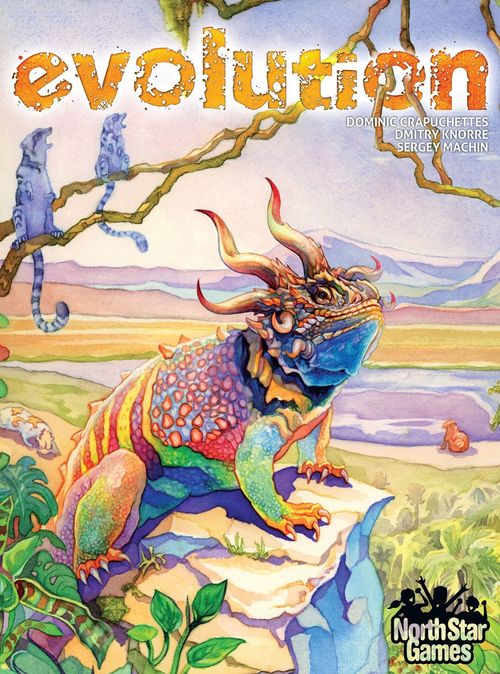
Evolution
Evolution Rulebook
Table of Contents
Table of Contents
Overview
In the game Evolution, players adapt their species with traits to survive in an ever-changing ecosystem. Food is scarce and carnivores run rampant. Your choices will determine the fate of the world's species: which will survive, which will thrive, and which will disappear from the planet forever.
Components
- 1 Rulebook
- 1 Watering Hole Board
- 1 First Player Marker
- 129 Trait Cards
- 17 Carnivore Trait Cards
- 7 of each other Trait Card
- 24 Species Boards
- 48 Wooden Markers
- 180 Food Tokens
- 6 Food Token Bags
- 6 Player Aids
Set-Up
- Place one Species Board in front of each player.
- Place a Wooden Marker on the "1" space of the Body Size track
- Place a Wooden Marker on the "1" space of the Population track
- Place the Watering Hole Board in the center of the table.
- Place the Food Tokens aside. This is the Food Bank.
- Give each player 1 Food Token Bag.
- Shuffle the deck of Trait Cards and place it face down on the table.
- Randomly determine the first player. Give this player the First Player Marker.
Note: The discard pile goes next to the draw pile.
Goal
The goal of Evolution is to gain the most points by feeding your species, increasing their population, and evolving them to best ensure their survival.
At the end of the game, players get points for:
- The food their species have eaten during the game.
- The Population of their surviving species.
- The Trait Cards on their surviving species.
Playing the Game
A game of Evolution is played over a variable number of rounds. There are 4 phases in each round. When playing with 2 players use the 2-Player Rules. When playing with 6 players use the 6-Player Rules.
Phase 1: Deal Cards
Deal each player 3 cards, plus 1 card for each species they have in front of them. If the deck needs to be shuffled during this phase, this will be the last round of the game.
Phase 2: Select Food
The number at the bottom right of each Trait Card represents an amount of Plant Food.
Each player secretly chooses 1 Trait Card from their hand and puts it facedown on the Watering Hole. These are the "Food Cards" that will be revealed during the Feeding Phase to determine how much Plant Food will be available for the round.
Phase 3: Play Cards
Starting with the First Player, a player may play as many Trait Cards as he wants, or save them for the next round. There are three things a player can do (in any order) with each Trait Card when it is his turn:
1. Play a Trait
A player may place a Trait Card facedown above one of his species.
A species may not have any duplicate Trait Cards and may not have more than 3 Trait Cards. If a species already has 3 Trait Cards, a player may play a Trait Card on that species by first discarding a Trait Card that is already on that species.
2. Create a New Species
A player may discard a Trait Card face-up into the discard pile to get a new species. He takes a new Species Board and puts Wooden Markers at Body Size "1" and Population "1". The new species must be placed to the left or the right of his existing species; they may not be placed between existing species.
3. Increase Body Size or Population
A player may discard a Trait Card face-up into the discard pile to increase the Body Size or Population of any one of their species by 1. A species cannot move its markers beyond Body Size 6 or Population 6.
Play passes to the left and the next player plays as many cards as he wants. When everyone has played cards, flip all of the played Trait Cards face-up.
Phase 4: Feeding
1. Reveal the Food Cards
The First Player reveals the Food Cards on the Watering Hole, adds up the food numbers on these cards, and places that much Plant Food from the Food Bank onto the Watering Hole. If the total on the Food Cards is a negative number, remove that much Plant Food from the Watering Hole (if possible). The revealed Food Cards are placed face-up on the discard pile.
Food Cards go into the face-up discard pile next to the Trait Deck.
Trait Cards that have a leaf symbol in the upper right-hand corner have effects that occur at this time. Players may choose the order in which their traits activate.
2. Feeding Species
Beginning with the First Player and continuing clockwise, each player must feed one of their Hungry species. A species is Hungry if it has less food than its Population. When a species takes food, it is placed in the space above the Population track starting with the "1" Population space. Any food eaten will be worth 1 point at the end of the game.
Feeding Non-Carnivores
Take 1 Plant Food from the Watering Hole and place it onto the Species Board of the species you are feeding.
Some traits (like Foraging) may modify the amount of food that will be taken from the Watering Hole, but in no case can food be taken from the Watering Hole if it would give a species more food than its Population.
Feeding Carnivores
Carnivores can never eat Plant Food, even with the help of traits such as Long Neck or Cooperation. They feed by attacking other species. A player may attack any species, including their own. Carnivores can continue to attack even if the Watering Hole runs out of Plant Food.
An attack can be made if:
- The Carnivore's Body Size is greater than the Body Size of the species being attacked.
- The Carnivore has the traits necessary to overcome the attacked species' defensive traits.
If the attack is successful:
- Take Meat Food from the Food Bank equal to the attacked species' Body Size and place it on the attacking Carnivore's Species Board.
- Reduce the Population of the attacked species by 1. If this reduces its Population to below the amount of food already eaten, place the excess food in the attacked player's Food Token Bag. If this reduces its Population to 0, it goes Extinct. (See Extinction)
Important Feeding Rules
- Non-Carnivores normally eat Plant Food, but they can also eat Meat Food with traits such as Scavenger or Cooperation. A Carnivore may never eat Plant Food.
- A species must eat if it is Hungry and there is food available. This means a Carnivore must eat a species with Horns if it is the only legal target.
- A species can never take more food than its Population.
3. End of Feeding
Feeding ends when all species have food equal to their Population, or when all Hungry species are no longer able to eat.
- If a species did not eat food equal to its Population, reduce its Population to the amount of food eaten. If a species did not eat any food, it goes Extinct. (See Extinction)
- Each player places all of the food eaten by his species into his Food Token Bag.
- Any Plant Food remaining after all the species are fed stays on the Watering Hole for the next round.
- Any player with no surviving species gets a new species.
- Pass the Start Player Marker to the left.
Extinction
If the Population of any species is reduced to 0, it goes Extinct. Discard the Species Board and Trait Cards on that species, and draw a number of Trait Cards equal to the number discarded. If the deck needs to be shuffled, the next round will be the last round of the game. Any food that was on a species killed by a Carnivore is placed in that player's Food Token Bag.
End of Game Scoring
If the deck had to be shuffled during the Deal Cards phase, the End of Game Scoring starts at the end of that round. If the deck had to be shuffled at any other time, play one more full round before the End of Game Scoring.
Scoring:
- Each food in a player's bag is worth 1 point.
- Each species is worth points equal to its Population.
- Each Trait Card on a surviving species is worth 1 point.
Add up each player's points to determine the winner. If there is a tie, the player with the most Trait Card points is the winner. If there is still a tie, the player with the most Population points is the winner. If there is still a tie, then you must immediately order pizza and play again.
2-Player Rules
The 2-player game is played with the same rules as the normal game with these exceptions:
- Remove 40 random Trait Cards from the deck before playing.
- A species can have a maximum of 2 traits instead of 3.
6-Player Rules
The 6-player game is played using the Quick Play Variant rules.
Quick Play Variant
During Phase 3: Play Cards all players play their cards at the same time without looking at what their opponents are doing.
Table Space Issues
If table space is an issue, players should flip their Species Boards over and play them vertically.
Trait Cards
Ambush
Allows a Carnivore to attack a species protected by the Warning Call trait.
Burrowing
This species may not be attacked by a Carnivore if it has food equal to its Population.
Carnivore
This species may attack another species during Feeding if its Body Size is greater than the Body Size of the species being attacked, and it has the traits necessary to overcome that species' defensive traits. Carnivores may never take Plant Food, even with other traits such as Long Neck, Cooperation, or Foraging.
Climbing
A species with Climbing may not be attacked unless the attacking Carnivore also has the Climbing trait.
Cooperation
Anytime this species takes food, if you have a species to the right of it, that species takes 1 food from the same source (Watering Hole or Food Bank). This means Cooperation will get triggered by traits such as Long Neck, Scavenger, Intelligence, and even another Cooperation (but not Fat Tissue).
Defensive Herding
A species with Defensive Herding may not be attacked unless the attacking Carnivore has a greater Population.
Fat Tissue
This species may place food on the Fat Tissue trait card once it has taken food equal to its Population. The food stored on Fat Tissue may not be greater than the Body Size of this species. The food stored on Fat Tissue is neither Plant Food nor Meat Food - it is fat. When the Food Cards are revealed at the beginning of Feeding, move the food on Fat Tissue to this species without exceeding its Population. This does not trigger Cooperation or any other trait that triggers when a species "takes" food. Any food remaining on this trait at the end of the game is discarded and does not count as points.
Fertile
Increase this species' Population by 1 when the Food Cards are revealed at the beginning of the Feeding phase.
Foraging
This species takes 2 food instead of 1 when Feeding from the Watering Hole (unless it does not have enough Population to take the second food). Foraging does not get triggered by other traits such as Cooperation.
Hard Shell
Add 3 to this species' Body Size when determining if a Carnivore can attack it. A species with Body Size 6 and Hard Shell will have an effective Body Size of 9. Hard Shell does not increase the amount of Meat Food that a Carnivore takes after an attack.
Horns
A Carnivore must reduce its Population by 1 when attacking this species. The reduction in Population occurs before the Carnivore takes Meat Food for the attack.
Intelligence
A player with Intelligence on his species may discard a card (or several) from his hand to gain an effect.
- If the species with Intelligence is a Non-Carnivore, the player may discard a card on his turn during Feeding to take 2 Plant Food from the Food Bank. This ability may be used multiple times in a round, but only one card may be discarded during a player's turn.
- If the species with Intelligence is a Carnivore, the player may discard multiple cards on his turn during Feeding. Each card discarded negates the effect of 1 Trait Card that is protecting a species. This can be used when the Carnivore is about to feed and lasts for 1 attack. This effect may not be used to negate a Scavenger Trait Card or any other trait that is not actively protecting a species from the Carnivore.
Long Neck
Take 1 Plant Food from the Food Bank (not the Watering Hole) when the Food Cards are revealed.
Pack Hunting
Add 3 to this species' Body Size when determining if it can attack another species.
Scavenger
Take 1 Meat Food from the Food Bank anytime a Carnivore takes food after attacking a species, including if a Carnivore attacks the species with the Scavenger trait. If this trait is on a Carnivore, it will take 1 extra Meat Food every time it makes a successful attack.
Symbiosis
If you have a species to this species' right with a larger Body Size, this species cannot be attacked.
Warning Call
If you have a species to the right and/or left of a species with Warning Call, it/they cannot be attacked unless the Carnivore has Ambush. Warning Call does not protect the species that has the Warning Call trait.
For more information please email [email protected]
Go to www.NorthStarGames.com and become a Fan. You'll get free replacement parts, the chance to test future games, and get notified when we release Evolution expansions.