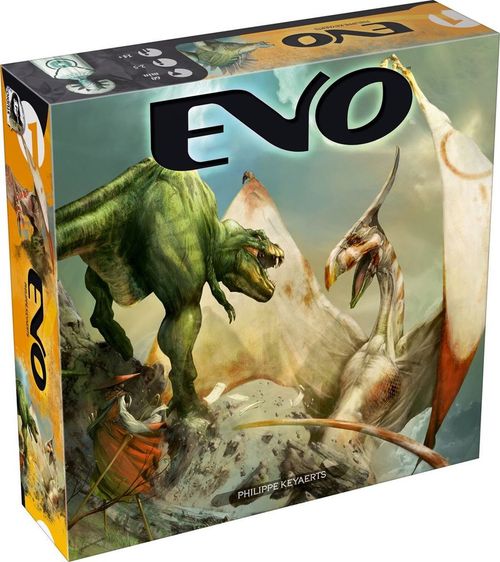
Evo (Second Edition)
Evo (Second Edition) Rulebook
Table of Contents
Table of Contents
Aim of the game
In EVO, you play a nomadic people in symbiosis with a primitive reptilian species. You travel the wild open spaces of Kumtagh with your mounts, you will use your knowledge of biology to help them adapt and succeed against both the hostile and changing climate and other competing species.
Technically, you will earn mutation points (MP in the remainder of the rules) during the course of the game. The player with the most at the end of the game is the winner. In the event of a tie, the player with the most dinosaurs wins. If the game is still tied, it's a draw.
Material
"Father, what are these long bamboo shoots used for?"
"They enable me to control Kort without losing a hand or an arm."
"But Kort is a powerful Nan Shan, he is the Animal of our tribe."
"Yes my son, you are right, the Nan Shan are only aggressive when they're hungry. But, as you will quickly learn, they are always hungry."
1 rulebook — You're reading it.
2 double-sided boards — Use the board corresponding to the number of players.
1 climate wheel — This is an important part of the game: it shows the territories where the dinosaurs can survive.
1 biology lab — This is where you will give genetics a helping hand in order to create the strongest dinosaur species.
5 clan markers (1 per player) — These are used to determine turn order and the choice of genes.
5 dinosaur boards (1 per player) — This is where you will put your dinosaur genes.
40 dinosaurs (8 per player) — These are the ones who will be born, live, fight and die on the game board.
13 climate tokens — These show the climate and determine the length of the game.
48 gene tokens — You'll need these in order for your dinosaurs to evolve.
1 bag — Put the gene tokens in the bag at the beginning of the game.
88 MP tokens — Kept face down, these are both game money and victory points.
15 event cards — It's always useful to have a few of these to surprise your opponents.
1 combat die
Setting up the game
The Nan Shan of the eastern clan fly. I've seen them flying over the high mountains as the first rays of the sun began to pierce the primeval jungle canopy. The tribe was gathered round the last egg. All knew that it was the last chance for the people of the forests. The alchemists worked constantly, day after day, around the immense milky white sphere, distilling their liquids through the hard shell. Fighting the winged monsters was an almost insurmountable challenge. The shell began to crack, and the women started singing the birth chant.
— Meziaky, savannah walker and witness to destiny
Set out the board corresponding to the number of players (the number of players is shown clearly on each board). Attention, they are double-sided!
Each player takes all the playing pieces in their colour: 1 clan marker, 8 dinosaurs and 1 dinosaur board. In addition, each player receives 6 MP.
Place the biology lab and the climate wheel near the game board. The climate wheel should be set up as shown opposite (initial position).
Shuffle the 15 event cards and make a face down deck with them.
Put all the normal gene tokens into the bag (36 in total). Add 8 unique gene tokens at random from the stock of 12.
Normal gene tokens: pair of legs (x6), horn (x5), egg (x6), thermoregulation layers (x7), fur layers (x7), alchemical vial (x5).
Unique gene tokens: 12 in total.
Then make the climate token pile. Remove the meteorite token: this will determine the end of the game. Discard one climate token at random without looking at it.
Meteorite token — Make a face down pile of 3 climate tokens by shuffling the meteorite token and 2 other random tokens.
Shuffle the remaining climate tokens and put them face down on top of this pile of 3.
When you've done this, the pile of climate tokens will contain 12 face down tokens, with the meteorite token somewhere in the bottom three.
Randomly determine a starting turn order by mixing up the players' clan markers and placing them on the appropriate spaces on the biology lab.
The player at the left of the initiative track is the starting player.
Finally, each player places a dinosaur token on each of the two starting areas nearest to them (or at random). The other dinosaur tokens are kept near the players.
The dinosaur board
"Master, why aren't your dinosaurs blurry? I can't seem to draw mine correctly, they're always moving." The wise man leant towards the infant and whispered into his ear, playfully: "I have a secret, I only draw them at night." The child opened his eyes wide in astonishment and added artfully: "But you can't see anything at night." The wise man added, still in a hushed voice, as if he was revealing the secret of life itself: "Naturally. But at night their temperature falls and their movements become slower. Even an old man like me can draw them then as if they were an apple on a table."
Each player has a dinosaur board corresponding to the species with which his tribe is in symbiosis. These boards thus continuously show the characteristics of the various dinosaurs.
The following information is shown on each board, from left to right:
The area at the top of the board is used for the alchemical vials, whose effects are described later.
Legs — All the dinosaur species start with 2 movement points. Each extra pair of legs adds an extra movement point.
Horns — All the dinosaur species start without a horn. Horns are used for fighting by the dinosaurs. They can be added during the game.
Thermoregulation layers — All the dinosaur species can acquire thermoregulation layers which enable them to survive in the hot areas on the island. They do not start with any layers but can acquire them during the game.
Fur layers — All the dinosaur species can acquire fur layers which will enable them to survive in the cold areas on the island. They do not start with any layers but can acquire them during the game.
Eggs — All the dinosaur species start with one egg, which represents their birth rate. This can be increased during the game.
The area at the bottom right is used to store unique genes, whose effects are described later.
Flow of the game
A game of EVO takes a certain number of rounds (between 9 and 11).
During each round, the following 6 phases must be resolved in this specific order. A given phase must be totally resolved before moving on to the next one.
CLIMATE PHASE — The starting player turns over the climate token on the top of the pile and applies its effect. If the meteorite token appears, the game stops immediately and the winner is determined.
MUTATIONS PHASE — The starting player randomly draws the genes that will be made available this round. The players will bid MP in order to acquire them.
INITIATIVE PHASE — The new player order is determined. This will remain unchanged until the next initiative phase.
MOVEMENT PHASE — Players move their dinosaurs in initiative order. This can cause fights to occur: these are resolved immediately.
BIRTH PHASE — Players "lay" new dinosaurs in initiative order.
SURVIVAL PHASE — The starting player verifies that all the dinosaurs can survive in the spaces where they are currently located. The climate can cause a number of animals to die. Each player then earns MP depending on the number of dinosaurs present on the island at the end of the Survival phase.
Climate phase
The council met on the great square. At midnight, the ground began to tremble and the astrolabe rose from its marble shell. It opened like a flower in the springtime and clicked like an army of crickets. The hooded individuals gathered closer to the slowly turning spheres and took measurements while murmuring a strange chant. Finally, the grand Haluah turned to the crowd and spat out: "The next season will see the sun crack the earth and dry out the rivers."
The starting player turns over the top climate token and applies its effect.
If the meteorite token appears, the game ends immediately and the winner is determined. The players reveal their MP tokens and the one with the most is the winner.
Otherwise, the starting player modifies the climate by turning the climate wheel in the direction shown on the revealed token:
- Token showing a clockwise arrow with 2: Move the climate wheel two sections clockwise.
- Token showing a clockwise arrow with 1: Move the climate wheel one section clockwise.
- Token showing 0: The climate wheel remains unchanged.
- Token showing an anticlockwise arrow with 1: Move the climate wheel one section anticlockwise.
The selected section determines the climate for the current round. It is vitally important that all the players understand what that implies for the survival of their dinosaurs (see the Survival phase).
Mutation phase
The still sputtered and a last drop flowed into the vial. The alchemist went over to the incubator. Using a large bone needle, he injected the liquid into the interior, waited, speechless. The minutes passed, then hours. The scientist remained there, contemplating his work. Finally, the shell cracked and a tiny beak appeared. When the animal had completely freed itself from the refuge where it had just spent three months, it spread two ridiculously small wings and let out a high-pitched cry. The man shrugged his shoulders, disappointed, and drove the creature away with a swift kick.
The starting player draws gene tokens out of the bag, one by one, and adds them to the biology lab until there are as many lines filled as there are players. Since the first line does not contain a space for a gene, the number of genes drawn will always be one fewer than the number of players.
There can never be two identical genes in the same mutation phase. If this happens, the starting player returns the extra gene to the bag and draws a new one to replace it.
Then, in initiative track order, the players bid for the available genes. Genes are paid for using MP. Since these are also victory points, be careful about how you spend them!
When it's their turn to bid, players place their clan marker opposite the token they would like to have (or on the first column, see below).
If the column is empty, the marker can be placed wherever the player likes (but the value chosen represents the number of MP that the gene will cost).
If the column is already occupied, the marker must be placed on a higher value than the marker that's already there, thus increasing the bid.
A player who has been outbid by another immediately removes his marker and makes a new bid. The new bid must be on a different column (however, if he is displaced again later, he can make a fresh bid on the original column).
Note that if a player bids 6 on a column, he cannot be outbid and therefore will always win the gene in question.
The player who won the bidding for the first column takes an event card.
The other players take the gene from the column that they won.
All the players must pay for their bids by handing in the appropriate number of MP to the bank.
Normal genes
The effects of normal genes are permanent.
Pair of legs — Each extra pair of legs adds 1 additional movement point to your species. Each species starts the game with 2 movement points.
Horn — Each horn increases your chances of winning a fight, both in attack and defence. The dinosaurs start the game without any horns.
Thermoregulation layers — Each layer enables a dinosaur to survive in a hot climate. Each species starts without any thermoregulation layers.
Fur layers — Each layer enables a dinosaur to survive in a cold climate. Each species starts without any fur layers.
Egg — Each egg enables a new dinosaur to be laid each round. Each species starts with one egg.
Alchemical vial — Each vial reduces the cost of genes and cards bought in subsequent rounds by 1 (minimum 0).
Unique genes
The effects of the unique genes are permanent.
Bony plates — This gene acts like 2 horns when defending (when one of your dinosaurs is attacked).
Large horn — This gene acts like 2 horns when attacking (when one of your dinosaurs attacks another one).
Thick shell — During the Birth phase, you can place your new dinosaurs up to 3 spaces away.
Flippers — One of your dinosaurs can move from one coastal space to another coastal space by paying 1 movement point. A space is coastal if it is next to the sea.
Wings — One of your dinosaurs can move 2 spaces by paying 1 movement point. The first space can contain a dinosaur (including another player's). This gene can only be used once per Movement phase.
Regeneration — You can never have fewer than 3 dinosaurs. If you have only 3, you cannot be attacked, you are no longer affected by the climate, etc.
Killer babies — You can add new dinosaurs to occupied spaces. Roll a die for each dinosaur so added. The opposing dinosaur is eliminated on a roll of claw, claw-with-equals or claw-with-plus. On a roll of cross or claw-with-two-plusses, your dinosaur dies.
Sixth sense — You can look at the next climate token whenever you like.
Cave dweller — One of your dinosaurs in a deadly area during the Survival phase survives.
Adrenaline rush — You can freely choose your spot on the initiative track during the initiative phase.
Strong thighs — This gene provides you with 2 extra movement points.
Chameleon skin — When you lose a fight, your dinosaur can move onto an adjacent space (but not the one from which the attacker came) instead of being killed. If no legal space is available, it dies.
Event cards
Each round, the player who won the bidding on the first column of the biology lab takes a random event card. These cards are kept secret until they are used. More than one may be played in a given round or phase as long as the correct timing for playing the card is respected.
The effects of an event card are never permanent and they are discarded after use.
Each card shows the moment when the card must be played, and the effect of the card.
The English rulebook does not list all 15 event cards; it only reproduces a few of them as illustrations, and in this printing those card illustrations were left in French. The five cards visible in the rulebook's illustrations are given below, with their card text translated from the French artwork:
- Geysers — To be played during the Survival phase. All your dinosaurs survive on cold terrain during this phase.
- Prescience (Foresight) — To be played during the Climate phase, when the weather token is revealed. The climate token does not take effect. Instead, move the climate wheel (one or two sections clockwise, or one section the other way) or leave it in place. Cannot be played on the meteorite token.
- Nuée de rats (Swarm of rats) — To be played during the Birth phase. There are no births at all during this phase.
- Voleur d'œufs (Egg thief) — To be played during the Birth phase, just after an opponent has placed a new dinosaur. Replace a dinosaur that has just been born with one of your own taken from your reserve. That dinosaur must belong to an opponent who has at least 4 of them.
- Attaque frénétique (Frenzied attack) — To be played during the Movement phase, before launching an attack. During this phase, all your dinosaurs are considered to have 2 extra horns, but only when attacking.
Initiative phase
All the clan markers are placed on the initiative track at the top of the column they occupied at the end of the previous phase. Then they are sorted in increasing order by the number of dinosaurs on the board (retaining the order in the case of a tie). Thus, players will fewer dinosaurs will go first.
The clan markers are moved from the bidding area to the initiative track.
Example: Red and green each have 5 dinosaurs, blue 6 and yellow 7. The markers are therefore sorted into this order (5, 5, 6, 7).
Movement phase
The Cornac struck the ground twice at the edge of the forest. Then he used his staff to scrape the moss that covered the stones. A first animal appeared, a young female of no more than ten seasons. Then came the three young. He stroked the backs of the young animals and offered a clump of moonflower to the biggest. Then the whole forest began to shake under the herd's steps. The Kartec had been gathered together and the migration could commence.
Beginning with the starting player and continuing in initiative track order, each player moves their dinosaurs. Initially, each dinosaur species has 2 movement points. An extra point is acquired for each additional pair of legs. The available movement points must be divided amongst all the dinosaurs of the species. Each movement point enables ONE dinosaur to move one space.
Example: a species that has 3 movement points could move 3 dinosaurs one space each, or one dinosaur 2 spaces and then another dinosaur a single space.
Dinosaurs are not allowed to move through or stop on a space that is already occupied by another dinosaur (friend or not). You are not required to use up all the available movement points.
Combat
The people of the three horns who lived to the north crossed the deep red mountains on the dawn of the second day. Their monsters swooped down on the sleeping village which had not thought to post sentries. It must be said that the three hundred seasons of peace had transformed the people from valiant warriors into lazy fishermen. They learnt to their cost that the hostile lands to the north were no longer sufficient to feed all the dinosaurs.
The only way to enter a space containing an enemy dinosaur is to start a fight, as follows:
The moving player spends a movement point and indicates which space is being attacked. He rolls the combat die. Two outcomes are possible (see sidebar):
- The attacking dinosaur wins and takes the place of the defeated animal. The losing dinosaur is removed from the game.
- The attacking dinosaur loses. The two dinosaurs stay where they are.
It is perfectly possible to attack the same dinosaur more than once, even with the same attacker. The only thing to bear in mind is that combat always costs 1 movement point.
COMBAT RESULT
- Cross: Attack fails.
- Claw: Attack succeeds.
- Claw with equals sign: If the attacking dinosaur has at least as many horns as the defender then the attack succeeds (if neither of the two dinosaurs has a horn, the attack succeeds).
- Claw with plus sign: If the attacking dinosaur has more horns than the defender then the attack succeeds.
- Claw with two plus signs: If the attacking dinosaur has at least two horns more than the defender then the attack succeeds.
Important: a clan that only has two dinosaurs may not be attacked.
Birth phase
The young girl threw a handful of tiny fledglings at the pack. The animals seized them in mid-flight and swallowed the feathered babies whole without delay. The litter was numerous and soon these dinosaurs, who were only the size of a cat, would be the fiercest warriors in the tribe. But for the time being, they needed to eat. Very quickly. Too quickly. Leana quickly found herself with an empty basket and looked around at the carnivorous predators that surrounded her. She showed them the inside of her basket and a single feather fell from it. Before it had even reached the ground, the dinosaurs had leapt on their keeper, determined to finish their meal.
Beginning with the starting player and continuing in initiative track order, each player can add new dinosaurs as follows:
The player places a new dinosaur pawn on a space adjacent to one of his dinosaurs. Once all the players have done this, players with two eggs repeat the process, then again for players with three eggs, and so on for players with more eggs.
A player who already has all 8 dinosaurs on the board is allowed to eliminate one of them in order to bring a new one on elsewhere.
Survival phase
The great male struck out in all directions to protect the minuscule water hole in between his two front legs. This muddy puddle barely two cubits wide was all that was left of a lake that had been as full of fish as the ocean. Soon, there would be nothing left and all the animals that hadn't taken the route east would die in agony. Already, the scavenging pterosaurs were circling in the sky, attracted by a feast which wouldn't be long in coming.
Beginning with the starting player and continuing in initiative track order, each player eliminates the dinosaurs that haven't been able to resist the island's hostile climate, as follows:
- On ideal terrain, all the dinosaurs survive.
- On deadly terrain, all the dinosaurs die.
- On hot terrain, the player can enable one of his dinosaurs to survive for each thermoregulation layer on his board. All the other dinosaurs die.
- On cold terrain, the player can enable one of his dinosaurs to survive for each fur layer on his board. All the other dinosaurs die.
Each player removes the dead dinosaurs in the order of his choice and stops if he only has two remaining on the board.
Finally, each player receives one MP for each of his dinosaurs on the game board. Then the next round begins.
The climate wheel shows which terrain types are ideal terrain, cold terrain, deadly terrain and hot terrain for the current climate.
Summary
A game round
- CLIMATE PHASE
- MUTATION PHASE
- INITIATIVE PHASE
- MOVEMENT PHASE
- BIRTH PHASE
- SURVIVAL PHASE
Gene summary
Normal genes
- Pair of legs — Each extra pair of legs adds 1 additional movement point to your species. Each species starts the game with 2 movement points.
- Horn — Each horn increases your chances of winning a fight, both in attack and defence. The dinosaurs start the game without any horns.
- Thermoregulation layers — Each layer enables a dinosaur to survive in a hot climate. Each species starts without any thermoregulation layers.
- Fur layers — Each layer enables a dinosaur to survive in a cold climate. Each species starts without any fur layers.
- Egg — Each egg enables a new dinosaur to be laid each round. Each species starts with one egg.
- Alchemical vial — Each vial reduces the cost of genes and cards bought in subsequent rounds by 1 (minimum 0).
Unique genes
- Bony plates — This gene acts like 2 horns when defending (when one of your dinosaurs is attacked).
- Large horn — This gene acts like 2 horns when attacking (when one of your dinosaurs attacks another one).
- Thick shell — During the Birth phase, you can place your new dinosaurs up to 3 spaces away.
- Flippers — One of your dinosaurs can move from one coastal space to another coastal space by paying 1 movement point. A space is coastal if it is next to the sea.
- Wings — One of your dinosaurs can move 2 spaces by paying 1 movement point. The first space can contain a dinosaur (including another player's). This gene can only be used once per Movement phase.
- Regeneration — You can never have fewer than 3 dinosaurs. If you have only 3, you cannot be attacked, you are no longer affected by the climate, etc.
- Killer babies — You can add new dinosaurs to occupied spaces. Roll a die for each dinosaur so added. The opposing dinosaur is eliminated on a roll of claw, claw-with-equals or claw-with-plus. On a roll of cross or claw-with-two-plusses, your dinosaur dies.
- Sixth sense — You can look at the next climate token whenever you like.
- Cave dweller — One of your dinosaurs in a deadly area during the Survival phase survives.
- Adrenaline rush — You can freely choose your spot on the initiative track during the initiative phase.
- Strong thighs — This gene provides you with 2 extra movement points.
- Chameleon skin — When you lose a fight, your dinosaur can move onto an adjacent space (but not the one from which the attacker came) instead of being killed. If no legal space is available, it dies.
Combat result
- Cross: Attack fails.
- Claw: Attack succeeds.
- Claw with equals sign: If the attacking dinosaur has at least as many horns as the defender then the attack succeeds (if neither of the two dinosaurs has a horn, the attack succeeds).
- Claw with plus sign: If the attacking dinosaur has more horns than the defender then the attack succeeds.
- Claw with two plus signs: If the attacking dinosaur has at least two horns more than the defender then the attack succeeds.