EVL
EVL Rulebook
Table of Contents
Table of Contents
Objective
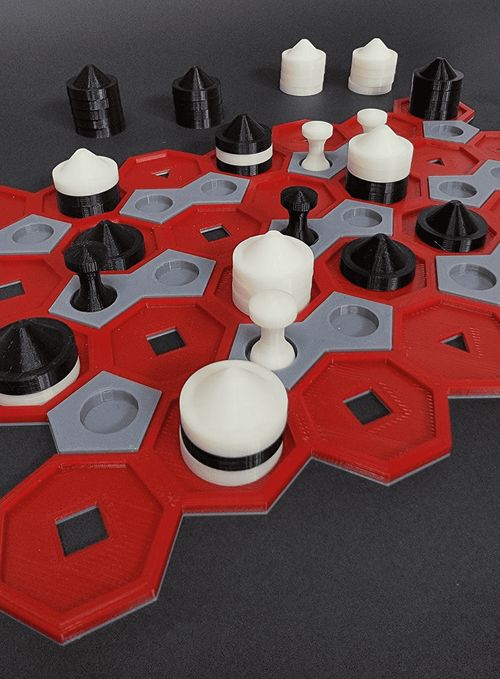
EVL is a territory capture game played on an unusual board of heptagons (7-sided) and pentagons (5-sided), using a stacking and unstacking mechanism.
EVL forces are trying to invade you; deploy your forces and defend your territory!
The first player to capture 10 pentagons wins the game.
Components
- 1 - board
- 24 - markers (12 of each color, tall skinny pieces)
- 56 - pieces (28 of each color, flat stackable cones)
Legal
© 2021 Nexus Games LLC, Oregon USA
All rights reserved
Resources
Visit www.NXSgame.com for more information.
Game Play
The board begins empty. Each player chooses a color. Black goes first. Underlined terms will be defined later in the rules.
On their turn, a player must either:
- place one piece from your hand onto the board
- on any empty space
- on an occupied space containing a piece or stack that you control
- legal stacks are a maximum of four pieces high
- the color on the top of a stack controls the stack
- unstack a stack of pieces that you control
Pentagons can only be captured by the active player on an unstack, not by placing.
The Board
The board is made up of four (4) rows of heptagons surrounding 18 pentagons.
note: if your board has square and triangle cutouts, they are purely decorative
Stacks
A stack consists of 2-4 pieces, stacked on top of one another. Stacks are created by placing one piece on top of one or more pieces that are already on the board. You cannot create a stack taller than four (4) pieces in height. The player who occupies the top of the stack controls the stack.
Example: Black has placed a piece, and White has placed a piece next to it. On their turn, Black places a second piece on top of their piece creating a stack. Placing on top of White's piece would be illegal.
Unstacking
To unstack, pick up the entire stack (a single piece is not a stack). You may move the stack up to a number of spaces equal to its height. With the exception of the space the stack occupied at the start of the turn; whenever a stack exits a space, it leaves behind exactly one piece from the bottom of the stack.
The stack height limit can be temporarily violated during an unstacking, but at the end of the turn no stack may be taller than four (4). In effect, this makes a stack of four an impassable wall, since there is no way to unstack over it without increasing its height.
Unstacking occurs via connected heptagons. You cannot jump over pentagons while unstacking.
In the diagrams below White unstacks their stack, one piece at a time from the bottom, up to three spaces (the height of the stack). Note, any of the three resulting positions would be legal (unstacking one space is essentially the same as moving the stack one space).
Unstacking does not need to be straight along a row (but you may not reverse direction and double back on the same path). The below sequence also shows a legal unstacking path. Any of the three resulting positions are valid.
Capturing Pentagons
The goal of EVL is to capture the most pentagons. Pentagons are captured by "surrounding" them with your pieces on any two non-adjacent heptagons.
You can only capture pentagons with an unstack, not by placing a piece.
In the diagrams below, White unstacks their stack to the right. At the end of the unstack move, White surrounds the pentagon that falls between a and b, and between b and c, because each pentagon is now surrounded by a White piece on two non-adjacent sides. White places a marker on each pentagon (replacing the existing Black marker).
Note that even though the unstack resulted in Black surrounding the pentagon between d and e, no capture for Black takes place. You can only capture pentagons for yourself.
Note: You do not lose a pentagon if you move a piece away and no longer surround it. Your marker stays until your opponent takes it from you. However, you cannot hold a pentagon just because you still have pieces surrounding it. An opponent can take it if they surround it with an unstack on their turn.
Let's examine a similar, but slightly different situation. In this case, when White unstacks to the right, White is still able to capture two pentagons. That is because the pentagons marked c and d are both surrounded on two non-adjacent sides by a White piece (a and b) at the end of an unstack.
Rare Situations
If you run out of tokens, you must unstack on your turn.
If a player can neither place a piece or unstack, the game ends immediately. The player with the most pentagons captured wins.
Winning the Game
The first player to capture 10 pentagons (have all their markers on the board at once) wins the game! You can play to more or less than 10 for game length variety.
Notation
- Placing a piece:
+b6 - Unstacking down the same row:
b1-b4 - Unstacking across rows:
b2-b4,a4-a5