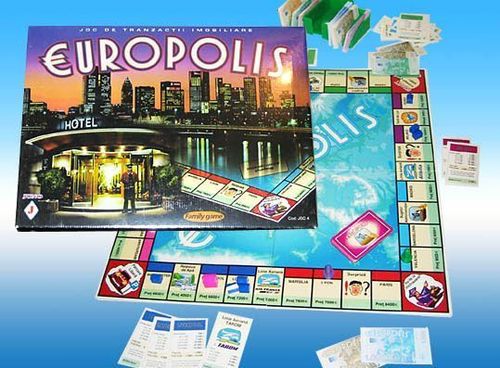
Europolis
Europolis Rulebook
Table of Contents
Table of Contents
Game Contents
The game contains:
- Game board
- 28 property titles
- 16 Surprise cards
- 16 Administration Budget cards
- Europolis special money
- Bank separator
- 34 villas
- 10 hotels (the larger pieces)
- 2 dice
- 6 pawns
Game Setup
Sort the money by denomination into the 6 compartments of the bank separator. The villas, hotels and property titles are placed face up on the table beside the board. Separate the "Surprise" cards from the "Administration Budget" cards, shuffle each pack and place each face down on the matching special spaces on the board.
Each player chooses a pawn and places it on the START space of the board. By agreement, one of the players will also hold the bank.
The Bank
The player who has been designated banker (holding the bank) has charge of the money, the property titles, the villas and the hotels. The bank also collects taxes, pays bonuses, lends money in exchange for mortgaging land, and acts as auctioneer. The bank never goes bankrupt! If the money runs out, the bank may issue promissory notes (a sheet of paper of similar size, handwritten).
Dividing the Money
If there are 4 players at the table, the banker gives each participant 50,000 euro, as follows:
- 2 banknotes of 10,000 euro and of 50 euro
- 3 banknotes of 1,000 euro and of 500 euro
- 4 banknotes of 100 euro
- 5 banknotes of 5,000 euro
[Transcriber's note: the printed four-player breakdown is transcribed as printed. The scan's denominations for this list do not add up to exactly 50,000 euro under a simple reading, so the list is reproduced without correction.]
If there are 5 or 6 players, the total divided among the participants will be 45,000 euro (only 4 banknotes of 5,000 euro are given). When there are 6 players at the table, it is recommended that the banker does not take part in the game (and holds only the bank). The bank may exchange banknotes whenever the interest of the game requires it.
Starting the Game
The order of the players is determined by rolling the dice. The game begins with the player who rolled the highest. When it is your turn, roll both dice and move your pawn in the direction of the arrow by as many spaces as the total points shown on the two dice. Depending on the space you land on, you have the following options:
- buy a property or a utility
- pay rent or taxes
- go to jail
- draw a card
- receive a bonus of 5,000 euro
- do nothing (Free Parking or Jail – Just Visiting)
Buying villas or hotels is the strategy of each player.
If you roll doubles, move your pawn according to the total of the points on both dice and then roll once more. If you roll 3 doubles in a row, go directly to jail! When you pass over START, or land on the START space (a full lap has been completed), you receive a bonus of 5,000 euro. You can receive an additional bonus if you draw a card that sends you to START, or that tells you to move past START again. The wording on the card is binding. For example, you do NOT receive 5,000 euro if that is what the card says!
Purchasing Properties
When your pawn lands on an unowned property, you may buy it by paying the bank the sum shown on the game board. The bank will hand you the "Property Title". If you do not want to buy, the bank must immediately put that property up for auction. The starting price is the amount offered by another player who wishes to buy. All players have the right to take part. The player who offers the highest price wins. The same procedure applies when you land on a utility or on an unowned aerial line (one not owned by another player). If you want to buy, you pay the bank the sum shown on the game board. If you do not, the bank auctions it, and you may also bid.
Owning a property is advantageous, because you can charge rent to the players who land on a space you own. When you manage to acquire all the properties of the same colour (that is, you own a country and have a monopoly in that country), the rent value is doubled and you may build villas or hotels, and the value of the property rises rapidly.
Rent
When you land on a space owned by another player, that player may ask you to pay rent. If the owner forgot to ask for the rent and the next player has rolled the dice, it is no longer payable. The rent is shown on the Property Title and depends on the number of buildings on that space. The rent asked for a plot without buildings may be doubled if the owner holds all the properties of the same colour. If one of those properties is mortgaged, the rent asked on the other properties of that colour can no longer be doubled. No rent is asked for mortgaged properties!
The same procedure applies when you land on a utility or an aerial line. The rent asked is the one shown on the respective Property Title, its value depending on the number of utilities (or aerial lines) owned. Likewise, if the owner did not ask for the rent before the next player rolled the dice, it is no longer payable.
Cards
If you land on one of the "Surprise" or "Administration Budget" spaces, draw the respective card from the top of the pack lying on that space of the board. The instructions on the card are carried out exactly. After carrying out the instructions, the card is placed at the bottom, on the respective space. If you drew the "You Are Lucky!" card (Ești norocos!), you may keep it until you need it. With it you can get out of jail, or cancel a tax (Income Tax, Luxury Tax, or any tax written on a card).
After use, the card is placed at the bottom of the pack, in the space allocated on the board. The "You Are Lucky!" card from the Surprise pack may be sold to another player by negotiation.
Other Spaces
- Tax spaces (Luxury Tax or Income Tax). If you land on this space, you pay the bank the sum shown on the game board. You may cancel this tax if you hold the "You Are Lucky!" card.
- Free Parking. You remain on this space, without obligations, until your turn comes round again. During this time you keep all your rights (you collect rent, you may build, etc.).
- Jail. You can go to jail in the following cases:
- You landed on the "Go to Jail!" (Du-te la închisoare!) space.
- You drew a card that requires this.
- You rolled 3 consecutive doubles.
If you are in jail, your turn in the game ends. During this period you may still collect rent from the players who land on your properties.
You may leave jail in the following cases:
- you roll doubles with the dice
- you use the "You Are Lucky!" card, if you have one
- you wait 3 turns (each time your turn comes you roll the dice, hoping to get doubles)
After you have spent 3 turns in jail, you leave by paying a bail of 1,500 euro and move your pawn according to the total of the points from your last roll of the dice. If you are not sent to jail and land on the jail space by rolling the dice, you are considered "Just Visiting" and you play normally when your turn comes.
Villas and Hotels
Building villas or hotels increases the value of the property. The rent asked in this case is significantly higher (see the Property Title). You may build only when you own all the properties of a colour group (that is, you own a country). Buying can be done on your turn or between the turns of the other players.
The price of a villa (or hotel) is shown on the Property Title. Building villas (buying them) may only be done proportionally, namely not. You may build a second villa on a site only once you have built one villa on every site of that colour. The rule continues up to the fourth villa. (Example: you cannot have 2 villas on one site and 4 villas on another site, if the sites belong to the same colour.) The same procedure applies when selling villas. You may buy or sell as many villas as you wish, at any time (between turns), according to your strategy, but always respecting the proportionality rule. You cannot build (buy) villas if one of the properties of the same colour is mortgaged. (First you redeem the mortgage, and then you may build.)
For a hotel you must first have 4 villas on each property of the same colour group. A hotel can never be built directly on a property! The price of a hotel is shown on the Property Title. To obtain it, you hand over to the bank the price shown and the 4 villas. The proportionality rule applies! (You cannot have a hotel and 3 villas on properties of the same colour group.)
Villas and hotels cannot be sold between players. They are sold only to the bank, at a price equal to half the price shown on the Property Title. They may be sold at any time and as many times as you like. For a hotel, the bank pays half the value shown plus half the value of the 4 villas returned earlier. A hotel may be returned to the bank, and in exchange you receive 4 villas plus half the value shown on the hotel.
Note! Villas and hotels are in limited number. If the bank has fewer than the demand, and two players request buildings in the same turn, go to auction. The starting price is the lowest price shown on the Property Title. It is recommended that the player pay attention to game strategy in order to benefit from the buildings!
Selling Properties
Properties (cities, utilities or aerial lines) can be sold only between players. You cannot sell a property if it has buildings on it. In this case you must sell to the bank all the buildings on the properties of the same colour as the property you want to sell. (See the paragraph "Villas and Hotels".) The sale is made by negotiation, at a price agreed by both sides, or exchanges of properties may be made, etc., according to each player's strategy. Mortgaged properties may also be sold.
Mortgaging Properties
To obtain an extra sum of money (if needed) you may mortgage a property. In this sense, you turn the Property Title face down and the bank pays you the sum printed on the back.
To redeem the mortgage you must pay the bank the mortgage amount plus 10% interest. (For example: Marsilia is mortgaged for 3,900 euro. To redeem it you pay the bank 4,290 euro.)
A property cannot be mortgaged if it has buildings on it. In this case you must first sell to the bank all the buildings on the properties of the same colour as the property you want to mortgage. The mortgaged property remains in your possession. No one may buy it from the bank.
While a property is mortgaged you do not receive rent from the player who lands on it, but you may receive simple rent from the other properties of the same colour group (you cannot ask for doubled rent).
A mortgaged property may be sold to another player. That player has the choice of redeeming the mortgage immediately, paying the bank the mortgage value plus 10% interest, or leaving the property mortgaged and paying the bank the 10% interest. On redeeming the mortgage he will be obliged to pay the 10% interest once more. The owner may build again at the moment he has redeemed his mortgages.
Rule! Lending money between players is forbidden!
Recommendation! Be attentive to collecting rent. If you do not ask for it, you may not receive it!
Bankruptcy
If at any moment your debt to the bank or to another player is greater than the sum of the values you hold, you are declared bankrupt. If your debt is to the bank, the bank takes all the values you hold (money, properties, etc.). The bank organises an auction (if one is requested) and sells your properties to the other players.
If you hold the "You Are Lucky!" card, you insert it at the bottom of the respective pack on the game board.
If a player has bankrupted you, you must first sell to the bank all your buildings, at half price, and hand over all your values to that player. He will also take over the mortgaged properties, being obliged to pay the bank 10% interest. Only after that may he redeem the mortgage (if he wishes to do so).
Rule! The last player remaining at the game table is declared the winner!
Short Game Variants
- Time limit.
- Only 2 players remain at the game table.
In both cases THE RICHEST PLAYER WINS!
To this end, the players evaluate their possessions as follows:
- the value of cash in hand
- the value of properties (plots, utilities, aerial lines) at the price shown on the game board
- the value of villas at purchase price
- the value of hotels at purchase price (including the value of the 4 villas given in exchange)
- the value of mortgaged properties (at half the price shown on the game board)
The sum of all these values represents the player's wealth.
Note:
- by buildings we mean villas or hotels
- players may also choose another short-game variant, by agreement between them
- the interest payments may not come to round sums. In this case rounding is done in favour of the player. For example, for Marsilia the interest is 390 euro, and the player pays 350 euro. [Transcriber's note: the printed example gives 350 euro, which does not match the 390 euro interest that the mortgage terms give (10% of 3,900 euro). The figure is transcribed as printed; it is not corrected here.]