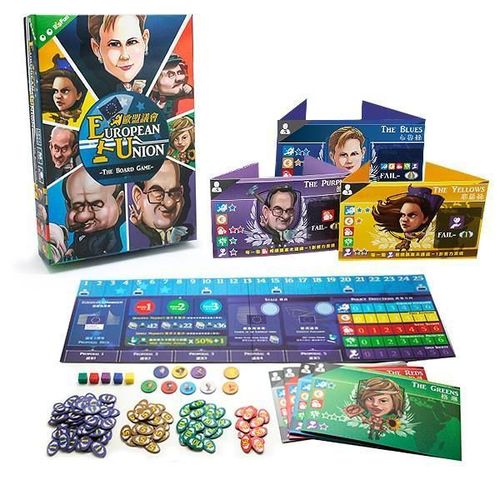
European Union: The Board Game
European Union: The Board Game Rulebook
Table of Contents
Table of Contents
Game Components
- Game Boards x1
- Party Cards x7
- Round Indication Token x1
- Stage Indication Token x1
- President Card x1
- Voting Cards x7
- Party Tokens x7
- Partition Boards x7
- Member State Cards x28
- Proposal Cards x50
- MEP Cards x12 (used only in the Advanced Version)
- Majority Indication Cards x14 (used only in the Advanced Version)
- End Game Scenario Cards x15
- Influence-Point Chips x100: 1 Point x50, 5 Point x20, 10 Point x20, 50 Point x10
- Policy Direction Blocks x5
Game Initial Setup
- The game owner holds the President card at the start of the game. Any ties in bids (two players with the same Influence-Points) during the game will be decided by the President. Any tied votes when selecting a new President will be decided by the sitting President. Whenever a new President is selected, all the associated powers are transferred to the new President.
- Depending on the number of players, the Party Cards with the same number (on the top left corner) as the number of players are used and dealt randomly to players. After the Party Cards are dealt, each player also receives the Party Token corresponding to his/her Party, as well as 1 Voting Card.
- The Proposal Cards are shuffled and placed on the European Commission slot on the Game Board.
- All Member State Cards are sorted into three piles. The cards marked with Round 1/2/3 in one pile, the cards marked with Round 2/3 in another pile, and the card marked with Round 3 in the third pile.
- All MEP Cards are shuffled and placed in one single pile. (MEP Cards are only used in the Advanced Version.)
- The Majority Indication Cards are placed beside the Game Board. (Majority Indication Cards are used only in the Advanced Version.)
- All End Game Scenario Cards are placed in 5 piles according to their Policy Directions.
- The Round Token is placed on the "Round 1" slot on the Game Board.
- The Stage Token is placed on the Council of the European Union slot on the Game Board.
- Place the Policy Direction Blocks on the "0" slots of their respective colours.
- All players receive 5 1-point Influence-Point chips and 1 5-point Influence-Point chip, and receive the Partition Board of their respective Parties. Influence-Point chips are placed behind each player's Partition Board so that other players may not see them. The remaining Influence-Point chips are placed in piles according to their denominations.
Versions
Basic Version (Game for 3 to 5 players): MEP Cards and Majority Indication Cards are not used. Rounds consist only of the "I. Council of the European Union" stage. After the Council votes, the game enters the "III. Calculate Scores" stage and proceeds until the third round is over and the game ends.
Advanced Version (Game for 3 to 7 players): The legislative procedure of the European Union is simulated in the Advanced Version. Each round consists of the "I. Council of the European Union" and "II. European Parliament" stages. Proposals from the European Commission must win approval in both stages in order to pass. After the European Parliament stage, the game enters the "III. Calculate Scores" stage and continues until the third round is over and the game ends.
Source note: the heading of the Advanced Version box in the source reads "Game for 3 to 5 players", while the player-count table at the top of the same page and the rest of the rulebook give 3 to 7 players for the Advanced Version. The 3 to 7 figure is used here.
How to Play
I. Council of the European Union Stage
- Move the Stage Token to the Council of the European Union slot.
- Turn the Member State Cards faced-up, and divide them into piles according to their voting powers and Influence-Points.
- Bid for Member State Cards: Each player secretly chooses an amount of Influence-Point chips and holds them in his/her fist. Once each player has decided how much to bid, all players reveal their bids simultaneously. The person with the most Influence-Points will be the first to choose a Member State Card, and other players choose in descending order of the number of the Influence-Points they bid. The process is repeated until all Member State Cards have been chosen. (Each player may have a different number of Member State Cards.) All bids are paid to the general supply. Players who choose Member State Cards that give Influence-Points immediately receive the appropriate corresponding Influence-Point chips.
Diagram: "The diagram for the bid for Member State Cards" (source page P15). Four players show bids of 3, 2, 1 and 1 chips in the example. "Ties!! Decided by the President. The Yellows pick first." The 1st, 2nd, 3rd and 4th bidders then take the cards in turn. The first round of picks is Germany, France, Italy and the Netherlands; the second round is Belgium and Luxembourg, taken by the 1st and 2nd bidders, with the 3rd and 4th bidders out of Member State Cards. "All bids are paid to the general supply." "Once a player gains a Member State Card, S/he also gains the corresponding Influence-Point chips."
- Appoint President: During the bidding process, the player with the highest bid becomes the President of the Council and holds the President Card.
- Move your Party Token (Indication of Voting Power): All players add up the voting power of their Member State Cards and place their Party Tokens on the corresponding voting power slots to indicate their respective voting powers.
- President Chooses 5 out of 7 Proposals: The President of the Council randomly draws seven Proposal Cards from the European Commission slot, then displays and reads each card. The President then chooses five of the Proposal Cards (the President must make his/her choices within 1 minute after reading all of the Proposal Cards). The five chosen Proposal Cards are placed on Proposal 1 to Proposal 5 slots on the Game Board, and the remaining two are discarded. The President has the power to decide the order.
Proposal Card layout (source page P16): Title of the Proposal; the influence on the policy directions of this Proposal (European Integration, Free Economy, Social Security, Environmental Protection, Open Society); the voting method of this Proposal (Council of the European Union / European Parliament).
- Discussion and Vote: The President chairs the vote of each Proposal. The Proposals are voted on one by one using the Voting Cards, based on the voting power of each player. Proposal Cards that win approval are kept faced-up; Proposals that are not approved are turned faced-down. Discussions amongst the players are allowed and even encouraged before each round of voting. The maximum discussion time limit for each Proposal is 3 minutes. The President, however, has the power to end the discussion prior to the maximum time and force the vote. After the consecutive voting of five Proposals, the game enters the next stage.
How are Proposals approved?
- Unanimous Decision: If a Proposal Card has Unanimous Decision indicated, then all players must vote "yes" in order for the Proposal to pass.
- Qualified Majority: If a Proposal Card has Qualified Majority indicated, then the sum of Member State voting power of the players who vote "yes" must equal or exceed the Qualified Majority number indicated on the Game Board for each round.
II. European Parliament Stage
This stage may be skipped in the Basic Version; it is only played in the Advanced Version.
- Move the Stage Token to the European Parliament slot.
- Randomly choose the same number of MEP Cards as the number of players, and place them in descending order based on voting power. (For example, if there are 4 players, randomly choose 4 MEP Cards.)
- Bid for MEP Cards: Each player secretly chooses an amount of Influence-Point chips and holds them in his/her fist. Once each player has decided how much to bid, all players reveal their bids simultaneously. All players choose a MEP Card, in descending order of the number of Influence-Points they bid. All bids are paid to the general supply.
Diagram: "Bid for MEP Cards" (source page P17). The 1st to 4th bidders take the MEP Cards with voting power 12, 11, 10 and 9 in turn. "Ties!! Decided by the President. The Yellow pick first." "All bids are paid to the general supply."
- Appoint President: During the bidding process, the player with the highest bid becomes the President of the Parliament and holds the President Card.
- Move your Party Token (Indication of Voting Power): All players add up the voting power of their MEP Cards and place their Party Tokens on the corresponding voting power slots to indicate their respective voting powers.
- Setting the Majority Card: Add the voting powers of all the players' MEP Cards, then divide the sum by 2 and add 1 to calculate the number of votes needed to obtain a simple majority in the Parliament. Set the Majority Indication Card to this number.
Example (source page P18): the MEP Cards are 12, 11, 10 and 9. The total is 42, and the Majority Indication Cards are set to 22.
- Review Remaining Proposals, Discussion and Vote: A simple majority vote is held on every Proposal Card that passed the Council of the European Union stage. The vote is based on each player's MEP Card voting power. Again, discussions are allowed with a maximum discussion time of 3 minutes for each proposal. The President has the power to end the discussion and force the vote.
How are Proposals approved?
- Simple Majority: If the total voting power of the players who vote "yes" equals or exceeds the number on the Majority Indication Cards, then the Proposal is approved and becomes an EU Directive.
III. Calculate Scores Stage
The number of Influence-Point chips gained or lost is calculated based on the information on each Party Card.
- Calculate Approved Proposals: Players receive Influence-Point chips based on the Policies associated with the approved Proposal. The number of stars given to the Policy on the approved Proposal Card is multiplied by the number of stars listed for the same Policy Preference on each Party's Card. Each player then receives that number of Influence-Point chips. The process is repeated for each Policy. Once a proposal is passed, it does not matter if a player voted for or against it; the player would still gain the corresponding Influence-Point chips.
Diagram (source page P18): the Party Card of "The Blues" and the approved "PASS" Proposal card, with the stars of each Policy multiplied in turn.
Example: if an approved Proposal has 2 stars on European Integration Policy, and if a Party has 2 stars on its European Integration Policy preference, then that Party gets 4 Influence-Point chips (2 x 2) for that approved Proposal. The same applies to other calculations.
- Calculate Party Special Abilities: Players may gain or lose Influence-Point chips based on their Party Special Abilities, also indicated on their Party Cards.
Example (source page P19): take the Purples as an example. The player with the Purples Party Card loses 1 Influence-Point chip for every FAILED Proposal associated with the Social Security policy. In the diagram, the failed Proposal has two stars on its Social Security policy preference, but the ability counts the number of Proposals, not stars. Therefore, only one Influence-Point chip is subtracted because of this Proposal.
- Policy Direction Adjustments: For each approved Proposal Card that has a box around a Policy listed on it, the Policy Direction Block for that particular Policy Direction is advanced by one slot.
Example (source page P19): the approved "Euro" (成立歐元) Proposal has a box around the European Integration and Free Economy policies, so those two Policy Direction Blocks each advance one slot.
- End of Round:
- Return Member State Cards.
- Return MEP Cards.
- Approved Proposals are placed in a faced-up pile, and failed disapproved Proposal Cards in another faced-down pile. The Proposal Cards for each round should be kept separate.
- Proceed to the next round. The Round Token is moved the next Round's slot. After the third round is over, the game ends.
End Game
- End Game Bonus: All players calculate the bonuses they receive based on the instructions on their Party Cards and the status of each Policy Direction on the Game Board, and receive the corresponding number of End Game Bonus Influence-Point chips.
Diagram (source page P20): "The result of the policy directions" on the Game Board, and the End Game Bonus scoring grids of The Purples (+35 in the example) and The Blues (+30 in the example).
- Winner: All players add up their Influence-Points, and the player with the highest number wins. If the end scores are tied, then the players with the highest tied scores are joint winners.
- End Scenarios: The appropriate End Scenario Cards are selected according to the Policy Direction Tokens on the Game Board and read. This is the European Union that all participating players have contributed to shape.
FAQ
Q1: Some players end up losing Influence-Points due to their special abilities. What happens if they have no more Influence-Points to lose?
A1: Players do not lose any more Influence-Point chips if they already have 0 Influence-Points.
Q2: In addition to Influence-Points and verbal commitments, can things outside the game be used in negotiations between players?
A2: Yes, anything can be used as a bargaining tool in negotiations. A player may promise to take another player out to dinner, or whatever players can think of, as long as they are legal!
Q3: If a Proposal fails in the "I. Council of the European Union" stage, and a player's special ability allows them to get Influence-Points for failed Proposals, does the player receive the Influence-Point chips immediately after the Proposal fails?
A3: No. All gains and losses due to Party special abilities only apply in the "III. Calculate Scores stage".
Q4: Can I split the voting power of my Member State Cards (or MEP Card) so that part of it goes to the "yes" side and part of it to the "no" side?
A4: No. A player must put all of their voting power on the "yes" or "no" side.
Q5: There are only 6 Member State Cards to bid on in Round 1. What happens to the 7th bidder in a 7-player game?
A5: The Player that fails to obtain a Member State Card has 0 voting power for that round. However, the player may still participate in the discussions.
Background: The EU Legislative Process
The source's Traditional Chinese-only page, headed "Board Game Knowledge: EU Legislative Process" (玩桌遊長知識-歐盟立法流程), translated into English by the transcriber.
The legislative flow:
- Citizens, interest groups and experts: discussion and consultation.
- European Commission: formal submission of a draft proposal.
- European Parliament and EU Council: joint decision.
- Member States and local governments: enforce the law.
- European Commission and European Court of Justice: ensure enforcement is effective.
The three main decision-making institutions of the EU:
- European Commission: the administrative body of the EU, and the only body that can propose legislation in the legislative procedure. It represents the common interests of the EU.
- Council of the European Union: represents the voices of the Member States. Each Member State sends representatives who take part in the Council, which jointly decides on the European Commission's proposals together with the European Parliament. The Council has two voting methods: Qualified Majority and Unanimous Decision. A Qualified Majority requires 55% of the Member States and 65% of the EU population. In the game, the Qualified Majority is simplified to 60% of the Member States' voting power.
- European Parliament: represents the voices of the people. MEPs are directly elected by EU citizens, and jointly decide with the Council on the European Commission's proposals. The difference is that the European Parliament has only one voting method, which is Simple Majority: a proposal passes once more than 50% of the voting MEPs support it.
Proposal List
The Proposal List page of the source. Items marked with an asterisk are imaginary Proposals, as printed (" denotes an Imaginary Proposal").*
Qualified Majority/Simple Majority:
- European Coal and Steel Community
- European Atomic Energy Community
- European Economic Community
- The Merger Treaty
- Free movement of workers
- Directive on Food Safety
- Common Agriculture Policy
- Harmonisation of VAT
- Regional Development Policy
- Common Fisheries Policy
- Direct Election of MEPs
- Create own resource for European Budget
- European Social Fund
- Declaration of fundamental rights and freedoms
- Launching Science and Research Programme
- Erasmus + Programme
- European Symbols
- Common Security and Foreign Policy
- Schengen Agreement
- Research Framwork Project 1-7
- REACH
- EEAS
- 2020 climate change targets
- 2030 climate change targets
- Anti-Counterfeiting Trade Agreement
- European Stability Mechanism
- Banking Union
- Charter of Fundamental Rights of the EU
Unanimous Decision/Simple Majority:
- European Single Market
- Euro
- *Nuclear free Europe
- *Union wide legalisation of gay marriage
- *EU Common Health Service
- EU Constitution
- *Carbon tariff