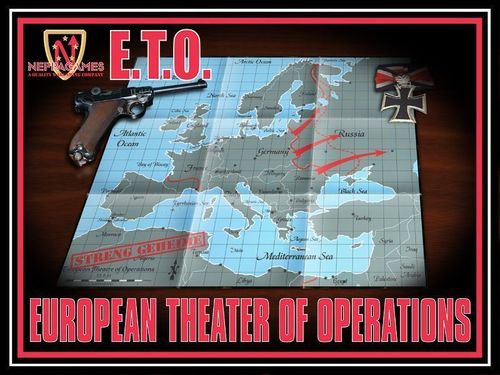
European Theater of Operations
European Theater of Operations Rulebook
Table of Contents
Table of Contents
- 1.0 Number of Players
- 1.1 Map Board
- 1.2 Stacking Limit
- 1.3 Seasonal Turns
- 1.4 Warfare Production Point
- 1.5 Declaration of War
- 2.0 Mountains
- 2.1 Swamp
- 2.2 Fortress
- 2.3 Capitals
- 2.4 Ocean Zone
- 2.5 Red Crossing Arrow
- 2.5a Blue Crossing Arrow
- 2.6 White Land Mass
- 2.7 Factory
- 2.7a Oil Tower
- 2.8 Beach
- 2.9 Russian Defense Zone
- 3.0 Country Unit Color
- 3.1 Infantry
- 3.2 Artillery
- 3.3 Armor
- 3.4 Airborne
- 3.5 Air Wing
- 3.6 Fleet
- 4.0 Force Pools
- 4.1 Major Country Force Pools
- 4.2 Minor Country Force Pools
- 4.3 Initial Setup
- 5.0 Year Start Sequence
- 5.1 WPP Base
- 5.2 Total WPPs
- 5.3 German Strategic Warfare Construction
- 5.4 Turn Expenditure Limit
- 6.0 Naval Basing
- 6.1 Naval Movement
- 6.2 Sea Transport
- 6.3 Naval Interception
- 6.4 Naval Combat
- 6.5 Amphibious Invasion
- 6.6 Shore Bombardment
- 6.7 Shipping
- 7.0 Air Movement
- 7.1 Ground Support
- 7.2 Defensive Air Support
- 7.3 Interception of DAS
- 7.4 Air Combat
- 7.5 Air Attacks on Fleet Factors in Port
- 7.6 Interception of Air Attacks on Fleet Factors in Port
- 8.0 Ground Movement
- 8.1 Combat
- 8.2 Combat Results Table
- 8.3 Post Combat Advance
- 8.4 Bridgehead
- 8.5 Breakthrough Zone
- 8.6 Exploitation Movement
- 8.7 Exploitation Combat
- 8.8 Post Exploitation Combat Advance
- 9.0 Convoys
- 9.1 British Convoy Box
- 9.2 Murmansk Convoy Box
- 9.3 North Sea U-boat Base Box
- 9.4 Biscay U-boat Base Box
- 9.5 Norway
- 9.6 Strategic Warfare Movement
- 9.7 ASW
- 9.8 Convoy Resolution
- 10.0 Unit Construction
- 10.1 WPP Grants
- 10.2 Lend-Lease
- 11.0 Strategic Redeployment
- 11.1 United States Initial Deployments
- 12.0 Anglo-French Cooperation
- 12.1 German-Italian Cooperation
- 12.2 Allied-Russian Cooperation
- 12.3 Axis Minor Allies
- 13.0 WPP Bonus
- 13.1 Russian Winter
- 13.2 Eastern Front Garrison
- 13.3 Deficit Spending
- 13.4 German Forces in North Africa
- 13.5 Persia
- 14.1 Major Country Conquest
- 14.2 Italian Surrender
- 14.3 Russian Surrender
- 14.4 Minor Country Conquest
- 14.5 Vichy and Free French Countries
- 14.6 Colonies
- 14.7 Eastern Europe
1.0 Number of Players
The game supports two to five players, with nations divided as follows:
| Players | Nations |
|---|---|
| 2 | UK/US/France/USSR vs. Germany/Italy |
| 3 | UK/US vs. France/USSR vs. Germany/Italy |
| 4 | UK/US vs. Germany vs. Italy vs. USSR/France |
| 5 | UK/US vs. France vs. Germany vs. Italy vs. USSR |
1.1 Map Board
The map covers roughly 2 by 3 feet, from France to Eastern Russia and from North Africa to the Middle East. It is divided into three fronts, marked in red: the Western Front, the Eastern Front and the Mediterranean Front. Country borders are bold black lines. Ocean areas and land areas inside each country are split into zones, outlined in black. Each zone is one movement factor for ground and air units.
1.2 Stacking Limit
- A land zone may hold a maximum of four ground units and two air wings.
- The airborne unit ignores stacking limits.
- A port (2.8a, 2.8b) may base up to 64 fleet factors (eight fleets).
- London may hold six ground units and three air wings.
- Gibraltar may hold six ground units.
- A bridgehead (8.4) raises a zone's ground limit from four to eight.
1.3 Seasonal Turns
Each game turn is a three-month season. A year has four turns: Spring, Summer, Fall and Winter. The Axis player moves first in each turn. Russia's turn always falls within the Allied turn, and Italy's turn always falls within the Axis turn.
1.4 Warfare Production Point
The Warfare Production Point (WPP, pronounced "whip") is the game's currency, representing a country's economic capacity to wage war. WPPs pay for everything from Declarations of War to unit construction.
1.5 Declaration of War
A Major Country must pay a one-time Declaration of War (DoW) before attacking another country. The cost is 5 WPPs against a Minor Country and 15 WPPs against a Major Country. The DoW counts against the declarer's Turn Expenditure Limit (5.4) for that turn. Only the declaring country pays. When one country declares war, its allies are automatically at war with the allies of the country attacked.
Restrictions on declarations:
- Russia cannot declare war on Rumania, Finland, Hungary or Bulgaria before the Fall of 1941 while at least one German unit is present in that country.
- Russia cannot declare war on Germany before the Fall of 1941 unless Germany has fewer than 10 attack factors on the Eastern Front at the end of a German Movement or Strategic Warfare Phase. Infantry count as one attack factor regardless of artillery present.
- Italy cannot declare war on Russia.
- Russia and Italy may build, move and SR units within their own country or colonies while neutral.
Intervention
A Major Country may give military assistance to a Minor Country whose capital has not been conquered on the turn a DoW is made, if it is already at war with the attacker. At each later YSS, the intervening country adds that Minor Country's WPP value to its new base while the Minor Country remains unconquered.
If the attacker issues a DoW but does not invade, a Major Country may still intervene even though it is not at war with the attacker. The attacker must then issue a DoW against the intervening Major Country before making any further attacks.
2.0 Mountains
Ground units always use their Terrain Defense Factors when defending in mountain zones.
2.1 Swamp
Ground units always use their Terrain Defense Factors when defending in swamp zones.
2.2 Fortress
Ground units use their Rugged Defense Factors only when attacked by at least one unit from a zone adjacent to the fortress. Example: if France has not been conquered, ground units in Strasbourg use Rugged Defense Factors against attacks from Bonn or Stuttgart, but not against attacks coming only from Metz or Lyons.
- Gibraltar and Malta are always fortresses. Every other fortress stops being one once an enemy occupies it.
- The Maginot Line (Strasbourg) stops being a fortress when France falls.
- The Siegfried Line (Bonn, in Germany) is not a fortress until 1944.
2.3 Capitals
Countries whose capital carries a red star are Major Countries. Those with a black star are Minor Countries or Colonies. A colony's controller in Fall 1939 is shown in parentheses after its name.
2.4 Ocean Zone
Naval movement is allowed only across ocean zones. Ground units need naval assistance to cross an ocean zone.
2.5 Red Crossing Arrow
Ground units use their Terrain Defense Factors when defending against an attack across a red crossing arrow. An airborne drop across a red crossing arrow forces the defenders there to use their Normal Defense Factors. Ground units need no naval assistance to cross land zones with red crossing arrows, and a red crossing arrow separates two ocean zones.
2.5a Blue Crossing Arrow
Denmark is the only zone with a blue crossing arrow. Its landmasses count as one landmass. Ground units there do not use Terrain Defense Factors, and they need no naval assistance to cross it.
2.6 White Land Mass
Ground units cannot enter white landmasses.
2.7 Factory
A factory is a source of industrial capacity only for the country that originally controlled it. The only factory zones belong to Russia, on the eastern edge of the map. Russia surrenders if Moscow, Stalingrad and the four factories are all conquered (14.3).
2.7a Oil Tower
An oil tower is a source of oil for the side that controls it, except Persia (13.5). Persia is a minor neutral country, but Britain receives its oil. The WPP value of each oil tower is included in the WPP base of the controlling Allied power.
- When the Axis first capture an oil tower, the losing Allied power immediately deducts its WPP value from its WPP total. This deduction does not count against the Turn Expenditure Limit (5.4). From then on, the oil tower is treated as a conquered Minor Country (14.4): the Axis add its value to their new WPP base (5.2) at each YSS (5.0) while they hold it, and the losing Allied power deducts it at each YSS while it stays lost.
- If the Allies liberate the oil tower, the Axis country that had added its value must immediately deduct it. This deduction also does not count against the Turn Expenditure Limit.
- If the Allies still hold the oil tower at year end, the original recipient no longer deducts its value at YSS, whichever Allied country liberated it.
2.8 Beach
Amphibious invasion may be attempted only at a beach, a beach port (2.8a) or a one-zone island (2.8c). Ground units use their Terrain Defense Factors in these zones only when defending against an amphibious invasion.
2.8a Beach Port
A beach port is a zone where the port symbol sits on beach terrain. Ports base naval units (6.0). A full eight-factor fleet in a beach port prevents amphibious invasion there, except that an airborne drop can displace the fleet and allow the invasion when either:
- the zone has no defending ground units (however many fleet factors are present), or
- the zone has one or more defending ground units and fewer than seventeen fleet factors.
Malta, Gibraltar and the Russian zone Leningrad also count as beach ports. Ground units there always use their Rugged Defense Factors against an amphibious invasion.
2.8b Coastal Port
A coastal port is a port not on beach terrain. It bases naval units (6.0), but fleets there do not prevent amphibious invasion of the zone.
2.8c One-Zone Island
Five one-zone islands have no beaches but can still be invaded from the sea: Corsica, Sardinia, Crete, Malta and Cyprus. Defenders in Corsica, Sardinia, Crete and Cyprus use Terrain Defense Factors. Defenders in Malta use Rugged Defense Factors.
2.9 Russian Defense Zone
There are seven Russian Defense Zones: Leningrad, Moscow, Stalingrad and the four factory zones. Only Russian units use Rugged Defense Factors when defending there. Only Russia may build and SR units into a Russian Defense Zone in the same turn it is recaptured.
3.0 Country Unit Color
Each country's units have their own colour: Green-Gray for Germany, Blue-Gray for Italy, Green for the United States, Gold for Britain, Red-Brown for Russia, Blue for France, Light Gray for each Axis Minor Country, and White for all other Minor Countries. The board is colour-coded so Major Countries match their unit colours. Neutral Minor Countries are coloured to show their historical political leaning.
3.1 Infantry
Infantry are the cheapest units, and so the most economical to lose in combat. An infantry unit's Attack Factor rises to two when it attacks alongside one artillery unit, and an infantry unit raised to two may be counted as two factors for combat losses.
3.2 Artillery
Artillery are strong attackers. An artillery unit raises the Attack Factor of the same number of infantry or airborne units by one each in an attack. Example: one artillery unit and three infantry attacking together make one infantry unit's Attack Factor two, with the other two at one.
In an amphibious invasion (6.5), artillery have an Attack Factor of zero and do not raise infantry to two.
3.3 Armor
Armor are the strongest attacking ground units and move much further than infantry or artillery. Armor can exploit a breakthrough in exploitation combat (8.5 to 8.8).
3.4 Airborne
Airborne units are elite troops. They can airdrop up to two zones away during the Combat Phase, which is how an attacker breaks a double or triple line of defense. Their movement factor is one, but they cannot move and then airdrop in the same turn. A dropped airborne unit may attack only the zone it lands in.
An airborne unit's Attack Factor rises to three when it attacks alongside one artillery unit, and it may then be counted as three factors for combat losses. An airdrop across a crossing arrow forces the defenders to use their Normal Defense Factors (2.5). Airborne units do not count toward ground stacking limits.
3.5 Air Wing
A full air wing is three air factors and costs nine WPPs (three per air factor). Each air factor may fly up to four zones in the Movement Phase to a new base, then fly one offensive mission up to two further zones in the Combat Phase. After combat, all air factors return to the zone they came from. Offensive missions are ground support (7.1), interception of defensive air support (7.3) and air attacks on fleets in port (7.5). Air units may also fly a defensive air support mission (7.2) to defend friendly ground units during the opposing player's turn.
Air wings can be split into air factors at any time at no cost, and three air factors in the same zone can combine into a full wing at any time at no cost.
3.6 Fleet
A fleet is a group of capital ships of eight factors. Unlike air wings, a full fleet cannot be split voluntarily, but partial fleets in the same ocean zone or port combine into a full eight-factor fleet at no cost. Each fleet factor has an Attack and Defense Factor of one.
A fleet can move anywhere on its own front in a single turn. Fleets can change to another front only during the Strategic Redeployment Phase (11.0).
Partial fleet factors cannot be rebuilt; only a full eight-factor fleet can. Rebuilding takes four construction turns, or one year, and costs sixteen WPPs. Example: a full fleet lost in the Summer 1941 turn that is rebuilt in that turn's Unit Construction Phase is not finished until the Spring 1942 Unit Construction Phase.
4.0 Force Pools
Each Major Country has a force pool that it can build and rebuild units from. No country may have more units in a class than that class's pool holds. Three categories apply:
- At Start Forces: the units a country begins the game with. Some must start in specific countries.
- Available Forces: units a country can build immediately.
- Additional Forces: units that become Available on a later turn. They can be built in the turn they become available and at any later time.
4.1 Major Country Force Pools
Each Major Country's force pool is listed on its Force Pool Card.
4.2 Minor Country Force Pools
Minor Country force pools are printed on the map board. A Minor Country sets up its forces when war is declared on it or when it becomes an active Minor Ally. Apart from the Axis Minor Allies (12.3), Minor Countries cannot rebuild units lost in combat, and must remove all remaining forces once their capital falls.
4.3 Initial Setup
Initial setup is done at the start of every game. Each campaign game or scenario sheet lists its own setup sequence and requirements (see the companion scenario book).
5.0 Year Start Sequence
The Year Start Sequence (YSS) is a four-step process run between every Winter and Spring turn. Its steps are WPP Base, Total WPPs, German Strategic Warfare Construction and Turn Expenditure Limit.
5.1 WPP Base
Each Major Country works out its WPP Base:
- If it ended the previous year with negative WPPs, that negative amount is subtracted from the previous year's WPP base.
- If it ended the previous year with a surplus, one third of the surplus, rounded down, is added to the previous year's WPP base.
Note: there is no WPP Base growth in 1940.
5.2 Total WPPs
A country's Total WPPs for the year equal its WPP Base (5.1) plus the WPP values of all conquered countries and Minor Allies. A Major Country counts as conquered or liberated only once its capital has been held for one opposition turn (14.1). A Minor Country changes hands immediately when enemy forces occupy its capital (14.4).
Russia and Britain subtract the WPP value of each lost oil tower from their WPP Base.
Note: Britain's Total WPPs are its WPP Base plus the thirty-two Convoy WPPs it may receive during the year.
5.3 German Strategic Warfare Construction
Germany may spend up to ten percent of its Total WPPs (5.2), rounded down, on U-boats, at one WPP each. Germany receives the U-boats across each turn's Unit Construction Phase, as evenly as possible, and chooses which turns get the extra ones.
Example: with 110 Total WPPs, Germany may build 11 U-boats, at least two per turn. It takes one extra in each of Spring, Summer and Fall, giving 3, 3, 3 and 2 for the year, 11 in all.
5.4 Turn Expenditure Limit
The Turn Expenditure Limit is the most WPPs a country may spend in one turn: its Total WPPs (5.2) divided by two, rounded down.
Note: Germany's limit is its Total WPPs less the WPPs it spent on U-boat construction, divided by two, rounded down.
6.0 Naval Basing
Fleets may base in ports controlled by their own country, a colony or an ally, subject to the cooperation rules (12.0, 12.1, 12.2). Only Russian and German fleets may base in Russia. French fleets may base only in France and French colonies. A port holds at most 64 fleet factors.
Two-Front Ports
Fleets based at a two-front port may fly missions on either front. The two-front ports are Kiel (in the Bremen zone), Gibraltar and Istanbul. Movement through the Turkish Straits is not allowed unless friendly forces control Istanbul, Izmir and Izmit.
6.1 Naval Movement
Fleets may change base during the Movement Phase anywhere on their front. The new base must be on the same front as the old one and must already be controlled by friendly forces at the start of the player's turn. A base change is subject to Naval Interception (6.3). Fleet movement to or from a convoy box is not subject to interception.
Overrun naval bases. Fleets in a zone overrun by enemy ground units must move to the nearest friendly-controlled port on the same front, within the basing and cooperation rules (6.0, 12.0, 12.1, 12.2). This move cannot be intercepted. If two or more friendly ports are equally near, the fleet's owner chooses. If no friendly port exists, the fleets are destroyed. If the fleets are in a two-front port that is overrun, the owner chooses the front and then moves to the nearest friendly port on that front.
U.S. fleets. Initially deploying U.S. fleets may leave the U.S. box only during Strategic Redeployment. Otherwise, U.S. fleets may move freely to and from the U.S. box during fleet movement.
6.2 Sea Transport
Fleets may carry ground or air units, subject to the cooperation rules (12.0, 12.1, 12.2), from one friendly-controlled port to another friendly-controlled port on the same front. Transport requirements:
- one armor unit, or one full or partial air wing: a full eight-factor fleet;
- one infantry, artillery or airborne unit: four fleet factors.
Sea transport is subject to Naval Interception (6.3). Fleets need not be based at the port of embarkation: they may sail from their base to the embarkation port, then to the debarkation port, then back to their base. A mission may use more than one embarkation port but only one debarkation port. Fleets always return to their own bases after the units are landed.
Every unit to be transported must start its turn in a port zone. Embarking costs no movement factors; disembarking costs one. An armor unit may use its remaining movement after disembarking. The debarkation port becomes the new base of any air units carried. Transported units may fight once all transport is complete. Airborne units cannot airdrop in the turn they are transported.
6.3 Naval Interception
Fleets that change base, carry sea transport or make an amphibious invasion may be intercepted by any defending fleet on the same front, subject to the cooperation rules (12.0 to 12.2). Fleets that change base because of an overrun naval base (6.0), move during the Strategic Warfare Phase (9.6), ship goods (6.7) or Strategically Redeploy (11.0) cannot be intercepted.
- Interception of transport or invasion missions can happen only after all the ground units involved have embarked.
- When interception is declared, the attacker names the exact course of zones the fleet will move through. Interception can take place in only one zone of that course, and the defender chooses which zone.
- Interception is not automatic. The defender rolls one die for each port where fleets are attempting interception and consults the Naval Interception Table. Each port needs its own roll.
- The defender counts sea zones from the zone next to the fleet's port of origin, which counts as 1, to the zone where interception is attempted. Fleets based in the U.S. box must use the largest zone count in the table.
Naval Interception Table
| Zones | Die roll that intercepts |
|---|---|
| 1-2 | Automatic |
| 3-4 | 2, 3, 4, 5, 6 |
| 5-6 | 3, 4, 5, 6 |
| 7-8 | 4, 5, 6 |
| 9-10 | 5, 6 |
| 11+ | 6 |
Interception results in naval combat (6.4). Fleets that fail the interception roll must return to their port of origin and do not count as having performed a mission.
The intercepting side may withdraw before combat is resolved. Combat still happens, but the withdrawing fleet automatically loses and loses half the factors it would normally have lost after modifying the dice. A withdrawing fleet can never lose more than half its strength. If the withdrawing fleet has the higher modified roll, neither side loses any fleet factors.
6.4 Naval Combat
Each side in naval combat rolls one die, modified by the Naval Combat Advantage Modifier and the Naval Combat Nationality Modifier, both printed on the map board. When a force contains several nationalities, the lowest Nationality Modifier applies.
The side with the lower modified roll loses, and eliminates fleet factors equal to the difference between the two rolls. Losses may come from any mix of full and partial fleets. If the loser had 16 or more fleet factors in the battle, it instead divides its factors in the battle by eight, rounded down, and multiplies that number by the difference between the rolls.
A tie means no losses. The defender wins, and the attacker's fleets must return to their port of origin and cancel the rest of the mission.
The loser must return to its port of origin and cancel the rest of its mission. The winner eliminates half the factors the loser lost, rounded down. A winning intercepting force may either continue its mission or abort and return to port. Whether the loser fought or aborted, surviving ground units carried by the fleets must return to their embarkation port(s).
Multinational losses. When a force has several nations, losses are split evenly between them. If the number is odd, the nation with the larger force takes the extra factor. If the forces are equal, the nation with the lower Nationality Modifier takes it. If that is also equal, the player decides.
6.5 Amphibious Invasion
An amphibious invasion may target any beach zone, one-zone island, Leningrad or Gibraltar. Gibraltar, as a two-front port, can be invaded by fleets on either the Western or the Mediterranean front.
- An invasion cannot be attempted against a beach port holding at least one full eight-factor fleet. The exception is when the zone has no ground units, or one or more defending ground units with fewer than seventeen fleet factors: then an airborne drop can displace the fleets and allow the invasion.
- A ground attack from an adjacent land zone always permits an amphibious invasion, whatever the number of fleets in the target zone.
Fleets may carry only ground units, subject to the cooperation rules (12.0, 12.1, 12.2), from a friendly port to the target. One armor unit needs a full eight-factor fleet. One infantry, artillery or airborne unit needs four fleet factors. Spare fleet factors may add shore bombardment (6.6). Fleets need not be based at the embarkation port(s): they move there during the Movement Phase, and return to their own bases once the invasion is complete.
All ground units in the invasion must start their turn in a port zone on the same front as the target. An invasion may use more than one embarkation port. Whatever the number of ground units carried, at most four ground units, plus any airborne units that drop, may attack the target zone.
Breakthrough and exploitation. These can occur when all of the following are true:
- at least one armor unit from the seaborne force, or from an adjacent land zone, takes part in the initial attack;
- at least one initially attacking ground unit survives and occupies the zone;
- at least one armor unit aboard an invading fleet, or in an adjacent land zone, did not take part in the initial attack.
Armor units adjacent to a beach zone may exploit only if at least one ground unit from that adjacent zone took part in the initial attack.
After a bridgehead (8.4) is placed, ground units aboard an invading fleet that did not join the initial attack may advance onto the beach zone, up to the eight-unit bridgehead stacking limit.
The attacker's exchange losses may come from the ground units in the initial attack, air factors giving ground support, and fleet factors giving shore bombardment (6.6) at four fleet factors per attack factor. If the attacker loses the battle, no fleet factors are lost.
6.6 Shore Bombardment
Every four invading fleet factors that are not carrying ground units in a seaborne invasion may add one attack factor to the attacking force. Shore bombardment cannot be used in an exploitation attack.
6.7 Shipping
Ground units, air units and WPP grants that Strategically Redeploy (11.0) across ocean zones require shipping. Air units need shipping only when crossing more than four ocean zones. U.S. Initial Deployments (11.1) need no shipping.
Shipping may use fleets, subject to the cooperation rules (12.0, 12.1, 12.2), from a friendly port to another friendly port on the same front. Requirements:
- one armor unit, one full or partial air wing, a WPP Grant of 1-8 WPPs (10.1), or a Lend-Lease Grant of 1-8 WPPs (10.2): a full eight-factor fleet;
- one infantry, artillery or airborne unit: four fleet factors.
Fleets may sail from their base to the embarkation port, then to the debarkation port, then back to their base. A mission may use more than one embarkation port but only one debarkation port. Fleets return to their bases after the goods are shipped. Fleets used for shipping cannot be intercepted and must not have performed any mission that turn besides a base change in the Movement Phase (6.1).
7.0 Air Movement
In the Movement Phase, air units may change base by flying up to four zones to another friendly-controlled zone. A zone may base a maximum of two full air wings. London is the exception, with a limit of three.
Overrun air bases. Air units in a zone overrun by enemy ground units must move to the nearest friendly-controlled zone within four zones of their original base. This move cannot be intercepted and does not count as a combat mission for that turn. If the zone is overrun while the air units are flying a mission, they must use their remaining movement after the mission to reach a friendly zone. If none is in range, they are destroyed.
7.1 Ground Support
Air units based within two zones of a zone attacked by friendly ground units may fly into that zone and add their Attack Factors to the attack. Total ground support may not exceed three times the total ground Attack Factors in the attack. Cooperation rules (12.0, 12.1, 12.2) may restrict it further.
Air units may give ground support in combat or exploitation combat, but only if they have not yet flown a mission that turn. Surviving air units must return to their original base, unless the enemy overran it (7.0).
If air factors support an amphibious invasion (6.5) and the invading fleets are defeated in naval combat (6.4) or the mission is aborted, the air units must return to base and may not fly another mission that turn.
7.2 Defensive Air Support
Air units may fly to a zone within two zones of their base and add their Defense Factors to its defense, except where cooperation rules (12.0, 12.1, 12.2) apply. Total Defensive Air Support (DAS) may not exceed three times the total modified Defense Factors of the ground units in the zone. Air units can give DAS to only one zone per turn. They may be committed in the Combat or Exploitation Phase. If committed in the Combat Phase and no combat happens there, they may stay to give DAS in the Exploitation Phase. Air units cannot give DAS to a zone with no defending ground units.
Surviving air units return to their original base unless the enemy overran it (7.0). Enemy air units that have not flown an offensive mission that turn may intercept DAS air units (7.3).
7.3 Interception of DAS
Air units based within two zones of a zone holding enemy DAS may fly there to intercept, except where cooperation rules (12.0, 12.1, 12.2) apply. They may intercept in the Combat or Exploitation Phase, but only if they have not yet flown an offensive mission that turn. Interception is automatic and results in air combat (7.4).
7.4 Air Combat
Each side in air combat rolls one die, modified as follows:
- the side with the larger force gets +1 for each factor it has beyond the smaller force's total;
- each side applies its Air Nationality Modifier from the map board. When a force has several nationalities, the lowest modifier applies.
The side with the lower modified roll loses and eliminates air factors equal to the difference between the two rolls. The winner eliminates half that number of air factors, rounded down.
A tie means no losses, and all air units return to their original base unless the enemy overran it (7.0).
Multinational air losses. These are split between nations as for naval losses (6.4). If the defender has the larger air force and wins, its surviving air factors may go on to give DAS. Otherwise the DAS mission is aborted, and surviving air units return to their original base unless the enemy overran it (7.0).
7.5 Air Attacks on Fleet Factors in Port
Air units based within two zones of a zone containing fleet factors in port may fly there and attack those fleets. If the fleets are displaced before the attack begins, the attack still counts as an offensive mission for the air units. Roll one die for each air factor in the attack:
- a roll of 1 eliminates one air factor;
- a roll of 2 or 3 eliminates nothing;
- a roll of 4, 5 or 6 eliminates one fleet factor.
7.6 Interception of Air Attacks on Fleet Factors in Port
Air units based within two zones of a zone where enemy air units are attacking fleets in port (7.5) may fly there to intercept, except where cooperation rules (12.0, 12.1, 12.2) apply. Interception is automatic and results in air combat (7.4). If the attacker has the larger air force and wins, its surviving air factors may go on to attack the fleets. Otherwise the mission is aborted, and surviving air units return to their original base unless the enemy overran it (7.0).
8.0 Ground Movement
Ground units may move their movement factors into any zone that holds no enemy units, subject to the cooperation rules (12.0, 12.1, 12.2). Armor units may use their full movement in the Movement Phase and again in Exploitation Movement (8.6).
Note: airborne units cannot move and airdrop in the same turn.
8.1 Combat
The attacker may attack with any or all of the units adjacent to enemy zones. An enemy zone need not be occupied by enemy units, only under enemy control. Each unit in a zone may fly its own combat mission, but each unit may fly only one per turn. The attacker chooses the order in which its attacks are made and resolved.
Resolution steps:
- The attacker totals the Attack Factors of all its ground units, ground support (7.1) and shore bombardment (6.6).
- The defender totals the modified Defense Factors of its ground units and any defensive air support (7.2).
- The two totals are expressed as a ratio, rounded down.
- Roll the dice and read the Combat Results Table (8.2).
Ratio examples: 10 attack against 5 defense is 2-1. 9 against 5 is 1-1. 4 against 8 is 1-2. 4 against 9 is 1-3.
8.2 Combat Results Table
The Combat Results Table (CRT) settles a battle with one roll. The loser is eliminated. The winner may take casualties. The winner chooses which factors to lose, but the number lost must be at least the stated percentage of the loser's total factors. The outcomes are:
- A: the attacker is eliminated.
- D: the defender is eliminated.
- AP: the attacker is eliminated and the defender loses 50% (rounded down) of the attacker's total factors.
- DP: the defender is eliminated and the attacker loses 50% (rounded down) of the defender's total factors.
- AX: the attacker is eliminated and the defender loses 100% of the attacker's total factors.
- DX: the defender is eliminated and the attacker loses 100% of the defender's total factors.
Example: a 10-factor Axis attack against a 5-factor Allied defense is 2-1. A roll of 5 in the 2-1 column gives DP. The defender is eliminated, and the attacker loses 50% of 5, which is 2 factors.
Attacks at 6-1 or better automatically eliminate the defender. Attacks worse than 1-4 automatically eliminate the attacker.
Combat Results Table (roll of two dice)
| Roll | 1-4 | 1-3 | 1-2 | 1-1 | 2-1 | 3-1 | 4-1 | 5-1 or better |
|---|---|---|---|---|---|---|---|---|
| 2 | A | A | A | A | A | DX | DX | DX |
| 3 | A | A | AP | AP | DX | DX | DX | DP |
| 4 | A | A | AP | DX |
8.3 Post Combat Advance
When combat eliminates the defender in the attacked zone, the attacker may advance surviving ground units into that zone up to the stacking limit (1.2). If two or more allies have surviving ground units, they must agree which country controls the zone.
Note: an airborne unit that dropped this turn may not advance. A defender that wins a battle may not advance.
8.4 Bridgehead
A bridgehead counter (BH) may be placed on an enemy-controlled zone that at least one attacking unit has occupied by amphibious invasion. A BH raises the zone's stacking limit from four to eight ground units. Only four units plus any airborne units may attack from a BH, but every unit on a BH may defend against attack. Each side has unlimited bridgeheads.
8.5 Breakthrough Zone
A breakthrough happens when at least one armor unit takes part in an attack and at least one ground unit advances into the defender's zone. That zone becomes the Breakthrough Zone (BZ). Armor units that did not fight and were adjacent to or stacked with a unit that attacked the BZ may move into it. Stacking limits and movement factors are ignored only in the BZ. At the end of the Strategic Redeployment Phase the BZ may not be overstacked; the attacker must eliminate units to meet the stacking limit (1.2).
8.6 Exploitation Movement
Armor units in the BZ that have not fought this turn may use their movement to enter zones not occupied by enemy units. Airborne units that have not moved or dropped this turn may airdrop in the Exploitation Movement Phase. Every zone except the BZ keeps the normal stacking limits.
8.7 Exploitation Combat
Only exploiting armor, airborne units that dropped in Exploitation Movement, and air factors that have not flown a combat mission this turn may take part in exploitation combat. It is resolved exactly like regular combat (8.1).
8.8 Post Exploitation Combat Advance
When exploitation combat takes an enemy-controlled zone, the attacker may advance surviving exploiting armor into it up to the stacking limit (1.2). If two or more allies have surviving ground units, they must agree which country controls the zone.
9.0 Convoys
Convoys carry war materials. The British Convoy Box carries Convoy WPPs (9.1) and WPP Grants (10.1) to Britain. The Murmansk Convoy Box (9.2) carries WPP Grants to Russia.
9.1 British Convoy Box
Britain's WPP Base starts at 30. Britain also receives 32 WPPs from convoys during the year, but only if it has at least one full eight-factor fleet in the British Convoy Box that turn. It can receive at most 8 Convoy WPPs per turn.
Note: Britain starts the Campaign game and 1939 Scenario with 46 WPPs, since both begin in a Fall turn.
Fleet movement to and from the British Convoy Box cannot be intercepted. Fleets that move or SR into the box must stay there until their player's next Movement Phase.
9.2 Murmansk Convoy Box
Britain and the United States may send WPPs to Russia through the Murmansk Convoy Box. Moving the grant takes one Strategic Redeployment (11.0) per eight WPPs. Shipping a WPP Grant of 1-8 WPPs (6.7) there requires a full eight-factor fleet.
Fleet movement to and from the Murmansk Box cannot be intercepted. Fleets that move or SR into the box must stay until their player's next Movement Phase, except for fleets based in Norway (9.5). Norwegian-based fleets may return to their Norway bases immediately after Convoy Resolution (9.8).
The Murmansk Convoy Box closes when the Axis control both Leningrad and Kirov, and reopens when either is liberated.
9.3 North Sea U-boat Base Box
Newly built U-boats go into the North Sea Base Box (NSBB) during the German Unit Construction Phase. U-boats cannot base in the Biscay Base Box until France is conquered. U-boats sailing from the NSBB to the British Convoy Box fight at 50% effectiveness, and those sailing to the Murmansk Convoy Box at 75%. If the Axis control Norway (9.5), these rise by 25%, to 75% and 100%.
U-boats in the NSBB may SR to the Biscay Base Box from the turn after France is conquered. This counts as one SR no matter how many U-boats move. The same applies in reverse.
9.4 Biscay U-boat Base Box
U-boats cannot base in the Biscay Base Box until the turn after France is conquered. From there they can sail only to the British Convoy Box, at 100% effectiveness during Convoy Resolution (9.8). U-boats in the Biscay box may SR to the NSBB; this counts as one SR no matter how many move.
Note: U-boats cannot SR into the Biscay base in the same turn France is conquered, because units cannot SR into a newly conquered zone.
9.5 Norway
Conquering Norway gives Germany two advantages.
First, U-boat effectiveness rises, as shown in 9.3.
Second, a fleet based in Norway may sail to the Murmansk Convoy Box during the Strategic Warfare Movement Phase and return to its Norway base after Convoy Resolution (9.8). Fleets entering a convoy box normally have to stay there until the next Strategic Warfare Movement Phase.
9.6 Strategic Warfare Movement
U-boats and fleets that have not flown a mission this turn may move to a convoy box. The Allies move first, then the Axis. This movement cannot be intercepted. Biscay-based U-boats may sail only to the British Convoy Box. All other U-boats and fleets may sail to either box. Fleets entering a convoy box must stay there until the next Strategic Warfare Movement Phase, except for Norwegian fleets (9.5). Fleets leaving a convoy box must return to their ports of origin.
9.7 ASW
Anti-Submarine Warfare (ASW) happens when U-boats and fleet factors carrying Convoy WPPs (9.1) or WPP Grants (10.1) share a convoy box. It is resolved in four steps:
- Find the Die Roll Modifier (DRM): +1 for every 8 Allied fleet factors beyond the number needed to carry the WPPs, and -1 for every 8 German fleet factors in the box.
- Roll the dice, apply the DRM, and read the Allied ASW Kill % Modifier from the map board.
- Read the Kill % for the turn from the Strategic Warfare/Murmansk Table on the map board, and add it to the Allied ASW Kill % Modifier. The result is the Modified Kill %.
- Multiply the Modified Kill % by the number of U-boats in the box. Round down. That is the number of U-boats destroyed.
Worked example: in the Summer 1940 Strategic Warfare Movement Phase, Germany sends 7 U-boats and 1 German fleet based in Norway to the British Convoy Box. The British have only the one fleet needed to carry the Convoy WPPs, so the German fleet gives a DRM of -1. The British roll a 6, giving 5 after the DRM. A 5 is a -5% Allied ASW Kill % Modifier. The Kill % in the box for Summer 1940 is 20%, so the Allied total is 15%. 7 U-boats times 15% is 1.05, rounded down to 1. The Allies destroy one U-boat.
9.8 Convoy Resolution
Convoy Resolution follows ASW (9.7) and has four steps:
- Find the DRM: +1 for every 8 German fleet factors in the box, and -1 for every 8 Allied fleet factors beyond the number needed to carry the WPPs.
- Roll the dice, apply the DRM, and read the Convoy Loss % Modifier from the Convoy Loss % Modifier Table on the map board.
- Read the Loss % for the turn from the Strategic Warfare/Murmansk Table, and add it to the Convoy Loss % Modifier. The result is the Modified Loss %.
- Multiply the Modified Loss % by the number of U-boats in the box and by the U-boat effectiveness (9.3 to 9.5), with U-boats of different effectiveness resolved separately. Round down. That is the number of WPPs sunk.
After Convoy Resolution, U-boats return to the North Sea Base Box or, if available, the Biscay Base Box. Norwegian fleets that sailed to the Murmansk Convoy Box may return to Bergen.
Worked example (continued from 9.7): the British have only the one required fleet in the British Convoy Box, so the German fleet there gives a DRM of +1. The German player rolls an 8, making 9. A 9 is +5% on the Convoy Loss % Modifier Table. The Axis Convoy Loss % in the box for Summer 1940 is 60%, so the total is 65%. 7 U-boats times 65% is 4.55. Multiplied by the 75% effectiveness, that is 3.41, rounded down to 3. Three WPPs are sunk. The British receive 5 Convoy WPPs that turn.
10.0 Unit Construction
A player may spend available WPPs, up to the Turn Expenditure Limit (5.4), on building units from the country's force pool and/or on WPP grants to other countries. New units must be placed in a zone within the player's home country that the player or an ally controlled at the start of the current turn. A zone is controlled by whichever nation last had units in it.
Exception: Russia may build units in any Russian-controlled Russian Defense Zone, whichever side controlled it at the start of the turn (2.9).
East Prussia counts as part of Germany's home country, and Sicily as part of Italy's. Corsica does not count as part of France's home country, and neither do Sardinia or Albania for Italy. New American units must be placed in the U.S. box.
10.1 WPP Grants
Only the United States, Britain and Germany may issue WPP grants. A country cannot give or receive more than 32 WPPs in a turn (counted before Convoy Resolution, 9.8), and cannot give more than half its WPP Base in a year. The United States cannot grant WPPs until it is at war.
Each eight WPPs granted takes one Strategic Redeployment (11.0). Grants shipped over ocean zones need a full eight-factor fleet for each WPP Grant of 1-8 WPPs (6.7). That fleet must not have performed any mission that turn except a base change in the Movement Phase. The fleet itself needs no separate SR.
Grants to Russia or Britain are sent to the relevant convoy box (9.0), where they stay until the next Strategic Warfare Phase. Grants to France or Italy are SR'd directly to that country during Strategic Redeployment (11.0).
Note: WPPs are deducted from the granting country during the Unit Construction Phase and added to the recipient's total after the next Strategic Warfare Phase, or during Strategic Redeployment for France or Italy. The recipient cannot spend them until the next Unit Construction Phase.
10.2 Lend-Lease
Lend-Lease is a second route for WPP grants to Russia, through Persia. It can be used alongside or instead of the Murmansk route.
- Opening the route costs 15 WPPs, representing Allied investment in infrastructure. Once it is paid, Persia falls under Allied control, although Allied forces need not enter Persia. With the route open, the Axis need not declare war before invading Persia. Russian units cannot SR into or through Persia.
- An Allied declaration of war on Persia and its conquest do not by themselves open the route. The 15 WPPs must still be spent.
- The maximum Lend-Lease grant is 16 WPPs, and delivery takes two turns. The first turn needs one SR per eight WPPs and one full eight-factor fleet per eight WPPs for shipping (6.7), and the fleets must not have performed any other mission that turn except a base change. The fleets need no separate SR. The second turn needs one SR per eight WPPs only. No shipping is needed for final delivery.
- If the Allies change their minds before the WPPs reach Russia, the process can be reversed. WPPs in the Lend-Lease box do not count toward growth or reduction at YSS.
- The Axis close the route by controlling both Tabriz and Mahabad. If it closes before delivery, the WPPs in the box stay there until the granting nation takes them back in its Strategic Redeployment Phase, or until the Allies reopen the route by controlling Tabriz and Mahabad. Reopening does not cost another 15 WPPs.
Note: U-boats and German fleets cannot enter the Lend-Lease box.
11.0 Strategic Redeployment
A Strategic Redeployment (SR) lets a country move a unit any distance without interception. Each country has a fixed number of SRs per turn: United States 10, Germany 9, Britain 7, Russia 6, Italy 5 and France 5. A unit cannot end an SR in a newly conquered zone, except that a Russian unit may end its SR in a newly conquered Russian Defense Zone (2.9).
- An SR over land may pass only through friendly-controlled zones. A zone is controlled by whichever nation last had units there.
- Ground units and WPP grants SR'd over an ocean zone need shipping (6.7). Air units need shipping only over more than four consecutive ocean zones. In those cases the units must move to a friendly port, be shipped to another friendly port on the same front, and then move on to the destination.
- Units SR'd to another front over water need shipping from a different fleet on each front.
- The side that controls Gibraltar may SR units into, out of or through Gibraltar.
Example: the Allies SR one armor unit from Britain to Egypt through Gibraltar. A western-front fleet ships it from Britain to Gibraltar, and a Mediterranean fleet ships it on to Egypt. This is one SR but needs two fleets. It works only while the Allies control Gibraltar.
The Suez route lets only the Allies SR units between Britain and Egypt, and only while they control the Cairo and Port Said zones. It costs two SRs per unit but needs only one fleet, which must be on the same front the unit starts from.
Example: an armor unit SR'd from Britain to Egypt by the Suez route, with one western-front fleet doing the shipping. This counts as two SRs and one fleet.
Naval units may pass through the Turkish Straits only if friendly forces control Istanbul, Izmir and Izmit. A U-boat SR between the North Sea and Biscay U-boat Base Boxes (9.3, 9.4) counts as one SR, however many U-boats move.
11.1 United States Initial Deployments
U.S. initial deployments are WPP grants (10.1), At Start forces (4.0), newly built units from the force pool, and rebuilt units SR'd out of the United States for the first time. A unit that has already been deployed to Europe and SRs back to the U.S. box is not counted as an initial deployment when it SRs back to Europe.
The U.S. has ten SRs per turn, of which at most six may be used for initial deployments. Initially deploying units must end their SR:
- in Britain, if France has been conquered;
- in a western port, if Britain is conquered and France is not;
- in any western port, if neither Britain nor France has been conquered.
U.S. initial deployments need no shipping (6.7). U.S. fleets must still ship any WPP grants the United States gives an ally.
12.0 Anglo-French Cooperation
British and French units cannot stack together, but they may attack the same zone together. British air cannot fly DAS over French units, and French air cannot fly DAS over British units. In an attack involving British and French ground units, either British or French air may give ground support and interception, but not both. Only the side giving ground support may intercept.
British ground units may not end their Movement, Post Combat Advance, Post Exploitation Advance or Strategic Redeployment Phase in Paris until France is conquered. British air units may not perform ground support, DAS or interception missions in the Paris zone until France is conquered.
12.1 German-Italian Cooperation
Italian units cannot stack or attack together with German units until Italy is allied with Germany. Italian air may fly ground support, DAS and interception only if at least one Italian ground unit is in the battle. German air units have no such restriction.
12.2 Allied-Russian Cooperation
Russian units cannot stack with any other allied units. Allied units may not enter any original Russian zone or any zone Russia controls. Likewise, Russian units may not enter any original Allied zone or zone the Allies control. Anglo-American and Russian forces cannot make a joint attack on the same zone in the same phase. One force may attack in the Combat Phase and the other in the Exploitation Combat Phase.
12.3 Axis Minor Allies
The Axis Minor Allies are Finland, Rumania, Hungary and Bulgaria. They are activated at the start of the Axis Summer 1941 turn. Before activation, the Axis may have no more than 12 attack factors at any time in those four countries combined. Infantry count as one attack factor regardless of artillery present.
When activated, a Minor Ally's forces are placed in their home country during the Axis Movement Phase. They may be moved by SR, which counts against Germany's SR limit. Their WPPs are added to Germany's WPP total. The only limit on Axis Minor forces is that ground units cannot move, and air units cannot base, more than two zones from their home country.
An Axis Minor conquered by the Allies or by a neutral Russia must be liberated before it can be activated. After activation, the Axis may rebuild the lost Axis Minor forces, and the rebuilt units must be placed in the home country. If Germany or Italy declares war on an Axis Minor Ally, that Minor Ally can no longer be activated and is treated as any other neutral Minor Country from then on.
Russia cannot declare war on an Axis Minor Ally unless it is at war with Germany and at least one German unit is present in that country. If Russia declares war on a Minor Ally or other neutral Minor Country and invades, Germany must declare war on Russia to intervene. If Russia declares war and does not invade, Germany may send forces into that country without a DoW. Doing so stops Russia from making any further attacks on that country until Russia is at war with Germany.
13.0 WPP Bonus
WPP bonuses go to the conquering Axis country's WPP total as soon as it captures certain Allied zones, marked with an asterisk beside the bonus amount. The Allied country that loses the zone deducts the same amount immediately. A bonus is paid once, however many times the zone changes hands.
- Leningrad, Moscow and Stalingrad each carry a 5 WPP bonus.
- Gibraltar and Suez carry no bonus for the Axis. Britain instead deducts 12 WPPs when either is conquered. This deduction also happens only once, however many times each is taken.
13.1 Russian Winter
The Russian Winter begins in the first Winter turn after the DoW between Germany and Russia. During it, Russian units cannot be attacked in Russia, and Axis ground forces in Russia have their defense factors halved.
The Russian player may postpone the Russian Winter to the second Winter turn after the DoW if the number of German and Italian ground units east of the original Russian border is less than a total rolled on four dice.
13.2 Eastern Front Garrison
Russia cannot declare war on Germany before the Fall of 1941 unless Germany has fewer than ten ground or air attack factors on the Eastern Front at the end of any Movement or SR Phase. Infantry count as one attack factor toward the garrison regardless of artillery present.
13.3 Deficit Spending
Britain is the only country that may voluntarily engage in deficit spending. Even so, it may not exceed its Turn Expenditure Limit (5.4) in a turn or its Total WPPs (5.2) in a year. Britain's Total WPPs are its WPP Base plus the thirty-two Convoy WPPs it may receive that year.
13.4 German Forces in North Africa
North Africa comprises Morocco, Algeria, Tunisia, Libya and Egypt. Germany may not have more than ten attack factors in North Africa at any time, unless the Axis control Malta, or all three of Ankara, Damascus and Haifa.
If the Allies liberate Malta, Ankara, Damascus or Haifa and leave Germany starting its turn with more than ten attack factors in North Africa, Germany may move and attack with only ten factors there that turn. Germany must either SR units out of North Africa, within its SR limit, or eliminate enough attack factors by the end of the turn to meet the limit, if the limit still applies then.
Note: infantry count as one attack factor regardless of artillery present. German air based in Crete, Sicily, Sardinia and Malta does not count toward this limit.
13.5 Persia
Persia is a minor neutral country and Britain's largest oil supplier. Persia comes under Allied control if the Lend-Lease route (10.2) is opened, or if one of the Allies declares war on it and invades. Britain loses the Persian oil tower WPPs only if the Axis conquer the Mahabad zone. Russia and the United States receive no oil tower WPPs if either conquers or liberates Mahabad.
14.1 Major Country Conquest
A Major Country is conquered, or liberated, by holding its capital for one opposition turn. If a Major Country counterattacks its own capital, only the units counterattacking the capital may move or attack. A counterattack on a Major capital succeeds only if the attack is 1-2 or better.
Once a Major Country is conquered, all its forces are permanently removed from the game. At every later YSS, the conquering country adds half of the Total WPPs the Major Country began the game with (rounded down) to its new base, provided it controls that Major Country at the end of its Winter turn.
If the conquered Major Country is liberated, the country that added its WPPs must immediately deduct them. That deduction does not count against the Turn Expenditure Limit (5.4). At each later YSS the liberating country adds half of those starting Total WPPs (rounded down) to its new base, provided it controls the country at the end of its Winter turn.
14.2 Italian Surrender
Apart from conquest of Rome, Italy surrenders when all of the following hold:
- it is Spring 1943 or later;
- at the end of an Axis Combat Phase there are no Axis non-Vichy units in Africa, including Egypt;
- at the end of an Axis Combat Phase the Allies have one non-airborne ground unit on the Italian mainland, not counting Sicily.
Under this surrender:
- all Italian units are permanently removed from the game;
- all Italian-controlled zones pass to German control;
- at each later YSS, Germany adds half of Italy's starting Total WPPs (rounded down) to its new base if it controls Rome at the end of its Winter turn. If Rome is liberated after Germany has added those WPPs, Germany must immediately deduct them. Thereafter the liberating country adds half of Italy's starting Total WPPs (rounded down) at each YSS while it controls Rome at the end of its Winter turn.
14.3 Russian Surrender
Russia is conquered when, at the end of any Allied Combat Phase, the Axis control Moscow, Stalingrad and all four factory zones on the eastern edge of the map.
14.4 Minor Country Conquest
A Minor Country is conquered, or liberated, as soon as an enemy ground unit occupies its capital. Once the capital falls, all the country's remaining forces are permanently removed from the board, except Axis Minor Ally forces (12.3). At each later YSS, the conquering country adds the Minor Country's WPP value to its new base, provided it controls that Minor Country at the end of its Winter turn.
If the conquered Minor Country is liberated, the country that added its WPP value must immediately deduct it. That deduction does not count against the Turn Expenditure Limit (5.4). At each later YSS, the liberating country adds the Minor Country's WPP value to its new base if it controls the country at the end of its Winter turn.
If two or more Major Countries take part in conquering a Minor Country, the one with the largest WPP base receives the WPPs at YSS. In a tie, the participating Major Countries must choose between them.
14.5 Vichy and Free French Countries
When France is conquered, Morocco, Algeria and Tunisia fall under Vichy French control. One Vichy French infantry unit is placed in each of Casablanca, Oran and Tunis. These infantry belong to the Axis, can move or SR only to other Vichy countries, and cannot be rebuilt if destroyed. The Axis player chooses which Axis country pays for any SR. Axis units may enter and base in the Vichy countries. Neither Axis power receives WPPs for the Vichy countries. The Allies need no DoW to attack a Vichy-controlled country.
Syria falls under Free French control. One Free French infantry unit is placed in Syria. It belongs to the Allies and may move or SR anywhere. The Allied player chooses whether Britain or, after Spring 1942, the United States pays the SR. Allied units may enter and base in Syria. Neither Allied power receives WPPs for Syria, and the Axis need no DoW to attack it. The Allies may rebuild the Free French infantry in Syria or Britain if it is destroyed.
14.6 Colonies
A country gets no WPPs from a colony it controlled at the start of the game, and does not lose WPPs if such a colony is conquered.
14.7 Eastern Europe
Eastern Europe comprises Estonia, Latvia, Lithuania, Vilna, Brest-Litovsk and Lvov. It forms when the Axis conquer Poland. Axis units may not enter Eastern Europe until Germany is at war with Russia. Eastern Europe is not conquered or liberated until one side controls all six of those zones.
So a country that conquers Eastern Europe keeps its WPP value for the year unless the enemy controls all six zones. Likewise, a country adds Eastern Europe's WPP value to its new base at YSS only if it controls all six zones at the end of its Winter turn. A Declaration of War (Minor Country) must be made before attacking a neutral Eastern Europe.