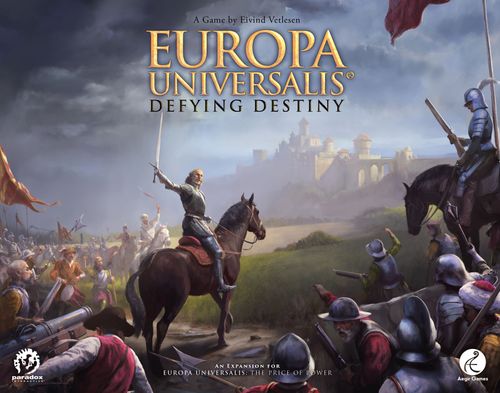
Europa Universalis: Defying Destiny
Europa Universalis: Defying Destiny Rulebook
Table of Contents
Table of Contents
- New Rules
- Components
- S4-01: Defiant Grand Campaign (6 players)
- S4-02: Borealis Rex (2 players)
- Variants for Scenarios I & II
- S4-03: Steppes & Stones (4 players)
- S4-04: The Spaghetti Incident (4 players)
- S4-05: Imperial Imps (6 players)
- S4-06: Conquistadors & Corsairs (5 Players)
- S4-07: Lepanto – Clash of the Titans (4 players)
- Variants for Scenarios III 2/2
- S4-08: The Sublime Porte (5 players + 1 Bot)
- S4-09: The Grand Duke of the West (Solo)
- S4-10: Der Hochmeister (Solo)
- 7-Player Variants
- New Bot Realms
- Optional Rules from the Scenarios III Booklet
New Rules
The new rules presented here can all be considered Advanced Rules. It is up to you if you wish to include them in your own scenarios or not.
Mercenary Leaders
Several of the new Events included in this expansion have a new type of historical Leader on them, highlighted with an orange name banner and an orange or half-orange flag. They also have a Religious Family symbol on their portrait, and most often one or more Home Areas listed on their name banner.
Note 1: If you do not want to play with the Mercenary Leader rules, the Mercenary Leaders on Realm-specific Events can be treated as normal Historical Rulers, while Mercenary Leaders on B-Events can only be Appointed as Generals or Admirals as instructed by the Event text.
Note 2: When constructing Event decks for scenarios, any Event with a Mercenary Leader may be used as a B-Event, even if their associated Realm is not a PR.
Appointing a Mercenary Leader
To Appoint a Mercenary Leader as your new Ruler (A) or General/Admiral (B):
- Your State Religion must match a Religious Family on the Mercenary Leader.
A) If you pick option A (marked with an e), the Mercenary Leader becomes your new Ruler if 1+ of the following are also true:
- The Event matches your Realm's flag.
- The Mercenary Leader has no listed Home Areas.
- Your Capital is adjacent by land to 1+ of the Mercenary Leader's Home Areas.
B) Option B will often allow you to Appoint the Mercenary Leader as a General or Admiral, under the additional conditions described on the card.
If you do not Appoint an Event's Mercenary Leader in any capacity, the card and Leader will simply be discarded after applying the effects of the Event (even if the Event is affiliated with a PR).
Anatomy of an Event Card with a Mercenary Leader
- Sort order indicator (works as with any Event in the game).
- Picking option A) on an Event with a Mercenary Leader will make that Leader your new Ruler (as indicated by the e) if your PR satisfies the requirements.
- Option B) often provides an opportunity to Appoint the Mercenary Leader as your General/Admiral.
- Orange banner and flag/shield: shows that this is a Mercenary Leader.
- Colored background behind the ID number: reveals that this Event is from the Defying Destiny Expansion.
- Event section of card.
- Home Area of the Mercenary Leader: in the Mercenary Leader section of the card.
- Religious Family alignment of the Mercenary Leader: some have two Religious Families.
- Card title.
- Battle Dice: provided if employed in a Battle.
- Split flag: shows that this Event is affiliated with a Realm, but also has a Mercenary Leader that can be used by the player who picks the Event.
- Leader's skill values in each type of Monarch Power, if serving as your Ruler.
Religion
In Defying Destiny, with the introduction of new Muslim featured Realms, the concept of Religious Families is introduced, along with the division between Sunni and Shia faiths.
Religious Families
Religious Families are groups of related faiths. The Religious Family that a faith is part of is named in parentheses at the top of the faith's description. Different faiths within the same Religious Family still cause Religious Dissent for one another (see main rules, p. 38).
- The Catholic/Counter-Reformed, Orthodox, and Protestant faiths form the Christian (Z) Religious Family.
- The Sunni and Shia faiths form the Muslim (Y) Religious Family.
- Revolutionary Ideology is its own family.
"Muslim" on the map board and page 38 of the main rules refers to just the Sunni faith. Otherwise, "Muslim" refers to all Muslim faiths. This includes for Crusade targeting and scoring (see main rules, p. 46).
Sunni (Muslim)
The Sunni faith is the dominant Muslim faith. All Muslim Realms on the map board are normally Sunni.
Sunni Ability: See the Muslim ability, main rules p. 38.
Shia (Muslim)
The Shia faith will normally only be in play in scenarios in which ›Persia is a PR.
Shia Ability: Once per Round, at the start of Phase 4, Shia Realms may pay 1 Ducat to develop a Small Town on the India & Arabia map into a Large Town.
Government Forms
Included in this expansion are 3 new cards labeled as "Government Forms": "Republic," "Theocracy," and "Steppe Horde."
- Unlike the previously-existing Government Form Ideas, they have no Monarch Power cost or Prestige reward.
- These Government Forms cannot be acquired via the Research Action and do not count as Ideas in any way.
- Some Realms start the game with one of these Government Forms. They can also be adopted or lost via Events or Missions.
- When you start with or adopt one of these, put your Tag chit on its card. Put the card on the table first, if necessary.
- You may still only have one Government Form. When you adopt another through any means, you lose your current one and remove your Tag chit on it.
Switching Realms
Some of the new featured Realms have a chance to change their identity and turn into another Realm via an Event (just as ›Denmark can turn into ›Sweden in the core game). When this occurs, all future Realm-specific Events for that Realm are replaced by those of the Realm they turn into, and their new flag indicates their Core Provinces from this point onwards. Everything else, including Prestige and tokens, stays the same as before, and they keep their original Mission decks.
New Tokens
Most tokens in this expansion are just extra copies of the tokens from the core game. This makes them less likely to run out.
- Sunni/Shia token: These tokens replace the Muslim side of the Muslim/Orthodox tokens when the Shia faith is in play. The original tokens are still used to mark the Orthodox faith.
- Capital Province token: Certain Events and Missions in this expansion let you move your Capital to another Province. To indicate this, place a Capital token on the chosen Province (beneath your Town). This is now your new Capital and will always be considered your Core Province.
- Elector Area token (%): Place a % in each HRE Elector Area upon setup and in any newly created Elector Areas during play. Remove the % if the Area leaves the HRE or ceases to be an Elector Area.
- DNPR tokens (third variant): Each color of the DNPR tokens has been given a third shield variant, making it possible to have 3 different DNPRs of each color.
Missions
The Generic Missions in this expansion follow the same ID number system as those in the core game, but the new ones have a small additional numeral, shown in a red circle on the cards themselves, and in parentheses when referred to in text elsewhere, e.g. 2B(2).
12 of the Generic Missions have a small Italian or HRE flag next to the white flag in the top-left corner. These are mainly intended for the HRE Realms that only have 2 Realm-specific Missions each, but work just like any other Mission.
- When a Mission lists IDs for other Missions it unlocks, or is unlocked by, any ID on a white or green background refers to all instances of that ID (e.g. 2A would refer to 2A, 2A(2), 2A(3), etc.).
- If the ID is on a red background, it only refers to that exact ID (e.g. 2A would refer only to 2A(2), not 2A or 2A(3)).
- A Mission deck can only have one instance of each ID (e.g. 1A or 1A(2), not both).
- Mission links on Realm-specific Missions supersede those on Generic Missions.
Suggested Mission Decks
- ›Aragon: Native: 1F, 2D, 2G, 3M, Generic: 1B, 1C, 2A(3), 3A(3), 3D(2), 3G, 3J(2), 4O(2)
- ›Bavaria: Native: 2E, 3E, Generic: 1C, 1E(3), 1F, 2A(4), 2H, 2I(4), 3A(4), 3C(3), 3H, 4N
- ›Bohemia: Native: 3H, 4O, Generic: 1A(2), 1C(2), 1E, 2A(4), 2C(3), 2E, 2H, 2I(4), 3A(4), 3C(3)
- ›Burgundy: Native: 1F, 2I, 3A, 4O, Generic: 1A, 1C, 2A(2), 2C, 2H, 3C(2), 3H(2), 3K(2)
- ›Florence: Native: 2D, 2H, Generic: 1A(3), 1C(3), 1D, 2A(3), 2C, 2E(2), 3A(3), 3H, 3M, 4O
- ›Great Horde: Native: 1F, 2A, 4A, 4O, Generic: 1A(2), 1D(2), 2B(2), 2F, 2H, 3A(2), 3B(2), 3H
- ›Hungary: Native: 1A, 2A, 3H, 4O, Generic: 1C, 1F, 2G(2), 2H, 2I(3), 3A(2), 3G(2), 3J
- ›Lithuania: Native: 1C, 2A, 3A, 4O, Generic: 1A, 1F, 2F(2), 2H, 2I(3), 3H(2), 3J(2), 3L
- ›Milan: Native: 2C, 2F, Generic: 1A(3), 1C(3), 1F(2), 2A(3), 2D(3), 2G(2), 3A(3), 3C(2), 3H(2), 4O
- ›Morocco: Native: 1A, 2D, 3A, 3B, Generic: 1B(2), 1F, 2A, 2F, 2G, 3G(2), 3M, 4O(2)
- ›Norway: Native: 1A, 2A, 2D, 3D, Generic: 1B(2), 1C, 2B, 2C, 3A(2), 3C, 3L, 4B
- ›Novgorod: Native: 1D, 2D, 3A, 4A, Generic: 1C(2), 1F(2), 2A, 2C, 2F, 2G, 3G(2), 3L
- ›Persia: Native: 1A, 2C, 3K, 4N, Generic: 1C(2), 1D(2), 2A, 2B(2), 2F, 3A, 3C(2), 3G(2)
- ›Savoy: Native: 2C, 3H, Generic: 1A(2), 1C(3), 1D(2), 2A(3), 2D(3), 2H, 3A(3), 3C(2), 4N(2), 4O
- ›Saxony: Native: 2C, 3H, Generic: 1A(2), 1C, 1E(3), 2A(4), 2H, 2I(4), 3A(4), 3C(3), 4A, 4N
- ›Scotland: Native: 1C, 2I, 3A, 3D, Generic: 1D, 1E(2), 2B, 2E(2), 2F, 3B, 3J, 4B(2)
- ›Teutonic Order: Native: 1E, 2A, 3A, 3C, Generic: 1A(2), 1D(2), 2C, 2D(2), 3H, 3L, 4A, 4N
- ›Tunis: Native: 1D, 2D, 3D, 4A, Generic: 1B(2), 1F, 2A(2), 2F, 3A(2), 3G, 3M, 4O(2)
Components
The expansion adds the following components. Card and token counts are as printed.
- Boards: HRE & Italy map board; Asian Continent map board.
- Card decks: Action Cards (30); Trade Cards (4); Event Cards (192); Setup Cards (14); Mission Cards (106); Milestone Cards (32); Idea Cards (12); Power Struggle Cards (6).
- Tokens: Ill Health/Interest (16); Protestant/Counter-Ref. (20); Catholic/Div. Faiths (14); Sunni/Shia (20); Revolutionary/+1m (6); Not HRE/+1m (8); Occupied/Battleground (11); Dynamic NPR (53); Capital (6); Elector Area (6); Icons are x3 Rebel/NPR Units (6); Papal Controller (1); Emperor (1); Not in play (20); Island tiles (2).
S4-01: Defiant Grand Campaign (6 players)
Key Information
- Time Period: 1444–1821 (Age I–IV)
- Number of Players: 6 (also 7-player variant on p. 23)
- Player Realms (in clockwise order): ›Novgorod (green), ›Persia (blue), ›Hungary (red), ›Aragon (yellow), ›Burgundy (white), ›Lithuania (purple)
- 1st Player Round 1: ›Novgorod
- Number of Rounds: 16
Introduction
As the scenario name indicates, this is another take on the Grand Campaign from Scenarios II, except that here the players will take charge of a very different constellation of Realms. Since no part of the map boards are off-limits, this scenario will have ample room for expansion. However, the PRs are generally somewhat weaker than the Major Powers, so some of the stronger NPRs will provide a tough challenge early on in the game. As a consequence, it will often take a while before PRs come into direct conflict with each other.
›Novgorod is a medium-sized and relatively protected Realm in the north-eastern corner of the map, but faces competition with ›Lithuania over the Baltic region. They can expand west into Scandinavia or, once they are strong enough to tackle ›Muscovy, into the Russian heartlands and further east into Asia, or south towards the Caucasus.
›Persia starts off with the medium-sized Qara Qoyunlu tribal lands, but has the south-eastern corner to themselves. They are surrounded by many strong NPRs, but have a great opportunity to expand into the India & Arabia Distant Continent early on. They will meet stronger resistance if they venture much further north and west.
›Hungary is a powerful Realm right from the start and has good opportunities for expansion in the Balkans, but finds stronger neighbors in the west and north, where they border the Holy Roman Empire and ›Poland. In the south, the ›Ottomans are not that far away. Once their Balkan base is secured they can expand in any direction.
›Aragon's Capital Area lies protected south-west of the Pyrenees with great access to Mediterranean trade, but their foothold in Italy can also bring them into conflict with ›Hungary around the Adriatic. ›France provides a barrier to the north, and they will face stiff competition from ›Burgundy on the shores of the Gulf of Lion.
›Burgundy is strong and rich, but lies squeezed in between ›France and the Holy Roman Empire, and their domains are split into two separate regions. If they can consolidate their lands and pick their conflicts with care, they can compete for the heart of Europe or even dominate the seas.
›Lithuania starts as a strong power but faces rivals on all sides once they start expanding. ›Poland will provide a natural ally, but ›Hungary will challenge their hegemony there and in the Carpathian region. They can expand east, but will have competition for those lands from ›Novgorod in the north and ›Persia in the south.
Historical Background
Most of the realms featured in this scenario were powers to be reckoned with in 1444, realms that seemingly had the potential to grow and thrive, but that faced unfortunate consequences that came as a result of having powerful, ambitious, and more fortunate neighbors. In some cases they faded from history as a result of entering dynastic unions with more prestigious dynasties. In some cases incompetent, over-ambitious rulers sealed the fates of their own realms.
The Republic of Novgorod got embroiled in the Muscovite civil war and pulled the short straw by backing the losing candidate. Internal disputes between Boyar factions eventually became their undoing.
Persia rose from the ashes of the Timurid Empire to become a major power in the region, and a longstanding rival of the Ottoman as well as the Mughal Empire, but internal turmoil hindered Persian dominance.
The kingdom of Hungary was a powerful and dominant force in their region until dynastic issues and aggressive Ottoman expansion tore the land into pieces, with foreign rulers dominating for centuries.
Aragon's position as one of the most potent kingdoms of the Western Mediterranean could not prevent them from being dominated by the Castilian nobility after the dynastic union of the Iberian kingdoms was sealed.
The Grand Duchy of Burgundy held the key to one of the richest regions in all of Europe at the time, but Charles the Bold's overly ambitious schemes, disastrous warmongering, and his failure to produce a male heir, meant that his lands fell into the hands of the Habsburg and Valois dynasties.
The Grand Duchy of Lithuania held vast territories stretching from the Baltic to the Black Sea, but still were reduced to playing second fiddle in their union with the Polish kingdom. Later on, the Russian Empire would swallow up the Lithuanian lands.
Setup Instructions
Set the game up as described on page 6 of the main rules, with the following additions.
Boards and Areas in play: Use the 1444 setup side of the Western Europe, Eastern Europe, and Distant Continents map boards. All areas of the maps are in play.
Trade Deck: Take out all cards that are marked with a † and set them aside to be added later (main rules, p. 35).
Missions: All players may pick two starting Missions from their underlined Missions below and set the remaining Missions aside for later Rounds.
- ›Novgorod: Native: 1D, 2D, 3A, 4A, Generic: 1C(2), 1F, 2C(2), 2F, 2G, 3G(2), 3L, 5A
- ›Persia: Native: 1A, 2C, 3K, 4N, Generic: 1C, 1D(2), 2A, 2B(2), 2D(2), 3A, 3D(2), 3M(2)
- ›Hungary: Native: 1A, 2A, 3H, 4O, Generic: 1E(2), 1F, 2E(2), 2H, 2I(3), 3A(2), 3J(2), 4P(2)
- ›Aragon: Native: 1F, 2D, 2G, 3M, Generic: 1C(3), 1D, 2A(3), 2C, 3A(3), 3G, 3J, 4O
- ›Burgundy: Native: 1F, 2I, 3A, 4O, Generic: 1C, 1E, 2A, 2C, 3C(2), 3H(2), 3K(2), 4N(2)
- ›Lithuania: Native: 1C, 2A, 3A, 4O, Generic: 1A, 1F(2), 2F, 2H, 2I(2), 3C, 3H, 4A
Emperor & HRE: ›Austria is the Emperor of the HRE (starting at +5 Imperial Authority). Use the rules for NPR Emperor, described on page 45 of the main rules.
Papal Curia: ›Aragon controls Cardinal #1, ›Burgundy Cardinal #2, ›Hungary Cardinal #3, and ›Lithuania Cardinal #4.
Player Realm Setups: Each Realm starts as follows. Realm setups are also described on their 1444 Setup Cards, which should be handed to their respective players.
| Realm | Setup Card | Provinces (Town t / Vassal v) | Influence | State Religion, Guarantees, Alliances, Royal Marriages | Merchants | Military |
|---|---|---|---|---|---|---|
| ›Novgorod | 029-1 | t: Novgorod (L), Neva, Ladoga, Olonets, Kargopol, Arkhangelsk | Novgorod (1), C. Russia (1), Moscow & Ryaz. (1), Vologda (1), Estonia & Livonia (1) | State Religion: Orthodox; Government Form: Republic | Novgorod N, Baltic Sea N | Novgorod (Army 1: 2 Infantry), Gulf of Bothnia (L. Ship) |
| ›Persia | 030-1 | t: Tabriz (L), Yerevan, Mosul, Kirkuk, Tikrit, Baghdad; v: Bitlis | Transcaucasia (2), Kurdistan (1), Caucasus (1) | State Religion: Shia; Guarantee: Kurdistan | Astrakhan N, Aleppo N | Transcaucasia (Army 1: 2 Cavalry) |
| ›Hungary | 024-1 | t: Pest, Szabolcs, Szepes, Sopron, Pozsony, Hunyad, Torda, Beograd; v: Zagreb, Rijeka | Croatia & Bosnia (2), Dalmatia (1), Serbia & Albania (1), Austria (1), Bohemia (1) |
Realm setups are also described on their 1444 Setup Cards. ›Lithuania must hand over their Setup Card to ›Burgundy after completing setup, and use Kazimierz IV from Successor of Wladyslaw III (Event 107-1) as their starting Ruler.
Event Decks:
| Age | 1st half | 2nd half |
|---|---|---|
| Age I | 11A-4, 12A-2, 13A-3, 14A-1; 156B, 164B, 165B, 168B; 118-1, 121-1, 124-1, 125-1, 129-1, 130-1 | 11A-3, 12A-1, 13A-1, 14A-3; 155B, 159B, 160B, 169B; 118-2, 121-2, 124-2, 125-2, 129-2, 130-2 |
| Age II | 21A-3, 22A-1, 23A-1, 24A-1; 255B, 267B, 272B, 274B; 218-1, 221-1, 224-1, 225-1, 229-1, 230-1 | 21A-2, 22A-2, 23A-3, 24A-4; 262B, 263B, 269B, 271B; 218-2, 221-2, 224-2, 225-2, 229-2, 230-2 |
| Age III | 31A-2, 32A-2, 33A-2, 34A-3; 367B, 368B, 369B, 370B; 318-1, 321-1, 324-1, 325-1, 330-1 + 1 of 305-1/359B* | 31A-3, 32A-3, 33A-3, 34A-4; 365B, 366B, 372B, 373B; 318-2, 321-2, 324-2, 325-2, 330-2 + 1 of 305-2/374B* |
| Age IV | 41A-3, 42A-1, 43A-3, 44A-3; 455B, 459B, 460B, 462B; 418-1, 421-1, 424-1, 425-1, 430-1 + 1 of 405-1/453B* | 41A-2, 42A-3, 43A-2, 44A-1; 461B, 466B, 467B, 468B; 418-2, 421-2, 424-2, 425-2, 430-2 + 1 of 405-2/458B* |
* The Events to be included depend on the outcome of Event 229-2, The Fate of Veliky Novgorod. Use 305-1/305-2/405-1/405-2 if ›Novgorod continues as ›Muscovy/Russia. Use the B-Events if ›Novgorod stays as ›Novgorod.
Scenario-specific Rules
Extra NPR Manpower: For the following Realms, place +1 Manpower tokens on all their Provinces in their Capital Areas: ›England, ›Poland, and ›Tunis. Also, place +1 Manpower tokens on the Capitals of ›Portugal, ›Scotland, ›Sweden, ›Mamluks, and ›Morocco. These Provinces provide additional MC and Base Tax for their NPR owners (see main rules, p. 36).
Expansion: Expand each DNPR twice when resolving DNPR Expansion symbols.
Power Struggles: We recommend using Defying Destiny and Lord of the Pontic Steppes in each of Age II, III, and IV, in random order.
Dynamic NPRs: If you want to start with DNPRs on the map board, we suggest using ›France (blue), ›Denmark (pink), ›Castile (orange 1), ›Austria (orange 2), and ›Ottomans (green), with a DNPR token on their Vassals too.
Victory Conditions: The winner is the player with the most Prestige at the end of the final Round. Normal endgame triggers apply (see main rules, p. 11).
S4-02: Borealis Rex (2 players)
Key Information
- Time Period: 1444–1821 (Age I–IV)
- Number of Players: 2 (also 3-player variant)
- Player Realms (in clockwise order): ›Scotland (yellow), ›Norway (red)
- 1st Player Round 1: ›Scotland
- Number of Rounds: 4–8
Introduction
This scenario uses the new "Speed Scenario" optional rule (p. 7), which means that there will be just two Rounds in each Age, and that you will move faster through the Ages of the game. Thus, you will be able to cover a bigger bulk of history in less time than normal, but the PRs will also expand and develop a bit slower in each Age. This combines neatly with smaller Realms, like the ones in this scenario, since they did not historically expand like the major powers of Europe. We advise that players adjust their expectations accordingly.
The fact that this is a duel-scenario means it can be played relatively quickly, even for a speed scenario.
The two Player Realms in this scenario are both located close to the northern edge of the map board and all have bigger and more powerful neighbors in their immediate vicinity that they need to deal with. This means players initially need to tread a bit carefully and cannot expand as fast as in other scenarios. On the other hand, the players normally won't pose an immediate threat to each other.
Historical Background
Scotland had endured a turbulent relationship with their southern brethren in England for a long time when James VI of Scotland in 1603, upon the death of Elizabeth I of England, became James I of England due to his Tudor ancestry. While it was the Scottish king who inherited the English throne, James soon swapped Edinburgh for London, and thus started an era where Scotland came to be ruled from the English capital.
The Norwegian nobility had been weakened by the Black Death and subsequent plague outbreaks and never recovered properly. When the royal line died out with Olav IV in 1387, the throne thus passed to his mother, Queen Margaret I of Denmark, architect of the Kalmar Union. The Norwegian Privy Councils thereafter elected a long line of Danish monarchs before it got abolished in 1536–37 after archbishop Olav's rebellion. Norway still kept its status as a separate kingdom until 1660.
Setup Instructions
Set the game up as described on page 6 of the main rules, with the following additions:
Boards and Areas in play: Use the 1444 setup side of the Western Europe and Distant Continents map boards.
Event Deck: As each half-Age is just one Round (see Optional Rule 16, p. 7), all 5 Events in a half-Age will be laid out in the Event display at once, revealing 3 Events as usual.
Trade Deck: Take out all cards that are marked with a * or † and set them aside to be added later (main rules, p. 35).
Missions: The players may pick two starting Missions from their underlined Missions below and set the remaining Missions aside for later Rounds.
- ›Scotland: Native: 1C, 2I, 3A, 3D, Generic: 1D, 1E(2), 2B, 2E(2), 2F, 3B, 3J, 4B(2)
- ›Norway: Native: 1A, 2A, 2D, 3D, Generic: 1B(2), 1C, 2B, 2C, 3A(2), 3B(2), 3C, 3L
Player Realm Setups: There are some changes to Realm setups compared to those listed on the 1444 Setup Cards: Influence is not placed in struck through Areas.
| Realm | Setup Card | Provinces (Town t) | Influence | Religion, Alliances, Royal Marriages, Guarantees | Merchants | Military |
|---|---|---|---|---|---|---|
| ›Scotland | 033-1 | t: Lothian (L), Ayrshire, Perth, Aberdeen | Ireland (1), Northumbria (1), Seine (1), | State Religion: Catholic; Alliance: ›France | North Sea N, English Ch. N | Scotland (Army 1: 2 Infantry), Doggerbank (L. Ship), N.E. Atlantic (L. Ship) |
| ›Norway | 028-1 | t: Akershus (L), Borgarsysla, Bergenhus, Trondheim | Jutland (1), Svealand (1), | State Religion: Catholic; Alliance and Royal Marriage: ›Denmark; Royal Marriage: ›Sweden | North Sea N, Lübeck N | Østlandet (Army 1: 1 Infantry), Skagerrak (L. Ship), Norwegian Sea (L. Ship) |
Event Decks:
| Age | 1st half | 2nd half |
|---|---|---|
| Age I | 11A-4, 12A-1, 14A-1; 128-1, 133-1 | 11A-1, 12A-2, 13A-3; 128-2, 133-2 |
| Age II | 21A-3, 23A-1, 24A-1; 228-1, 233-1 | 21A-2, 23A-4, 24A-2; 228-2, 233-2 |
| Age III (optional) | 31A-1, 32A-1, 34A-3; 328-1, 333-1 | 32A-3, 33A-3, 34A-4; 328-2, 333-2 |
| Age IV (optional) | 41A-3, 43A-1, 44A-3; 428-1, 433-1 | 42A-2, 43A-3, 44A-2; 428-2, 433-2 |
Scenario-specific Rules
Power Struggles: If you decide to include Power Struggles in your game, we recommend randomizing the order of Seven Years' War and Distant Trade, both triggering on the fully white Power Struggle icons. If only one Power Struggle will be in play, use the first of those.
Emperor: ›Austria is the Emperor of the HRE (starting at +3 Imperial Authority). Use the rules for NPR Emperor, described on page 45 of the main rules.
Papal Curia: The Papal Curia is not in play in this scenario.
Dynamic NPRs: ›France (blue), England (orange), and ›Denmark (pink) start as DNPRs, with a DNPR token on their Vassals too.
Optional Rule 16: Speed Scenario — This scenario is designed to be used with the optional rule below.
- There are only 2 Rounds in each Age. All Events in a half-Age will come out during the same Round.
- The number of Events per half-Age should be equal to: the number of PRs × 2, plus 1 (remove B-Events if necessary).
- Every Round, PRs must take 2 Event Actions each.
- When the end of the Action Phase has been triggered, each remaining player gets one more Turn as normal. After that, if they have still not taken 2 Events, play continues with each player only being allowed to take Event Actions, Minor Actions, or pass.
- Character Mortality symbols on Events are ignored, instead all Characters in play receive a Mortality (skull) symbol in Phase 5A.
- In a 2-player Speed Scenario, use the rules for Passing from section 20.2 of the main rules (p. 16) but ignore the rest of it.
3-Player Variant
If you want to add another player, you can add ›Netherlands (3rd in Turn order), using Setup Card 011-1 along with these Events:
- Age I: 111-1, 164B / 111-2, 169B
- Age II: 211-1, 267B / 211-2, 269B, replace: 24A-2 → 24A-3
- Age III: 311-1, 352B / 311-2, 367B
- Age IV: 411-1, 460B / 411-2, 468B
›Netherlands' Missions: Native: 1D, 2A, 2H, 3B; Generic: 1C, 1F, 2B(2), 2C(2), 3A, 3H, 3K(2), 4B
Variant with Bots
If you want to make this scenario really challenging, you can throw in ›Denmark and ›England (3rd and 4th in Turn order respectively) as Bots, include the Eastern Europe map, and add these Events:
- Age I: 103-1, 108-1, 152B, 164B / 103-2, 108-1, 159B, 169B
- Age II: 203-1, 208-1, 267B, 269B / 203-2, 208-1, 261B, 272B
- Age III: 303-1, 308-1, 355B, 358B / 303-2, 308-1, 367B, 374B
- Age IV: 403-1, 408-1, 451B, 462B / 403-2, 408-1, 460B, 468B
Victory Conditions
The winner is the player with the most Prestige at the end of the final Round. Normal endgame triggers apply (see main rules, p. 11).
Variants for Scenarios I & II
The printed tables use bold type on some Event IDs and fade the S1-01 Age III rows; the bold and fading are not reproduced here, and the Event IDs are transcribed as printed.
S1-01 with Alternative Events
Keep all Realm-specific Events, but use these A- and B-Events instead:
| Age | 1st half | 2nd half |
|---|---|---|
| Age I | 11A-4, 12A-2, 13A-1, 14A-1; 157B, 165B | 11A-2, 12A-3, 13A-3, 14A-2; 163B, 170B |
| Age II | 21A-3, 22A-4, 23A-1, 24A-1; 253B, 270B | 21A-2, 22A-1, 23A-4, 24A-2; 256B, 269B |
| Age III | 31A-3, 32A-1, 33A-2, 34A-1; 353B, 371B | 31A-2, 32A-3, 33A-3, 34A-2; 351B, 365B |
Events to add for Age IV (1st half): 41A-1, 42A-3, 43A-3, 44A-3; 451B, 459B; 401-1, 402-1, 403-1, 404-1
Events to add for Age IV (2nd half): 41A-2, 42A-2, 43A-2, 44A-1; 456B, 463B; 401-2, 402-2, 403-2, 404-2
S2-01 with Alternative Events
Keep all Realm-specific Events, but use these A- and B-Events instead:
| Age | 1st half | 2nd half |
|---|---|---|
| Age I | 11A-4, 12A-2, 13A-3, 14A-1; 157B, 158B, 165B, 166B or 168B | 11A-2, 12A-3, 13A-1, 14A-2 or 14A-4; 159B, 162B or 170B, 167B, 169B |
| Age II | 21A-3, 22A-3, 23A-1, 24A-1; 251B, 266B, 267B, 270B | 21A-2, 22A-4, 23A-4, 24A-2; 252B or 253B, 265B, 269B, 271B |
| Age III | 31A-3, 32A-1, 33A-2, 34A-4; 353B, 365B, 369B, 371B | 31A-2, 32A-3, 33A-3, 34A-2; 351B, 362B, 367B, 368B |
| Age IV | 41A-3, 42A-3, 43A-1, 44A-3; 451B, 455B, 459B, 467B | 41A-2, 42A-2, 43A-3, 44A-1; 457B, 458B, 461B, 463B |
S1-01 and S2-01 with Flavor Packs
If you have Flavor Pack 1, you can replace ›English Events as follows: Age I: 103-1 → 103-3 / 103-2 → 103-4; Age III: 303-1 → 303-3; Age IV: 403-2 → 403-4.
If you have Flavor Pack 2, you can replace ›Austrian Events as follows: Age I: 101-1 → 101-3 / 101-2 → 101-4; Age II: 201-1 → 201-3; Age III: 301-1 → 301-3; Age IV: 401-1 → 401-3.
S1-02 and S1-06 on HRE & Italy Map
S1-02 and S1-06 from the Scenarios I booklet can both be played on the 1444-side of the HRE & Italy Map Board (see p. 11) with only minor adjustments, such as dropping all the +1 Manpower tokens. Set up DenmarkBot in S1-06 as an Off-map Player Realm (see p. 17).
S2-02 with Asian Continent Map
S2-02 from the Scenarios II booklet can easily be played using the 1444-side of the Asian Continent Map Board (see p. 9) instead of the normal Distant Continents Map Board.
S4-03: Steppes & Stones (4 players)
Key Information
- Time Period: 1444–1617 (Age I and II)
- Number of Players: 4 (also 3- and 5-player variant)
- Player Realms (in clockwise order): ›Great Horde (white), ›Persia (purple), ›Mamluks (yellow), ›Ottomans (green)
- 1st Player Round 1: ›Great Horde
- Number of Rounds: 8
Historical Background
The tumultuous 15th century saw the rise and decline of many powers in the Middle East. The Abbasid caliphate had resided in Cairo since 1261, after Baghdad fell to the Mongols. This gave the Mamluk sultanate the status of leaders of the entire Muslim world until they were defeated by the Ottoman sultan, Selim II, who claimed the caliph title for himself in 1517.
The Great Horde, one of the many fractured offshoots of the Golden Horde of Jochi, ruled over the steppes along the banks of the Volga river. They competed with many others, like the tribes of Nogai, Kazan, and Crimea, in their attempts to unite the hordes again under a strong khan.
Meanwhile, having ruled for almost a century in modern-day Iraq and Iran, the Timurids had seen their empire fragment in the years prior to 1444. The Turkic tribes of the Qara Qoyunlu, and Aq Qoyunlu, managed to gain control in the region, ruling over the local Persian population. The Persian Safavid dynasty rose to power at the end of the 15th century, leading to the downfall of the Turkic tribes.
Introduction
This Scenario features an all-Muslim setup, with 1 Shia (›Persia) and 3 Sunni (›Ottomans, ›Mamluks, and ›Great Horde) Realms.
The Scenario uses only the Eastern Europe map board, and the Distant Continents Board (or the Asian Continent Board, if you prefer), which means a significantly smaller footprint than that of most scenarios.
With a focus on the Middle East and the steppes, all players start within a short distance of each other, meaning that this scenario should see bigger doses of diplomacy and conflict between players.
While ›Mamluks and ›Ottomans start with larger Realms than ›Great Horde and ›Persia, the latter two have the option to expand their Realms across the Asian Distant Continents more easily.
Setup Instructions
Set the game up as described on page 6 of the main rules, with the following additions.
Boards and Areas in play: Use the 1444 side of the Eastern Europe and Asian Continent boards. Finland, Ostrobothnia, Baltic Sea and Gulf of Bothnia are off-limits. Royal Hungary is in play, even if its name is not shown.
If you want to start with DNPRs on the map board, we suggest using ›Lithuania (pink), ›Hungary (green), and ›Muscovy (orange), also placing a DNPR token on their Vassals.
Trade Deck: Remove T02-2, T02-3, T03-1, T08-1, T08-2, T08-3, T10-1, T11-1, T16-1, T17-1, T22-1, T24-1, T25-1, and T25-2 from the game and return them to the box. T01-1 is set aside and only added later (see main rules, section 12.6, p. 35). The remaining Trade Cards (including the four new Trade Cards from Defying Destiny) form the starting Trade deck.
Ideas: Ideas are set up as normal, but "Quest for the New World" is replaced with "Far-Reaching Dynasty" in the starting setup grid.
Missions: All players may pick two starting Missions from their underlined Missions below and set the remaining Missions aside for later Rounds.
- ›Great Horde: Native: 1F, 2A, 4A, 4O; Generic: 1A(2), 1C, 2C, 2H, 3A(2), 3C, 3H, 5A
- ›Persia: Native: 1A, 2C, 3K, 4N; Generic: 1C(2), 1D(2), 2A, 2B(2), 2F, 3A, 3C(2), 3G(2)
- ›Mamluks: Native: 1D, 2A, 2H; Generic: 1C, 1F, 2C, 2F(2), 3A, 3G, 3H(2), 4A
- ›Ottomans: Native: 1A, 1B, 1C, 2A, 2B, 2C, 3A*, 3B, 3D
- * Ignore Pest as a requirement for ›Ottoman Mission 3A.
Emperor, Papal Curia and Religion: No Papal Curia or HRE mechanics are in play in this scenario. Place Catholic tokens in Royal Hungary and Hungarian Plain.
Player Realm Setups
| Realm | Setup Card | Provinces (Town t / Vassal v) | Influence | Religion, Guarantees | Merchants | Military |
|---|---|---|---|---|---|---|
| ›Great Horde | 023-1 | t: Saratov, Tambov, Don, Sarai, Majar, Astrakhan, Terek | Moscow & Ryazan (1), Kazan (1), Crimea (1), Caucasus (1) | State Religion: Sunni (Muslim); Government Form: Steppe Horde | Astrakhan N, Kazan N | Saratov (Army 1: 3 Cavalry) |
| ›Persia | 030-1 | t: Tabriz (L), Yerevan, Mosul, Kirkuk, Tikrit, Baghdad; v: Bitlis | Transcaucasia (2), Kurdistan (1), Caucasus (1) | State Religion: Shia; Guarantee: Kurdistan | Astrakhan N, Aleppo N | Transcaucasia (Army 1: 2 Cavalry) |
| ›Mamluks | 015-1 | t: Qahirah (L), Halab (L), Bangazi, Iskandariyya, Dumyat, Fayyum, Gazzah, Jaffa, Al-Quds, Tarabulus, Dimashq; Distant t: Upper Egypt (L); Distant v: Hejaz | Karaman (2), Kurdistan (1), |
Realm setups are also described on their 1444 Setup Cards, which should be handed out, but no ›Mamluk is placed in Tripolitania.
Event Decks
| Age | 1st half | 2nd half |
|---|---|---|
| Age I | 11A-4, 12A-1, 13A-1, 14A-1; 160B, 164B; 106-1, 115-1, 123-1, 130-1 | 11A-1, 12A-2, 13A-3, 14A-3; 162B, 163B; 106-3, 115-2, 123-2, 130-2 |
| Age II | 21A-1, 22A-3, 23A-3, 24A-3; 260B, 269B; 206-1, 215-1, 223-1, 230-1 | 21A-3, 22A-1, 23A-4, 24A-4; 263B, 271B; 206-2, 215-2, 223-2, 230-2 |
| Age III (optional) | 31A-3, 32A-2, 33A-2, 34A-3; 367B, 368B; 306-1, 315-1, 323-1, 330-1 | 31A-1, 32A-3, 33A-4, 34A-4; 365B, 373B; 306-2, 315-2, 323-2, 330-2 |
Scenario-Specific Rules
Extra NPR Manpower: Place +1 Manpower tokens on Szepes, Szabolcs, Kraków, and Lublin. These Provinces provide additional MC and Base Tax for their NPR Owners (see main rules, p. 36). Initial Base Tax: ›Poland: 8, ›Hungary: 7.
Adjacency: The Areas Royal Hungary, Mazovia & Malopolska, and Prussia are considered adjacent by Land to the HRE, for the purpose of Event effects, even if the HRE is not in play.
Power Struggles: If you decide to include Power Struggles in your game, we recommend using Lord of the Pontic Steppes as the first and Silk Route Rivalry as the second, both triggering in Age II. If also playing Age III, you may include The Holy League, triggering on the first Prestige icon in Age III.
Victory Conditions: The winner is the player with the most Prestige at the end of the final Round. Normal endgame triggers apply (see main rules, p. 11).
One and Three Age Variants
This scenario is primarily intended for playing through two Ages, but there is nothing to prevent you from playing a shorter game ending after Age I, or a longer game continuing through Age III.
3-Player/Solo Variant
You can play this scenario with three players instead of four, by removing ›Mamluks as a PR (making them a DNPR (blue) instead), and taking the following Events out:
- Age I: 115-1, 160B / 115-2, 163B
- Age II: 215-1, 260B / 215-2, 263B
- Age III: 315-1, 367B / 315-2, 365B
You can of course play this scenario solo as well, in which case you set it up just as the 3-player variant, but making the usual setup adjustments for Bots (see Solo & Bot Rules, p. 1). We recommend playing as ›Persia, with ›Ottomans and ›Great Horde as Bots.
5-Player Variant
You can play this scenario with five players instead of four, by adding ›Lithuania as a PR (5th in Turn order, red color), removing it as a DNPR, making Baltic Sea in play, including Trade Card T16-1, using Setup Card 025-1 and adding Events as follows:
- Age I: 125-1, 168B / 125-2, 169B
- Age II: 225-1, 229-1 / 225-2, 264B
- Age III: 325-1, 363B / 325-2, 364B
Missions for ›Lithuania: Native: 1C, 2A, 3A, 4O; Generic: 1A, 1F, 2F(2), 2H, 2I(3), 3H(2), 3J(2), 3L
The Asian Continent Map Board
The Asian Continent board replaces the existing Distant Continents in the scenarios in which it is used. This means that America, as well as parts of Africa and the Far East maps will not be in play. Even if Africa, India & Arabia, Far East, and Northern & Central Asia are shown as one continuous map in this map board, they still count as different Continents for all game purposes, e.g. for adding new Trade Cards during play. The borders between the Distant Continents are indicated by dashed lines.
New Provinces: There are 2 new Provinces on the 1444 side of the map board. This means ›Chagatai now has ›Yarkand as a Vassal, and that there is a new NPR, called ›Tsang, that Owns Tibet.
The Prestige Track: Once a PR passes 10 Prestige, they will need to use 2 tokens on the Prestige Track to indicate their Prestige.
S4-04: The Spaghetti Incident (4 players)
Key Information
- Time Period: 1444–1718 (Age I–III)
- Number of Players: 4 (also 3-player variant)
- Player Realms (in clockwise order): ›Florence (white), ›Milan (yellow), ›Papal States (red), ›Savoy (blue)
- 1st Player Round 1: ›Florence
- Number of Rounds: 4–6
Introduction
This scenario uses the new "Speed Scenario" optional rule (p. 7), which means that there will be just two Rounds in each Age, and that you will move faster through the Ages of the game.
All the PRs in this scenario are minor powers who need to carefully consider their expenses and try to get the most out of their limited resources. A well-timed Alliance with one of the Off-map Realms (see p. 11) can make a big difference in times of war.
Historical Background
From the Renaissance onwards, Italy was one of the battlegrounds on which the major powers of Europe struggled for hegemony. Its rich and populous cities, historical and religious significance, and reputation as the most culturally advanced region on the European continent made it a prestigious target. The lack of a unified and strong Italian state meant that French, Spanish, and Austrian monarchs would press competing claims to try to dominate the peninsula themselves. Yet, for a very long time, the many small Italian realms were able to survive and thrive by playing these major powers against each other, and against their local rivals.
Setup Instructions
Set the game up as described on page 6 of the main rules, with the following additions.
Boards and Areas in play: Use the 1444 setup side of the HRE & Italy map. Seine, Flanders & Wallonia, Westphalia, Saxony, Bohemia, and Wielkopolska, and all Areas and Sea Zones above those are out of play, but the Champagne N, Saxony N, and Krakow N are still in play.
Event Deck: As each half-Age is just one Round, all 9 Events in a half-Age will be laid out in the Event display at once, revealing 3 Events as usual.
Trade Deck: Form the Trade deck as described under "The HRE & Italy Map Board" (p. 11), but also remove T13-2 and T15-3 from the game, and set aside T09-1, T12-3, and T16-1, to be added later during play.
Ideas & Milestones: Ideas are set up as normal, but "Quest for the New World" is replaced with "Trade Privileges" in the starting setup grid.
Remove the following Milestones from the game: Age I: Expansion: Religious Assimilation; Warfare: Crusader King. Age II: Expansion: Circumnavigation. Age III: Expansion: Colonial Empire, Trade Centers & Estuaries, Where the Sun Never Sets.
Missions: All players may pick two starting Missions from their underlined Missions below and set the remaining Missions aside for later Rounds.
- ›Florence: Native: 2D, 2H; Generic: 1A(3), 1C(3), 1D, 2A(3), 2C(2), 3C
- ›Milan: Native: 2C, 2F; Generic: 1A(2), 1C, 1F, 2A(3), 3A(3), 3H(2)
- ›Papal States: Native: 1F, 3K; Generic: 1A(2), 1C, 2A(2), 2C, 2G(2), 2E(2)
- ›Savoy: Native: 2C, 3H; Generic: 1C(2), 1D(2), 1F, 2A(4), 2D(2), 3A(4)
Emperor & HRE: Ignore the HRE rules in this scenario. Read "Emperor" as ›Austria.
Papal Curia: ›Papal States controls Cardinal #1, ›Florence Cardinal #2, ›Milan Cardinal #3, and ›Savoy Cardinal #4. The Roma is not in play when ›Papal States is a PR.
Dynamic NPRs: ›France (blue), ›Austria (pink), ›Castile/Aragon (orange), and ›Ottomans (green) start as DNPRs. Place a DNPR token on their Main Flag and on any Core Provinces and Vassals they have on the map board. The DNPRs may expand into Provinces that are adjacent to their Realm (read more on Off-map Realms in the info box below).
Player Realm Setups
| Realm | Setup Card | Provinces (Town t) | Influence | Religion, Government, Guarantees | Merchants | Military |
|---|---|---|---|---|---|---|
| ›Florence | 022-1 | t: Firenze (L), Pisa | Central Italy (2), Lombardy (1), Naples (1), Venetia (1) | State Religion: Catholic; Government Form: Republic | Genoa N, Adriatic Sea N | C. Italy (Army 1: 1 Infantry), C. Mediterranean (L. Ship) |
| ›Papal States | 012-1 | t: Roma (L), Ancona, Avignon | Central Italy (2), Lombardy (1, underlined in print), Venetia (1), Naples (1), Burgundy (1), Bavaria & Swabia (1), Rhineland (1) | State Religion: Catholic; Government Form: Theocracy | Genoa N, Adriatic Sea N | C. Italy (Army 1: 1 Infantry) |
| ›Milan | 026-1 | t: Milano (L), Cremona, Parma | Lombardy (2), Central Italy (1), Switzerland (1), Burgundy (1), Venetia (1) |
Note the changes to the ›Papal States setup compared to the 1444 Setup Card: They start with "Theocracy" and only 1 Influence is placed in Lombardy.
Event Decks
| Age | 1st half | 2nd half |
|---|---|---|
| Age I | 11A-4, 13A-3; 158B, 165B, 169B*; 122-1, 126-1, 112-1, 131-1 | 11A-3; 155B, 163B, 167B, 170B*; 122-2, 126-2, 112-2, 131-2 |
| Age II | 21A-3, 24A-4; 257B, 269B, 273B*; 222-1, 226-1, 212-1, 231-1 | 21A-1, 22A-2, 23A-4; 255B, 266B*; 222-2, 226-2, 212-2, 231-2 |
| Age III | 31A-1, 32A-3*, 33A-1; 359B, 367B, 371B*; 322-1, 312-1, 331-1 | 31A-3*, 32A-2; 355B, 362B, 366B, 372B*; 322-2, 312-2, 331-2 |
Scenario-specific Rules
This scenario is designed to use Optional Rule 16 (see p. 7). ›Papal States is allowed to have the Roma symbol, even if they Own Roma.
Power Struggles: If you decide to include Power Struggles in your game, we recommend just using Defying Destiny, revealing it at the start of the second half of each Age and scoring it that same Round (never count as Upcoming).
Victory Conditions: The winner is the player with the most Prestige at the end of Age III. Normal endgame triggers apply (see main rules, p. 11).
Even Faster Variant
For a scenario that moves even faster through the Ages, let PRs pick only 1 Event per Round. Use only the Realm-specific Events and the Events marked with a * in the table above. This will work for the 3-player variant below as well.
3-Player Variant
If you wish to play the scenario with just 3 PRs (whether humans or Bots), you can take out ›Papal States and remove these Events:
- Age I: 112-1, 165B / 112-2, 163B
- Age II: 212-1, 257B / 212-2, 255B
- Age III: 312-1, 359B / 312-2, 366B
The HRE & Italy Map Board
When this board is in use, it replaces all other map boards, and the Strength and Tax Income of all Realms is determined by their Provinces included on this board (not by the Realm Player Aid).
Off-map Realms: There are 7 Off-map Realms, each of them a Major Power represented by a big "Main Flag" with some icons and slots next to it. PRs can put Off-map Areas in the slots representing their off-map Areas, as if they were a separate Area on the map, and enter into Alliances (each at a cost of 3 Diplomatic Power) and Royal Marriages with them, using normal rules, but they cannot be Subjugated. Infectious faiths may spread to the Off-map Realms (except ›Ottomans), in which case a Religion token is placed on the Main Flag. For rules for Off-map Realms as PRs, see p. 17.
The Main Flag of each Off-map Realm is located in an unnamed Area (see below) and is not counted as a Province. However, this is considered as their Capital Area. Since Main Flags cannot be Sieged, any Peace Term requiring the Victor to Occupy the Loser's Capital cannot be enforced on an Off-map Realm.
The Base Manpower of an Off-map Realm represents its off-map Provinces and is added to its MC for all its Land Battles in Areas adjacent to its Main Flag. The NPR Strength of an Off-map Realm is equal to its Base Manpower × 2, plus the Tax Value of the Provinces it Owns on the map. Off-map Realms also have up to 2 Fleet Strength values. For the purpose of NC and adjacency for any Area it touches, count Fleet Strength as a number of Ports that the Realm has facing the Sea Zone where its icon is located.
Unnamed Areas cannot be entered by a PR's Military Units. Adjacency – by Land and Sea – to these Areas is determined as normal (e.g. when calculating MC or resolving NPR Invasions).
Distant Continents are represented by boxes along the left and bottom edges of the map, with Territories, Distant Realms, Trade Nodes, Trade Protection Slots, and Sea Zones, and they work in the exact same way for all game purposes.
Connecting letters connect Sea Zones just like they do in the core game boards.
Trade Deck: Set aside T07-1, T20-1 and T22-1, and all cards marked with a * or † except for T09-1 and T27-1 (keep those two in the deck), to be added later during play (see main rules, p. 35). The rest of the cards form the Trade deck.
Prestige Track: See p. 9, The Asian Continent Board.
S4-05: Imperial Imps (6 players)
Key Information
- Time Period: 1444–1517 (Age I, optionally II and III)
- Number of Players: 6 (also 5- and 7-player (p. 23) variants)
- Player Realms (in clockwise order): ›Bavaria (blue), ›Saxony (green), ›Brandenburg (white), ›Bohemia (purple), ›Milan (yellow), ›Savoy (red)
- 1st Player Round 1: ›Bavaria
- Number of Rounds: 4–12
Introduction
As princes of the Empire, players initially have limited power and little room for rapid expansion. Skillful resource management and use of Influence and Alliances make it possible to climb up the ranks of the princely hierarchy and achieve greater glory.
Historical Background
Nominally subjects of the Holy Roman Emperor, the many princes of the Empire enjoyed a largely autonomous existence as long as they respected the Imperial institutions and did not challenge the Emperor's authority directly. When the Reformation started spreading in the 16th century, the Imperial institutions and traditions (largely justified by a divine order that suddenly seemed to be faltering) came under increasing pressure. As Imperial authority dwindled and the estates gradually expanded their own institutions of government, princes increasingly sought to step out of the Emperor's shadow and gain glory for themselves on the wider international stage.
Setup Instructions
Set the game up as described on page 6 of the main rules, with the following additions.
Boards and Areas in play: Use the 1444 setup side of the HRE & Italy map board (see p. 11).
Trade Deck: Form the Trade deck as described under "The HRE & Italy Map Board" (p. 11).
Ideas & Milestones: Ideas are set up as normal, but "Quest for the New World" is replaced with "Trade Privileges" in the starting setup grid.
Remove the following Milestones from the game: Age I: Expansion: Religious Assimilation; Warfare: Crusader King. Age II: Expansion: Circumnavigation. Age III: Expansion: Colonial Empire, Trade Centers & Estuaries, Where the Sun Never Sets.
Missions: All players may pick two starting Missions from their underlined Missions below and set the remaining Missions aside for later Rounds.
- ›Bavaria: Nat.: 2E, 3E; Gen.: 1D(2), 1E(3), 1F, 2D(2), 2F(2), 2I(2), 3A, 3C(3)
- ›Saxony: Nat.: 2C, 3H; Gen.: 1A(2), 1C, 1E, 2A(4), 2E(2), 2H, 2I, 3C(2)
- ›Brandenburg: Nat.: 1C, 2A, 2F, 2I; Gen.: 1F, 3A(4), 3C, 3H(2), 3J(2), 4N
- ›Bohemia: Nat.: 3H, 4O; Gen.: 1A, 1C, 1E(2), 2A(2), 2C(2), 2H, 2I(4), 3A
- ›Milan: Nat.: 2C, 2F; Gen.: 1A(3), 1C(3), 1F(2), 2A(3), 2D(3), 2G(2), 3A(3), 4O
- ›Savoy: Nat.: 2C, 3H; Gen.: 1A(2), 1C(2), 2A(3), 2F, 2H(2), 3A(2), 4A(2), 4N(2)
Player Realm Setups
| Realm | Setup Card | Provinces (Town t / Vassal v) | Influence | Religion, Guarantees, Royal Marriages | Merchants | Military |
|---|---|---|---|---|---|---|
| ›Bavaria | 019-1 | t: München (L), Landshut, Regensburg | Bavaria & Swabia (1), Rhineland (1), Saxony (1), Tirol (1) | State Religion: Catholic | Wien N, Saxony N | Bavaria & Swabia (Army 1: 1 Infantry) |
| ›Saxony | 032-1 | t: Dresden (L), Wittenberg, Leipzig | Saxony (1), Lower Saxony (1), Westphalia (1), Rhineland (1), Bavaria & Swabia (1) | State Religion: Catholic | Saxony N, Wien N | Saxony (Army 1: 1 Infantry) |
| ›Brandenburg | 013-1 | t: Berlin (L), Potsdam, Altmark | Pomerania (2), Prussia (1), Lower Saxony (1), Westphalia (1), | State Religion: Catholic |
There are some changes to Realm setups compared to those listed on the 1444 Setup Cards: notably 3 Battleground markers and no Influence in Bohemia.
Event Decks
| Age | 1st half | 2nd half |
|---|---|---|
| Age I | 11A-4, 12A-1, 13A-3, 14A-1; 156B, 164B, 165B, 169B; 113-1, 119-1, 120-1, 126-1, 131-1, 132-1 | 11A-1, 12A-2, 13A-2, 14A-3; 155B, 159B, 167B, 170B; 113-2, 119-2, 120-2, 126-2, 131-2, 132-2 |
| Age II (optional) | 21A-3, 22A-2, 23A-1, 24A-3; 255B, 259B, 270B, 273B; 213-1, 219-1, 220-1, 226-1, 231-1, 232-1 | 21A-2, 22A-4, 23A-4, 24A-2; 254B, 258B, 268B, 269B; 213-2, 219-2, 220-2, 226-2, 231-2, 232-2 |
| Age III (optional) | 31A-1, 32A-2, 33A-1, 34A-3; 355B, 358B, 359B, 369B, 371B; 313-1, 319-1, 320-1, 331-1, 332-1 | 31A-3, 32A-3, 33A-3, 34A-2; 354B, 365B, 366B, 370B, 372B; 313-2, 319-2, 320-2, 331-2, 332-2 |
Scenario-specific Rules
Emperor: ›Austria (green DNPR) is the Emperor of the HRE (starting at +3 Imperial Authority).
Papal Curia: ›Milan controls Cardinal #1, ›Savoy Cardinal #2, ›Bavaria Cardinal #3, ›Saxony Cardinal #4, and ›Brandenburg Cardinal #5.
The Aftermath of the Hussite Wars: ›Bohemia starts the game with Battleground markers (crossed-swords icon) in Praha, Rudohoří, and Olomouc, and 1 fewer of each [icon] type than normal.
Dynamic NPRs: ›France (blue), ›Austria (green), and ›Denmark (pink) start as DNPRs. Place a DNPR token on their Main Flag as well as any Core Provinces and Vassals they have on the map board. The DNPRs may expand into Provinces that are adjacent to their Realm (read more on Off-map Realms in the info box on p. 11).
Optional Rule 17: NPR Alliances: If an Event specifies that two Realms enter into an Alliance with each other, and both of those Realms are NPRs, merge these NPRs (incl. Vassals) into one DNPR using an available DNPR color. If one or both NPRs are already DNPRs, use the DNPR color of the DNPR with the highest NPR Strength.
Optional Rules 18–19 (recommended for this scenario)
Using the optional rules below is recommended for this scenario.
Optional Rule 18: Imperial Solidarity
- Do not use the rules in section 18.8 (p. 45) of the main rules for defending Units when attacking HRE Members.
- At the start of Phase 2, if a human PR (ignore Bots) Owns or Occupies 3+ Provinces that are not among their Core Provinces in an original HRE Area where they do not have a Guarantee:
- An NPR Emperor immediately Declares War on that PR, as if the DoW was triggered by an Event (see main rules, p. 40).
- A PR Emperor must place a CB token on that PR's Capital.
- When Declaring War on an HRE Member NPR, human PRs must also, if possible, Declare War on 2 other HRE Members in their initial target's Capital Area (check CBs for each Realm).
- If the Emperor is an NPR, add 2 × Imperial Authority to the number of Units defending when 1+ HRE Member NPRs are defending against a non-HRE PR. Increase Imperial Authority by 1 if the defenders win the Battle.
- Always add Imperial Authority to the number of defending Units when an NPR Emperor is defending against a HRE Member PR.
- During Phase 3B, add Imperial Authority to the number of invading Units for invasions from an NPR Emperor (see main rules, p. 36).
- During Phase 3D, when Fully Annexing an HRE Member, a PR loses 1 Influence in HRE Areas per Tax Value gained.
Optional Rule 19: Advanced Imperial Elections
If an NPR or Bot is Emperor and 1+ of the following conditions apply, an Imperial Election will be held immediately:
- ›Austria does not Control Wien at the start of Phase 3.
- Imperial Authority reaches 1 or 0.
- Neither Westphalia nor Rhineland have any remaining NPR Capitals.
If a human PR is Emperor, Imperial Elections will be triggered under normal conditions (see main rules, section 18.9, p. 45).
Imperial Election procedure:
- PRs get 1 vote per Elector Area they control, determined like so:
- PRs automatically control the vote for an Elector Area if their Capital is located in that Area.
- PRs control the vote for an Elector Area that has no NPR Capitals, if they are the only PR to have a Vassal there.
- The vote of an Elector Area that matches none of the above is controlled by the PR that has the most Influence (including Imperial Influence) there. If there is a tie for most Influence in such an Area, that Elector Area does not vote.
- Eligible Emperor candidates are determined per normal rules (see main rules, section 18.9, p. 45).
- PRs must then use their votes to vote for an eligible candidate, and do so by taking one player chit of the desired PR candidate per vote they control and secretly putting it in their fist. All voting PRs reveal their votes simultaneously on the count of three.
- In case of a tie, the current Emperor stays Emperor.
- Imperial Authority and Defending the HRE are affected as normal.
- The new Emperor may place an Elector Area token (%) in a non-Elector HRE Area if there are 5 or fewer Elector Areas. They must, if possible, do so if there are 3 or fewer Elector Areas.
Power Struggles
Defying Destiny, Imperial Balance of Power, The Italian Wars, Thirty Years' War, War of Spanish Succession, and Seven Years' War are suitable candidates if you want to use Power Struggles for this scenario.
5-Player Variant
If you wish to play the scenario with just 5 PRs (whether humans or Bots), you can take out ›Brandenburg and remove these Events:
- Age I: 113-1, 156B / 113-2, 155B
- Age II: 213-1, 255B / 213-2, 254B
- Age III: 313-1, 355B / 313-2, 354B
Imperial Favors Variant
For a fun variant, if you have the Scenarios III booklet (separate supplement for EU:tPoP), you can use the "Imperial Favors" scenario-specific rules from S3-04 (see p. 8 of Scenarios III).
Victory Conditions
The winner is the player with the most Prestige at the end of the final Round. Normal endgame triggers apply (see main rules, p. 11).
S4-06: Conquistadors & Corsairs (5 Players)
Key Information
- Time Period: 1444–1615 (Age I and II)
- Number of Players: 5 (also 4-player variant)
- Player Realms (in clockwise order): ›Tunis (green), ›Morocco (purple), ›Portugal (white), ›Castile (yellow), ›Aragon (red)
- 1st Player Round 1: ›Tunis
- Number of Rounds: 8
Introduction
This is an incredibly crowded scenario, where the only two places you can really expand, without direct conflict with other PRs, are Italy and the Distant Continents. Still, control of the seas and the flow of trade is really what is at the heart of this scenario.
Historical Background
The Reconquista, the focal point of the conflict between Christianity and Islam in the West, had been ongoing, off and on, for centuries already but was about to enter its final phase. At the same time, dynastic disputes between the Christian Iberian kingdoms were threatening Christian unity in the peninsula. Both Morocco and Tunis had their own internal dynastic struggles to deal with. The Ottoman-backed corsairs took advantage.
Setup Instructions
Set the game up as described on page 6 of the main rules, with the following additions.
Boards and Areas in play: Use the 1444 setup side of the Western Europe and Distant Continents map boards.
Trade Deck: Remove T02-4, T12-2, T13-1, and T16-2 from the game, and set aside T05-1, T13-3, T16-1, T27-1, and all cards that are marked with † or *, except cards marked with a 2 symbol (keep those in the deck), to be added later (see main rules, p. 35). The rest form the Trade deck.
Missions: All players may pick two starting Missions from their underlined Missions below and set the remaining Missions aside for later Rounds.
- ›Tunis: Native: 1D, 2D, 3D, 4A; Generic: 1B(2), 1C, 2G, 3G(2)
- ›Morocco: Native: 1A, 2D, 3A, 3B; Generic: 1D(2), 1C, 2A, 2C
- ›Portugal: Native: 1F, 2B, 2D, 3B; Generic: 1C(2), 1D, 2A(2), 2C
- ›Castile: Native: 1B, 1C, 2B, 2C, 2D, 3C, 3D; Generic: 1A*
- ›Aragon: Native: 1F, 2D, 2G, 3M; Generic: 1B, 1C(3), 2A(3), 3A(3)
- * Note that Generic Mission 1A unlocks ›Castilian Mission 2D here.
Emperor: ›Austria is the Emperor of the HRE (starting at +3 Imperial Authority). Remember to use the rules for NPR Emperor, on page 45 of the main rules.
Papal Curia: ›Aragon controls Cardinal #1, ›Castile Cardinal #2, and ›Portugal Cardinal #3.
Extra NPR Manpower: Place +1 Manpower tokens on Toulouse, Montpellier, Provence, Piemonte, Krain, and Rijeka. These Provinces provide additional MC and Base Tax for their NPR Owners (see main rules, p. 36). Initial Base Tax of NPRs with +1 Manpower tokens: ›France: 4, ›Provence: 3, ›Savoy: 2, ›Austria: 2, ›Croatia: 2.
Dynamic NPRs: This scenario has no starting DNPRs.
Player Realm Setups
| Realm | Setup Card | Provinces (Town t / Vassal v) | Influence | Religion, Guarantees, Alliances, Royal Marriages | Merchants | Military |
|---|---|---|---|---|---|---|
| ›Tunis | 035-1 | t: Tunis (L), Bizerte, Sousse, Tripoli, Mitidja, Kabylia | Algiers (1), North Sahara (1) | State Religion: Sunni (Muslim) | Maghreb N, Genoa N | Tunisia (Army 1: 1 Infantry, 1 Cavalry), C. Mediterranean (L. Ship, Fleet: 2 Galleys) |
| ›Morocco | 027-1 | t: Fez (L), Tangiers, Gharb, Marrakech, Tafilalt, Sus | Algiers (2), Andalucia (1) | State Religion: Sunni (Muslim); Guarantee: Northern Morocco, Algiers | Sevilla N, Maghreb N | Northern Morocco (Army 1: 1 Infantry, 1 Cavalry), Central Atlantic (L. Ship), W. Mediterranean (L. Ship) |
| ›Portugal | 010-1 | t: Lisboa (L), Porto, Beira, Madeira, Ceuta | Aragon (2), Central Italy (1) |
There are some changes to Realm setups compared to those listed on the 1444 Setup Cards. Ignore all struck through items.
Event Decks
| Age | 1st half | 2nd half |
|---|---|---|
| Age I | 11A-4, 12A-2, 13A-3, 14A-1; 156B, 164B, 165B; 102-3, 110-1, 118-1, 127-1, 135-1 | 11A-1, 12A-3, 13A-1, 14A-3; 163B, 167B, 169B; 102-2, 110-2, 118-2, 127-2, 135-2 |
| Age II | 21A-3, 22A-4, 23A-4, 24A-3; 251B, 257B, 267B; 202-1, 210-1, 218-1, 227-1, 235-1 | 21A-1, 22A-2, 23A-2, 24A-4; 265B, 266B, 273B; 202-2, 210-2, 218-2, 227-2, 235-2 |
Scenario-specific Rules
Power Struggles: If you decide to include Power Struggles in your game, we recommend randomizing the order of Barbary Pirate Menace and Distant Trade.
Victory Conditions: The winner is the player with the most Prestige at the end of Age II. Normal endgame triggers apply (see main rules, p. 11).
Additional Prestige awarded during play:
- Every time a PR collects Trade Income, they may choose to score Prestige instead: 3 Prestige for qualifying for the top income row, 2 for the middle row, and 1 for the bottom row.
- In Phase 4E, PRs score 1 Prestige per Trade Protection slot they occupy, and 1 Prestige per Main Map Port they Own that was not among their starting Provinces or Vassals.
4-Player Variant
If you wish to play the scenario with just 4 PRs, take out ›Portugal (placing +1 Manpower in Lisbon and Porto) and remove these Events:
- Age I: 110-1, 165B / 110-2, 167B
- Age II: 210-1, 267B / 210-2, 273B
S1-05: Variant of Team Variant
This is a variant of the S1-05 variant from page 7 of the Scenarios II booklet, which includes the new Realm-specific Events and Missions for ›Aragon as well as some other new Events and Missions. There are also some changes to the scenario-specific rules.
Setup Additions: ›Spain II (Aragon)'s Missions: Native (›Aragon): 2G, 3M; Generic: 1C, 2A(3), 3A(2), 3G, 3J(2), 4O(2) (completed: Nat.: 1F, 2D, Gen.: 1B).
Event Decks: Ignore the Event deck from the original scenario and variant, and use the Events listed below (using the "+1 Event" rule as normal).
| Age | 1st half | 2nd half |
|---|---|---|
| Age III | 31A-2, 32A-2, 33A-2, 34A-1; 353B, 355B, 360B, 369B; 301-1, 302-1, 303-1, 304-1, 311-1, 318-1 | 31A-3, 32A-3, 33A-3, 34A-2; 351B, 365B, 370B, 372B; 301-2, 302-2, 303-2, 304-2, 311-2, 318-2 |
| Age IV | 41A-1, 42A-1, 43A-1, 44A-1; 451B, 452B, 455B, 462B; 401-1, 402-1, 403-1, 404-1, 411-1, 418-1 | 41A-2, 42A-2, 43A-2, 44A-2; 456B, 458B, 459B, 460B; 401-2, 402-2, 403-2, 404-2, 411-2, 418-2 |
Scenario-Specific Rules:
- ›Spain I (Castile) and ›Spain II (Aragon) play as a Team, using the Team Play Rules on page 1 of the Scenarios II booklet.
- If ›Spain I enters an Interregnum, ›Spain II is subject to the same DoW restrictions. ›Spain II's own Interregnums cause no penalties.
- ›Castile/Spain-Events are considered as Spain I-Events, but ›Spain II's Town/Vassal Provinces count as ›Spain I's Town/Vassal Provinces for purposes of placing Battleground tokens through ›Castile/Spain-Events.
- ›Aragon-Events are considered as ›Spain II-Events.
Variants for Scenarios III 1/2
S3-04 with New Events
Replace Events as follows:
- Age I: 13A-2, 154B, 156B → 13A-3, 164B, 165B
- Age II: 21A-1, 22A-1, 252B, 257B → 21A-3, 22A-4, 266B, 267B / 259B, 261B → 265B, 268B
- Age III: 31A-1, 357B → 31A-3, 370B / 358B, 361B → 365B, 372B
If you have Flavor Pack 1: Britannia, you can replace Events as follows: Age I: 103-2 → 103-4; Age III: 303-1 → 303-3; Age IV: 403-2 → 403-4.
S3-07 with Defying Destiny Events
With the new Events added, this scenario will have the normal extra Event per Round, so the "No +1 Event" scenario-specific rule goes out. Also, ignore the "Extra Action Cards" scenario-specific rule.
- Replace Starting Rulers: ADM-01-1 → 021-1, MIL-06-1 → 018-1
- Add Events as follows: Age I: 118-1, 121-1 / 118-2, 121-2; Age II: 218-1, 221-1, replace: 202-1 → 202-3 / 218-2, 221-2
If you have Flavor Pack 1: Britannia, you can replace Events as follows: Age I: 103-1 → 103-3 / 103-2 → 103-4; Age II: 258B → 280B.
S4-07: Lepanto – Clash of the Titans (4 players)
Key Information
- Time Period: 1545–1718 (Age II and III)
- Number of Players: 4 (2 Teams)
- Player Realms (play in the listed order): ›Spain II (white), ›Ottomans I (green), ›Spain I (yellow), ›Ottomans II (purple)*
- 1st Player Round 1: ›Spain II
- Number of Rounds: 6
* Note that the player order in this scenario will not be clockwise around the table if each team is seated together at their half of the board as is most convenient.
Historical Background
In the mid-16th century, there were two superpowers at each end of the Mediterranean Sea. The conflict had been escalating for quite some time already, with conflicts of interest over Cyprus, Tunis, Algiers, and Sicily, before culminating in a big clash between the Ottoman fleet and the Holy League armada led by the Habsburg commander, Don Juan de Austria, at the famous Battle of Lepanto in 1571. The rivalry would prove to last much longer.
Introduction
In this scenario the two Teams will compete for control of the region around the Mediterranean Sea. The two Teams each dominate their end of the Mediterranean Sea, but will clash over who will get to dominate in the middle, where it will be decided who is going to win.
This scenario can also easily be played by two players, who each control both of the Realms of their respective Teams.
Setup Instructions
Set up the game as described on p. 6 of the main rules, with the following additions:
Boards and Areas in play: Use the 1618 setup side of the Western Europe, Eastern Europe, and Distant Continents map boards. Certain Areas and Sea Zones are off-limits, as shown by the shaded region of the map on the right.
Trade Deck: For this scenario, include all Trade Cards except T16-2.
Missions and Milestones: No Missions or Milestones are used for this scenario.
Emperor, HRE, and Papal Curia: ›Austria is the Emperor of the HRE (starting at +3 Imperial Authority). Use the NPR Emperor rules on page 45 of the main rules. The Papal Curia is not in play in this scenario.
Ideas on Display (Researched by) – 4 × 3 grid:
- Administrative: "Tolerance" (›Ottomans I), "Adaptability", and 2 random Ideas.
- Diplomatic: "QftNW" (›Spain I), "Guarantor", "Trade Privileges", and 1 random Idea.
- Military: "Cannons" (all PRs), "Tercios/Janissaries" (›Ottomans I, ›Spain I, ›Spain II), "Noble Knights" (›Ottomans II), "Grand Army".
Dynamic NPRs: ›France (blue), ›Austria (pink), and ›Persia (green) start as DNPRs.
Player Realm Setups
| Realm | Setup Card | Provinces (Town t / Vassal v) | Influence | Religion, Guarantees, Alliances, Royal Marriages | Merchants | Military |
|---|---|---|---|---|---|---|
| ›Spain II (Aragon) (Marie, Scottish Privateers, 221-1) | (as printed in Realm name) | t: All in Aragon and Naples, plus Milano (L), Cremona, Franche-Comté, Artois, Brugge (u), Gent (u), Antwerpen (u), Namur, Luxembourg, Sardenya, Palermo, Mesina, Tlemcen, Oran | Sicily (1), Central Italy (1), Lombardy (1), Burgundy (1), Rhineland (1), Cors. & Sard. (1) | State Religion: Counter-Reformed; Alliance and Royal Marriage: ›Austria; Alliance: ›Spain I – permanent; Royal Marriage: ›Portugal, ›France | Genoa N, English Ch. N | Naples (Army 1: 2 Infantry, 1 Cavalry, 1 Artillery), Western Mediterranean (L. Ship), Central Mediterranean (L. Ship), English Channel (L. Ship) |
| ›Ottomans I (Rumelia) (Süleiman I, Suleiman the Magnificent, 206-1) | (as printed in Realm name) | t: All in Macedonia & Thrace, N. Anatolia, Aydin, Greece, Serbia & Albania, Hungarian Plain, plus Naxos, Rhodes, Bosnia, Sofya, Silistre, Basarabia, Caffa, Azov; v: Torda, Hunyad, Tîrgoviste, Buzau, Suceava, Crimea, Kyzyl-Yar, Ragusa | Crimea (2), Transylvania (1), Wallachia & Bulgaria (1), Seine (1) | State Religion: Muslim; Guarantee: Royal Hungary, Aegean Archipel.; Alliance: ›Ottomans II – permanent, ›France |
Event Decks
| Age | 1st half | 2nd half |
|---|---|---|
| Age II | There is no first half of Age II in this scenario. | 21A-3, 22A-1, 23A-4, 24A-4; 255B, 266B; 202-2, 206-2, 215-2, 218-2 |
| Age III | 31A-1, 32A-1, 33A-1, 34A-3; 357B, 365B; 302-1, 306-1, 315-1, 318-1 | 31A-3, 32A-3, 33A-3, 34A-2; 364B, 372B; 302-2, 306-2, 315-2, 318-2 |
Scenario-specific Rules
- The Team rules on p. 1 of Scenarios II are in use, and also all the scenario-specific rules for the S1-05 variant on p. 15 of this booklet.
- ›Ottomans I (Rumelia) and ›Ottomans II (Egypt) play as a Team.
- ›Ottomans-Events are considered as ›Ottomans I-Events.
- ›Mamluks-Events are considered as ›Ottomans II-Events.
Victory Conditions: The winner is the Team with the most Prestige at the end of Age III. Normal endgame triggers apply (see main rules, p. 11).
Additional Prestige scoring at the end of each Age:
- Each Team scores:
- 2 Prestige per Town/Vassal on a Port adjacent to the Adriatic Sea or Central Mediterranean Sea Zones (marked on the map)*
- 4 Prestige for having the most Ships in total in the Adriatic Sea and Central Mediterranean.
- Each Team loses:
- 4 Prestige if they have gained no Town/Vassal adjacent to the Adriatic Sea or Central Mediterranean Sea Zones since the game's start.
- 2 Prestige if they have no Ships in the Adriatic Sea or Central Med.
- * If one Team Controls all such Ports at any point during the scenario, they instantly win the scenario.
Variants for Scenarios III 2/2
S3-02 on HRE & Italy Map
This is a variant for S3-02 from the Scenarios III booklet (separate supplement for EU:tPoP) which uses the 1444-side of the HRE & Italy Map Board from Defying Destiny. Set the scenario up as normal. The Bots are treated as Off-map PRs and set up as instructed in the text box below (see Off-map Realms as PRs).
S3-08 on HRE & Italy Map
This is a variant for S3-08 from the Scenarios III booklet (separate supplement for EU:tPoP) which uses the 1618-side of the HRE & Italy Map Board from Defying Destiny.
- Set up ›Netherlands and ›Austria as normal.
- Set the other PRs up as Off-map PRs, as described below, and place their Armies in the unnamed Areas with their Main Flags.
- The ›Danish Ship in the Norwegian Sea is instead placed in the North Sea (not in a Trade Protection slot).
- The ›Swedish Ship in the Skagerrak should not occupy a Trade Protection slot.
- Place a token (icon as printed) on Szepes.
Replace Events as follows:
- 1st half: 360B, 361B → 369B, 318-1*
- 2nd half: 31A-2, 351B, 358B → 31A-3, 366B, 372B
- * 318-1 counts as a Realm-specific Event for ›Spain II.
If you have Flavor Pack 2: Holy Roman Empire, you can replace any B-Event in the 2nd half of Age III with 381B.
Off-map Realms as PRs
To use an Off-map Realm (p. 11) as a PR, follow these rules:
- Setup: Off-map Player Realms are set up only with the Town and Vassal tokens that are shown on the map board. For each Province listed in a Realm's setup that is not on the map, that player simply takes a matching Town or Vassal token off their Town or Vassal Track, and removes it from the game. This token provides Tax Income and Manpower (as indicated by the track), but cannot be Occupied or lost.
- Recruiting: Off-map PRs may always Recruit Land Units in the unnamed Area with their Main Flag. This is the only way Units can enter these unnamed Areas. Such Units may later be moved to Areas directly adjacent to the flag's Area.
- Calculate their MC as normal but add their Base Manpower value (see The HRE & Italy Map Board, on p. 11) to MC when they Recruit in Areas adjacent to their Main Flag.
- When calculating NC for Recruitment purposes, treat Sea Zones containing the Fleet Strength icon of an Off-map PR as if the PR Owns a number of Ports facing that Sea Zone equal to the Fleet Strength value.
- Capital: The unnamed Area with the Main Flag counts as an Off-map PR's Capital Area and, just as with Off-map NPRs, the Main Flag cannot be Sieged, making certain Peace Terms unavailable to their Enemies.
S4-08: The Sublime Porte (5 players + 1 Bot)
Key Information
- Time Period: 1453–1718 (Age I–III)
- Number of Players: 5 humans + 1 Bot
- Player Realms (in clockwise order): OttomanBot (green), ›Hungary (red), ›Venice (blue), ›Aragon (yellow), ›Austria (white), ›Lithuania (purple)
- 1st Player Round 1: ›Ottomans
- Number of Rounds: 8–12
Introduction
In this scenario everything revolves around a super-charged Bot, controlling an aggressive and expansionist Ottoman Empire. The human players need to work together to prevent the Bot from winning, but also compete with each other in order to snatch the win for themselves.
While the PRs that are the closest to the Ottomans run a greater risk of becoming a target for the Bot's aggression, they also have a greater opportunity to score Prestige from fighting the Bot.
Historical Background
When Constantinople fell to the Ottomans, it shocked all of Christendom to its core. The greatest of cities, capital of what was once the greatest of all Christian empires, had fallen in to the hands of a Muslim Sultan who now seemed unstoppable. Who would be the next victim of Ottoman expansion, and who could resist the might of the Sublime Porte? For centuries the threat of the potent Janissary armies would make European nobles, clergy, and commoners alike tremble with fear.
Setup Instructions
Set the game up as described on page 6 of the main rules, but disregard the Setup Cards and make the following additions.
Boards and Areas in play: Use the 1444 setup side of the Western and Eastern Europe maps. Certain Areas and Sea Zones are off-limits, as shown by the shaded region of the map below.
Trade Deck: Take out all cards that are marked with a † together with cards T16-1 and T27-1, and return them to the box. These cards are not in use for this scenario.
Ideas: Ideas are set up as normal, but "Quest for the New World" is removed from the game and replaced with "Efficient Spies" in the starting grid.
Milestones: Milestones related to Distant Continents (incl. Exploring, Distant Provinces, Distant Areas) should be removed from the game.
Missions: All players may pick two starting Missions from their underlined Missions below and set the remaining Missions aside for later Rounds.
- ›Hungary: Native: 1A, 2A, 3H, 4O; Generic: 1C, 1F, 2G(2), 2H, 2I(3), 3A(2), 3G(2), 3J
- ›Venice: Native: 1F, 2B, 3L, 3M; Generic: 1A(3), 1D, 2A(3), 2C, 2D, 2F, 3A, 4P
- ›Aragon: Native: 1F, 2D, 2G, 3M; Generic: 1B, 1C, 2A(3), 3A(3), 3D(2), 3G, 4A, 4O
- ›Austria: Native: 1A, 1B, 1C*, 2A, 2B, 2C, 3A, 3B, 3C, 4B, 4E
- ›Lithuania: Native: 1C, 3A, 4O; Generic: 1A, 1F, 2A(2), 2F(2), 2H, 2I(2), 3H(2), 3J(2), 4A(2)
- * ›Austria's Mission 1C only requires that they Own Brescia.
Papal Curia: ›Aragon controls Cardinal #1, ›Venice Cardinal #2, ›Austria Cardinal #3, ›Hungary Cardinal #4, and ›Lithuania Cardinal #5.
Emperor & HRE: ›Austria is the Emperor of the HRE (starting at +3 Imperial Authority). Place an Elector Area token (%) in Bavaria & Swabia.
Dynamic NPRs: If you want to start with DNPRs on the map board, we suggest using ›Poland (pink) and ›Tunis (orange), with a DNPR token on their Vassals too.
Player Realm Setups
| Realm | Setup Card | Provinces (Town t / Vassal v) | Influence | Religion, Guarantees, Alliances, Royal Marriages | Merchants | Military |
|---|---|---|---|---|---|---|
| OttomanBot | 006-1 | t: Constantinople (L), Edirne (L), Hüdavendigar (L), Selanik, Yanya, Athina, Morea, Sofya, Silistre, Ankara, Izmir, Kütahya, Menteşe, Teke, Amasya, Sivas | Karaman (2), Kurdistan (1), Rum (1), Wallachia & Bulgaria (1), Crimea (2), Tunisia (2), | State Religion: Muslim; Guarantee: Macedonia & Thrace; Alliance: ›Crimea, ›Tunis, ›Wallachia | Black Sea N | Not on Map (Army 1: 3 Infantry), Aegean Sea (L. Ship) |
| ›Hungary | 024-1 | t: Pest, Szabolcs, Szepes, Sopron, Pozsony, Hunyad, Torda, Beograd; v: Zagreb, Rijeka | Croatia & Bosnia (2), Dalmatia (1), Serbia & Albania (1), Bohemia (1), | State Religion: Catholic; Royal Marriage: ›Bohemia, ›Austria | Krakow N, Wien N | Hungarian Plain (Army 1: 2 Infantry, 1 Cavalry) |
| ›Venice |
There are some changes to Realm setups compared to those listed on the 1444 Setup Cards. Influence is not placed in Struck Through Areas.
Event Decks
| Age | 1st half | 2nd half |
|---|---|---|
| Age I | 11A-1, 12A-1, 13A-3, 14A-1; 156B, 165B, 166B, 168B; 101-1, 106-1, 114-1, 118-1, 124-1, 125-1 | 11A-4, 12A-2, 13A-1, 14A-3; 155B, 160B, 162B, 169B; 101-2, 106-3, 114-2, 118-2, 124-2, 125-2 |
| Age II | 21A-3, 22A-2, 23A-1, 24A-4; 251B, 264B, 266B, 273B; 201-1, 206-1, 214-1, 218-1, 224-1, 225-1 | 21A-2, 22A-1, 23A-4, 24A-3; 257B, 263B, 269B, 271B; 201-2, 206-2, 214-2, 218-2, 224-2, 225-2 |
| Age III (optional) | 31A-1, 32A-1, 33A-1, 34A-3; 353B, 357B, 369B, 371B; 301-1, 306-1, 314-1, 318-1, 324-1, 325-1 | 31A-3, 32A-3, 33A-2, 34A-4; 362B, 364B, 370B, 372B; 301-2, 306-2, 314-2, 318-2, 324-2, 325-2 |
Scenario-specific Rules
Super-charged OttomanBot
- Bot Siege Assault: Every time OttomanBot wins a Battle in an Area with Hostile NPR Provinces, it will immediately pay 1 Bot Power to Siege all Hostile NPR Provinces in that Area.
- Bot Expansion: Every time DNPR Expansion symbols of any color on an Event are resolved, expand OttomanBot once as if it was a DNPR, placing one of the Bot's Towns, but consider all Provinces with Town/Vassal as ineligible for expansion.
- Bot Power: OttomanBot is set to Very Hard Difficulty Level for all purposes, but gains 12 Bot Power when Refreshing Bot Power in Phase 4.
- The Sublime Porte: Constantinople is the Ottoman Capital. Place a Capital token there to indicate this.
Defeating OttomanBot
If OttomanBot is defeated and Fully Annexed by one of the PRs, remove all of its future Events from the Event deck along with any as yet unplayed Events among the following B-Events:
- Age I: 156B, 162B
- Age II: 251B, 263B
- Age III: 357B, 362B
Power Struggles
We do not recommend using any Power Struggles with this scenario.
Flavor Pack Variant
If you have Flavor Pack 2: Holy Roman Empire, you can replace Events as follows if you wish:
- Age I: 101-1 → 101-3
- Age II: 201-1 → 201-3 / 257B → 281B
- Age III: 301-1 → 301-3
Victory Conditions
- Every time PRs win a Land Battle against OttomanBot, each PR on the winning side scores 3 Prestige. For similar Naval Battles, each PR on the winning side scores 2 Prestige.
- A PR who Controls Constantinople at the start of Phase 3 scores 5 Prestige.
- A PR who achieves a Total Victory against OttomanBot scores 8 Prestige.
OttomanBot wins the game instantly – and everyone else loses – if the Bot satisfies any one of these conditions:
- Achieves a Total Victory against a PR
- Occupies two PR Capitals at once
- Owns Roma
- Has all their Towns on the map board
Otherwise, the winner is the player with the most Prestige at the end of the final Round. Normal endgame triggers apply (see main rules, p. 11).
S4-09: The Grand Duke of the West (Solo)
Key Information
- Time Period: 1444–1715 (Age I–III)
- Number of Players: 1 human + 2–3 Bots
- Player Realms (in clockwise order): ›Burgundy (purple), FranceBot (blue), AustriaBot (white) / EnglandBot (red)
- 1st Player Round 1: ›Burgundy
- Number of Rounds: 12
Introduction
A solo campaign playing as ›Burgundy, where only an ambitious leader will be able to survive and thrive as they try to carve out their own space between two powerful neighbors: the aggressive FranceBot and the mighty Holy Roman Empire, ruled by AustriaBot. Eventually, a successful duke can choose many exciting paths to go down.
Historical Background
The Valois-Bourgogne house, a cadet branch of the French Valois dynasty, ruled the Duchy of Burgundy from 1363 to 1482. In 1444 Philip the Good also ruled a vast domain that included Artois, Flanders, Luxembourg, Hainaut, and the county palatine of Burgundy (Franche-Comté). During the Hundred Years' War, the Burgundian dukes at times rivaled the French kings. However, Charles the Bold's ambition to establish an autonomous kingdom ultimately failed when he was killed at the Battle of Nancy in January 1477, during the disastrous Burgundian Wars.
Setup Instructions
Set the game up as described on page 6 of the main rules, with the following additions:
Boards and Areas in play: Use the 1444 setup side of the Western Europe and Distant Continents map boards (the Eastern Europe map board is not in play).
Trade Deck: Take out all cards that are marked with a † or *, and set them aside. These are only added later (see main rules, section 12.6, p. 35).
Missions: You may pick two starting Missions from the underlined Missions below. Set the remaining Missions aside for later Rounds.
- ›Burgundy: Native: 1F, 2I, 3A, 4O; Generic: 1C, 1D, 1E(2), 2A, 2B, 2C, 2D(2), 2E(2), 2F(2), 2H, 3C(2), 3H(2), 3J(2), 3L, 4N(2), 5A
Emperor and HRE: ›Austria is the Emperor of the HRE (starting at +4 Imperial Authority).
Papal Curia: ›France controls Cardinal #1, ›Austria Cardinal #2, and ›Burgundy Cardinal #3.
Dynamic NPRs: ›Denmark (pink), ›England (orange), and ›Castile (green) start as DNPRs; place DNPR tokens on ›Denmark's Vassals too.
Power Struggles: We do not recommend using any Power Struggles with this scenario.
Player Realm Setups
| Realm | Setup Card | Provinces (Town t / Vassal v) | Influence | Religion, Guarantees, Alliances, Royal Marriages | Merchants | Military |
|---|---|---|---|---|---|---|
| ›Burgundy | 021-1 | t: Bourgogne (L), Franche-Comté, Luxembourg, Namur, Artois, Picardie; v: Brugge, Gent, Antwerpen, Breda, Amsterdam, Zeeland | Burgundy (1), Rhineland (1), Flanders & Wallonia (1), Netherlands (1) | State Religion: Catholic; Guarantee: Flanders & Wallonia; Royal Marriage: ›Holland, ›Brabant, ›Flanders | Champ. N, English Ch. N | Burgundy (Army 1: 2 Infantry), English Ch. (L. Ship) |
| FranceBot | 004-1 | t: Paris (L), Champagne (L), Orléans (L), Lyon (L), Saintonge, Poitou, Armagnac, Limousin, Berry, Bourbon, Toulouse, Montpellier | Languedoc (2), Scotland (2), Burgundy (1), Lombardy (1) | State Religion: Catholic; Alliance: ›Scotland, ›Provence; Guarantee: Aquitaine, Brittany & Normandy | Champagne N | Not on Map (Army 1: 4 Infantry), Bay of Biscay (L. Ship), Gulf of Lion (L. Ship) |
| AustriaBot |
Realm setups are also described on their 1444 Setup Cards. Set up ›France, ›Austria, and ›England as Bots, placing no Influence in Seine.
Event Decks
| Age | 1st half | 2nd half |
|---|---|---|
| Age I | 11A-4, 12A-1, 13A-1, 14A-1; 165B; 121-1, 101-1, 104-1 | 11A-3, 12A-2, 13A-3, 14A-3; 169B; 121-2, 101-2, 104-2 |
| Age II | 21A-1, 22A-4, 23A-1, 24A-1; 262B; 221-1, 201-1, 204-1 | 21A-2, 22A-2, 23A-2, 24A-2; 269B; 221-2, 201-2, 204-2 |
| Age III | 31A-1, 32A-1, 33A-1, 34A-3; 353B; 321-1, 301-1, 304-1 | 31A-3, 32A-2, 33A-3, 34A-4; 372B; 321-2, 301-2, 304-2 |
Scenario-specific Rules
Activating DenmarkBot, EnglandBot, or SpainBot
At the beginning of Phase 5, if ›Burgundy has Eclipsed either of their two Opponents (AustriaBot or FranceBot), new Bots will be activated as a replacement for any Eclipsed Bots, as described in Optional Rule 8 (p. 28).
AustriaBot, when Eclipsed, will be replaced by DenmarkBot (green) or SpainBot (yellow), while FranceBot will be replaced by EnglandBot (red).
Replace Events as follows when EnglandBot replaces FranceBot:
- Age I: 104-1 → 103-1 / 104-2 → 103-2
- Age II: 204-1 → 203-1 / 204-2 → 203-2
- Age III: 304-1 → 303-1 / 304-2 → 303-2
Replace Events as follows when SpainBot or DenmarkBot replaces AustriaBot (use SpainBot if ›Burgundy Owns Ports facing a Sea Zone marked with †, and DenmarkBot if not):
- Age I: 101-1 → 102-1 or 108-1 / 101-2 → 102-2 or 108-2
- Age II: 201-1 → 202-1 or 208-1 / 201-2 → 202-2 or 208-2
- Age III: 301-1 → 302-1 or 308-1 / 301-2 → 302-2 or 308-2
Flavor Pack Variants
If you have Flavor Pack 2: Holy Roman Empire, you can replace Events as follows upon setup:
- Age I: 101-1 → 101-3 / 169B → 181B
- Age II: 201-1 → 201-3 / 269B → 281B
- Age III: 301-1 → 301-3 / 372B → 381B
If you have Flavor Pack 1: Britannia, you can replace Events as follows when EnglandBot replaces FranceBot:
- Age I: 104-1 → 103-3 / 104-2 → 103-4
- Age II: 204-1 → 203-1 / 204-2 → 203-2
- Age III: 304-1 → 303-3 / 304-2 → 303-2
Hundred Years' War Variant
To get embroiled in the messy conflict between ›France and ›England, replace Events as follows to set up EnglandBot instead of AustriaBot (let AustriaBot replace EnglandBot if eclipsing the latter):
- Age I: 101-1 → 103-1 / 101-2 → 103-2
- Age II: 201-1 → 203-1 / 201-2 → 203-2
- Age III: 301-1 → 303-1 / 301-2 → 303-2
If you have Flavor Pack 1: Britannia, you can instead replace Events as follows:
- Age I: 101-1 → 103-3 / 101-2, 169B → 103-4, 180B
- Age II: 201-1 → 203-1 / 201-2, 269B → 203-2, 280B
- Age III: 301-1 → 303-3 / 301-2, 372B → 303-2, 380B
Bold Ambition Variant w/ 3 Bots
If you have the Extra Bot Decks add-on for EU:tPoP and wish to try a more sprawling variant, with more enemies and more lands to conquer, you can add the Eastern Europe map board with ›Ottomans as a DNPR (blue), as well as EnglandBot as a 3rd Bot upon setup by adding the following Events:
- Age I: 103-1, 164B / 103-2, 170B
- Age II: 203-1, 267B / 203-2, 261B
- Age III: 303-1, 352B / 303-2, 354B
If you have Flavor Pack 1: Britannia, you can instead add these:
- Age I: 103-3, 164B / 103-4, 180B
- Age II: 203-1, 267B / 203-2, 280B
- Age III: 303-3, 352B / 303-2, 380B
Replace EnglandBot with SpainBot or DenmarkBot if Eclipsed. Later, when SpainBot and DenmarkBot are Eclipsed, replace them with PolandBot or OttomanBot.
Also, add the following Missions to ›Burgundy's Mission deck: Generic: 2G(2), 3D(2), 3G(2), 3M(2), 4O
Additional Victory Conditions
You can decide the difficulty you want for this solo campaign:
- Easy difficulty level: In order to win the game ›Burgundy must be the Realm with the highest Prestige.
- Medium and Hard difficulty level: You need to achieve certain feats before a given moment (and make sure those are still met in later Ages):
- By the end of Age I: ›Burgundy must Own all their starting Provinces and 1+ Provinces in Rhineland.
- By the end of Age II: ›Burgundy must have Eclipsed an Opponent and needs to Own all Provinces in Burgundy and Flanders & Wallonia.
- By the end of Age III: ›Burgundy must have completed 16 Missions and Own all Provinces in Netherlands and 5+ Ports facing the Gulf of Lion.
- At Medium difficulty, if ›Burgundy fails to meet all the goals above, they lose 10 Prestige. At Hard difficulty, if ›Burgundy fails to meet the goals above, the scenario will immediately end in defeat.
- Extreme difficulty level: In addition to the conditions for Hard difficulty, in order to win the game, ›Burgundy also needs to Own all Provinces in 2+ original Elector Areas.
Victory Conditions
The winner is the player with the most Prestige at the end of Age III. Normal endgame triggers apply (see main rules, p. 11).
S4-10: Der Hochmeister (Solo)
Key Information
- Time Period: 1444–1720 (Age I, II and III)
- Number of Players: 1 human + 2–3 Bots
- Player Realms (in clockwise order): ›Teutonic Order (white), and two Bots: ›Poland (red), ›Lithuania (purple)
- 1st Player Round 1: ›Teutonic Order
- Number of Rounds: 12
Introduction
›Teutonic Order is a small Realm with a lot of potential, but with some really strong and scary rivals right on their doorstep. If they can survive the first Age, ›Teutonic Order must make a big choice: shall they remain a monastic crusader state, or secularize and adapt?
Historical Background
In 1226, the Duke of Masovia asked the Teutonic Knights to defend his borders and subdue the pagan Prussians. The Order would rule Prussia as a sovereign monastic state under Papal and Imperial charters. The 14th century saw the Order, at the height of its powers, getting embroiled in conflicts with Poland and Lithuania. Going into the 15th and 16th centuries, these conflicts eventually led to the decline and subsequent secularization of the Order, making Prussia a vassal of the Polish Crown in 1525.
Setup Instructions
Set the game up as described on page 6 of the main rules, with the following additions.
Boards and Areas in play: Use the 1444 setup side of the Western Europe, Eastern Europe, and Distant Continents map boards.
Trade Deck: Take out all cards that are marked with a †, and set them aside. These are only added later (see main rules, section 12.6, p. 35).
Missions: You may pick two starting Missions from the underlined Missions below. Set the remaining Missions aside for later Rounds.
- ›Teutonic Order: Native: 1E, 2A, 3A, 3C; Generic: 1A(2), 1D(2), 2C, 2D(2), 2G, 2H, 2I(3), 3G(2), 3H, 3L, 4A, 4N, 5A
Emperor: ›Austria is the Emperor of the HRE (starting at +3 Imperial Authority), and thus has +3 Manpower and +3 Tax Income.
Papal Curia: ›Poland controls Cardinal #1, ›Teutonic Order Cardinal #2, and ›Lithuania Cardinal #3.
Dynamic NPRs: ›Sweden (blue), ›Austria (pink), and ›Muscovy (orange) start as DNPRs; place DNPR tokens on ›Muscovy's Vassals too.
Power Struggles: We do not recommend using any Power Struggles for this scenario.
Player Realm Setups
| Realm | Setup Card | Provinces (Town t / Vassal v) | Influence | Religion, Government, Royal Marriages | Merchants | Military |
|---|---|---|---|---|---|---|
| ›Teutonic Order | 034-1 | t: Marienburg, Danzig, Königsberg, Kulm | Estonia & Livonia (2), Pomerania (1), Brandenburg (1) | State Religion: Catholic; Government Form: Theocracy | Lübeck N, Krakow N | Prussia (Army 1: 1 Infantry, 1 Cavalry), Baltic Sea (L. Ship, Fleet: 1 Galleys) |
| PolandBot | 007-1 | t: Kraków (L), Poznań, Lublin, Sandomierz, Kalisz, Sieradz, Lwów, Podole, Warszawa, Suceava, Basarabia | Bohemia (1), Royal Hungary (1), | State Religion: Catholic; Royal Marriage: ›Lithuania | Krakow N | Not on Map (Army 1: 2 Infantry) |
| LithuaniaBot | 025-1 | t: Vilnius, Kaunas, Zemaitija, Polockas, Minskas, Smolenskas, Voluine, Naugardukas, Kijevas, Cernigovas, Poltava, Edisanas |
Realm setups are also described on their 1444 Setup Cards. Set up ›Poland and ›Lithuania as Bots, placing no Influence in Struck Through Areas.
Event Decks
| Age | 1st half | 2nd half |
|---|---|---|
| Age I | 11A-4, 12A-1, 13A-3, 14A-1; 164B; 134-1, 107-1, 125-1 | 11A-2, 12A-2, 13A-2, 14A-4; 165B; 134-2, 107-2, 125-2 |
| Age II | 21A-3, 22A-1, 23A-1, 24A-1; 272B; 234-1, 207-1, 225-1 | 21A-2, 22A-2, 23A-4, 24A-2; 263B; 234-2, 207-2, 225-2 |
| Age III | 31A-1, 32A-1, 33A-1, 34A-1; 373B; 334-1, 307-1, 325-1 | 31A-2, 32A-3, 33A-2, 34A-4; 374B; 334-2, 307-2, 325-2 |
Scenario-specific Rules
Activating SwedenBot or MuscovyBot
At the beginning of Phase 5, if ›Teutonic Order has Eclipsed either of their two Opponents (PolandBot or LithuaniaBot), new Bots will be activated as a replacement for any Eclipsed Bots, as described in Optional Rule 8 (p. 28).
PolandBot, when Eclipsed, will be replaced by SwedenBot (blue), while LithuaniaBot will be replaced by Muscovy/RussiaBot (yellow).
Replace Events as follows when SwedenBot replaces PolandBot:
- Age I: 107-1 → 109-1 / 107-2 → 109-2
- Age II: 207-1 → 209-1 / 207-2 → 209-2
- Age III: 307-1 → 309-1 / 307-2 → 309-2
Replace Events as follows when MuscovyBot replaces LithuaniaBot:
- Age I: 125-1 → 105-1 / 125-2 → 105-2
- Age II: 225-1 → 205-1 / 225-2 → 205-2
- Age III: 325-1 → 305-1 / 325-2 → 305-2
Two Paths
When playing on Medium or Hard difficulty (see Victory Conditions), there are two different paths that ›Teutonic Order can take in this scenario. Which path you end up following will normally depend on the outcome of Event 234-1, Reforming the Order. The path will greatly impact what Missions and goals you need to achieve.
- Path 1 – Religious Order: If ›Teutonic Order still has the "Theocracy" Government Form at the end of Age II, they will score according to Path 1 criteria.
- Path 2 – Secularized Realm: If ›Teutonic Order no longer has the "Theocracy" Government Form at the end of Age II, they will score according to Path 2 criteria.
Variant with 3 Bots
With the Deluxe Ed. or Fate of Empires Expansion, and the Extra Bot Decks add-on, the scenario can be played with 3 Bots for a sterner challenge. Add SwedenBot (2nd in Turn order, blue color, Cardinal #4) from the start. Use Setup Card 009-1, and add the following Events:
- Age I: 109-1, 153B / 109-2, 156B
- Age II: 209-1, 256B / 209-2, 257B
- Age III: 309-1, 355B / 309-2, 351B
Additional Victory Conditions
- Easy difficulty level: In order to win the game ›Teutonic Order must be the Realm with the highest Prestige at the end of Age III.
- Medium and Hard difficulty level: ›Teutonic Order will be penalised if they do not achieve the following goals in time:
- By the end of Age I: ›Teutonic Order must Own all of their starting Provinces, and 1+ of Livland, Zemaitija, or Poznań.
- Medium and Hard difficulty level, Path 1: If ›Teutonic Order still has the "Theocracy" Government Form, they will be penalised if they do not achieve the following goals in time:
- By the end of Age II: ›Teutonic Order must be Counter-Reformed, have completed Mission 2A, 2G and 3L, and 1+ of Novgorod or Karelia must be Catholic/Counter-Ref.
- By the end of Age III: ›Teutonic Order must have completed Mission 3A, 3G(2), and 4A. They must have a higher Base Tax Income than all active Bots, and they must Own 1+ of Volga or Nogai. Friedrich I is not their Ruler. 1+ of Moscow & Ryazan or Saratov must be Catholic.
- Medium and Hard difficulty level, Path 2: If ›Teutonic Order does not have the "Theocracy" Government Form, they will be penalised if they do not achieve the following goals in time:
- By the end of Age II: ›Teutonic Order must be Protestant, have completed Mission 2I(3), have a higher Base Tax Income than ›Poland, and Own all Provinces in 1+ of Pomerania, Brandenburg, or Wielkopolska.
- By the end of Age III: ›Teutonic Order must have completed Mission 3C and 4N, and they must have a higher Base Tax Income than all active Bots.
- At Medium difficulty, if ›Teutonic Order fails to meet all the goals above, they lose 10 Prestige. At Hard difficulty, if ›Teutonic Order fails to meet the goals above, the scenario will immediately end in defeat.
Victory Conditions
The winner is the player with the most Prestige at the end of Age III. Normal endgame triggers apply (see main rules, p. 11).
7-Player Variants
If you have the Extra Player Set add-on for EU:tPoP and wish to play a scenario with 7 PRs, you can try one of the following two variants.
S4-01 w/ Tunis or Denmark
Add ›Tunis (light blue, 4th in Turn order, with all their native Missions, and generic Missions 1A(2), 1B(2), 2A(2), 2H(2), 3A, 3M, 4O(2), 5A(2)), using Setup Card 035-1 along with the following Events:
- Age I: 135-1, 151B / 135-2, 163B
- Age II: 235-1, 268B / 235-2, 266B
- Age III: 335-1, 354B / 335-2, 357B
- Age IV: 435-1, 451B / 435-2, 457B
Alternatively, you can add ›Denmark (light blue, 6th in Turn order, Cardinal #4, with all their native Missions), using Setup Card 008-1 along with the following Events:
- Age I: 108-1, 151B / 108-2, 167B
- Age II: 208-1, 268B / 208-2, 265B
- Age III: 308-1, 360B / 308-2, 361B
- Age IV: 408-1, 451B / 408-2, 457B
S4-05 w/ Florence or Netherlands
The 7-player version of S4-05 is played without any Missions.
Add ›Florence (light blue, 5th in Turn order, Cardinal #1), using Setup Card 022-1 along with the following Events:
- Age I: 122-1, 158B / 122-2, 154B
- Age II: 222-1, 274B / 222-2, 261B
- Age III: 322-1, 362B / 322-2, 356B
Alternatively, you can add ›Netherlands (light blue, 2nd in Turn order, Cardinal #5), using Setup Card 011-1 along with the following Events:
- Age I: 111-1, 151B / 111-2, 154B
- Age II: 211-1, 274B / 211-2, 257B
- Age III: 311-1, 352B / 311-2, 367B
New Bot Realms
The eight new Bot Realms below are given with their printed setup cards, Bot Deck removals, Manpower recommendations and RAID rules. Each Bot's Military and Diplomatic Targeting Chart is a flowchart diagram in the booklet (pp. 24–27) and is not transcribed to text here; consult the printed chart for targeting.
GermanyBot (›Bavaria, ›Saxony)
- Setup Cards: 019-1, 019-2 or 032-1, 032-2.
- We recommend giving GermanyBot 1 extra Manpower upon setup, indicated by placing a +1 Manpower token in their Manpower Reserve.
- Remove the following cards from their Bot Deck: Age I: 9/10/11/12; Age II: 10/11/12/17; Age III: 10/11/12/14; Age IV*: 11/12/14/19.
ItalyBot (›Florence, ›Milan, ›Papal States, ›Savoy)
- Setup Cards: 022-1, 022-2 or 026-1, 026-2 or 012-1, 012-2 or 031-1, 031-2.
- We recommend giving ItalyBot 1 extra Manpower upon setup, indicated by placing a +1 Manpower token in their Manpower Reserve.
- Remove the following cards from their Bot Deck: Age I: 4/5/11/12; Age II: 4/11/12/16; Age III: 11/12/17/22; Age IV*: 11/12/16/21.
HordeBot (›Great Horde, ›Crimea)
- Setup Card: 023-1.
- Remove the following cards from their Bot Deck: Age I: 9/10/11/12; Age II: 9/10/11/12; Age III: 10/11/12/14; Age IV*: 10/11/12/14.
- If setting HordeBot up as ›Crimea, place a Merchant in Astrakhan, 2 Units in the Army, and give them 1 extra Manpower upon setup, indicated by placing a +1 Manpower token in their Manpower Reserve. Place 3 of the icon shown in the printed setup note (see the Diplomatic chart above).
- *RAID: Instead of a normal Military Action, Exhaust all Merchants except the Bot's in one Trade Node (roll a d6: 1–2: Kiev, 3–4: Astrakhan, 5–6: Kazan), then each affected PR gains the Battleground icon (crossed swords) in a Province with a Town or Vassal token adjacent to that Trade Node, and the Bot scores 2 Prestige.
BarbaryBot (›Morocco, ›Tunis)
- Setup Cards: 027-1, 027-2 or 035-1, 035-2.
- We recommend giving BarbaryBot 1 extra Manpower upon setup, indicated by placing a +1 Manpower token in their Manpower Reserve.
- Remove the following cards from their Bot Deck: Age I: 7/12/14/15; Age II: 8/18/19/22; Age III: 14/15/17/19; Age IV*: 14/19/20/21.
- *RAID: Instead of a normal Military Action, Exhaust all Merchants except the Bot's in one Trade Node (roll a d6: 1–2: Sevilla, 3–4: Genoa, 5–6: Adriatic Sea), then each affected PR gains the Battleground icon (crossed swords) in a Province with a Town or Vassal token adjacent to that Trade Node, and the Bot scores 2 Prestige.
NorwayBot
- Setup Card: 028-1.
- We recommend giving NorwayBot 1 extra Manpower upon setup, indicated by placing a +1 Manpower token in their Manpower Reserve.
- Remove the following cards from their Bot Deck: Age I: 3/4/12/16; Age II: 4/8/18/22; Age III: 14/16/17/23; Age IV*: 14/18/19/21.
ScotlandBot
- Setup Cards: 033-1, 033-2.
- We recommend giving ScotlandBot 1 extra Manpower upon setup, indicated by placing a +1 Manpower token in their Manpower Reserve.
- Remove the following cards from their Bot Deck: Age I: 2/7/12/20; Age II: 2/7/18/22; Age III: 14/15/17/20; Age IV*: 14/16/19/21.
PersiaBot
- Setup Cards: 030-1, 030-2.
- We recommend giving PersiaBot 1 extra Manpower upon setup, indicated by placing a +1 Manpower token in their Manpower Reserve.
- Remove the following cards from their Bot Deck: Age I: 9/10/11/12; Age II: 9/10/12/14; Age III: 11/12/14/17; Age IV*: 11/12/14/18.
TeutonicBot
- Setup Card: 034-1.
- We recommend giving TeutonicBot 1 extra Manpower upon setup, indicated by placing a +1 Manpower token in their Manpower Reserve.
- Remove the following cards from their Bot Deck: Age I: 5/10/11/12; Age II: 6/11/12/14; Age III: 10/11/12/20; Age IV*: 11/12/18/21.
- *CLEANSE HERESY: Instead of a normal Military Action, the Bot gains +1 Manpower. Then, if an Area adjacent to their Realm has a Religion other than their State Religion, they gain a shield token (as printed) there. If not, the Bot develops one of its Small Towns into a Large Town.
The printed "Age IV*" asterisk is not explained in the text on these pages of the booklet and is transcribed as printed.
Optional Rules from the Scenarios III Booklet
The final page of the booklet reprints Optional Rules 8–15 from the Scenarios III booklet. They are not repeated here; they are transcribed in the separate Scenarios III rulebook (europa-universalis-the-price-of-power-scenarios-iii-rulebook.md). The Defying Destiny booklet notes that Optional Rules 13, 14 and 15 were primarily designed to work with specific scenarios in the Scenarios III booklet.