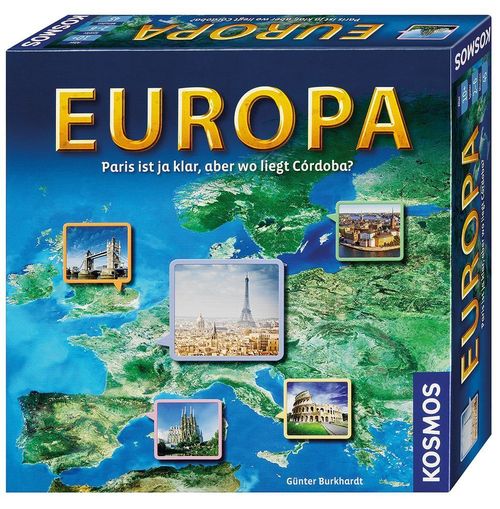
Europa: Paris ist ja klar, aber wo liegt Córdoba?
Europa: Paris ist ja klar, aber wo liegt Córdoba? Rulebook
Table of Contents
Table of Contents
Game Preparation
The game board is placed in the middle of the table.
Each player chooses a color and receives 1 tip board, 4 tip stones, 1 game figure and 2 exchange cards in the player's color.
The game pieces are placed on the starting squares of the game board, which are marked according to the number of players. For example, if four players are taking part, the game pieces are placed on the squares with the number 4 printed on them. The oldest player's game piece goes to the front, and the other game pieces follow behind them according to the age of the players.
The location indicator is initially placed next to the game plan.
All 224 location cards are shuffled and about half of them are placed in a stack next to the game board with the solution side facing down.
1. Lay Out Location Cards
At the beginning of each round, as many location cards as there are players are drawn from the stack and placed next to the game board with the task side facing up. No one is allowed to look at the solution side!
2. Select the Location Card and Swap It if Necessary
The player whose playing piece is in the last position is the starting player and is the first to choose one of the location cards on display. The other players then follow according to their position on the victory point track (from back to front). The leading player (the oldest at the start of the game) takes the location card that is left over. Each player places the chosen location card in front of them with the task side facing up. The solution side may not be looked at.
Swap: Each player has two swap cards that they can use to swap location cards during the game. When it's their turn, they choose one of the location cards on display as usual. They put the unwanted location card in the box along with one of their swap cards (both are out of the game) and take the top location card from the stack instead. Everyone has two opportunities during the game to swap an unwanted location card.
3. Tipp-Phase (Guessing Phase)
Now everyone plays at the same time. Each player tries to guess the location of the place on their location card on the map of Europe as accurately as possible. To do this, they place 1 to 4 of their guessing stones on their guessing board.
East or West: First, you have to decide whether the place is in the east or west. The white line divides Europe along the 10th meridian into east and west. To make a guess, you place a guessing stone on the corresponding field (O or W) on your own guessing card.
All other tips are voluntary. However, the order is fixed.
North, middle or south: Secondly, you can guess whether the location is in the north, middle or south (N, M, S) of the map. These areas are separated from each other on the game board along the 45th and 55th parallels.
Sector with number: The sector can then be typed. Each area (N, M, S) is divided into 12 or 18 sectors, which are delimited by the thick black and white lines and marked with large white numbers.
A, B, C or D: Finally, you can type where the location lies within the sector. The thin black lines on the game board divide the sectors into 4 sections. These are only divided into A, B, C and D on the tip board.
Players can place 4 guessing stones, but can also place just 1, 2 or 3 stones if they are not sure. For each stone placed correctly, their own playing piece moves one space forward on the victory point track. If even just one stone is placed incorrectly, the player does not move any spaces forward!
4. Evaluation
Once all players have guessed, the evaluation begins. The player whose game piece is at the back begins the evaluation.
The player in last position evaluates his guess first and moves his playing piece forward if he guessed correctly.
He places the location indicator on the game board, visible to the other players, where he thinks his location in Europe is according to the tip board. He then turns his location card over to the solution side and compares the solution with his tips on the tip board by reading the coordinates out loud.
If his guessing pieces are correct, he can move his playing piece forward by the corresponding number of spaces (4, 3, 2 or 1 space). Spaces with opposing pieces are skipped!
Example: The starting player (white) has placed 3 guessing stones on his guessing board. All of them are correct. He can now move his playing piece 3 spaces forward on the victory point track. He skips over the opponent's playing pieces if any field is already occupied.
It is also checked whether the player may keep the location card for the final scoring. To be allowed to keep a yellow card, all required tips must be placed and correct:
- To be allowed to keep a yellow card, 4 tips must be placed and correct.
- To be allowed to keep a red card, at least 3 guesses must be placed and all of them must be correct.
- To be allowed to keep a blue card, at least 2 guess stones must be placed and all must be correct.
Attention: If even one tipping piece is placed incorrectly, the player is not allowed to move his figure forward and must put the card on the discard pile. It does not matter whether he had enough correct tipping pieces to keep the card!
The player then removes his tip stones from the tip card to indicate that his tip card has already been scored.
Then the next player (who was in second to last place) follows and so on until all players have been evaluated in the current round.
Keep Task Cards
The cards won can bring extra points in the final scoring at the end of the game and decide the winner! So it can be worth placing another stone, even if you are not completely sure. Once all players have evaluated their guess, the next round begins.
End of Game
As soon as a player steps onto one of the dark blue fields with his playing piece, the game ends. The current scoring is completed. A final scoring then takes place.
Final Rating
a) Points for most cards in a category
Now, in each category of location cards (capital cities - yellow, cities - red, bodies of water/natural areas - blue), points are awarded to the players who have collected the most or second most location cards in the respective category:
For first place in a category a player receives 3 points and for second place 2 points:
- Who has the most yellow cards and who has the second most yellow cards?
- Who has the most and who has the second most red cards?
- Who has the most and who has the second most blue cards?
If several players share first place, they receive 2 points. In this case there are no points for second place.
If there is a first place with 3 points and several players share second place, they receive 1 victory point.
b) Points for each complete set of cards
A player has completed a set if one card of each color is kept during the game. Each complete set of cards is worth 3 points.
Points are awarded in the usual order. The player whose playing piece is at the back is the first to convert his card sets into points.
So if a player has one card each from the categories capitals, cities, bodies of water/natural areas (yellow, red, blue), he puts these 3 cards on the discard pile and can move his playing piece forward 3 spaces. If he has further sets of yellow, red and blue, he can move forward 3 spaces for each additional set.
Whoever is furthest ahead on the victory point track after the final scoring wins and can call themselves "European Champion". If there is a tie, there are multiple winners.
Notes
- Some maps have multiple solutions. This means that the location is not just in one section or sector, but in several. In this case, a guess is correct if one of the possible solutions is correct.
- If there is a tie, there are multiple winners.
- The placement of the location points on the map depends on where the city center is predominantly located or, in larger areas, where the majority of it is located.
- The rivers are searched for their mouths, otherwise they would flow over too many quadrants.
- Türkiye and Cyprus are also represented, even though geographically they are predominantly or no longer part of Europe.