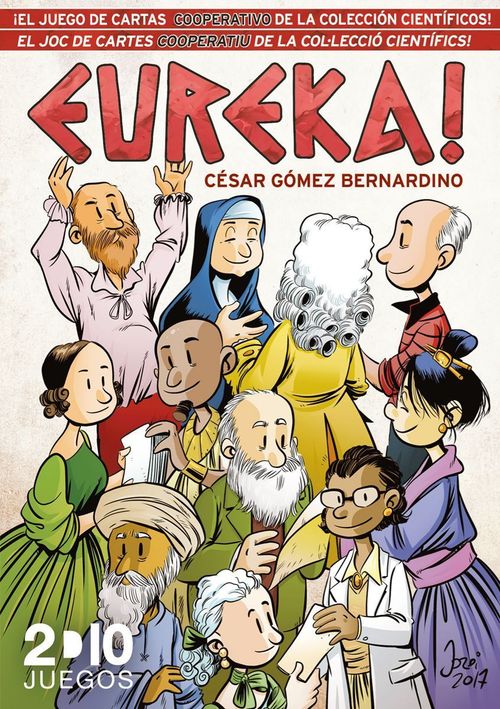
Eureka!
Eureka! Rulebook
Table of Contents
Table of Contents
Components
52 cards divided into 4 suits, or areas of knowledge, numbered 1 to 13; one wild card; and two help cards.
Object of the Game
Get rid of as many cards as possible by playing them in order by area of knowledge and number.
During the game players may not share any information about the cards in their hands, including comments about where it would suit them for a card to be played or whether a play has hurt them or not.
Setup
Assemble and shuffle the deck, and deal cards according to the number of players as shown in this table.
| Players | Cards per player | Deck |
|---|---|---|
| 2 | 6 | Cards 1 to 6 |
| 3 | 6 | Cards 1 to 8 |
| 4 | 5 (+ wild card) | Cards 1 to 11 |
| 5 | 5 (+ wild card) | Cards 1 to 13 |
Then create the draw row: take as many cards as there are players and place them face up in front of the deck. Whenever a player has to draw or exchange cards with the deck, they do so with the cards of this row.
Example layout for 3 players (Ada, Albert and Patty): each player has a hand in front of them; the deck sits in the centre with the draw row beside it, and each player's rows are played out in front of them.
Initial Draft
Choose a starting player; remember that you may not share information about your cards. The last player gives a card from their hand to the previous player (on their right); that player looks at it and then immediately gives one of their cards to the player on their right. This process is repeated until it reaches the starting player, who gives a card to the last player. The aim of this semi-draft is to balance the hands and share some initial information.
Example: Ada asks to be the starting player; Albert is the first to hand over a card and gives Patty a red 8, making it clear that he is loaded with high numbers. Patty decides to pass a red 5 to Ada so that she can play her 6 immediately after Ada lays it down. Ada has most of the low numbers and decides to give a yellow 1 to Albert, making it easier for her to place the 2 immediately. The initial draft is important for balancing the hands of cards and getting an idea of what the others may have.
Turn Sequence
On their turn the player must place 1 card if they can, either opening a new suit (it need not be with the number 1) or continuing an existing one, always in ascending order and partially covering the previous card.
Example: Ada opens the red row with the 1. Patty plays the green 3, her lowest card. Albert plays the yellow 1.
If the card played is of the same suit as, and consecutive to, the previous card of the row, it means we are making very small cultural advances and we suffer 1 penalty; the card is played turned face down so that the band with the penalty symbol is at the top of the row. If it is of the same suit but not consecutive, we have made a great discovery and obtain 1 bonus (see the table of bonuses and penalties).
Clarification: we must always play cards of the same suit in a row, but the bonus of the formal knowledge suit (yellow) allows us to play cards of another suit in that row. If the cards are not of the same suit as the previous one in the row, they generate neither bonus nor penalty.
If the player plays the last card of their hand, it does not generate a penalty, but it can generate 1 bonus.
If the player cannot place any of the cards in their hand they must pass. If there was a penalty or bonus active, it remains until a play is made (for example "the next play does not generate a bonus").
If all players pass consecutively the game ends.
Example of Play
(1) Ada, fearing that Patty will be forced to play yellow, decides to get rid of her 2 before opening blue. (2) As it is consecutive to the yellow 1 it generates a penalty and she must draw a card. She takes the green 7 and adds it to her hand, after which the draw row is refilled. (3) Patty, who knows her partner has the green 7, can play her 4 without fear that it will cause the end of the game; a penalty is generated and the next play must be green. (4) Albert passes since he cannot play a green card. (5) Ada plays a 5 and chains a new penalty, (6)(7) making Patty and Albert pass, and she plays the green 7, which stops the chain and generates an exchange bonus that she offers to Patty, since she seems to be the one with the worst cards.
Wild Card
In games of 4 and 5 players the wild card is used. This card, which can be used once for the whole game, may be used by any player before their turn to apply whichever bonus they want.
End of the Game
The game ends when all players pass consecutively. Each player scores one penalty point for each card in their hand. Add up the points of all the players to obtain the final score.
Example: Ada, Albert and Patty finish the game with 0, 1 and 0 cards respectively, for a total of 1 point.
Consult the table to see how well you have done.
| 2 players | 3 players | 4-5 players | Result |
|---|---|---|---|
| 0 | 0 | 0 | Que os den un Nobel (Give yourselves a Nobel) |
| 1 | 1-2 | 1-3 | Muy bien, respect (Very good, respect) |
| 2-3 | 3-4 | 4-5 | Necesitáis mejorar (You need to improve) |
| 4-5 | 5-7 | 6-8 | Medievooooo (Medieval!) |
| 6+ | 8+ | 9+ | Pon el juego en 2ª mano (Put the game up for sale second-hand) |
Bonuses and Penalties
Bonuses are always optional. A player's last card in hand never generates a penalty.
Formal Knowledge (yellow)
Bonus: Crossed knowledge. The formal knowledge bonus allows, in a later play, covering the card that gives the bonus with another card of equal or higher value from any other area. This bonus remains active until it is used or another yellow card is played (if you wish you can turn the card 180 degrees as a reminder). The row does not change colour after using the bonus, and the next card of the row must be yellow. Since it is of a different colour, neither the card played on top of the bonus nor the next yellow card played will generate a bonus or a penalty.
Penalty: Unnecessary studies. The player takes a card from the draw row and adds it to their hand, then a card is drawn from the deck to refill the draw row.
Natural Knowledge (green)
Bonus: Evolution. The player who obtains this bonus chooses a player (it may be themselves) to benefit from an exchange. The exchange can be:
- Player-Player: The beneficiary gives one of their cards to another player, who looks at it and gives one of their own cards in exchange (it may be the same card they received).
- Player-Deck: The player draws a card from the draw row and replaces it with one from their hand.
- Deck-Deck: A card from the draw row is returned to the bottom of the deck and replaced by a new card from the deck.
Penalty: Mutation. The next play must necessarily be in the green row; players must pass if they cannot do so. This can cause the end of the game.
The last card of the suit (6, 8, 11 or 13 depending on the number of players) does not generate a penalty even if it is played consecutively.
Social Knowledge (blue)
Bonus: Social revolution. The player may pick up into their hand the last card of any other row. This allows repairing plays that have left gaps of very large numbers.
Penalty: Culture clash. The player takes a card from the draw row and gives it to another player, then a card is drawn from the deck to refill the draw row.
Artistic Knowledge (red)
Bonus: Epiphany. The next play does not generate a penalty, in case it was going to. If it was not going to generate a penalty anyway, this bonus is lost and cannot be saved for later plays.
Penalty: Plagiarism. The next play does not generate a bonus, in case it was going to.