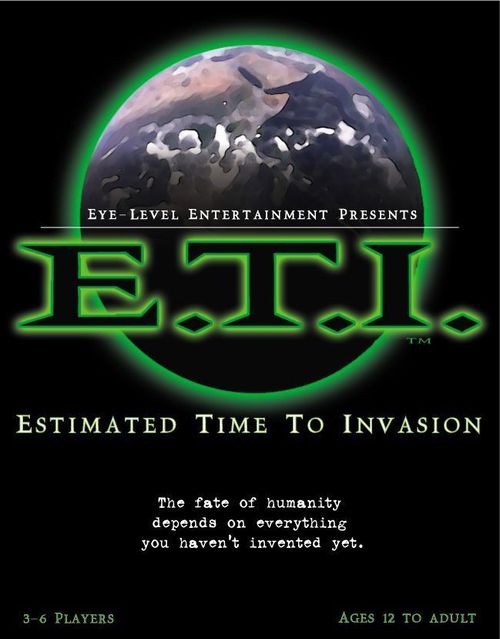
E.T.I.: Estimated Time to Invasion
E.T.I.: Estimated Time to Invasion Rulebook
Table of Contents
Table of Contents
- Game overview
- I. Materials and overview
- II. Setting up the game
- III. Sequence of play
- 1. ISSA president draws an event card
- 2. Choose and reveal turn agendas
- 3. Conduct research phase
- Let's tour your company:
- A project primer:
- Respect the badge:
- 4. Submit findings phase
- The research cards
- Two examples of submitting research
- 5. Any new projects are drawn and selected
- 6. ISSA badge is passed clockwise
- IV. Endgame invasion
- 1. Alien reveals endgame strategy
- 2. Alien transfers traits to new gameboard
- Alien gameboard overview
- 3. Humans continue research as normal
- 4. Alien claims any remaining projects
- 5. Alien places and flips/maneuvers attack cards
- 6. Alien adds attack cards from project mashes
- 7. Humans reveal endgame strategies
- 8. Resolve attacks and determine winner
- An endgame example:
- V. Glossary
- I.S.S.A. Internal Memorandum A732.3
Game overview
You and your friends are about to become the directors of powerful corporations in 1965 tasked with defending the Earth against an alien invasion!
You will compete to discover increasingly advanced technologies from all corners of science and technology. Successfully completing a project will increase the power and influence of your company.
After a predetermined number of projects have been discovered, one of the players will reveal himself as the alien co-conspirator and begin the countdown to invasion. The remaining players will use their fantastic discoveries to lead Earth's final defense!
Will your discoveries be able to repel the invasion, or will Earth fall? It's all in your hands!
I. Materials and overview
Game materials
This box should contain:
- 6 human company gameboards
- 1 alien gameboard
- 1 ISSA badge
- 6 human endgame cards
- 4 alien endgame cards
- 90 research cards
- 40 project cards
- 25 event cards
- 18 agenda cards
- 180 green tokens
- 30 red tokens
- 12 company logos with bases
- 1 sand timer
There are two logos for each company. Place them upright in the appropriately colored plastic bases.
II. Setting up the game
- Choose game length.
- Pass out gameboards and company items.
- Prepare the cards.
- Determine alien and draw endgame cards.
- Choose free company trait upgrades.
- Draw and choose starting projects.
1. Choose game length
The length of the game depends on how many projects you decide can be discovered by the competing companies. Longer games allow the players to complete more projects before the invasion can begin.
Once you have decided how long of a game you want to play, multiply the value listed in the chart below by the number of players. The resulting number (called the threshold) equals the number of projects that must be discovered before the alien player can announce its presence.
| Game Length | Project Multiplier |
|---|---|
| Short | 2 |
| Standard | 3 |
| Epic | 4 |
Ex.) Five players are going to play a short game. This means that the threshold is 10 projects (5 x 2). That many projects must be completed among all of the players before the endgame invasion can begin.
2. Pass out gameboards and company items
Each player takes a human company gameboard (not the alien one). Place one green token on the left-most space of each of your company traits:
- Staffing
- Creativity
- Security
- Analysis
Each player then chooses a specific company from the six provided and places one of its company tokens on the space provided at the top left of the gameboard. (Your choice of companies does not affect gameplay.)
Each player should also take that company's three corresponding agenda cards.
3. Prepare the cards
Shuffle the research and event cards into separate face-down piles. Do the same for each tech level of projects, keeping each level in its own pile.
4. Determine alien and draw endgame cards
Each player will control a powerful human corporation, but one player is secretly allied with the aliens and will help command the ensuing invasion!
Before anyone becomes the alien, however, you must determine what type of alien force will be trying to destroy humanity. There are four aliens of differing strength, each with its own alien endgame card. An increasing number of UFO symbols on the alien card equals an increasingly challenging alien foe.
It is recommended that you pick the weakest alien for your first game. After that, you can select an alien to reflect how difficult of a nemesis you want to face. Generally speaking, tougher aliens are better suited for longer games and/or more players. You can even leave the choice completely random... if you're feeling particularly brave!
After you have chosen the alien endgame card, shuffle the human endgame cards face-down and draw one for each remaining player without looking at the cards. Shuffle the alien card in with the human cards. Each player draws a face-down card without revealing it to the other players. After looking at it, each player places it under his own gameboard for safe keeping.
5. Choose free company trait upgrades
Each company has four traits that represent its corporate strengths and weaknesses. Each player takes three more green tokens and makes three trait upgrades. Place these on the space provided on the gameboard under the trait(s) that you want to improve. These can be spread out or focused among the different traits as you see fit.
If you gain immunity to an alien threat due to a security upgrade, immediately select the alien threat that you want to neutralize. Cover that alien threat icon on your gameboard with a red token.
6. Draw and choose starting projects
Draw a number of level one projects equal to the number of players minus one. (i.e. 4 players = 3 initial projects.) Place these projects face-up in the center of the table.
The owner of the game decides who starts with the ISSA badge. Then, starting with that player and proceeding clockwise, each player places her other company token on the project that she wants to start working on. There will always be at least two players competing to discover the same project.
III. Sequence of play
- ISSA president draws an event card.
- Choose and reveal turn agendas.
- Conduct research phase.
- Submit findings phase.
- Any new projects are drawn and selected.
- ISSA badge is passed clockwise.
1. ISSA president draws an event card
An ISSA president draws an event card only if he has at least one completed project beneath his gameboard (a.k.a. in his vaults). He draws the top event, shows it to all the players and follows its directions.
Some events allow the ISSA president to choose the beneficiary of the event. Players can influence his decision by offering him items (banked research points, held event cards, and/or completed projects). One can even offer the promise of support in future votes. Research cards, however, cannot be traded.
The ISSA president flips over the sand timer after he reads an event that allows him to choose a recipient. Players must finish their negotiations before it runs out. After that, the ISSA president must make his choice.
All offers are non-binding. This means that only after the event's outcome is awarded are any items exchanged. If a player decides to keep her end of the deal, the items must be exchanged before agendas are chosen for that turn. At no other time can players exchange items.
Traded projects become public domain (see page 5) and their upgrades must be transferred to the new owners.
RULES FOR VOTING EVENTS: Any player may be the beneficiary of a vote, but only players with projects in their vaults can cast votes. Starting with the ISSA president, each player casts ALL of his votes for one company (no abstaining and no splitting votes among multiple companies). A player can vote for himself.
Since there are multiple decision makers in a vote, anyone can try to sway another player's vote by offering her items with the same procedure listed above.
Each project tech level counts as one vote. (For example: if a player had two level I projects and one level III project, then he would have 5 (1+1+3) votes.)
Votes can double the value of projects with specific trait upgrades. (For example, in a 'creativity vote' any projects with a creativity upgrade count at double their listed tech levels. So a level II project with a creativity upgrade would count as four votes in that case, not two.) Some projects have double upgrades of the same trait. These still count at double value, not triple.
2. Choose and reveal turn agendas
Agendas are the three basic courses of action a player may choose to pursue at the beginning of a turn. Each agenda allows the player to do different things.
Choose your agenda carefully; the success of your company and the survival of the planet depends on it.
The agenda choices:
- CONDUCT RESEARCH: A company collects research cards for its current project.
- SUBMIT FINDINGS: A company forgoes collecting research cards in an effort to claim a project for its vaults.
- SWITCH PROJECTS: A company picks a different project to start studying. (You can, in theory, switch back to your old project later.)
Each player secretly selects one agenda card and sets the other two aside. Then all players reveal their agendas at the same time, based on the ISSA president's lead.
3. Conduct research phase
The ISSA president deals out to any players who chose to conduct research starting with the player to his left and moving clockwise. (Each player conducting research should hold up enough fingers to let the ISSA president easily determine how many cards to deal out.) The number of cards the player receives is determined by his staffing trait.
Without looking at the values of the dealt cards, each player places them face-down next to the numbered spaces around the perimeter of his gameboard (a.k.a. the data ports) starting with the lowest data port available. The gameboard only has 14 data ports. Any cards collected beyond that are discarded. A player cannot choose to conduct research if his 14 data ports are already completely filled with research cards.
A player cannot look at the values of his face-down cards until he decides to submit his results. The exception to this is if a company has analysis upgrades. This trait allows a player to peek at the research values of a certain number of face-down cards in his data ports (i.e. two upgrades of analysis allows you to peek at your first four data ports). You may do this at any time, but you cannot change the order of any cards.
Let's tour your company:
(Printed as a labelled diagram of the human company gameboard, in the sequence-of-play section.)
- Company logo: One of your company logos goes here. (The other will go on the project that you are researching.)
- Staffing: Determines how many research cards you'll draw when investigating new projects.
- Creativity: Measures how well you can manipulate your research cards to maximize your findings.
- Security: Allows you to ignore certain alien threats that hinder the progress of your research.
- Analysis: Lets you check your research progress and can help you plan your future agendas.
- Alien threats: The alien threats are hazards that you'll encounter when you try to submit your research. As your security trait increases, you'll get to decide which threats your company has been able to neutralize. The four threats are: Abduction, Arson, Data Virus and Spy. Choose your immunities wisely!
- Data ports: You'll place your research cards around the gameboard at your data ports. Start at '1' and fill clockwise. (Any cards beyond '14' are discarded.)
- Data bank: The data bank allows you to store research and use it later.
- Top secret vault: If you want increased defense from your completed projects, then you'll place them below the left side of your gameboard, a.k.a. the top secret vault.
- Public domain vault: If you want increased fame from your completed projects, then you'll place them below the right side of your gameboard, a.k.a. the public domain vault.
A project primer:
- Field of study: There are eight fields of study which encompass a variety of disciplines and technologies.
- Tech level: The tech level indicates the relative complexity of the project. Each field of study has five increasingly powerful levels, from I (the simplest) to V (the toughest).
- Project name: The name of the project. (You sure that you're up for this?)
- Defense: The defense value of your projects will determine how well your company can counter the alien attack. Without a lot of defense, your company will probably be destroyed during the invasion.
- Fame: A project's fame measures how much society will be impacted by its discovery. If more than one company survives the alien invasion, the human with the most fame left wins.
- Company trait upgrades: Some projects will provide you with valuable company trait upgrades. These remain with you for as long as you hold the project in your vaults.
- Difficulty: A project's difficulty tells you how much data you must successfully submit to ISSA before you can claim it for your facility's vaults.
Respect the badge:
The owner of the game decides who starts with the ISSA badge. This represents the rotating presidency of the International Space Security Agency, the organization that is secretly funding your work. This player is responsible for: dealing out cards, drawing events and deciding who wins (such as votes, research, events, etc.). The badge is passed clockwise at the end of the turn.
For the record, E.T.I. starts in 1965 and each game turn represents one year of work. Feel free to keep track of the game year for fun.
4. Submit findings phase
Ready to try and claim a project for your company? There are two ways to submit your findings to ISSA:
SAFE: Leave your research cards face-down and discard all of them for 10 research points a piece. (Remember: you cannot look at the values of face-down cards unless your analysis trait allows you to do so.)
STANDARD: This method is more risky, but potentially more fruitful. There are five steps to a standard submission of findings. (Examples of this entire process are located on the next page.)
i. Flip over all research cards. Flip over all of your research cards, leaving them at the same data port.
ii. Swap the order of the cards if allowed. If your creativity trait is high enough, you can make one or more swaps of adjacent research cards. This can be done to maximize the effects of positive multipliers and/or to minimize the effects of 'x0' multipliers or alien threats. The same card(s) can even be involved in multiple swaps, if your creativity trait is high enough.
iii. Resolve alien threats. Alien threats are resolved one-by-one starting with the first data port and working around the gameboard. Each alien threat card will destroy the highest numeric research card farther up the queue. If there is more than one research card of that value, an alien threat will destroy the nearest one. Therefore, an alien threat at the end of your queue cannot hurt your research.
You can ignore any alien threats that you are immune to through your security trait. (Remember to immediately pick out new immunities whenever your security upgrades allow you to do so. You cannot change those choices later.)
iv. Determine research total. Add up the values of the cards left in the research queue, remembering that each multiplier affects the closest numeric research card before it in the queue. If there are none, then that multiplier is ignored. Hence, multipliers at the beginning of your queue will have no effect on your research.
v. Move successful projects to the vault. Add your research total to the research that you have stored in your data bank, if any. If the total meets or beats the project's difficulty, then you claim the project. Whenever you claim a project that you were researching, you must always reset your data bank to 'zero' whether you needed the stored research or not.
You must place newly claimed projects side-by-side (don't stack them on top of each other) in either your...
TOP SECRET VAULT: Due to the secretive nature of these discoveries, you'll gain an advantage against the aliens in the endgame. Each top secret project gains a +5 defense bonus during the invasion.
PUBLIC DOMAIN VAULT: You have decided to allow the other companies to know about your findings. This goodwill translates into a +10 Fame bonus for each public domain project that isn't destroyed during the invasion.
Whether top secret or public domain, your completed projects always help your future work in the same field. You gain an additional research card for each project in your vaults from the same field of study whenever you continue research in that specific field.
Ex.) A player has two weaponry projects in her vaults. Anytime she conducts research on another weaponry project, she'll gain two additional research cards!
If you submitted findings but fell short of the project's difficulty, then add the research total from your cards to your data bank. Use the green tokens to light up the total amount of research in your data bank. (The source prints "dank bank" here; read as "data bank".)
When submitting findings, if more than one player surpasses the difficulty on the same project, then the player with the highest total (submitted findings + banked data) gets to claim the project. If there is a tie, then the ISSA president decides which of the companies involved claims the project. (Since this is not an event, players cannot bribe the ISSA president with items.)
If another player claims a project that you were also working on, you have been scooped. This can be inconvenient early in the game and devastating to your progress later on, so try to avoid it!
If you get scooped while submitting research, bank your completed research as normal, but you can only keep a maximum of 100 research points in your data bank.
Ex.) A player submits her findings and adds those 90 research points to her 50 points of banked research for a total of 140 in the bank. Unfortunately, another player submits enough data during the same turn to claim the project. She drops her data bank down to 100 points and will have to pick a new project to research at the end of the turn.
The research cards
- Numeric values: These cards make up the core of your research.
- Multipliers: Multiplies the value of the numeric card before it in the queue. They can combine. (x2 x2 = x4)
- Alien threats: Unless you possess the specific immunity through your security trait, each one will destroy the highest numeric card farther up the queue. They do not affect multipliers!
Two examples of submitting research
First example: If this player didn't have immunity to 'Arson', then she would lose the '50' to it. The 'Spy' is at the end of the queue so there is no card to the right of it that it could cancel out. Her research total would equal 20 x 0 + 30 = 30.
Now if she had enough creativity to make one swap, then she could have switched the positions of the '50' and 'Arson'. 'Arson' would instead cancel out the '30'. Now the research total would equal 50 + 20 x 0 = 50.
Second example: If this player didn't have immunity to 'Data Virus', then he would lose the '40'. The '10' and the '20' would each benefit from a multiplier. His research total would equal 10 x 2 + 20 x 3 = 80.
If the player had enough creativity to make two swaps, he could move the '40' two spots to the left. 'Data Virus' would then cancel out the '20'. Both the modifiers would fall back onto the '40' as his research total would equal 10 + 40 x 2 x 3 = 250! Booyah!
If you get scooped while you were conducting research, you can bank your face-down research cards (including the new ones you got that turn) using the 'safe' method. You, however, can still only keep a maximum of 100 research points in your data bank.
Example one: A player with 70 research points in his data bank and five face-down research cards gets scooped while conducting research. The research cards could get safely banked as 50 more points for a total in his bank of 120 research points. But since he got scooped, he can only keep 100 points in his bank.
Example two: A player with 130 research points in his data bank and ten cards in his data queue gets scooped while conducting research. Now his research cards could get securely banked as 100 research points, but he has too much data in his bank as it is, so he loses the excess research and lowers his data bank to 100. Ouch.
5. Any new projects are drawn and selected
Starting with the ISSA president and moving clockwise, any player who claimed a project must place a new one in the center of the table. A player can draw a project from any tech level up to the highest level in her vaults or one tech level higher.
Ex.) A player has a level II project in her vaults. She can pull a new project from tech level I, II or III.
If there are no projects left in the allowed tech level(s), he must draw one from the lowest tech level available.
After this is done, certain players must pick a new face-up project from the center of the table to investigate. Again, this starts with the ISSA president and moves clockwise. Simply place your second company logo on any project in the center of the table. There are three situations when you pick a new project to research:
a) You claimed a project. Remember, you must also reduce your data bank to zero.
b) You chose to switch projects. These players first bank any research using the 'safe' method on page 5.
Ex.) A player with 100 research points in her data bank and five cards in her data queue chooses to switch projects. The cards get securely banked as 50 research points, so her data bank is now at 150.
When you choose a new project, however, you cannot keep more than half the difficulty of the new project as research in your data bank.
Ex.) The player with 150 research points in her data bank can only keep 90 points of it if she chooses a new project with a difficulty of 180. (180/2 = 90). She could keep it all, if the difficulty was at least 300.
There is one notable exception to this: if you choose a new project in the same field of study as the one you abandoned, you can keep all of your banked research.
Ex.) If the player in the last example was to choose a new project with a 230 difficulty, she could only keep 110 research points in her data bank (230/2 = 115). If, however, that project was in the same field of study as the last one she was working on, she could keep the entire 150 research points in her data bank.
c) You got scooped. Follow the same rules for transferring banked research as above. Remember, however, the penalty for getting scooped; your data bank must be reduced to 100 research points before you pick out a new project.
6. ISSA badge is passed clockwise
When all players have adjusted their data banks, drawn new projects and placed their company logos on new projects, the ISSA badge is passed from the outgoing ISSA president to the new one (a.k.a. the player to her left).
An outgoing ISSA president has the final duty of giving her fellow players a count of claimed projects, so that all players can see how close they are reaching to the project threshold determined at the start of the game.
There are also two duties that the incoming president should do to help speed up gameplay:
a) All discarded research cards must be shuffled back into the deck before the ISSA president deals out new cards for the next turn.
b) If there are no event cards left, the incoming president should shuffle the discarded ones and start over with the fresh deck.
In either case, be sure to have another player cut the new decks before any new cards are drawn/dealt.
Play continues in this fashion until the alien player reveals itself to the other players at the beginning of a turn. An alien can do this once the project threshold has been met by any combination of players.
Want to dominate an entire planet in eight easy steps? Turn the page to learn how!
IV. Endgame invasion
The endgame invasion:
- Alien reveals endgame strategy.
- Alien transfers traits to new gameboard.
- Humans continue research as normal.
- Alien claims any remaining projects.
- Alien places and flips/maneuvers attack cards.
- Alien adds attack cards from project mashes.
- Humans reveal endgame strategies.
- Resolve attacks and determine winner.
1. Alien reveals endgame strategy
The alien can reveal itself once the project threshold has been reached. The higher the project threshold, the more time humanity has to prepare its defenses.
It is often to the alien's advantage to begin the invasion countdown as soon as possible. The alien, however, might have a strategic reason to delay exposure for another turn or two. Whatever the case, the alien MUST reveal itself by the next project threshold. [i.e. the number of players x (the project multiplier +1)]
Ex.) In a 3 player 'standard length' game, the alien can choose to reveal itself the turn after 9 projects are discovered (3 players x 3 projects). It MUST reveal itself by the turn after 12 projects are discovered (3 players x 4 projects).
The alien can only reveal itself BEFORE the ISSA president draws his event card on any given turn. Once outed, the alien can no longer vote or be the recipient of any vote or event. The alien immediately claims the project it was working on. Any player who gets scooped must immediately follow the appropriate procedures for adjusting his data bank and moving his company logo to a new project. No new projects are brought into play for the rest of the game, unless done so by an event.
2. Alien transfers traits to new gameboard
Each human company trait has a corresponding alien counterpart. The alien transfers the same number of tokens to each new trait. Each of these traits will affect different aspects of the coming endgame invasion:
- Staffing becomes E.T.I.
- Creativity becomes Intel
- Security becomes Tactics
- Analysis becomes Brutality
Alien gameboard overview
(Printed as a labelled diagram titled "How I learned to start loving the alien:".)
- E.T.I.: measures how long the humans can continue their futile efforts before your main fleet arrives.
- Intel: gives you the flexibility to maneuver your fleet and/or gauge its attack strength.
- Tactics: gives you access to powerful tools of destruction to help aid your mighty attack.
- Brutality: measures the baseline strength of your forces without any additional troop commitments.
- Alien tactics: Your alien tactics are the alien threats that your unearthly masters are particularly good at employing. Your company's research was protected against these threats while your allegiance to the aliens was a secret, and now they will be used against the defenders of this pathetic planet.
- Vault: Your vault now contains all of the projects that you have kept out of the hands of the humans. You will combine these into terrifying technological hybrids and rain further destruction upon the human resistance.
- Invasion overview: A summary of the endgame invasion steps is printed on the alien gameboard.
- Human projects are stored in the vault.
Any alien threat that a player was immune to as a human becomes a powerful tactic for use during the invasion. Cover each with a green token to indicate this.
Ex.) The alien was immune to 'Spy' and 'Arson' as a human. It places a green token on each to indicate that they are now the alien's invasion tactics.
3. Humans continue research as normal
The alien E.T.I. trait will determine how many turns the humans can continue advancing their agendas. If the E.T.I. trait is high enough, the humans have no time left to prepare and invasion begins that very turn!
If the invasion is not beginning immediately, the human companies should use the remaining turns to try and claim the remaining face-up projects. The invasion begins the turn after the last project is claimed or when time runs out. The player who is the ISSA president during the turn that the invasion begins will remain the ISSA president for the rest of the game.
4. Alien claims any remaining projects
When the invasion arrives, any unclaimed projects in the center of the table are captured by the alien. It should upgrade its gameboard if the projects allow it to do so.
5. Alien places and flips/maneuvers attack cards
The alien places a number of face-down research cards (now called attack cards) equal to the threshold multiplier in front of each human gameboard. These represent the fleet attack strength against each company.
Ex.) In an 'epic length' game, 4 attack cards are dealt face-down in front of each human company.
The alien's intel trait provides two valuable options. It allows the alien to shift attack cards between companies to account for their relative defenses. It also allows the alien to flip over attack cards to see their numeric values before the final attack. The alien can do either or both depending on its intel strength and can use these two powers in any order it pleases. Each flip or shift counts as one use of the intel trait. The alien gameboard indicates how many times the alien can use this ability.
6. Alien adds attack cards from project mashes
Lastly, the alien can combine its projects into horrific hybrid weapons. Every two projects which the alien has claimed can be 'mashed' together for one additional attack card to be placed at its discretion. It cannot, however, place more than one of these extra attack cards per company. Excess attack cards from project mashes, if any, are discarded.
Although it has no effect on gameplay, the alien player is encouraged to come up with creative project combinations to entertain the human players before attempting to annihilate them.
7. Humans reveal endgame strategies
Once the alien is done with its set-up, the human players reveal their endgame cards and resolve any needed actions. This is done one-at-a-time starting with the ISSA president and moving in a clockwise order.
8. Resolve attacks and determine winner
The attack cards in front of each facility are flipped (unless the alien already did so with its intel trait) to reveal the total attack strength against each player. The numeric cards count as attacks at their listed values. The 'x0', 'x2', 'x3' multipliers count as 10, 20, and 30 point attacks, respectively.
Any threats that the alien was immune to as a human become specialized attacks as dictated by its tactics trait. The strength of those attacks depends on comparing the human's immunities vs. the alien's tactics:
| Alien has that threat as a tactic | Alien DOES NOT have that threat as a tactic | |
|---|---|---|
| Human NOT immune to that alien threat | 50 Attack | 25 Attack |
| Human immune to that alien threat | 25 Attack | 0 Attack |
Ex.) The alien has 'Arson' as a tactic, but the human has immunity to it through his security trait. So that attack card has a value of 25.
The total attack from the cards is added to any base attack provided by the brutality trait of the alien player.
To survive, each company must discard enough projects so that the defense total of those discarded projects meets or beats the total attack strength against it. Remember: each top secret project gains a +5 defense bonus in the endgame invasion.
A player can lose all of her projects and still survive the invasion as long as the combined alien attack against her company does not exceed the combined total defense of all of the projects that she had in her vaults.
Each surviving public domain project gains +10 fame. The surviving human company with the highest remaining fame wins the game.
If there is a tie, the final ISSA president decides which of those companies wins the game.
If no human survives, then the alien wins! (For the record, I welcome our new alien masters.)
An endgame example:
Frank, Todd and Angie are playing a 'standard length' game (threshold = 3 players x 3 project multiplier = 9 projects claimed before Invasion). Todd and Angie have four projects each, while poor Frank only has one.
Then why is 'poor' Frank grinning? Uh-oh... he's the alien! Now that the threshold of nine projects has been met, Frank reveals himself as the 'Raiding Party' at the beginning of the turn. He immediately claims the project he was working on for his evil alien vault. (The alien combines its human projects into one vault since it has no need to separate them for defense or fame bonuses).
Todd and Angie race to claim the remaining project, but their efforts are thwarted through some bad research cards. The last project falls into the alien claws after the number of turns indicated on Frank's E.T.I. trait passes.
Todd becomes the final ISSA president and the game looks like this: [Projects are listed as follows: NAME (DEFENSE/FAME). Remember that in the endgame, each top secret project gains a +5 defense bonus.]
Frank (3 projects):
- Moon Outpost Lens Array (40/20)
- Dedicated Observatories (10/10)
- Alien Linguistics (30/0)
His brutality rating is high enough to give him a base attack of 5 and he has 'Spy' as an alien tactic.
Todd (4 projects and a 90 defense total):
- Top secret: Assault Rifles (20+5/0), Mechanical Exoskeletons (20+5/20)
- Public domain: Space Flight Calculations (20/10), String Theory (20/30)
Todd is immune to 'Spy' and 'Abduction'.
Angie (4 projects and a 40 defense total): (as printed; the four projects listed below sum to 50 defense, and the example later uses 50 + 15 = 65 for her, so the printed "40" appears to be a misprint.)
- Top secret: Transplant Surgery (0+5/10), Advanced Neuroscience (0+5/30)
- Public domain: Satellite Network (20/20), Alien Detection (20/0)
Angie has no immunities (gulp!).
Frank places three face-down attack cards in front of each of his opponents and notices that Todd has a much stronger defense than Angie. Frank has a high enough intel rating to allow him to shift one attack card from Angie to Todd. (He could have instead used his intel to flip over one of the attack cards to see its numeric strength, if he wanted.)
With three projects, Frank can also make one project mash. He decides to use the moon outpost to radio back to the fleet in an alien code (i.e. he combines Alien Linguistics with the Moon Outpost Lens Array)! He adds yet another card to the attack against Todd. That makes 5 attack cards against Todd and only 2 against Angie. Frank cackles as he calls in the alien attack fleet.
Todd and Angie don't intend on going quietly! Todd reveals that he is 'The Survivalist' and shifts the 30 fame from String Theory to its defense. Angie reveals that she is 'The Visionary' and draws Computer Languages (10+5/10) and places it in her top secret vault.
Todd has a total defense of 120 entering the final attack. Frank flips over the five cards to reveal 'x0', 'Abduction', 'Spy', '50' and '10'. The 'x0' equals a '10' attack. Todd is immune to 'Abduction' thanks to his security and Frank does not have it as a tactic, so that attack equals a '0' attack. Todd is also immune to 'Spy', but Frank has it as a tactic, so that card equals '25'. The other two are treated at face value, so the total attack = 10 + 0 + 25 + 50 + 10 + 5 (the base attack from his brutality trait) = 100! Todd must discard 100 defense of projects. Still, he is able to save his Space Flight Calculations. Since it was public domain, he ends up with 10+10 = 20 fame.
Frank howls in anger and hopes to destroy at least one human company. Angie faces the invasion with only 65 defense. Frank flips over the cards against Angie to reveal 'x2' and 'Spy'. The 'x2' equals a '20' attack card. 'Spy' is one of his tactics and since Angie is not immune to it, that card equals '50'. 20 + 50 + 5 (the base attack from his brutality trait) = 75. Her defenses were only 65, so Angie's company is destroyed!
Since Todd is the only human company that survived the invasion, he wins the game!
If more than one player had survived, then the winner would be the one with the highest total fame of any remaining projects.
If those survivors had ended up with identical fame totals, then the last ISSA president (in this case, Todd) would decide which of those players wins the game.
Hmmm... I wonder who Todd would have picked?
V. Glossary
(The printed credits and thanks block is omitted as attribution.)
- Alien: The player who has secretly allied himself with the alien invaders before the start of the game.
- Analysis: (human trait) Allows a player to peek at the research cards located at a certain number of her data ports.
- Brutality: (alien trait) Determines the base attack strength of the invasion fleet against each company.
- Creativity: (human trait) Allows a player to switch the position of adjacent research cards when submitting findings.
- Data Bank: Stores a player's completed research while she is trying to claim a project.
- Defense: The amount of protection each project provides against the alien attack.
- Difficulty: The amount of research points that must be collected before a player can claim a project.
- E.T.I.: (alien trait) Stands for 'Estimated Time to Invasion'. Besides being the name of this awesome game, it represents how much time the human players have to complete projects after the alien reveals itself.
- Endgame: The time period after the alien reveals itself. It ends with the final attack against all human companies.
- Fame: A measure of how important the general public will deem the societal ramifications of a completed project.
- Fields of Study: The eight disciplines available for research: chemistry, life sciences, physics, robotics, sensors, weaponry and xeno studies.
I.S.S.A. Internal Memorandum A732.3
Printed as a flowchart, with the following header: "I.S.S.A. Internal Memorandum A732.3 / Omega Level Clearance / 11/05/65 - 14:05:08". Marginal note: "Here is that flowchart you wanted. Keep up the research... Remember: the invasion is coming!"
CHOOSE YOUR AGENDA! The three branches are:
- Conduct Research: Place research cards at data ports. Then ask: Did another company meet or beat the difficulty of your project? YES: You got scooped. NO: Keep working.
- Submit Findings: Choose SAFE or STANDARD.
- SAFE: Add ten research points to your data bank for each face-down card.
- STANDARD: Flip over research cards and calculate the total value.
- Then ask: Did you meet or beat the difficulty of your project? NO: Ask Did another company meet or beat the difficulty of your project? YES: You got scooped. NO: Add your research total to your data bank and keep working. YES: Ask Did another company submit more research on your project than you did? YES: You got scooped. NO: You claim the project.
- Switch Projects: Add ten research points to your data bank for each face-down card. Pick a new project at the end of the turn.
CLAIMING A PROJECT: Clear your data bank. Move the project to either your 'Top Secret' or 'Public Domain' vault. Pick a new project at the end of the turn.
GETTING SCOOPED: Add ten points to your data bank for each face-down card. When scooped, you cannot keep more than 100 research points in your data bank. Pick a new project at the end of the turn.
PICKING A NEW PROJECT IN THE SAME FIELD OF STUDY: You can apply any and all of your banked data to the new project.
PICKING A NEW PROJECT IN A DIFFERENT FIELD OF STUDY: The maximum research that you can apply to the project equals half of its difficulty. Any banked research over that amount is discarded. For example, you cannot start a 230 difficulty project with more than 110 banked research points (230/2 = 115 and it rounds to 110).