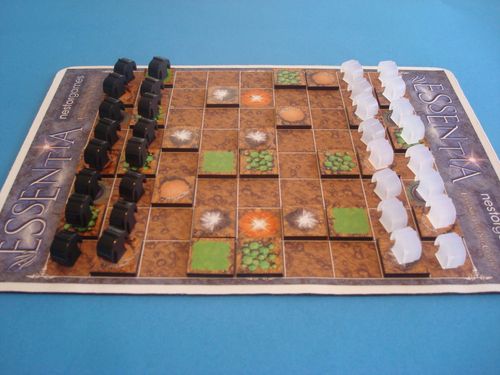
Essentia
Essentia Rulebook
Table of Contents
Table of Contents
Material
- An 8 x 9 board representing the Changing Land.
- 16 dark golems and 16 light golems.
- 28 terrain tiles (8 plateaus, 8 forests, 8 mountains, 4 plains).
The Changing Land
At the beginning, each player will have 16 golems in one color, which he will move through the spaces or the tiles set on the board. There will be 28 mobile tiles altogether, to be placed on as many spaces. These tiles, along with the uncovered terrains, will determine the identity of the 72 spaces of the board.
The Changing Land's main feature is the anarchic nature of the essence. Every day it modifies the terrain configuration save for the springs of essence, which position is fixed. That means every battle is different and only the ability of the players will decide the fight's outcome.
Terrains and Powers
- Plains: large prairies that provide the golem with the power to move and attack in any direction (orthogonal and diagonal) as many spaces as desired as long as no piece is found in the middle of the way.
- Plateaus: formidable high plains which provide with the power to move and attack orthogonally as many spaces as desired as long as no piece is found in the middle of the way.
- Rocks: the usual terrain in the Changing Land. Stony ground, hard and slow. It lets move just through a one-space distance, always orthogonally. However, the haphazard situation of the rocks only permits to attack diagonally, one-space distance as well.
- Mountains: high peaks only reachable by ascending in zigzag. The power they give the golem consists in moving and attacking diagonally as many spaces as desired as long as no piece is found in the middle of the way.
- Forests: ancestral woods that emanate stealth and subterfuge. They provide the only power which makes possible to get through obstacles. It lets move and attack, in a sort of jump, by drawing an 'L' (two spaces high and one space wide) in any direction. The golem starts its movement at one end of the 'L' and finishes it at the other one.
- Circles of essence: two special zones that can be enabled or disabled. This state has to be maintained all game long.
- Enabled state: zone of pure essence that provides, according to the player's choice, the power of the forests, the plateaus or the rocks. This choice is to be declared at the moment of occupation and cannot be changed until the zone is taken again.
- Disabled state: dead zone that cannot be occupied by any golem, but it can be traversed by the usual powers.
Setup
Each player chooses a magic Order (light pieces for Dawn, dark ones for Twilight). After deciding whether the circles of essence will be on or off, the board has to be oriented in a way that the springs are in front of each opponent.
Two ways of setup are suggested.
- Random setup: the tiles are put face down and each player, on alternate turns, sets them blindly one by one on the board (any spaces are allowed but for the Circles' and Springs') until they run out. Then they are put face up, revealing their identities.
- Strategic setup: each player chooses a tile (in sight) and puts it, on alternate turns, on the board. He must do it in this way: one in his part of the board, the next in his opponent's and so on. The central row can be used at any time by both players.
When the 28 tiles are set, each player puts his 16 golems across the two rows closer to him and the game is ready to start.
Play
The starting Order is established at random. From this moment on, the players move their pieces, one per turn, according to the power the space or tile they are on give them. Passing is not allowed. As a golem reaches the place an enemy golem occupies, the latter is eliminated from the game. Spaces and tiles can be occupied by just one piece.
A golem possesses the power his terrain gives him until he moves to another; then the power changes to adjust to the new terrain.
Goal
A magic Order beats the other in any of these circumstances:
- A golem takes over a spring of essence when it is occupied by a foe.
- An Order makes the other lose its springs at a given moment (that is, when one player has no golems left on springs).
Variants
To speed up games or, on the contrary, to make them more difficult, two variants about the circles of essence are proposed: if active, to allow them to offer the power of any terrain (not only the one given by rocks, plateaus or forests); if inactive, besides the occupation is banned, to prevent any power from getting through them (with the exception of the power provided by the forest, as the circles can be jumped over).
FAQ
Can the game end in a draw? It's very unlikely, but in case neither player is able to finish his opponent, a truce is announced and a new battle, with a new initial configuration, is to be scheduled.
When a golem threatens an enemy occupied spring... is there any need to declare it? Not at all. The players must be alert: distractions take their toll in the Changing Land.
Can a golem take an enemy spring without winning the game? Yes, as long as the other player keeps another spring occupied by one of his pieces. Nonetheless, the player who controls the golem is taking a big risk, because if he is defeated there the battle is lost, although the spring was not originally "his".