Espinas
Espinas Rulebook
Table of Contents
Table of Contents
Objective of the Game
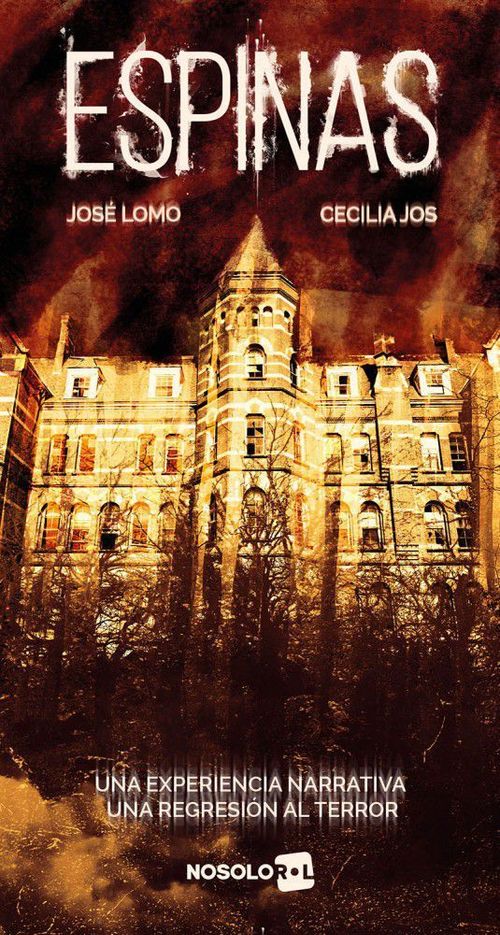
In the old sanatorium dwell evil forces that have sought to destroy your Characters since they visited the place fifteen years ago. Back then they escaped... but the Evil that lives there will make sure that does not happen again. It calls you back, and it longs for your destruction with all its strength.
If all the Characters die, the game is lost. But if all or some of them survive, you obtain a global score for the session, which you can improve in future games, building your own survival ranking. Espinas is therefore a cooperative game in which all players try to survive the threat that inhabits the sanatorium.
Beyond its mechanical elements, Espinas is a narrative game. The most important reward of each session is the unique and chilling horror story that you experience together. Whether your Characters live or die, that story will remain in your memory... and in the memory of the sanatorium itself. Those memories may be precisely what keeps the Evil hidden among its shadows alive.
Components
Espinas uses cards to stimulate the players' storytelling ability. The experience is complemented by a board and some markers. Each component is described in detail below.
- Board: Its design shows a diagram that helps structure the turns of the game. The spaces arranged in a circle are the Scenes. The remaining marks and spaces help locate the different card decks. The board has two sides: one for normal play (ten Scenes) and one for easy play (seven Scenes).
- 10 Scene markers: Used to mark Scenes as resolved or unresolved. One side has skull drawings and the other has "seen" symbols.
- 18 Truce markers (12 worth "1" and 6 worth "3"): Given as rewards to players who correctly resolve certain Scenes. They are used to avoid the death of a Character or to retry failed recollections.
- 6 Character cards: Players take on one of these six lead roles in the story. Each Character has its own identity, a special ability that can be used once per session, and a distinct way of using its Truces.
- 40 Location cards (25 grey and 15 black): They describe the varied corners of the sanatorium that the players can visit during the game. Those with a black back are especially eerie places. Besides a short phrase and an evocative illustration, they include instructions for passing the turn to the next player during the exploration phase.
- 3 Access cards: Three special Location cards that establish the possible points of entry into the sanatorium at the start of the exploration phase.
- 10 Regression cards: They indicate specific times at which certain Scenes happen. A key element that allows the Scenes to be resolved in order during the regression phase.
- 40 Event cards (25 grey and 15 black): A good number of strange occurrences and objects that the Characters will find during their visit to the sanatorium. They are always placed in the context of a Location card.
Rules
Espinas is a game for creating horror stories using only a few components, imagination and memory. It is a narrative experience in which between three and six players can take part.
A session of Espinas is divided into two major phases, of ten rounds each, plus an optional epilogue.
Exploration Phase
Preparation
- Place the board on the table. The players sit around it.
- Take as many Character cards as there are players in the session, making sure that the card of "Nieves" (Snow) is always present. Shuffle them and deal them at random among the participants.
- Take at random one of the three special Location cards marked "Access" ("Door", "Window" and "Hole in the wall") and set it aside for the next step.
- Shuffle the grey Location cards and, without looking at them, take six of them at random. Also shuffle the black Location cards and take three of them. With these nine cards, form the session's Location deck, leaving the six grey cards on top and the three black cards on the bottom. Finally, place the Access card you set aside earlier on top of the deck, forming a deck of ten cards. Place this deck in the indicated spot in the centre of the board.
- As for the Event cards, shuffle them and take seven cards with a grey back and three with a black back, at random. Form the session's Event deck, leaving the seven grey cards on top and the three black cards on the bottom. Place this deck in its corresponding spot in the centre of the board.
- Leave the remaining Location, Event, Thorn and Regression cards in the indicated spaces around the edge of the board.
- Keep all the Scene and Truce markers off the board, but accessible to all participants.
Phase Resolution
- The player who plays Nieves speaks the introductory phrase: "That night we decided to enter the old abandoned sanatorium... and this is what happened"... The phrase may be personalised if the player wishes to give it their own style.
- The same player takes a card from the central Location deck and keeps it in hand. On the first turn this will be an Access card; on the following turns various locations of the sanatorium will come up.
- Take a card from the central Event deck and add it to hand.
- The player reads the two cards in hand (Location + Event) and narrates a first exploration Scene that includes:
- The time of the Scene, shown on the space of the turn being narrated (01:00, on the first turn).
- The Character who is the protagonist of the Scene. It must be the Character played by the player who is narrating (on the first turn it will always be Nieves). The rest of the Characters may be included in the narration, but it must be clear who is the protagonist of the Scene.
- The Location where the Scene takes place, stating (very important) its title and a brief description. It may be as simple as reading the text of the card, or a more personal and elaborate version of the setting if the player wishes.
- The Event that occurs in the Scene. It has to do with finding a disturbing object or a strange occurrence. The key elements of the Event card must be described precisely: the terms in yellow and underlined.
The player narrating the Scene may integrate all of the above elements in the manner and order they prefer, as long as all of them remain present in the account. It is advisable to highlight the characteristics of the Event (yellow terms), either by placing more emphasis on those words, narrating more slowly, or adding some bodily expressiveness.
Example: The player who plays Nieves has revealed "Window" as the Location card (Access) and has drawn the following Event card: "You find a broken, burnt doll hanging from a wire." So, after speaking the introductory phrase, they launch into narrating their first exploration Scene: "It was one in the morning (Time) and the fog that had settled that night around the sanatorium did not make things easy, but Nieves (Character) finally found an open window (Location), one of the few that had not been bricked up. It was hidden behind the branches of a fallen tree. With a sombre expression and without giving a glance to her companions, Nieves slipped into the darkness of the building. While she waited for the others to enter after her, the beam of her torch caught the glint of eyes in a corner of the room. Her heart raced for a few moments until she discovered that it was only a broken, burnt doll hanging from a wire (Event)."
- Following the instructions in the bottom margin of the Location card, the player passes the turn to another participant. Then they leave the two cards they used (Location + Event) face down on the space of the Scene they have just narrated.
- The next player takes the next Location and Event cards from the central decks and proceeds in the same way described in points 4 and 5, narrating the next Scene of the story. The process repeats over the following seven turns, until reaching the Scene at 02:30 in the morning. The turn jumps between participants according to the instructions on the Location cards.
- In the last three rounds of exploration (from 02:45 to 03:15) the procedure is the same, with the difference that the players will now be taking the black-backed Location and Event cards from the bottom of each deck. These black cards propose the most disturbing Locations and Events of the game, giving rise to more intense and terrifying narrations. In this way a crescendo is intended, culminating in the last Scene (03:15), which must be narrated in a particularly memorable way.
- Once the exploration phase is complete, return the Location and Event cards from the central decks to their discard spaces on the sides of the board.
Example: The player who plays Héctor has to narrate the last exploration Scene, the one corresponding to the 03:15 space. They take the last Location card and Event card, and obtain "Room 905" and "You find a rusted metal punch next to an old hammer", respectively. During the story the players have been weaving together, they have built a plot around the possible consequences of a satanic invocation that took place in the sanatorium by some occultists whose game got out of hand. After thinking for a while about how to leave the story on a high note, the player describes the following Scene:
"It was 3:15 in the morning and, by then, we were all sure that something terrible was happening with whatever those occultists had summoned... Héctor, who in spite of everything kept up his role as the sceptical uncle, had led the group up to the upper floors, the area occupied by the nuns. Something told him that if those satanists wanted to summon some terrible entity, the most fitting place to do it, given its sacrilege, was the floor the nuns had occupied. (The player takes a few seconds to look silently, one by one, at the other players, while preparing the cherry on top of their part of the story.) It was somewhat reassuring to discover that there were no signs of satanic activity there. But just as Héctor was about to propose that everyone leave, he stopped in front of the door of room 905. Something drove him to open the door and enter, while the rest of the group followed him. The room, with a vaulted ceiling, was completely empty. There was not a trace of furniture, only silence. It was then that Héctor found something on the floor of room 905: a rusted metal punch resting next to an old hammer. Hardly thinking, and with his back to the others, Héctor crouched to pick it up and stood up again, very slowly. The sound of his laughter, first faint and then wild and shrill, made his friends shudder as he turned around, slowly, with a murderous look"...
Regression Phase
Preparation
- Shuffle the ten Regression cards and place them in the indicated space in the centre of the board.
- Shuffle the thirteen Thorn cards and place them in the indicated space in the centre of the board.
- Leave the Truce and Scene markers in a place accessible to the participants.
Phase Resolution
- The first turn of this phase belongs to the player on the left of the one who narrated the last Scene of the exploration phase. To open the regression phase, the player must speak the phrase: "Fifteen years later, we return to the sanatorium. We must finish what we started that night. The Devil is in the details, so it is important that we remember everything that happened"... The player may, if they wish, improvise a similar phrase in their own style.
- The player takes a Regression card from the central deck. It will indicate a Time. From that Time they must recall the details of the Scene that happened at that Time during the exploration phase. This is called making a regression. Specifically, they must recall the following details:
- The Location where it happened. Stating the title is enough for it to be valid, but additional details are appreciated.
- The Character who was its protagonist.
- The basic characteristics of the Event in the Scene, that is, the terms that are in yellow and underlined on the Event card. If they also recall the terms that were in yellow but not underlined, they obtain additional benefits.
To corroborate this information, another participant must take the cards that were present at the time indicated by the Regression card, consult them, and answer "yes" or "no" to each detail the player recalls. It is recommended that this task be performed by the participant who is furthest from the player trying to remember (so as to keep their cards hidden from that player's view), or by any participant whose Character has already died.
If the three requirements are confirmed (Location, protagonist Character and basic characteristics of the Event), the Scene is considered resolved. The player gains as many Truce markers as the hand icons shown on the Scene's Event card indicate (it may be that they gain none). Finally, a Scene marker showing the "seen" symbol is placed on these cards. If the player has also recalled any of the secondary characteristics of the Event (the yellow phrases that are not underlined), they gain one more Truce for each additional characteristic revealed.
If the player fails to recall any of the requested elements, they may do one of two things:
- Spend a Truce to reword an incorrect statement.
- Accept a Thorn.
Spending a Truce and rewording the statement: The player spends one of their Truces and may attempt to reword their statement. If they paid attention to the answers of the participant who was confirming the data, they will have detected at which point or points of the statement they failed, and can try to improve it.
Accepting a Thorn: If they do so, the player must take a Thorn card from the deck, read it, and apply its consequences. Some Characters may react in a special way to a Thorn, mitigating its effect. In addition, one Truce point allows you to ignore one of the deaths proposed by the Thorn (not all of its effects), always respecting the instructions on the Character cards.
When a regression is failed or a Thorn is accepted, the cards are returned to the Scene space they occupied and a skull marker is placed on top, to indicate that it is an unresolved Scene.
- Whether or not the previous Scene was resolved, the turn passes to the next living player to the left, and the previous steps are repeated until all the Scenes narrated in the exploration phase are resolved. The players must keep drawing cards from the Regression deck until all pending Scenes are completed or until all the Characters of the session die. See the possible outcomes below.
How to Resolve Regressions Correctly
Since this is a description in words, which may be full of nuances, it is important to establish clear rules for the statement:
- It is not necessary to recall the details in any specific order. It is enough to include all of them in the statement.
- It is advisable for the player to complete all the details of their statement, so that the participant confirming the data has the opportunity to say "yes" or "no" to each of them. That makes it possible to locate the specific points where a mistake was made and improves the chances of success if a retry is needed.
- It is perfectly possible that a player is asked to recall a Scene that they themselves narrated. This gives a certain advantage that the player may take advantage of, but it by no means guarantees that all the details will be remembered...
- The player making the regression may think aloud, if they wish, without anyone else being able to intervene, but they must clearly indicate the moment when they will make their actual statement. From then on there is no turning back, and any word they say will be taken as part of their statement.
- The participant confirming the data must affirm or deny each detail of the player's statement by saying "yes" or "no", clearly. And only "yes" or "no". Any additional information distorts the use of the Truces and the very essence of the game.
- It is enough to recall the title of the Location for it to be valid. The remaining details are irrelevant at the level of the rules, although they add narrative value. Here is a very useful tip: do not add overly singular details when describing the Location, or the rest of the players might confuse it with some of the details of the Event. It is part of Espinas that such confusion may exist, but it is advisable not to accentuate it, or the difficulty may increase exponentially.
- With the details of the Events you must be very precise. For the yellow underlined or non-underlined terms to be valid, they must be exact or very close and unquestionable synonyms. If the card says "metal punch", the detail will only be accepted if the player says "metal punch" or, failing that, "metallic punch". Synonyms that barely fit ("iron spike") or partial statements ("punch") should not be considered valid. In case of doubt, all the players (whether their Characters are alive or dead) may vote to decide whether it is accepted.
- Although the players will already have enough work with the effort of remembering all the details, nothing prevents each regression from becoming, in turn, a brief narration in the style of "Fifteen years ago we were here, in this Endless Corridor, at 01:45 in the morning (...)". But this is by no means essential.
Using Truce Markers
A Truce marker may be used to gain certain advantages or avoid certain negative effects during the session. A player may use as many Truces as they wish on their own Character, even several in the same turn. Truces may also be given to other Characters to help them (the only exception is the Character of Héctor, who never shares them), but always respecting the guidelines on each Character card, since each of them may give them away in a different way.
Each Truce marker allows you to do one of these three things:
- Cancel the effect of a single death caused by a Thorn, either of the Character using the Truce or by giving it to another Character to save their life, always respecting the guidelines indicated on their Character card.
- Consult the Location card of a Scene during the regression phase, thereby obtaining part of the statement. In this case, the Truce must be used before making the statement.
- "Erase" an incorrect statement and try it again. If the player makes a mistake in some key aspect of the statement, they may use a Truce and try again. In fact, they may do so as many times as their accumulated Truces allow. Although it may seem better to save Truces to avoid deaths, it must be noted in advance that the players' actions will be evaluated at the end of the game, giving rise to a session score. And in that case, correctly resolving a Scene secures a substantial number of points. Sometimes it is worth trying to reword an incorrect statement in order to resolve the Scene successfully.
Possible Outcomes and Epilogue
- If all the Characters die before the ten Scenes have been resolved, the game ends. The Evil of the sanatorium, whatever it may be, has defeated the players.
- If at least one of the Characters survives:
- The player who resolved the last regression Scene may add a narrative epilogue, describing what really happened fifteen years ago and giving some answers to the story. It is as optional as it is interesting.
- A count of elements is made to obtain the score of the game:
- Each resolved Scene adds 10 points.
- Each Thorn activated subtracts 5 points.
- Each dead Character subtracts 5 points.
- Write down the score and try to beat it in future games of Espinas! The maximum score attainable in a session is 100 points. Will you be able to achieve it in future sessions?
Easy and Quick Mode
In its normal mode, a session of Espinas lasts about an hour and is a difficult challenge, where it is likely that all or some of the Characters will die. We believe that this is how a good horror story should be, but it can be somewhat frustrating for some play groups. In addition, you may want a shorter session, perhaps to try the game for the first time or to play it with people less accustomed to narrative games.
To play Espinas in easy mode you only need to play the seven Scenes indicated on the Easy Mode board. This way the session is shorter and the difficulty of memorising is considerably reduced.
Also keep the following in mind:
In the exploration phase:
- The central Location and Event card decks are formed from seven cards. Three of these seven must have a black background and be placed under the deck so that they come up last. In the Location deck, one of the three Access cards must be placed on top.
In the regression phase:
- Only the Times relating to the Scenes marked on the board are left in the central Regression deck: 01:00, 01:30, 02:00, 02:30, 02:45, 03:00 and 03:15.
- The session score is calculated in the same way, but taking into account that the maximum attainable is 70 points.
All other elements work in exactly the same way as in normal mode.
Tips
Atmosphere and Immersion
Beyond the rules, the indispensable element for a good session of Espinas is the imagination of the participants, so using any resource that contributes to the players' immersion in an atmosphere of terror is a good idea. Dim lighting, with mood lamps or candles, will help them concentrate on their darkest thoughts. The most intense option, given its analogy with the situation the game presents, is to use a pair of torches: one for the player who is the main player of the Scene and the other for the mirror player. In either case, make sure there is enough light to comfortably read the text on the cards.
It is also recommended to use ambient music. Any soundtrack from a horror film or a good dark ambient album will set a good emotional tone for the game, boosting the energy that Espinas aims to summon during play sessions.
Weaving the Plot
Connecting the different Scenes narrated during the exploration phase into a coherent story is by no means essential, but it is very satisfying. Establishing a structure of introduction, development and conclusion makes the experience more consistent and memorable. To do this, the participants must consider more than the elements indicated on their cards: they must give continuity to the Scenes that the previous players have narrated, with the intention of generating a coherent plot. In essence, it means taking up the baton from the previous player and continuing to advance in the same narrative direction that has been proposed. It can be something as simple as putting the focus on certain aspects of the plot (for example, establishing that the Characters entered the sanatorium with a very specific intention or looking for something in particular), or as abstract as concentrating on a definition of the Evil that inhabits the place: Are we talking about the tormented ghost of a nun? About a diabolical entity summoned by young people reckless with a Ouija board? Do the spirits of the children in the children's wing need someone to save them from a dark entity that prevents them from reaching the Light?... This desire to give unity to the story may appear subtly during the session itself, without the need to force it. The energy of the game itself will help generate that meta-plot.
Point of View
Narrating in the first person (I walked down that Endless Corridor with my heart in my mouth) or in the third person (Nieves walked down that Endless Corridor...) is an aesthetic decision that has to do with the wish to narrate the story from within or from an external narrator. Both are completely valid and may even be combined without problems in the same session, although a greater sense of coherence is achieved if all participants keep the same point of view. The same reflection applies when deciding whether to use the present tense (I open the door and discover a Medical Room...) or the past tense (I opened the door and discovered that Medical Room...). However, Espinas bases part of its mechanics on the act of remembering the past, so narrating in the past during the exploration phase is more appropriate. These advanced narrative details should never condition the smooth development of the game session, but they are very interesting resources for more demanding groups.
The Final Scenes
If your play group has decided to make an effort to give the highest coherence to its story, there is another point to consider in order to achieve a more complete horror experience. It is about raising the intensity of the narration, in the same way a good horror film would. The game's own mechanics contribute to this, thanks to the most intense Locations and Events (black-backed cards) that must be taken during the last exploration Scenes. Beyond this mechanical condition, the participants can ensure the crescendo by adding increasingly macabre and disturbing details as the Scenes progress. The last spaces are the moment to put everything into it and begin to make visible the Evil that threatens them. There is no need to give a complete solution to the mystery; on the contrary, it is always favourable to maintain a point of ambiguity, but it is appreciated if in the final Scenes something more striking happens, or that Evil shows its face in some way. Another important consideration: the Characters cannot die during the exploration phase, since that would break the logic of the game, which establishes that the same Characters return to the sanatorium fifteen years later. The idea is to end the exploration phase with an image left in suspense, a macabre hook that suggests the Characters woke up or discovered something that has marked them for the rest of their lives, and that this has forced them to return, either in search of an explanation for what they lived through, or to give rest to, or confront, something they awakened and that must be made to rest again. There are as many possible explanations as your play group is able to imagine.
Resolving Thorns
The Thorns are terrible and mournful events that awaken horrors until now latent in the sanatorium. They are horror events, more or less generic, that the players may embellish to adapt them to the plot they were weaving. For example, if the story they were creating seemed to have to do with a ghostly plot, details about spectral apparitions may be added, or the description adapted to fit that context, always respecting the lethal effect described in the Thorn. This means that, beyond the text indicated on the card in question, you are free to adapt the details to whatever context best suits the story. As long as the mechanical consequences set out on the card are respected, the description is entirely in your hands and should always serve the story.
The Epilogue
Although it is not mandatory, it is advisable to end the session with an epilogue. To do so, you only need to think about answering some logical questions, which will depend on the structure the story has taken. Do the Characters escape from the sanatorium? Do they discover the truth about what they lived through fifteen years ago? Do they manage to give rest to what was calling for it? Can they eliminate the Evil that dwells between the walls of the sanatorium? And, ultimately... what becomes of the surviving Characters in the end? How do they come to terms with what happened? With what spirit do they face their lives from that moment on?
It is not about aiming for the award for best screenplay of the year, but if you close certain aspects narratively with a good epilogue, you will have a great finish for your story and make it more memorable. And, of course, if the experience has already been rewarding in itself and the epilogue is dispensable, simply ignore it. There are excellent horror stories that leave us with many more questions than answers. And they are fine just as they are.