Escoba
Escoba Rulebook
Table of Contents
Table of Contents
Object of the Game
The objective is to get a determinate number of points, fixed before starting the game. There must be played as many hands as necessary until some of the players reach that score.
The dynamic of the game entails joining groups of cards whose sum is 15.
The Pack
It is played with a Spanish pack of 40 cards.
Number of Players
It is a game for two, three, playing individually, or for four or six players, forming groups of two and three players, respectively.
Value of Cards
In Escoba, king (12) counts as 10, horse (11) as 9, jack (10) as 8 and the other cards at their pip value.
The Deal
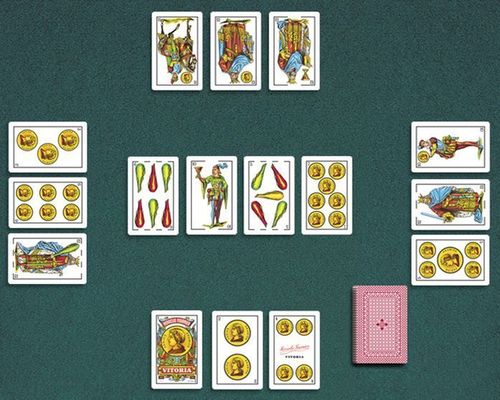
Each player draws one card, being the dealer the player who drawn the highest one. The dealer shuffles the cards, gives the pack to the player in his left to cut it, and deals three cards to each player, one at a time anticlockwise, and puts four cards face up in the centre of the gaming table.
The Play
The player to dealer's right plays first, and the turn to play passes anticlockwise, until all the cards have been played.
A turn consists of playing one card face up to the table, which may capture one or more table cards. In the event of a capture, both the played card and the captured card(s) are taken and stored face down in front of one of the members of the team that made the capture. If there is no capture the played card remains face up on the table. In either case, the turn passes to the next player.
When one of the players takes in his turn all the uncovered cards on the table it is called an Escoba. This is pointed out by crossing face up one of the cards in his own pack.
Exceptionally, when the four cards that the dealer puts uncovered on the table make one or two groups of 15, one or two Escobas, the dealer takes them in his pack and counts the Escobas for him.
Turn goes anticlockwise, each player uses one of his cards in his turn, and movements are repeated until they discard. Then, the dealer gives again three cards to each of the players, and the cycle is repeated until the pack is finished.
There is no obligation to play a card that makes a capture. It is legal simply to add a card to the table. However, if the played card does make a capture, the captured cards must be taken, even if the player would prefer to leave them on the table.
In every hand, the dealing changes to the next player to the right.
When all the cards of the pack have been dealt and moved, the hand finishes and the last player who has joined 15 points takes the remaining cards in the centre of the table.
The Scoring
When the hand is finished, the players proceed to count the obtained cards in order to update the scoreboard, using the following rules:
| Bonus score | Points |
|---|---|
| For each Escoba | 1 point |
| For having all the coins | 2 points |
| For having most of coins | 1 point |
| For having the 7 of coins | 1 point |
| For having all the sevens (the value of 7 of coins included) | 3 points |
| For having most of sevens | 1 point |
| For having most of cards | 1 point |
| If the opponent has less than 10 cards | 2 points |
End of the Game
Usually, the game is played up to 21 or 31 points, being possible to achieve it through several hands. When one of the hands is finished and one or more of the players reaches the agreed score, the player with the highest score wins the game. If there is a tie, new hands are played until the tie is broken.
If the opponent has not obtained any cards, he will lose the game.
Four or Six Players
When four or six players take part in the game, the players of both groups are placed in alternate positions and the rules are the same. The only aspect that has to be taken into account is that, in order to determine the score in every hand, the cards got by all players of the each group are count together.