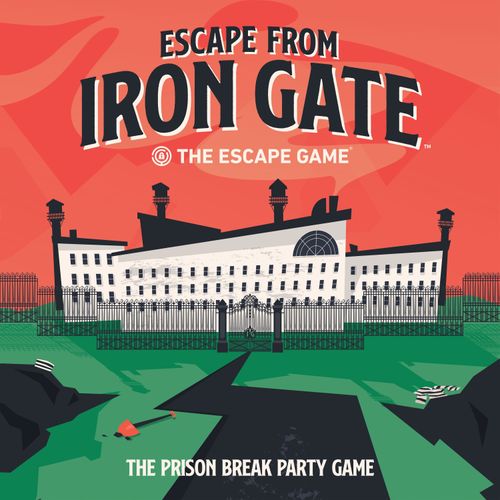
Escape from Iron Gate
Escape from Iron Gate Rulebook
Table of Contents
Table of Contents
Objective
Your objective is to escape Iron Gate Prison by moving through each of the four areas on the board - from the Cellblock to The Yard, The Cafeteria, The Warden's Office, then finally to freedom! In order to progress to the next area, you'll need to turn in the items on your Gate Card to the Commissary. Items are collected by completing puzzles, drawing, acting, and trading. The player that passes through the Final Gate first wins.
Quick Play Guide
Phase One - Roll. Roll both symbol dice.
Phase Two - Draw. Draw and fulfill cards based on your roll.
- Roll A and A (AA): Draw a "Lucky" card and fulfill it first. Then draw an Action Card, start the timer, and begin acting or drawing.
- Roll P and P (PP): Draw a "Lucky" card and fulfill it first. Then draw a Puzzle Card and add it to your hand. Begin solving after your turn has ended. You have until the beginning of your next turn to solve the puzzle.
- Roll A and P (AP): Your choice! Choose an action or a puzzle. (No "Lucky" card.) Either draw a Puzzle Card and add it to your hand (begin solving after your turn has ended; you have until the beginning of your next turn to solve the puzzle), or draw an Action Card, start the timer, and begin acting or drawing.
Phase Three - Trade. Trade items, pass a gate, or end your turn. Now choose one of these, then your turn is over:
- Trade with another player.
- Trade with the Commissary.
- Pass a gate.
- Take no action.
Setting Up
The Board. Place the Common Items, Rare Items, Action Cards, "Lucky" Cards, and Puzzle Cards on the board. There are a lot of Action and Puzzle cards, so feel free to use smaller decks.
Player Tokens. Choose a token and place it in the prison cell of your choice. There's no right or wrong choice. All cells are equally dingy and depressing (also the placement is not important to gameplay).
Dealing. Deal three Common Item cards facedown to each player. This is your hand. You may view your own hand at any time.
Then deal each player one Gate card for each gate on the board (The Yard, The Cafeteria, The Warden's Office, and Freedom). Gate Cards tell you what items you'll need to pay the Commissary to progress to the next area. You may view all of your own Gate Cards at any time, but don't show them to other players.
The four gates, as printed in the setup illustration, are: 1 - "Pick the lock to the Yard." 2 - "Tunnel into the Cafeteria." 3 - "Crawl through the Warden's vent." 4 - "Exit the window to Freedom!"
Editor's note: in the printed setup illustration the gate cards overlap, so the item icons listed on each gate card are partly hidden. They are not transcribed here; the item requirements are printed on the physical Gate Cards.
Reference Cards. These have valuable information about trading and values. You'll want to keep these close during your escape. Make sure every player has access to them.
Play Order. The youngest player always goes first, followed by the player to the left. Continue clockwise.
Playing the Game
Turns
Each turn consists of three main phases: Roll, Draw, and Trade.
Phase 1 - Roll. Roll both symbol dice (the "A" and "P" dice).
Phase 2 - Draw. If both dice match (AA or PP), draw a "Lucky" card, fulfill it immediately, then draw the card you rolled. AA = Action Card, PP = Puzzle Card.
- AA - Draw an Action Card, start the timer, and begin your action.
- PP - Draw a Puzzle Card, add it to your hand, and begin solving after your turn has ended. At the beginning of your next turn, say your answer aloud.
If you roll A+P, you may draw either a Puzzle Card or an Action Card (no "Lucky" card).
Phase 3 - Trade. After fulfilling the cards you draw, you may choose one (and only one) of these options:
- Trade with another player.
- Trade with the Commissary.
- Pass a gate.
- Take no action.
After completing your trade or passage, your turn is over.
Pro Tip. Getting the hang of things? Try speeding up your game with unlimited trades! More alternate rule ideas on page 10.
Trading With Other Players
Not having any luck finding the items you need? Strike a deal with a fellow inmate! You may trade items with one other player, once per turn. The terms of the trade are entirely up to you. Your turn ends once the trade is complete.
Trading With the Commissary
Need some new items? Trade with The Commissary at the exchange rates below. You may only trade on your turn, but you can make as many trades with The Commissary as you want.
Commissary Trades
- 3 identical Common Items for 1 Rare Item of your choice.*
- Any 1 Rare Item for 1 Common Item of your choice.
- Any 3 Rare Items for 1 Rare Item of your choice.*
*"Cake" can't be traded from the Commissary.
Room Trades
Each area of the board features a specific Rare Item which can be traded to the Commissary for any item while you're in that area.
- Soap in the Cellblock: for any item of your choice.
- Rope in the Yard: for any item of your choice.
- Instant Noodles in the Cafeteria: for any item of your choice.
- Flashlight in the Warden's Office: for any item of your choice.
*If any deck is searched, shuffle the deck afterward.
Cards
Gate Cards
Be the first to fulfill all of your Gate cards to win the game.
Gate Cards are the only things standing between you and sweet, sweet freedom. Keep them facedown in front of you until they have been fulfilled. Flip each one face-up as it's passed. (You can look at your own facedown Gates whenever you want.)
Fulfill your Gate cards by collecting the items listed and paying them to the Commissary. You may pass only one gate per turn and all gates must be passed in order.
Item Cards
Obtain Item cards by completing puzzles, performing actions, trading, or by the effect of a "Lucky" card.
There are two types of items, Common and Rare. They hold different values to the Commissary, but you'll need both to escape. There is no limit to the number of items you can have in your hand.
The "Cake" Item card is a Wild Card and can be played as any Common or Rare Item.
Common Items: Cash, Clothes, Toilet Paper, Books, Toothbrush.
Rare Items: Rope, Flashlight, Instant Noodles, Soap, "Cake" (Wild Card).
"Lucky" Cards
These can be good, bad, or a little of both. Always fulfill a "Lucky" card before drawing any other card.
Example card shown in the rulebook - "The Switcharoo": Discard 1 Common Item of your choice, then draw 1 Common Item.
Action Cards
Once you draw an Action card, check the top to see if you act or draw.
Each card has three levels of difficulty. Choose one word from the card and start the timer. You'll have 30 seconds to either act out or draw the subject while the other players try to guess the word. If the word is guessed correctly within the time limit, collect Items according to the difficulty of the action.
Action Rewards
| Difficulty | Artist/Performer | Guesser |
|---|---|---|
| Easy | Draw 1 Common Item. | Draw 1 Common Item. |
| Medium | Draw 1 Rare Item. | Draw 1 Common Item. |
| Hard | The Artist/Performer draws 2 Rare Items, keeps 1, and gives the other to the Guesser. | (See Artist/Performer.) |
Puzzle Cards
If you draw a Puzzle card, you have until the beginning of your next turn to solve it.
Puzzle Cards are solved between turns. Say your answer (or best guess) aloud at the beginning of your following turn. The player to your right then checks the correct answer using the Decoder Card.
Puzzle Clues. If you're stumped, you may hand the Puzzle Card to the player on your right. This player uses the Decoder Card to read the Clue aloud (no hesitation here, prisoners). You can ask for a clue at any point before your next turn.
Puzzle Rewards
- If you solve the puzzle correctly without a Clue, draw 1 Rare Item.
- If you used a Clue, draw 1 Common Item.
- If you didn't solve the puzzle or your answer is incorrect, no cards for you!
Decoder Card
The Decoder Card is used to view Puzzle Clues and Answers. Hold it over the red text to reveal the hidden message!
Prison Rules
During the course of your escape, you may encounter a situation in which the rules are unclear (this is prison, after all).
In this case, your only choice is to establish Prison Rules. These are basically house rules that you can use during moments of uncertainty (or to spice up your game). An example might be the way you interpret a "Lucky" card or it could be your group's definition of "acting" when performing an Action card (can you use sounds/props? It's up to you!). Establish Prison Rules to personalize your experience or fill in any gaps in rules you might come across.
Tips
- Trade often.
- Puzzles may be tougher than Action cards, but they don't give resources to other prisoners. Remember, only one of you will escape.
- Keep your reference cards close while learning the game.
Alternate Rules
Try some of these alternate rule ideas!
Unlimited Trading. Players may trade freely, with no limit per turn.
Puzzle Choice. When drawing a Puzzle card, draw 3 instead of 1. Choose 1 card to solve, then place the remaining 2 on the bottom of the deck.
Action Choice. When playing an Action card, ignore the type (Act/Draw) and do whichever you like. Try letting other players choose for you to switch it up!
Let Fate Decide. When drawing an Action card, roll a craps die and choose your difficulty based on your roll.
- 1-2: choose Easy.
- 3-4: choose Medium.
- 5-6: choose Hard.
Post photos of your escape using #EscapeFromIronGate.