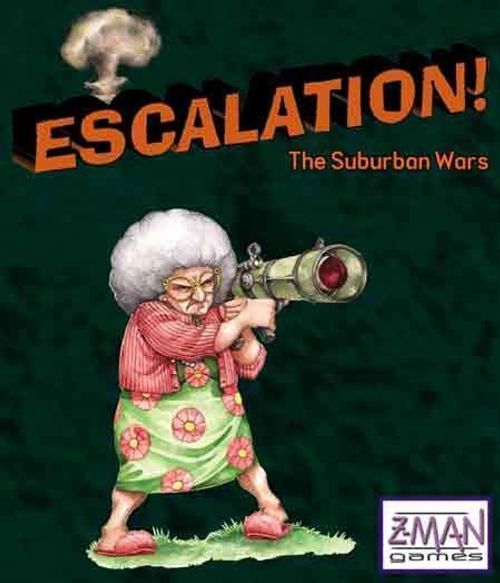
Escalation!
Escalation! Rulebook
Table of Contents
Table of Contents
Overview
Escalation! is played by two to six players.
Deck
The deck has 56 cards in total:
- "1": 1 card
- "2": 5 cards
- "3", "4", "5", "6": 6 cards each
- "7": 5 cards
- "8": 4 cards
- "9", "10": 3 cards each
- "11", "12", "13": 2 cards each
- "1-7" cards: 3 cards
- "Joker": 2 cards
Course of Play
Each player is dealt 6 cards. The remaining cards are placed in the centre of the table as a draw deck. The players agree by consent who makes the first move. Turns pass clockwise.
During your turn you may lay down one or several cards, following these rules:
a) The card must have a higher number, or a higher sum, than what the previous player played.
b) You may play several cards at once, provided these cards have the same number.
c) The "Joker" card can replace any other card. If it is played, the next player must then make the move.
d) If a player cannot fulfil the conditions described in points a, b and c, or does not want to make a move (this is a matter of strategy: if you have bad cards at the start, it is better to take fewer cards and make the next move yourself), he must take all the cards that have been played for himself. These cards can no longer be used in the game and are not taken into the hand. The player who took the cards starts a new series.
After each turn, if you have laid down one or several cards, you must immediately draw from the deck so that you again have 6 cards in hand.
End of the Game and Winner
The game continues until one of the players has played his last card. Then all the cards that players still hold in their hands are laid out in the centre of the table. These cards are not counted when scoring.
The player who has the fewest cards taken during the game is the winner.
You can play several games in a row.
Clarifications
The "wild" card (marked "1-7") can take a value from 1 to 7. If a player plays one such card alone, he must name the value of the card, that is, name the number whose function the "wild" card will perform. If he plays this card together with another card or other cards (with identical numbers), then the "wild" card takes the value of the cards played with it.
For example: one "3" + "1-7" gives a sum of 6; two "5" + "1-7" give a sum of 15; three "7" and "1-7" give 28.
A "wild" card may not be played together with cards of "8" and higher.
It is possible to play only two "wild" cards and announce a number, for example 4 (2x2=4), or 10 (2x5=10), or 12 (2x6=12). You can also play three "wild" cards at once and announce a number, for example 15 (3x5=15) or 21 (3x7=21).
Example of Play
Player A starts with a "2". The next player, B, continues with two "3" cards and announces 6 (3+3=6). Then player C lays down an "8". Player D plays a "12". Then player A plays two "5" cards and one "wild" card (marked 1-7) and announces the number 15 (5+5+5=15). Player B lays down a "Joker" and says 15 (that is, he skips his turn). Player C plays three "7" cards at once and announces 21 (7+7+7=21). Player D has no possibility to play a higher number and takes all the cards laid out in the game (but not into his hand, rather beside himself). After this, player D starts a new series with any card that he has in his hand.