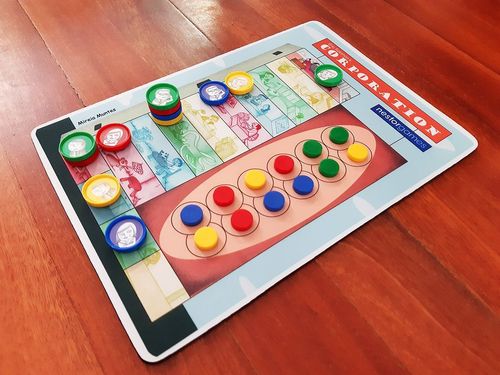
Eric Solomon's Corporation
Eric Solomon's Corporation Rulebook
Table of Contents
Table of Contents
Equipment
A CORPORATION set includes:
- 3 employees in each of 4 colours, red, green, blue, and yellow.
- 3 counters in each of 4 colours, red, green, blue, and yellow, with no images.
- A "Corporation" board.
Setting Up
The 3 employees in each of the 4 colors are placed outside the board, near the bottom of the building.
Each player selects a color. The 3 counters in each of the 4 colors are placed in a pile off the board, near the Directors Table. The latter are the pieces that will be used to manipulate the PROMOTIONS in the Corporation.
In turn, each player selects one of these counters and places it on a vacant circle of the Table on the board. Thus, the Table will finally contain 12 counters, 3 of each color.
Objective
Each player aims to be the first to get three employees of his own color into the BOARDROOM.
If an opponent is forced to get one, or more, of your own employees to the BOARDROOM, that is tough for him! It does not matter in whose turn employees get to the BOARDROOM. If they are your color they count for you.
Play
A player starts his turn by optionally exchanging any two counters on the Directors Table.
Then, during his current turn a player may optionally enter any employee from outside the board onto one of the four coloured areas at the bottom of the building (the reception). If there is an employee already at the chosen position, the piece entered onto the board must be placed on top of it.
The player must then apply all relevant promotions, and in any order. His turn ends when no further promotions can be applied.
Promotions
In the "Example of board setup" (see Setting Up), you see pairs of colored circles on the Director's Table. Each of those pairs of circles represents a potential Promotion that you can make. The colored circle on the left represents the color of the Employee's counter, and the colored circle on the right represents either the color of the Employee's current office or the color of the Employee counter below him (if he's in a stack). So, the bottom pair of circles shows that any Green Employee in a red office or directly on top of a red Employee counter is eligible for Promotion.
Only the top Employee counter of a stack is eligible for Promotion. When an Employee is promoted, move him to the office above his current position as shown in the Promotions Movement image. Place him on top of the stack of Employees, if there is one, in his new office.
You can use the potential Promotions in any order on your turn, and you can use any potential Promotion color-pair as many times as you want in the same turn. After each Promotion is made, if any other Promotions are still legal you must make them. You can, however, make Promotion choices which make other types of Promotions impossible, and it will often be to your tactical advantage to do so.
Example of a Promotion
This Promotion means that a topmost red employee lying on a blue employee OR a blue office MUST move forward one space.
Example of movement sequence
Some examples are shown, and offices and promotions have been labelled to aid discussion.
Promotion 5 specifies that a red employee on top of a blue employee, or a blue office, can move forward one position. Hence the red at position 'A' can move to position 'B'. But Promotion 2, 'red on yellow' can now be applied. So the red employee can move forward to position 'C'. There is no promotion specifying 'red on red' so that would be the limit of red's movement. The blue at position 'A' exposed by the movement of the red employee must now be moved according to promotion 3, and must stop at position 'B'. However, a player may apply the promotions in any order he chooses.
So now let us examine an alternative strategy.
Suppose the player applies promotion 6 'yellow on yellow' first. This moves the yellow on the yellow office 'B' forward to position 'C'. There is no 'yellow on red' promotion so the yellow must stop at position 'C'. Now promotion 5 can be applied to move the red at 'A' to position 'B', then promotion 2 can be applied to move the red successively to positions 'C' 'D' and 'E'! Usually, if the player's pieces are red, he would favour this latter strategy. However there is one final move that must be made. This is the 'blue on green' promotion 3. On his turn a player must execute all promotions that apply. No other promotions can now be applied, and the player's turn ends.
It must be emphasised that promotions may be applied singly in any order. So, in this example, the player allowed to move red over positions 'C' 'D' and 'E', might choose to stop the movement at 'C' or 'D' then apply another promotion possibly involving other colors. But he would not be permitted to leave the red at position 'C' or 'D' unless it was no longer the top piece at its current position. At the end of a turn other players may, if they wish, draw attention to any relevant promotion that has not yet been applied. At the start of the next player's turn any unreported errors are condoned, and play proceeds normally.
3 and 4 Player Games
When there are three or four players the promotions are applied in the same way as for two players.
Tactics
In the two and three-player games there may be a tendency to neglect some pieces outside the board yet to be entered into the building. This is bad tactics. Such pieces are just as useful as any others in aiding or impeding the progress of pieces in the building. An important tactic is to cover opponent's pieces which may be able to move, after a promotion change, in the opponent's next turn.
Puzzle: Solo Play
Place the counters randomly on the Directors Table and try to promote all the employees to the Boardroom in a minimum number of turns.