Era of Tribes: Grey Leader Variable Cost Module
Era of Tribes: Grey Leader Variable Cost Module Rulebook
Table of Contents
Table of Contents
Replacement of Action D a)
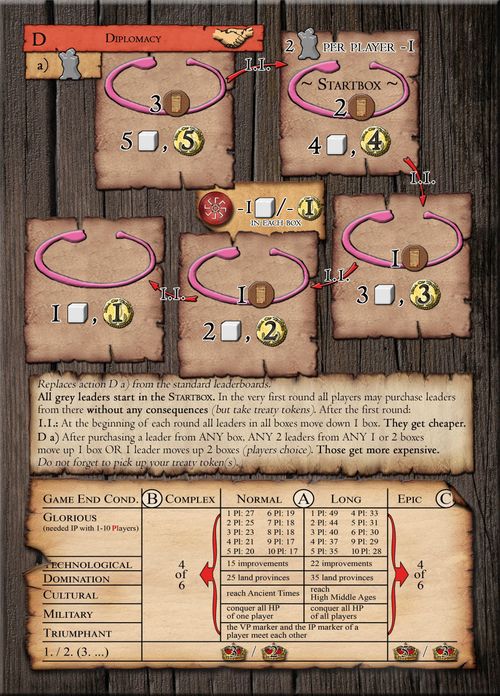
Replaces action D a) from the standard leaderboards.
All grey leaders start in the Startbox. In the very first round all players may purchase leaders from there without any consequences (but take treaty tokens). After the first round:
- I.I.: At the beginning of each round all leaders in all boxes move down 1 box. They get cheaper.
- D a): After purchasing a leader from ANY box, ANY 2 leaders from ANY 1 or 2 boxes move up 1 box OR 1 leader moves up 2 boxes (player's choice). Those get more expensive.
Do not forget to pick up your treaty token(s).
Leader Boxes and Prices
The sheet shows five boxes on the leader board: the Startbox and four price boxes. Each price box prints its leader price as vassals (white cubes) plus Thalers (coins). The arrows between the boxes show the "I.I." movement of leaders, which runs from the top-left box to the Startbox, from the Startbox to the middle-right box, then to the centre-bottom box and to the bottom-left box.
| Box (as placed on the sheet) | Printed price | Printed number token |
|---|---|---|
| Top-left box | 5 vassals, 5 Thalers | 3 |
| Startbox (top-right) | 4 vassals, 4 Thalers; text reads "2 per player -1" | 2 |
| Middle-right box | 3 vassals, 3 Thalers | I |
| Centre-bottom box | 2 vassals, 2 Thalers | I |
| Bottom-left box | 1 vassal, 1 Thaler | none printed |
Notes on the leader board as printed:
- The sheet prints a red marker reading "-I [vassal] / -I [Thaler] in each box". The sheet does not say when this reduction applies; it is transcribed as printed.
- The sheet prints the abbreviation "I.I." on its movement arrows without expanding it. It is transcribed as printed.
- The sheet writes the number 1 as the Roman numeral "I" in several places (for example "1 box", "-I"). These are read as 1.
- The meaning of the number tokens (3, 2, I, I) is not explained on the sheet and is transcribed as printed.
Game End Conditions
The sheet prints a game-end condition table in four columns: Complex (B), Normal (A), Long (A) and Epic (C). Normal and Long are both printed under the letter A. The Glorious row lists the influence points (IP) needed with 1 to 10 players, and the Glorious row is only printed for the Normal and Long columns.
| Condition | Complex (B) | Normal (A) | Long (A) | Epic (C) |
|---|---|---|---|---|
| Glorious (needed IP with 1-10 players) | — | 1 Pl: 27; 2 Pl: 25; 3 Pl: 23; 4 Pl: 21; 5 Pl: 20; 6 Pl: 19; 7 Pl: 18; 8 Pl: 18; 9 Pl: 17; 10 Pl: 17 | 1 Pl: 49; 2 Pl: 44; 3 Pl: 40; 4 Pl: 37; 5 Pl: 35; 4 Pl: 33; 5 Pl: 31; 6 Pl: 30; 9 Pl: 29; 10 Pl: 28 | — |
| Technological | 4 of 6 | 15 improvements | 22 improvements | 4 of 6 |
| Domination | 4 of 6 | 25 land provinces | 35 land provinces | 4 of 6 |
| Cultural | 4 of 6 | reach Ancient Times | reach High Middle Ages | 4 of 6 |
| Military | 4 of 6 |
Notes on the game-end table as printed:
- The "4 of 6" entry for Complex and for Epic is a single printed cell spanning the five condition rows (Technological to Triumphant). It is shown in each row here for readability.
- A red brace links the Normal column to the Complex cell and a second red brace links the Long column to the Epic cell. The sheet gives no further text explaining this link.
- The Long column's Glorious row, as printed, lists "4 Pl: 33", "5 Pl: 31", "6 Pl: 30", "9 Pl: 29" and "10 Pl: 28" on the right, and "4 Pl: 37" and "5 Pl: 35" on the left. The player counts 4 and 5 therefore appear twice, and 7 and 8 do not appear. This is a misprint on the sheet as printed. It is transcribed exactly as printed and has not been corrected.
- The crown values in the bottom row are printed as crown icons with numbers: Complex shows 3 and 2, Epic shows 5 and 3.