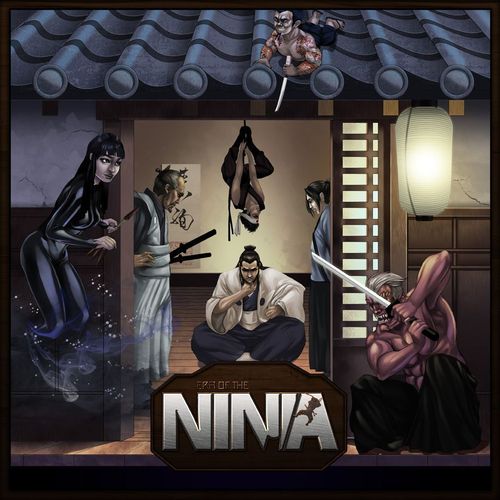
Era of the Ninja
Era of the Ninja Rulebook
Table of Contents
Table of Contents
Goal
The main goal of the game is to be the player that defeats the lord. Only the player that defeats the lord may be declared the victor.
Glossary of Game Terms
Activate – Placing a deactivated card face up to show that it is in use by the player.
Ashigaru – The common foot soldier of the lord's army. These troops are normally weaker when alone, but are commonly found in large groups.
Awareness die – The lone die that is used for determining the Awareness value of the lord's units for a given sequence of play. It cannot be modified by Ki from a Ninja player.
Daimyo – The generals of the lord's armies. They are elite samurai and master tacticians that bolster most troops' abilities when present.
Deactivate – Placing a card face down to show that it is not in use.
Ingenuity – The measure of the craftiness of a player. It is gained by hiding from or defeating units. It may be spent to gain weapons, items, skills, and skill synergies on a player's turn.
Inventory Limit – Players may only have a total of four cards from the Weapon and Item card decks. Extra cards must be discarded.
Ki – A mystical power that exists within the world that the Ninja players are able to channel. This energy allows the players to break some rules, reroll any result of their Ninja die, or even access some powerful skills and abilities.
Leader – A unit type. It refers to a stronger unit that tends to work alone or in small groups. Some abilities affect units based on their membership or non-membership of this group.
Lord – The boss of the castle and the main objective of the basic game. Units with this designation have special rules that are applied to them, which are listed in the Special Rules section of the rulebook.
Lord die – Also known as the Awareness die.
Minion – Any enemy unit that is not of type Lord. These are the followers of the lord of the castle.
Monk – Religious warriors trained in the mystical martial arts. They act independent of the samurai, and often work alone or in pairs.
Ninja – The assassins entering the castle. This references the character each player is utilizing and is often used interchangeably with the word 'player'.
Ninja die – The pair of die that each player uses for their Ninja character. These die are used for Attack, Dodge, and Shadow rolls that the player may make. Any abilities that a Ninja player makes from Weapons, Items, Skills, or Ninja character cards should use the player's Ninja dice. Take note that any roll of the Ninja die may be altered through the use of Ki.
Range – The distance a weapon with the Range trait may attack. This distance starts at the adjacent tile and may continue a number of tiles equal to the Range number. It may only be counted through tiles with paired Move markers.
Limit of 2 and 9 – When making any die roll with a Ninja die, any result between the numbers of 2 and 9 cannot be adjusted to a number below 2 or higher than 9.
Samurai – The elite troops of the lord's army. These units are stronger than the ashigaru and are found either alone or in pairs.
Stack – A group of units combined to make a stronger force. Many of the weaker units join forces to form a larger fighting force. Each such grouping is represented by adding tokens underneath the representative miniature for the group. A single unit can be considered a stack if it does not have any tokens underneath.
Total Failure – A natural score of 1 on the roll of a Ninja die.
Total Success – A natural score of 0 on the roll of a Ninja die.
Unit – This refers to a single enemy or individual. Any ability that targets a unit may only affect one enemy or individual unless stated otherwise.
Wounds – The amount of damage one can take before defeat. Ninja players start with a number of tokens and are defeated when losing their final token. Lords and minions do not start with tokens, but instead gain wound tokens when hit, which weakens their Attack, Damage, Wound, and Dead values for a short time.
Card Anatomy
Ninja Character Card
- Name and traits – The name of the Ninja character and the basic traits of Element, Gender, and Realm.
- Move – The number of points of Move a Ninja character has to use.
- Attack – The bonus or penalty to Attack rolls for the character.
- Dodge – The bonus or penalty to Dodge rolls for the character.
- Shadow – The bonus or penalty to Shadow rolls for the character.
- Wounds – The total amount of damage a character may take before defeat.
- Ki – The number of points of mystical energy a player has. This can be used to remove limits, reroll any roll of your Ninja die, or to activate some characters' special abilities.
- Special Abilities – A list of any skills, powers, or traits your character has.
- Shadow Roll box – Where you should place your Shadow Roll after adjusting the die value.
Lord Card
- Name – The name of the lord.
- Traits – A list of general traits of the lord. Only the Type: Lord is used in this version of the game, and the Realm and Gender fields will be used in future expansions.
- Move – The amount of Move points unit has to use during its turn.
- Attack – The Attack value that a Ninja player must roll equal to or above to avoid taking damage from this unit.
- Damage – The amount of Wounds a player receives if they fail to Dodge the attack.
- Wound – The value needed to weaken the unit with an attack. Add a wound token to the unit if this number or above is rolled when attacking the unit.
- Dead – The value that must be rolled or above to defeat the unit.
- Ingenuity – This has multiple effects in the game, see the section on Ingenuity for more details.
- Special Abilities – Any special traits, abilities, or skills the unit has.
Unit Card (Minion Card)
- Name and Traits – The name and traits of the unit. Only the Type trait is used in this version of the game and the other traits will be used in upcoming expansions.
- Move – The amount of movement the unit has to use during the Lord's Units phase.
- Attack – The Attack value that a Ninja player must roll equal to or above to avoid taking damage from this unit.
- Damage – The amount of Wounds a player receives if they fail to Dodge the attack.
- Wound – The value needed to weaken the unit with an attack. Add a wound token to the unit if this number or above is rolled when attacking the unit.
- Dead – The value that must be rolled or above to defeat the unit.
- Ingenuity – This has multiple effects in the game, see the section on Ingenuity for more details.
- Special Abilities – Any special traits, abilities, or skills the unit has.
- Stacking Limit – The maximum number of Minion tokens that may be in a stack of this unit type.
Encounter Card
- Name – The name of the card.
- Units – The number and type of units that should be placed on a tile when a new tile is explored.
Tokens
The tokens are labelled Ingenuity, Ki, and Wounds. Two further token types are labelled:
- Fire Ki (for Lord Kasai Ki)
- Ability Modifier (for Ninja Kitsune and Ninja Tanuki)
Item Card
- Name – Name of the item.
- Special Abilities – Any bonuses or special abilities that the item grants.
Skill Card
- Name – The name of the skill.
- Special Abilities – Any bonuses or special abilities that the skill grants.
- Synergy Bonus – An extra boost that the skill grants if the synergy is purchased.
Weapon Card
- Name – Name of the weapon.
- Attack Bonus – The bonus to any Attack rolls for Ninja players.
- Weapon Type – The type of weapon, currently either Melee or Ranged.
- Special Abilities – Any additional bonuses or special abilities this card may grant.
Room Tile
- Move markers – The exits to the board.
Game Setup
Begin by separating out all cards, token, and miniatures by type. Keep the Ingenuity, Ki, and Wound tokens in separate piles. Group the Minion tokens and miniatures by type. Keep all of these pieces close to the playing area for easy access.
Setup the starting area – Locate the Room tiles and remove one of the Courtyard tiles (tile with the pond) from the stack, placing the tile in the center of the playing area. Take the remaining tiles and shuffle them and place them face down close to the Courtyard tile.
Build the Encounter deck – Search the Encounter deck for 'The Lord Enters' cards and keep them separate from the deck. Shuffle the Encounter cards and draw five cards face-down into a stack, which will be the starting deck. Next, deal another nine cards face-down, which will be the middle deck. Deal three more cards face down to create a guard deck. Take the remaining Encounter cards including the extra 'The Lord Enters' card and place them out of the play area as they will not be used. Take the middle deck and add one 'The Lord Enters' card. Shuffle the Middle deck, and then place the starting deck on top of the middle deck and the guard cards underneath.
Players chose a Ninja – Place all tokens for the Ninja characters in a pile face down. Have each player draw two tokens at random from the Ninja tokens. Each player should choose one of the two characters and discard the extra. Give players the Ninja character card that matches their chosen Ninja token. Have each player read their character's special abilities, searching for abilities that might affect setup.
Once each player has a character card and token, shuffle and deal two cards to each player from the Weapon, Item, and Skill card decks. Place the remaining cards from each deck by the playing area in order of Weapon, Item, and Skill deck. Each player chooses one card from each of the deck types and discards the extra card. Each character should now have 1 Weapon card, 1 Item card, and 1 Skill card.
Give each player a number of Wound and Ki tokens equal to the number of Wounds and Ki on their character card, plus any additional gained by Item or Skill cards. Each player should choose a colored pair of die, referred to as the Ninja die, and a matching colored Ninja miniature. Take the single unpaired die and place it aside for now. This die is the Awareness die.
Choose a Lord – Place all of the Lord tokens face down and have one player draw a token from the Lord tokens. Locate the matching Lord card and read the special abilities aloud, checking to see if there are any abilities that may be in play while the Lord is hidden. Once the special abilities are revealed, place the Lord's card, Lord's Token, and the Lord's Miniature near the playing area.
Prepare to play – Have each player place their Ninja miniature on the starting Courtyard tile to begin play.
Game Round
Each round of play is broken into the following six phases:
- Lead Ninja
- Shadow
- Ninja
- Awareness
- Lord's Units
- Recovery
Each phase is repeated in order until either all Ninja players are eliminated or the Lord of the Castle is defeated.
1. Lead Ninja
The first player to act during the Ninja phase and also the player responsible for determining direction and targets of the Lord's units during the Lord's Units phase. The Lead Ninja changes each round and is determined by the previous leader.
On the very first round of play, each player should take one of their Ninja die and roll it. The player with the highest total (rerolling any ties) is declared the Lead Ninja. This player now takes the Awareness die and changes the value of 1 and places it by their character card.
During each Lead Ninja phase after the first round, the current Lead Ninja player must declare a new Lead Ninja from the other players at the table, and hand the Awareness die with the current Awareness total to the new Lead Ninja player.
2. Shadow
The ability of each Ninja to hide from the enemy. This value can change if a player decides to attack an enemy unit during their turn.
Each player should take a single Ninja die and roll it adding any bonuses or subtracting any penalties to Shadow. The player must keep in mind the Limit of 2 and 9 when adjusting their die. After making all adjustments, each player should place their adjusted die on the Shadow Roll box on their character card.
3. Ninja
When the players are able to act; searching for their elusive target. Play moves clockwise from the Lead Ninja, around the table until each player has had a chance to act. Players may only act during their turn and may perform the following four operations during their turn.
- A. Spend Ingenuity
- B. Adjust Equipment
- C. Move
- D. Action
A. Spend Ingenuity
If a player has acquired Ingenuity, they may spend it at the beginning of their turn. They may make any number of purchases with their Ingenuity and spend it as follows:
- 2 Ingenuity = 1 Weapon card
- 3 Ingenuity = 1 Item card
- 4 Ingenuity = 1 Skill card
- 5 Ingenuity = 1 Skill Synergy
Players should keep in mind the equipment limit of four cards when purchasing Weapon and Item cards. They may have no more than a total of four cards from their Weapon and Item cards. If the new card(s) purchased places the characters equipment limit over four, then the player must determine which card or cards that they must discard to return their total number to four.
If a player purchases a Skill Synergy bonus, then have them take the top card from the skill deck and place it face down under the skill card they want to activate the Synergy bonus on. Any Skill cards with a face down skill card underneath have their Synergy bonus active.
If a player purchases a Skill card and it is a duplicate of one of their active Skill cards, then they must place the duplicate card under the active card to activate the Synergy bonus. If there is already a face down card under the active Skill card, replace the face down Skill card with the duplicate Skill card. Turn the face down card face up and activate this skill instead.
Layout note: in the PDF the duplicate-Skill paragraph sits in a separate box on page 10. It is placed here because it belongs to the Spend Ingenuity operation.
B. Adjust Equipment
When players may determine which weapons and items that they want to use for their current round. Players only gain bonuses or penalties from active cards in play.
Players may only have a single weapon active at a time unless they have weapons combined through the Paired trait. Any weapons that are not active must be placed face down or otherwise known as deactivated. Players may deactivate their active weapon and activate another weapon at this time.
Players may also activate any items cards that are currently deactivated in their inventory paying any costs that may be required. Players may not deactivate Item cards in their inventory, unless activating another item card causes the current card to be deactivated.
A player may only Spend Ingenuity or Adjust Equipment before the Move and Action operations. Once a player has moved or used an action, they cannot spend any Ingenuity or Adjust equipment until their turn during the next Ninja phase.
C. Move
The current player may enter a new room, an explored area, or not move at all to possibly recover. To move the player must spend the appropriate number of Move points:
- 1 Move = Move to an adjacent Room tile in play
- 2 Move = Reveal a new Room tile and move your Ninja token to the newly revealed tile
If a player wants to move to an adjacent tile that has already been revealed and is currently in play, then it will only cost a single point of Move to enter the tile.
If the goal is to explore and reveal a new tile, the player must spend two points of Move. The player draws the top tile from the Room tile deck and places the new tile adjacent to their current tile creating a pair of Move markers. After the tile is placed, the player places their Ninja token on the tile, then draws the top card of the Encounter deck. Take the appropriate tokens and miniatures and place them on the tile with the Ninja player. Once all of the tokens and miniatures are placed, the player may continue with their turn.
Pairing Move Markers – When placing a new Room tile, the player must create a pair of Move markers with their current tile and the newly placed tile. If the newly placed tile touches other existing tiles after placement, then try to pair as many Move markers as possible. If the placement causes a Move marker to face a tile and remain unpaired, then movement and Range attacks may not go through the side with the unpaired Move marker.
Placing New Units – For the first unit of a given type, take the appropriate miniature and place it on the tile. If there are more units of the given type, then place a Minion token under the miniature for each additional Minion of that type.
Do not forget to maintain the Stacking Limits. If there are ever more units in a stack than the Stacking Limit, then the stack may become too powerful to defeat. Monk tokens especially need to follow this rule. Three or more Monk tokens in the same stack will be near impossible to defeat.
If a player is ever forced to place a unit and all of the tokens and miniatures of that type are in play, then the player may place one miniature or token of a similar type or lower on the board in its place. Use the following chart of hierarchy for reference:
- Daimyo/Monk – replace with Samurai
- Samruai Daishyo/Samurai Daikyuu – replace with alternate Samurai type or Ashigaru
- Ashigauru Yari/ Ashigaru Harquebus – replace with alternate Ashigaru type or nothing if no other Ashigaru units are available.
D. Action
This is the last thing a player may do on their turn. After choosing an action, the player's turn ends and play moves clockwise to the next player. A player may choose to do one of the following actions:
- Sprint
- Attack
- Hide
Sprint – The player gains a number of Move points equal to their move value and may spend these points with any unspent Move points from the earlier Move action.
Players with a modified Move value of one may Sprint to gain a second Move point and enter a new Room tile.
Attack – This action is broken into four steps:
- Declare a target
- Determine Wound and Dead values
- Roll the Attack
- Apply results
1. Declare a target – The player must declare the target of their attack. If the player is using a Melee weapon, then they may only attack units on the player's current tile. They may however declare a single Minion or Lord, an entire stack of Minions, or a single Minion within a stack as their target. If a player is using a Range weapon, then they may not attack a target on their current tile, unless the weapon allows it. They must select a target that is within Range, and can only select a single unit as their target.
Ranged attacks cannot target a stack of units, only a single unit.
Range – A target is in Range if the player can draw a horizontal or vertical line from their current tile, the line passes over paired Move markers, and the number of tiles to reach the target is equal to or less than the Range value of the Weapon card. Remember that unpaired Move markers break the line of sight to a target.
2. Determine Wound and Dead values – Once the target has been declared, determine the Wound and Dead values for the target.
If the target is a single unit or a single unit within a stack of units, use the Wound and Dead values on the Minion or Lord card.
If the target is a stack of units, then use the base Wound and Dead values and add the Ingenuity value of each additional unit to the base Wound and Dead values.
If the target has any Wound tokens on it, reduce the Wound and Dead values of the target by 1 for each Wound token.
Example: Hikage wants to attack a stack of two Samurai Daikyuu. The Wound value for one is 6 and the Dead value is 8. Since Samurai Daikyuu have an Ingenuity value of 2, the target values change to Wound: 8 and Dead: 10. Hikage needs to roll well to hurt these foes.
Example: Chibi wants to attack a stack of 3 Ashigaru Yari. A lone Ashigaru Yari unit has a Wound: 5 and Dead: 7. Since there are two extra units in the stack, add two points to the Wound and Dead values, one point for each additional Ashigaru Yari, since their Ingenuity value is 1. The new total values are Wound: 7 and Dead: 9.
Example: Oni wants to attack a Wounded stack of 4 Ashigaru Yari. The base values are Wound: 5 and Dead: 7. Since there are three extra units with an Ingenuity value of one each, the new values are Wound: 8 and Dead: 10. Since there are two Wound tokens on the stack, both values are reduced by two (one point for each Wound token on the stack), resulting in the final values of Wound: 6 and Dead: 8. Oni should have no problems.
3. Roll for the Attack – Roll a Ninja die and add any bonuses and penalties to the result. Keep in mind the Limit of 2 and 9 when adjusting the die roll.
4. Apply results – Compare the Attack roll result with the Wound and Dead values of the target.
- If the Attack roll was lower than the Wound value of the target, then the Attack misses. The attacker immediately changes their Shadow Roll result to 1.
- If the Attack roll is equal to or greater than the Wound value, but less than the Dead value, then the target is Wounded. Add a Wound token to the unit or stack for each unit that was a target of the attack. For every three wound tokens on a stack, remove one unit token from the stack and then three wound tokens. The attacker gains Ingenuity from units defeated in this manner. The attacker also reduces their Shadow Roll by the total combined Ingenuity value of the units attacked.
- If the Attack roll is equal to or greater than the Dead value of the target, then remove the defeated target or targets from the board. The attacker gains Ingenuity for each unit defeated. The attacker also reduces their Shadow Roll by the total combined Ingenuity value for all units attacked.
Example: Chibi attacks a stack of five Ashigaru Yari and Wounds the stack. Chibi adds five Wound tokens to the stack. Since there are more than three Wound tokens, he removes one Ashigaru Yari token from the stack and then removes three Wound tokens. The stack is still Wounded, because there are two remaining tokens. Ninja gains one Ingenuity for the fallen Ashigaru Yari (the Ingenuity value of a lone Ashigaru Yari is 1). Chibi must then adjust his Shadow roll value by 5 because the Ingenuity value for the combined stack of Ashigaru Yari was 5.
Remember that if you attack during your turn, you will reduce your Shadow Roll result.
Hide – If a Ninja player wants to attempt to hide on their turn, they may flip their character token face down signaling their attempt. A Ninja player that successfully hides in a room with enemy units gains ingenuity equal to the number of stacks present on the tile. The player must wait until the Awareness roll during the Awareness phase to see if their attempt was successful.
Once a player performs an Action during their turn; the player's turn ends after the action is resolved. Once a Ninja player finishes their turn, play continues to the player sitting clockwise from them. Play continues clockwise around the table until play returns to the Lead Ninja player. At this point move to the next phase.
4. Awareness
Determines how alert the Lord's minions are. The Lead Ninja player takes the Awareness die and rolls it. The result on the die determines if the minions are able to locate any Ninja.
If any players attempted to Hide during the Ninja phase and the die result on the Awareness die is equal to or lower than the Shadow Roll score, then award the player a number of Ingenuity equal to the number of Minion stacks on the tile. If the player's Shadow Roll score is lower than the Awareness die result, then flip the player's token face up to show that they were not able to hide from the Lord's units.
Afterwards, if other players have a higher Shadow roll score, you may flip their tokens face down to show that their character is hidden from the Lord's units.
Remember that Ninja tokens that are face down are hidden from the view of the Minions and Ninja tokens that are face up are visible.
Players do not need to flip tokens face up or face down if it slows down game play. If players are able to understand that a Ninja is hidden by observing the Shadow Roll score in the player's Shadow Roll box, then you do not need to worry about flipping your token face down. Players that attempt to Hide should flip their token face down though, as this signals their attempt regardless of success or failure.
Players should be aware of which Ninja players are visible and which are not.
5. Lord's Units
When the Lord and his units may strike back at the Ninja players. All stacks of the Lord's Minions may Move and Attack at this time. The Lead Ninja player determines the order in which the stacks activate. Each stack will move according to the following rules:
- If the unit or stack does not have a Ranged attack, then the unit or stack will move up to its maximum Move value towards the closest visible Ninja and attack the Ninja. If there is a tie between targets to move toward or to attack, then the Lead Ninja determines which player the unit or stack targets. A unit or stack will not leave a tile with a visible Ninja unless a special ability forces the unit or stack to do so. If there are no visible Ninja players, then the unit or stack will not move unless forced to do so by a special ability.
- If the unit or stack has a Ranged Attack then it will only move if there are visible Ninja players, and none of those players are within range of the unit or stack. If a Ninja player is visible, then check if the player is within range of the unit or stack. If the Ninja player is within range, then the unit or stack will not move but will attack. If the target is not within range, then the stack will move the shortest route to attempt to get into range then stop moving to make an attack. Units with a Ranged Attack will not move into a Room tile with a visible Ninja player unless they are forced to do so by a special ability.
Range – A target is in Range if the Minion or Lord can draw a horizontal or vertical line from their current tile, the line passes over paired Move markers, and the number of tiles to reach the target is equal to or less than the Range value on the unit's card. Remember that unpaired Move markers break the line of sight to a target.
Once a unit or stack has moved, it may make a single attack against a Ninja target within range. Units or stacks without a range listed on the Minion card can only attack targets on their tile. Minions with a Range: value listed may attack Ninja characters within their Range: value.
To make an attack the target must locate the Attack value of the unit type listed on the Minion card. For each additional unit in the stack, add the Ingenuity value of the unit to the Attack value. For each Wound token on the stack, reduce the Attack value by 1. The final result is the target value that the Ninja player being targeted must roll using Dodge to avoid the attack.
Example: Shinmai is under attack from a Wounded stack (1 Wound) of 3 Ashigaru Harquebus units. The initial Attack value of an Ashigaru Harquebus is 4. Since there are two extra units, increase the value by two (one point for the Ingenuity value of each unit) for an Attack value of 6. Since there is a Wound token on the unit, reduce the total by one (one point for each Wound token) to a total Attack value of 5. Shinmai does not have much to worry about as this should be an easy attack to dodge.
If a Ninja player fails to Dodge the attack, then the Ninja player must take Damage equal to the unit's Damage value plus the Ingenuity value of each additional unit in the stack, subtracting Wounds from the final total.
Example: Shinmai failed to succeed in dodging the attack from the pesky Ashigaru Harquebus units. The unit is Wounded (1 token) and there are three of them. The Damage value of a single Ashigaru Harquebus unit is 1. Shinmai must also add the Ingenuity value of each additional unit to the total, which is 2. Ashigaru Yari have an Ingenuity value of 1 and with two additional units in the stack, the total Damage value from all of the Ashigaru is now 3. There is a Wound token on the Ashigaru Yari stack, which reduces the total Damage value by one. Shinmai has to lose two Wounds because of the attack. It is a light hit, but he should be careful to avoid more attacks or it could bring his demise.
Play continues until each unit or stack has acted.
6. Recovery
When the players are able to recover valuable Wounds and Ki and when the Lord and his units refresh.
The Lord and his minions remove all Wound tokens at the start of this phase.
Ninja players may only recover a Wound and a Ki if the player did not Move, Sprint or Attack on their turn. Players may not gain more Wounds or Ki than their starting amount unless granted extra through items or skills. A Ninja may Hide and recover if they did not Move during their Ninja phase.
Play returns to the Lead Ninja phase and a new round begins. Play continues until all Ninja players are eliminated from the game or the Lord of the Castle is defeated.
Special Rules
The Limit of 2 and 9
Displays the physical limitations of a person. When rolling a Ninja die, if the die result is a 2 or a 9 or any number between, then the lowest number a player may earn through penalties is a 2 and the highest number a player may earn through bonuses is 9. A player may not achieve a value lower than 2 or higher than 9 through bonuses or penalties. If a player's roll is a natural 1 or a natural 0, then the result becomes a Total Failure or Total Success and the rules for Total Failures and Successes apply.
Keep in mind that the Rule of 2 and 9 is only applied to a die result when the die roll is made. It does not apply to a change in a die result caused by different action, such as changing of a Shadow Roll because a player attacked.
Example: Shinmai thinks that he is Invisible and possibly invincible with a Total Success for a Shadow Roll (0 or 10 on his Ninja die). He decides to attack a stack of two Monk units and rolls a total of 8. This Wounds the two Monks, but also forces Ninja to reduce his Shadow Roll value by 6 (3 for each Monk which is the Ingenuity value). Since this is an Attack roll and not a Shadow roll, the Shadow die can be adjusted below the Total Success value. Shinmai now has a 4 for a Shadow Roll value and is easier to notice.
Total Failure – When a natural roll of 1 is on the die. Its value is declared a Total Failure and is an automatic failure to whatever action the player was attempting.
- If the result occurs on a Shadow roll; the Ninja player is extremely noisy and cannot hide this round. Every unit or stack is aware of your position regardless of the number on the Awareness die.
- If the result occurs on a Dodge roll; the Ninja player was not careful and moved into the enemy's attack. Not only does the Ninja player take Damage from the attack, but also earns an extra Wound of damage.
- If the result occurs on an Attack roll; the Ninja player is extremely clumsy and grants the enemy an opening for an attack. The Ninja player suffers a Wound and reduces their Shadow Roll score to 1.
Total Success – When a natural roll of 0 is on the die. Its value is equal to 10 and is best possible result. Whatever skill or feat you are attempting should automatically succeed.
- If the result occurs on a Shadow roll; the Ninja player is automatically hidden from the Lord's Units. Unless the player attacks during their turn, the Lord's units should not have a chance of locating this Ninja.
- If the result occurs on a Dodge roll; the Ninja player avoids the attack regardless of the score required to meet. If an Attack value is a 10 or higher, the player may still avoid the attack with a score of a Total Success for Dodge.
- If the result occurs on an Attack roll; the Ninja player automatically defeats the target if it is not a Lord or player, regardless of the Dead value.
- If the target is a Lord, the player must add all Attack bonuses and see if the total score would normally defeat the Lord. If the total value is greater than or equal to the Lord's Dead value, then the Lord is defeated. If not, add three Wound tokens to the Lord and immediately make another Attack roll against the Lord.
- If the target is a player, then the player may avoid the attack with a Total Success for a Dodge roll.
- Also when rolling a Total Success on an Attack roll, the Ninja player does not change their Shadow Roll value.
Example: Onijin decides to attack a pesky Daimyo that is in his way. He needs a result of 10 to succeed. Onijin has a base Attack bonus of 1 and is wielding a Katana which adds 2 points for a total Attack bonus of 3. Currently a to roll of 0 is needed to defeat the Daimyo, but Onijin decides to spend a point of Ki to remove the Limit of 2 and 9, so now a result of 7 is needed to defeat the target (7 from the roll + 3 from bonuses = 10 the result needed to defeat the Daimyo). Onijin rolls his Ninja die for the Attack roll and scores a 3. This is lower than what he wanted, so he spends another point of Ki to reroll the die. The new die result is 5, which is higher than the 3, and with bonuses is enough to wound the Daimyo, but Onijin does not want to settle for a Wound. Onijin spends his last point of Ki to reroll the die again, and must accept this result as he is now out of Ki for rerolls. The new result is an 8 which becomes an 11 which allows Onijin to defeat his target. Onijin must still reduce his Shadow Roll by 5 (the Ingenuity value of his target, the Daimyo) because the die result was not a Total Success, which would have prevented the Shadow Roll adjustment.
Ki
Ki – A mystical life energy that flows through everything, and Ninja have some training in its use. Ki has two main purposes for most Ninja characters, though some have found other uses for it as well.
First a Ninja may go beyond their normal limitations and ignore the Limit of 2 and 9. Before any Ninja die roll, a player may spend a point of Ki to remove the Limit of 2 and 9 from that roll. Bonuses and penalties added to the roll may go lower than 2 or higher than 9.
Remember that only natural rolls of 1 or 0 are considered Total Failures or Total Successes. Final results below a 2 after a Ninja die roll do not receive the penalties of a Total Failure and Ninja die results above a 9 after bonuses do not receive the benefits of a Total Success.
Second a Ninja may reroll a result. After any of their Ninja die rolls a player may spend a point of Ki to make a reroll. Ki may be used to reroll Ki rerolls, but only the most recent die result is accepted.
Multiple Ki abilities may be used with the same action, as long as the player pays the Ki cost for each.
Units and Stacks
Through proper training and practice even weak soldiers become a threat when attacking in groups. Most units do not like to work alone and are often found in large groups throughout the castle.
When placing new units on a Room tile, units of the same name will create a stack. For a single unit, take the miniature for the unit and place it on the Room tile. For each additional unit of that type, place a unit token under the miniature. When finished this forms a Stack of the given unit type.
Example: An Encounter card calls for 5 Ashigaru Yari. The player should take one Ashigaru miniature from the pool of Ashigaru Yari miniatures and then take 4 Ashigaru Yari tokens from the Ashigaru Yari pool. The player places the four Ashigaru Yari tokens in a stack on the tile, and then places the Ashigaru Yari miniature on top of the newly formed stack.
Unit Stacking Limits
The weaker units have been trained to work in large packs, while the stronger units work alone or in pairs. Most units have limits with their numbers as it becomes difficult to operate in close quarters if the group is too large.
All Minions have a Stacking Limit, which is the maximum number of units allowed within a stack of that unit type.
If an Encounter card calls for more units than are allowed in a stack, create an additional stack with the extra units.
If a stack of units enters a room with another stack of units of the same name, the stacks will combine if the joining of stacks will not violate the stacking limit. If the newly created stack would violate the stacking limit, then leave the stacks separated.
A lone Samurai Daishyo will not stack with a lone Samurai Daikyuu. They may both be of Type: Samurai, but they are not of the same name and have different training and combat techniques.
A stack of 3 Ashigaru Yari and 2 Ashigaru Yari would combine if they ever ended their turn on the same Room tile, but 3 Ashigaru Yari and 3 Ashigaru Yari would not combine as it would violate their Stacking Limit: 5.
Lord of the Castle
The Lord of the Castle is much tougher and more cunning than the other units or stacks in the game. Due to the Lord's nature, the Lord always has the following abilities:
- The Lord is not automatically defeated with a Total Success unless the total value after bonuses is higher than the Lord's Dead value.
- Lords cannot be defeated by Wounds. Lords do not succumb to Wounds if there are three or more Wound tokens on them.
- Wounds only increase vulnerability of and do not weaken. Wound and Dead values are reduced as normal, but Attack and Damage values remain unaffected.
- The Lord is always aware of any Ninja on his tile regardless of the Shadow Roll value. If a Lord is in a tile and moves into a tile with a hidden Ninja while moving toward a visible Ninja, the hidden Ninja becomes visible and the new target of the Lord.
- A Lord never stacks.
Special Abilities and the rules
Due to the number of rules in the book and on the cards, not every possible combination can be easily located. Rules listed within this book are considered standard rules, while rules on the cards are considered special rules. If there is ever the case of a rules conflict, the special rules always take precedent over standard rules. If there is ever a conflict in the special rules then have a friendly discussion with the other players at the table to determine which rule takes precedent. If there is still a conflict, roll a die and the player with the highest result makes a decision.
Advanced Rules
Ninja vs. Ninja Combat (NvN)
Ninja are not always willing to work together as they raid a castle. Ninja players do not openly trade unless they are from the same clan (see co-op play), which means that players must attack each other if they want another player's items or weapons. Players may attack to kill another player to reduce their opposition. Keep in mind that if you attack another player, you may become the target of others as well.
Players may only attack each other if the attacking player has a higher Shadow Roll then the target player.
When attacking, the Attacker may attempt to Steal from the target or Wound the target. Stealing from a target can only be attempted if the attacker is on the same tile as the target, while wounding a target may be attempted from any range.
If a player chooses to Steal, then the attacker must openly declare the Item or Weapon card that is the target of the attempt. The attacking player then rolls a Ninja die for Attack and adds all bonuses and penalties while the defending player makes a Dodge roll adding all bonuses and penalties to the roll.
If the attacker's result is higher than the target's, the target player must give the attacking player the target card from their inventory.
If the target's result is higher, then the attack fails and the attacker must reduce their Shadow Roll to 1.
If a player chooses to Wound the target player, then the attacker makes an Attack roll; including all bonuses and penalties while the target makes a Dodge roll; including all bonuses and penalties.
If the attacker's result is higher, then reduce the target's wounds by the difference in the values, and reduce both players' Shadow Roll value by the difference in values.
If the target's result is higher, then the attack misses and the attacker must reduce their Shadow Roll to 1.
In NvN combat, Ki can be used as normal to activate special abilities and to remove the Limit of 2 and 9. Ki can only be used for rerolls by the player with the lower total. If the player with the lower total becomes the player with the higher total, then the opposing player may then use Ki for rerolls to attempt to become the player with the higher total.
Ties in NvN combat are not successes or failures. The attacker does not adjust their Shadow Roll, while the target does not lose anything.
Total Success and Total Failure in NvN
Total Success and Total Failure in NvN combat can be dangerous. If the attacker scores a Total Success, then they may ignore the Limit of 2 and 9 when adding bonuses and achieve a number much higher than 9. If the target scores a Total Success, then the attack automatically fails regardless of the attack result, causing the Attacker to reduce their Shadow Roll to 1.
If the attacker scores a Total Failure, then the attack fails, and the attacker suffers a wound and changes their Shadow Roll to 1. If the target scores a Total Failure, then the attack automatically succeeds and the target must immediately suffer one wound before determining the results of the attack and the target must adjust their Shadow Roll to 1.
Ninja players do not have a Wound or Dead value, so any abilities that alter Wound or Dead values do not apply when used in NvN combat. For example, the Garrote has the Deadly ability which changes all Wound results to Dead results. When used in NvN combat, players do not have a Wound value, therefore the players cannot be automatically killed if hit by a Garrote.
Reinforcements
During the game's setup, take and shuffle the remaining Encounter cards ("The Lord Enters" card included) and set them near the play area, away from the normal encounter deck to form the Reinforcements deck. Also, after drawing Ninja tokens, leave any unused tokens face down in a pile nearby for defeated player to draw from when they are able.
At the end of the Recovery phase a new option is added, which allows the addition of reinforcements for each side.
Ninja Reinforcements
When a player is defeated, the player may draw a new character from the unused characters and may equip the new character following the standard rules of character setup. Once the Lord is located or all extra characters are defeated, then no more reinforcements may be drawn and the player is eliminated from play.
Minion Reinforcements
Draw a card form the Reinforcement deck for each of the following conditions:
- The Awarness value is higher than the Ninja character with the highest Shadow Roll (Draw one card)
- A Ninja character has a Shadow Roll result of 1 (Draw a card for each Ninja with a Shadow Roll of one)
- If the Awareness value is a Total Success. (Draw one card)
For each card drawn the Lead Ninja must select a Room Tile that has an unpaired Move Marker facing an open edge. Each card may be placed on the same tile or different tiles of the Lead Ninja's choosing. Reveal the card and place the reinforcements following the standard rules for stacking and placement.
The Lord may enter play earlier with this option, so be prepared!
Layout note: in the PDF the Minion Reinforcements heading is printed after the Ninja Reinforcements text on page 20, and the draw conditions are printed in a separate column. They are placed under the Minion heading here, consistent with the Rules Reference sheet, which lists them under Minions.
Clans (Co-op)
Ninja rarely work alone and are often the part of a much larger network. Through these networks, they are able to achieve greater tasks and work over larger areas. There are problems though as competition between rivals is fierce and membership requirements may exclude potential members.
Ninja do not normally work together unless they members of the same clan. Ninja that are part of a clan share their clan benefits with other members. There are three types of clans:
- Elemental – Clans formed based on the elemental bias that the members hold. Members may include only those of the same element bias or those of a friendly element. Members of opposing elements cannot join. Some ninja have multiple Element types and may freely choose a clan to join.
- Hierarchy – Clans with membership based on the Realm trait. Clans of this type may openly enroll members from an adjacent realm on the ladder of realms. Clans of this type are more limited in their benefits as the resources are spread farther across a larger member base and small pools of resources.
- Named – Clans created and named after a famous person in their clan. These clans do not follow the rules of the other clan types when enrolling members and openly welcome all Ninja characters. While these clans offer fewer benefits than the other clan options, the open enrollment allows for a more diverse base of membership.
Universal Clan Benefits
These benefits are available to all clans and are the only benefits other than diversity that the Named clans use. All members of a clan gain the following benefits during a game:
- Trading – If two or more Ninja characters are members of the same clan and one member starts their Ninja phase on the same tile as another member, then all members on the tile may trade Weapon and Item cards. There is no limit to the number of cards a character may trade, but each player must adhere to the limit of four cards after all trades are complete, discarding any extra cards. Players cannot trade Skill cards.
- Clan Ingenuity Pool – A player at the start of their turn may place any number of points of Ingenuity that they have into the clan Ingenuity pool. Any member of the clan may draw upon Ingenuity from the clan pool at the start of their turn to purchase a single Weapon, Item, or Skill card or a Skill Synergy. Players may supplement their purchases with clan Ingenuity, but if they do so, they are limited to the single card or Synergy purchase for their turn. If a player is defeated, any Ingenuity that they donated to the clan pool remains in the clan pool until the end of the game. If a player uses the Ninja Reinforcements rule and draws another member of the clan, then the clan Ingenuity pool is available to the player.
- Shared Victory – If a player in a clan wins the game, all members of the clan may also declare victory.
Elemental Clans
Elemental clans enroll members based on elemental bias. Members of allied elements may join, but opposing elements may not. Members of an Elemental clan work well with each other and gain the clan benefit only when on a tile with another member of their clan.
Chart of the Elements – Each element generates another element which forms a circular bond between the elements. Each element opposes the two elements furthest from it.
- Water – Movement, Flowing, Liquid. Allies: Metal and Wood. Opposes: Fire and Earth. Benefit: Move: +1 if starting your turn on a space with another member of Water.
- Wood – Healing, Nurturing. Allies: Water and Fire. Opposes: Earth and Metal. Benefit: May Heal during their turn instead of Attacking, Sprinting, or Hiding. A player using the Heal action may restore one Wound to another member of their clan.
- Fire – Destruction, Change. Allies: Wood and Earth. Opposes: Metal and Water. Benefit: You may throw yourself into an Attack to prevent a member from taking damage. If a member fails their Dodge roll, you may instead take the damage. You may apply armor benefits, but must suffer at least one point of damage regardless.
- Metal – Offensive, Empowering. Allies: Earth and Water. Opposes: Wood and Fire. Benefit: Attack: +1.
- Earth – Protection, Avoidance. Allies: Fire and Metal. Opposes: Water and Wood. Benefit: Dodge: +1.
Hierarchy Clans
These are Clans that form due to members carrying a similar Celestial status. These clans may only draw enrollment from members of the same Realm or an allied Realm.
The Hierarchy Ladder
- 天 – Heaven – Celestial Order, Light. Looking to maintain celestial law and order, they seek out those that break the rules. Allies: Way. Benefit: Declare a Unit Type as your enemy before the start of a game and gain a +1 benefit to attacking all units of that type. Examples of Unit Type are Lord, Monk, Samurai, and Ashigaru or an opposing clan.
- 道 – Way – The Path Between. Those on the path to Heaven or fallen from Heaven attempting to redeem themselves. Allies: Heaven and Spirit. Benefit: Moving onto an unexplored tile costs one point of Move instead of two.
- 心 – Spirit – Beyond Mortal Coil. Supernatural beings. Allies: Way and Man. Benefit: Gain Ki: +1. This extra Ki must be the first point of Ki spent when you use Ki and it cannot be recovered for the remainder of the game.
- 人 – Man – Mortal Realm. Those of the mortal realm. Allies: Spirit and Void. Benefit: Gain Wounds: +2. These extra Wounds must be the first points lost when taking damage and cannot be recovered for the remainder of the game.
- 虚 – Void – Absence of Order, Darkness. Anyone or thing that is looking to avoid the Celestial Order. Allies: Man. Benefit: Gain Shadow: +1 if using a Hiding action.
Sneak Attack
Ninja are able to hide and gain an advantage on unsuspecting troops. The first player to make an attack on a tile may be qualified to make a sneak attack.
A player may acquire an Attack bonus if:
- They are the first player to make an attack on the given tile.
- Their current Shadow Roll is higher than the current Awareness value.
The successful player gains a bonus of Attack: +1 unless the Shadow Roll is a Total Success, which results in a bonus of Attack: +2.
If a player has already attempted to attack a Minion on your target's tile this round, then you cannot gain the Sneak Attack bonus because the guards are prepared for an attack this round.
The Limit of 2 and 9 applies to this option.
Game Modes
There are multiple game modes of play and the mode of play should be determined before the start of each game. By default, most players should begin with the Standard mode of play for their first few games. This allows players to become familiar with the rules and begin to form strategies of play. The game modes are:
Standard
Defeat the Lord of the Castle and stop his evil reign.
- Players: 2-4
- Setup: Setup follows the rules listed under Game Setup.
- Victory Condition: A player defeats the Lord of the Castle.
- Rule Changes: None, as this is the regular game. All advanced rules are optional and not required.
NvN Death Match
A fight to the death with only one walking out.
- Players: 2-4
- Setup: Do not use the Lord or Minion cards, tokens, or miniatures. Players each choose a Ninja character and equip them per the standard rules. Instead of placing only the courtyard tile in play, players should alternate placing Room tiles (face up) until all Room tiles are in play. Players then should determine the initial Lead Ninja by rolling a die. The player with the highest die (rerolling ties) is the Lead Ninja. The player with the lowest number places their miniature on any Room tile of their choosing. Continue placing Ninja miniatures in order from lowest to highest until all players have placed their miniatures on the board. Players may not begin on the Room tile of another player.
- Victory Condition: A single player remains, the surviving player is declared the victor.
- Rule Changes:
- There is no Lord nor are there Minions in an NvN Deathmatch, so players may ignore the Awareness and Lord's Units phases.
- Players that do not like their current Shadow Roll Value may attempt to Hide again on their turn. When a player takes a Hide action, they may reroll their Shadow Roll result.
- Search action – Players may convert their action into a Search action. When searching a player rolls a Ninja die and gains a number of points of Ingenuity equal to the result divided by two (rounding down). The player then reduces their Shadow Roll value by the number of Ingenuity gained. If a Total Failure is scored on a Search action, then the player gains no Ingenuity and reduces their Shadow Roll to 1. If a Total Success is scored, then the player does not adjust their Shadow Roll value. Players with special abilities that prevent a Shadow Rolls or Shadow Roll changes reduce their Shadow Roll value to 1 after a Search.
- Once a player is defeated (lose all Wounds), they may not call upon reinforcements for the fight; they are out of the game.
- Players may still recover Wounds as normal.
Clan Death Match
Animosity between clans has finally taken its toll. Only one clan will survive this night.
- Players: 2 or 4
- Setup: Setup follows the rules listed under NvN Death Match with the following exception: Before choosing characters, players must agree to which clans are fighting and which clan each player belongs to. Multiple sides may be of the same clan as inter clan fighting has been known to occur, but treat each side as a separate clan for the purpose of benefits. Players must choose characters that are within their chosen clan. If you want a random draw for characters, find the character tokens for all Ninja characters that can be a member of your clan and place them facedown. Then have a player draw a token at random from the pool. If there are only three players available, then one player may use two Ninja characters for their side instead of one. Players may fight with an uneven number of Ninja on a side, though it will be more difficult on the player with fewer characters.
- Victory Condition: Members of only one clan or side of a clan remain in play.
- Rule Changes: Follow the rules of NvN Death Match, though a clan or side wins when all players of the opposing team are defeated. Players that are the member of a clan are open to use the clan rules and benefits.
Clan Attack (Co-op)
A single clan has decided to eliminate the Lord.
- Players: 2-4
- Setup: Setup follows the rules listed under Game Setup except that all players must choose a clan and then choose characters from the chosen clan.
- Victory Condition: (none printed)
- Rule Changes: Players use the clan rules of play and may not use NvN combat. If any player defeats the Lord, then all players win. If players want to use the Ninja Reinforcement rules, defeated players may only draw from members from their clan.
Multi-Clan Attack
Multiple clans have drawn the same contract, but which will succeed.
- Setup: Setup follows the rules listed under Game Setup except that players must choose clans and which players belong to a clan before the start of play. Players may only choose characters from their clan. Both sides may be of the same clan, though players must determine which side of the clan feud that they belong to.
- Victory Condition: The Lord of the Castle is defeated.
- Rule Changes: Players use the clan rules of play and may use NvN combat against members of the opposing clan. If any player defeats the Lord, then all players of the clan or side win. Players may use the Ninja Reinforcement rules, but may only draw members from their clan.
Lord's Head
Proof of victory must be shown after the mission to collect the reward.
- Setup: Setup follows the rules listed under Game Setup.
- Victory Condition: The first player to begin their turn on the Courtyard tile with the Lord's miniature on their character card wins.
- Rule Changes: Gameplay does not end when a player defeats the Lord. The player gains Ingenuity equal to the Lord's Ingenuity value and places the Lord miniature in their inventory. The player must return to the Courtyard tile and begin their turn on the tile with the Lord's miniature on their card. Opposing players may attempt to Steal the Lord's miniature from the player using a Steal action mentioned in the NvN rules. The player that is able to begin their turn with Lord's miniature in their inventory on the starting Courtyard tile at the start of their turn wins.
The Lords miniature has the following traits:
- Counts as one slot for the Weapon and Item card limit.
- Cannot be hidden in reserve inventory spaces such as Pocket Space and can be stolen by other players regardless of the controlling player's skills or abilities.
- The player with the Lord's miniature cannot score Total Successes and consider all rolls as a 9 instead. Abilities that treat 9's as a Total Success are ignored. If they have Total Success for a Shadow Roll value, then change it to 9.
- Players with the Lord's miniature cannot use Ki to remove the Limit of 2 and 9.
- Players may drop the Lord's miniature onto their current tile as their action.
- Players may spend their action to pick up the Lord's miniature.
- Total Failures on rolls cause a Wounds to the head. After three Wounds, destroy the head and nobody wins.
Lone Ninja (Solitaire)
A single ninja enters the castle in an attempt to defeat the Lord.
- Players: 1
- Victory Condition: The Lord of the Castle is defeated.
- Setup: Setup follows the rules listed under Game Setup.
- Rule Changes: Ignore the Lead Ninja phase. On the Recovery phase the Ninja player may recover wounds as normal, but do not remove Wound tokens from an injured Lord or Minions.
Arcade
At the end of the mission, only points determine the winner, nothing else.
- Players: 2-4
- Setup: Setup follows the rules listed under Game Setup.
- Victory Condition: At the end of play, the player with the most Ingenuity wins.
- Rule Changes: Follow that rules of play for the mode that you like, except players count their total Ingenuity at the end of the game to determine the victory. The player or clan with the most points of Ingenutiy at the end of the game wins. Weapon, Item, Skill, and Skill Synergies do not count towards the victory total.
Rules Reference
This is the printed Rules Reference sheet on the last page of the PDF, reproduced in text form.
Game Round
- Lead Ninja
- Shadow
- Ninja
- a. Spend Ingenuity
- b. Adjust equipment
- c. Move
- d. Action
- i. Sprint
- ii. Attack
- iii. Hide
- Awareness
- Lord's Units
- Recovery
Ingenuity Costs
- 2 Ingenuity = 1 Weapon Card
- 3 Ingenuity = 1 Item Card
- 4 Ingenuity = 1 Skill Card
- 5 Ingenuity = 1 Skill Synergy
Limit of 2 and 9
When adding bonuses or subtracting penalties, 2 is the lowest number, and 9 is the highest value possible.
Total Success
Rolling a 0 or 10.
- Shadow Roll – Invisible to the enemy
- Attack – Automatically defeat Minions. Possibly defeat Lord, otherwise grants three Wounds and a second attack. Do not adjust Shadow after attack.
- Dodge – Avoid any attack
Total Failure
Rolling a 1.
- Shadow Roll – Visible to all enemies
- Attack – Suffer a Wound and reduce Shadow to 1.
- Dodge – Suffer an additional Wound
NvN Combat
Players may attack to:
- Steal an Item or Weapon
- or Wound an opposing player
Reinforcements
- Ninja – upon defeat, draw a new Ninja character and enter the castle.
- Minions – draw cards from the Reinforcements deck when:
- The Awarness value is higher than the Ninja character with the highest Shadow Roll (Draw one card)
- A Ninja character with a Shadow Roll of 1 (Draw a card for each Ninja with a Shadow Roll of one)
- If the Awareness value is a Total Success. (Draw one card)
Clans
Three types: Named, Elemental, and Hierarchy.
Universal Clan Benefits:
- Trading
- Clan Ingenuity Pool
- Shared Victory
Sneak Attack
Gain an Attack bonus if your Shadow Score is higher than the Awareness Score and if you are the first player to attack a unit on the tile.
- Attack: +1 if Shadow Roll is greater
- Attack: +2 if Shadow Roll is a Total Success