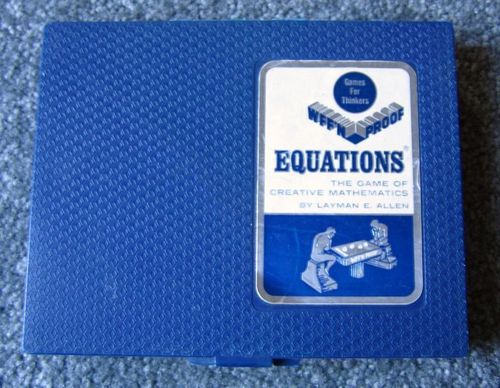
Equations
Equations Rulebook
Table of Contents
Table of Contents
Basic Equations
Basic Equations can be introduced with the following seven rules. The complete Equations Tournament Rules should be used once players become familiar with the game.
I. GOAL Rule
Two- or three-player matches will be played. To start, one player rolls 24 cubes (six of each color). The numerals and operations that show on the top faces of the cubes form the Resources.
A. The player who rolled the cubes sets a Goal by moving one to six cubes from the Resources to form a legal mathematical expression on the Goal section of the playing mat.
B. The Goal may contain one- or two-digit numbers in addition to operation signs.
II. MOVE Rule
After the Goal has been set, play progresses to the left. When it is your turn to play, you must either challenge (see rule IV) or move a cube from Resources to the Forbidden, Permitted, or Required section.
III. SOLUTION Rule
A Solution, which is written on paper, must equal the Goal and also obey these requirements.
A. The Solution must contain at least two cubes.
B. It must use the cubes as specified on the playing mat: all cubes in Required, no cubes in Forbidden, and none, some, or all of the cubes in Permitted.
C. It may contain only one-digit numerals.
D. It may contain parentheses to show the order of operations.
E. It may use the + and – signs to indicate only the operations of addition and subtraction. The x, ÷, and ^ (or *) signs indicate multiplication, division, and exponentiation, respectively. (This also applies to the Goal.)
F. If the radical sign (√) is used, it must be preceded by an expression to denote its index with the exception that when no index is shown, it is understood to be 2. (This also applies to the Goal.)
IV. CHALLENGE Rule
A. Whether or not it is your turn, you may challenge another player who has just set the Goal or moved. To do so, you must pick up the challenge block and say one of the following.
-
NOW: This means that the Challenger claims a Solution can be written using: a. all the cubes in Required and b. none, some, or all of the cubes in Permitted and c. one more cube from Resources, if needed.
-
IMPOSSIBLE: This means the Challenger claims that nobody can write a Solution that satisfies all the requirements placed on the cubes in the Forbidden and Required sections, no matter how many cubes might still be used from the Permitted section and the Resources.
B. After a challenge in a three-player match, the Third Party (the player who is neither the Challenger nor the last Mover) may present an Equation but does not have to.
V. CORRECTNESS Rule
After a challenge, a player is correct if and only if that player
A. has to write a Solution or may write a Solution and does so correctly or
B. does not have to write a Solution (someone else does) and nobody writes a correct Solution.
VI. CHALLENGE-SCORING Rule
A. Any player who is not correct scores 2.
B. A correct Challenger or Mover scores 6.
C. A correct Third Party scores 6 if they (a) present a correct Equation after an Impossible challenge or (b) present a correct Equation after a Now challenge and the Challenger does not present a correct Equation, or (c) do not present an Equation after a Now challenge, and the Challenger's Equation is incorrect. Otherwise, a correct Third Party scores 4.
VII. LAST CUBE Rule
As soon as there is only one cube left in Resources, the only challenge allowed is Impossible. If nobody challenges Impossible, the player whose turn it is must move the last cube to either Required or Permitted. Then, unless someone makes an Impossible challenge, all players write an Equation. Whoever is correct scores 4 points; whoever is incorrect, scores 2.
Equations Tournament Rules
The following is the complete tournament rule set (Equations Tournament Rules 2026-27). Sections marked as league overlays are AGLOA tournament procedure rather than kit rules.
I. Starting a Match (Round)
A. Two- or three-player matches will be played. A match is composed of one or more shakes. A shake consists of a roll of the cubes and the play of the game ending with at least one player attempting to write an Equation, which contains a mathematical expression that equals the Goal and correctly uses the cubes on the playing mat.
B. The following equipment is needed to play the game.
-
24 cubes: there are six of each color (red, blue, green, and black). Every face of each cube contains either a digit (0, 1, 2, 3, 4, 5, 6, 7, 8, 9) or an operation sign (+, –, x, ÷, ^ or *, √).
-
A playing mat: this contains four sections. a. Goal: cubes played here form the Goal. b. Required: all cubes played here must be used in any Solution. c. Permitted: any or all cubes played here may be used in any Solution. d. Forbidden: no cube played here may be used in any Solution. Comment: Many game boards have a section labeled "Resources." However, any reference in these rules to the "playing mat" or "mat" does not include the Resources section.
-
[League overlay] A one-minute sand timer: this is used to enforce time limits.
-
A challenge block: This is a cube or similar object and not a flat object like a coin. It should not be so large that two players can grab it simultaneously.
C. Players may use only pencils or pens, blank paper, and (for Adventurous Equations) variation sheets. No prepared notes, books, tables, calculators, cell phones, smart watches, or other electronic devices may be used.
In Elementary and Middle Divisions, players may use an approved preprinted chart for recording the Resources, variations, Goal, and Solutions. Refer to the Appendix that contains sample charts.
D. The Goal-setter for the first shake is determined by lot. On each subsequent shake, the Goal-setter is the player immediately to the left of the previous Goal-setter. To determine the first Goal-setter, each player rolls a red cube. The player rolling the highest digit sets the first Goal. A player who rolls an operation sign is eliminated unless all players roll an operation sign. Players tied for high digit roll again until the tie is broken.
II. Starting a Shake
A. To begin a shake, the Goal-setter rolls all 24 cubes. The symbols on the top faces of the rolled cubes form the Resources for the shake.
-
A shake begins as soon as the timing for rolling the cubes is started or the cubes are rolled.
-
During a shake, no player may turn over a cube or obstruct the other players' view of any cube. (See section IX-C.)
B. [League overlay: variation selection timing] In Adventurous Equations, after the cubes are rolled but before the Goal is set, each player must select a variation from the appropriate list in section XIII of these rules. A variation is a special rule which, if it conflicts with any of the regular tournament rules, supersedes those rules.
-
The Goal-setter makes the first selection, then the player to the left of the Goal-setter, then the third player if there is one.
a. Each player has 15 seconds to make a variation selection.
b. To begin a shake, the Goal-setter has one minute to roll the cubes. At the end of this minute, they have 15 seconds to select a variation. However, if the Goal-setter selects a variation before the minute for rolling the cubes expires, the next player has the rest of that minute plus 15 seconds to select a variation. If the second player also selects a variation before that minute expires, the third player (if there is one) has the rest of that minute plus 15 seconds to select.
c. A player selects a variation by circling its name in the list for that shake. This list is located on the reverse side of the scoresheet or on a separate sheet. For certain variations (e.g., Base m or Multiple of k), the player must also fill in a blank to indicate which base or value of k is chosen, and so on.
-
[League overlay: illegal variation penalty] If a player selects a variation that has no effect on the shake, a variation that conflicts with one already chosen for the shake, or a variation that has already been chosen for the shake, the player loses one point and must pick another variation. If, on the second try, the player still does not select an appropriate variation, they lose another point and may not pick a variation for that shake.
If a player's illegal variation selection is not pointed out before the next player selects a legal variation or a legal Goal is set (whichever comes first), the player making the illegal selection is not penalized. However, the illegal variation is ignored for the shake.
Examples: It is illegal to choose 0 Wild with no 0 cube in Resources or Average when no + was rolled.
-
[League overlay] In two-player matches in Elementary, Middle, Junior, and Senior Divisions, the player who is not the Goal-setter must select two variations for the shake. In Senior Division, any player may pick two variations for any shake in both two- and three-player matches.
A player picking two variations must select both within the 15 second time limit. (See section XI-A-1-b.)
III. Legal Mathematical Expressions
A. A legal mathematical expression is one which names a real number and does not contain any symbol or group of symbols which is undefined or illegal in Equations.
Examples: a ÷ 0 for any value of a does not name a real number. (See section C below for additional examples.) √26 is an illegal expression in Elementary Division because it does not equal a whole number. 27+16-3 is an illegal expression in the Goal because it contains more than six cubes.
Comments: (a) An expression on paper may contain pairs of grouping symbols such as parentheses, brackets, or braces even though these do not appear on the cubes. These symbols indicate how the Equation-writer would physically group the cubes if the Equation were actually built with the cubes. (b) With the Imaginary variation (see section XIII-D-11), expressions may contain complex numbers.
B. The symbols on the cubes have their usual mathematical meanings with the following exceptions.
-
The + and – cubes may be used only for the operations of addition and subtraction; they may not be used as positive or negative signs. Examples: +7, –8, 6x+4, and 17÷ (–8) are illegal expressions.
-
If the radical sign (√) is used, "it must always be preceded by an expression to denote its index" unless the index equals 2. If no index is shown, it is understood to be 2. Examples: 2√9 or just √9 is legal and means "the square root of 9"; 1√2 means "the first root of 2," which is 2. (2+1)√8 means "the cube root of 8," which is 2. 4x√9 means "4 times the square root of 9," which is 4 x 3 or 12. 3√√9 means "the cube root of the square root of 9," which is the sixth root of 9. (This expression is illegal in Elementary Division – see the "General Rule" in section XIII-A.)
-
^ (or ) means exponentiation (raising to a power). Example: 4^2 (or 42) means 4², which is 4 x 4 = 16.
C. Expressions involving powers and roots must satisfy these requirements.
-
Even-indexed radical expressions indicate only non-negative (principal) roots. Examples: √9 equals 3, not –3; 4√16 = 2 (not –2).
-
The following expressions are undefined. Note: In all cases, ^ may be replaced by * for older games. a. 0√a where a is any number b. 0 ^ a where a ≤ 0 c. a √ b where a is an even integer and b is negative d. (a ÷ b) √ c where c is negative and, when a ÷ b is reduced to lowest terms, a is an even integer and b is an odd integer e. a ^ (b ÷ c) where a is negative and, when b ÷ c is reduced to lowest terms, b is an odd integer and c is an even integer
Examples: (a) (–8)^(4/6) is defined, as shown by the following steps. First reduce the fractional exponent to lowest terms: (–8)^(4/6) = (–8)^(2/3). (–8)^(2/3) is of the form a ^ (b ÷ c) where a is negative. Since b is even and c is odd, (–8)^(2/3) is defined. (–8)^(2/3) = 3√(–8)² = 3√64 = 4. (b) (–4)^(2/4) is not defined because (–4)^(2/4) = (–4)^(1/2), which is of the form a ^ (b ÷ c) with a negative, b odd, and c even. Note: The following reasoning is not allowed since the exponent is not reduced first: (–4)^(2/4) = 4√(–4)² = 4√16 = 2. (c) 3/6√(–9) is defined because 3/6√(–9) = 1/2√(–9), which is of the form (a ÷ b) √ c, with c negative. However, a is odd and b is even. So 3/6√(–9) = (–9)^(6/3) = (–9)² = 81. (d) 8/2√(–5) is not defined because 8/2√(–5) = 4√(–5), which is of the form a √ b where a is even and b is negative.
Comment: Some of the expressions that are listed as undefined above are defined when the Imaginary variation is in play in Senior Division. See section XIII-D-11.
IV. Setting the Goal
A. The player who rolls the cubes must set a Goal by transferring the cube(s) of the Goal from Resources to the Goal section of the playing mat.
B. A Goal consists of at least one and at most six cubes which form a legal expression.
-
Numerals used in the Goal are restricted to one or two digits. The use of operation signs is optional. Examples of legal Goals: 6, 23, 8–9, 17x8, 19+8–5, 87÷13, 3√64, √49, 17^2 Examples of illegal Goals: 125 (three-digit numerals not allowed), 23+18+7 (too many cubes), 45x (does not name a number), +8 (does not name a number since + means addition).
-
The order of operations of mathematics does not apply to the Goal. The Goal-setter may physically group the cubes in the Goal to indicate how it is to be interpreted. If the Goal-setter does not group the cubes, the Goal may be interpreted in any valid way.
Examples: (a) 2x 3+5 (with space between x and 3) means 2 x (3 + 5). (b) 2x3 +5 (with space between 3 and +) means (2 x 3) + 5. (c) The Goal 2x3+5 (with no spaces) may be interpreted as either 2 x (3 + 5) or (2 x 3) + 5.
Comment: The Goal-setter may not be able to remove all ambiguities from the Goal. Example: √ 5+4 x9 where the Goal-setter wants to apply the √ to the entire expression (5+4)x9. Declaring orally that the √ applies to everything that follows is not binding. Players may interpret this Goal as [√(5+4)]x9 or as √[(5+4)x9].
-
Once a cube touches the Goal section of the mat, it must be used in the Goal.
a. The Goal-setter indicates the Goal has been set by saying "Goal." b. The Goal-setter may rearrange or regroup the cubes in the Goal section until they say "Goal." c. The Goal may not be changed once it has been set.
C. Before moving the first cube to the Goal section of the mat, the Goal-setter may make a bonus move.
-
To make a bonus move, the Goal-setter must say "Bonus," then move one cube from Resources to Forbidden.
-
A Goal-setter who is leading in the match may not make a bonus move. If the Goal-setter makes a bonus move while leading in the match and an opponent points out the error before the next player moves or someone legally challenges, the cube in Forbidden is returned to Resources. The Goal-setter is also penalized one point.
D. If the Goal-setter believes no Goal can be set which has at least one correct Solution (see section VII-B), they may declare "no Goal." Opponents have one minute to agree or disagree with this declaration.
-
If all players agree, that shake is void, and the same player repeats as Goal-setter for a new shake.
Comments: (a) The Goal-setter would declare "no Goal" only in those rare instances when an unusual set of Resources was rolled. For example, there are less than three digit cubes or only one or two operation cubes. (Even in these cases, the Goal-setter could choose a variation like 0 Wild that might allow a Goal to be set.) (b) Players receive no points for the void shake. (c) If the Goal-setter makes a bonus move, they are committed to setting a Goal and may not declare "no Goal."
-
An opponent who does not agree with the "no Goal" declaration indicates disagreement by picking up the challenge block and challenging the "no Goal" declaration. They then have two minutes to write a correct Equation (Solution and Goal). If there is a third player, they may also write an Equation. The Challenger and Third Party may use as many cubes from Resources as needed for the Goal and Solution.
Scoring for this Challenge is as follows:
- If the Challenger presents a correct Equation, they score 6. If the Challenger's Equation is incorrect, they score 2.
- If the Third Party presents an incorrect Equation, they score 2. If the Third Party presents a correct Equation, they score 4 if the Challenger's Equation is also correct or 6 if the Challenger's Equation is incorrect. If the Third Party does not present an Equation, they score 6 if the Challenger's Equation is incorrect or 2 if the Challenger's Equation is correct.
- If either the Challenger or the Third Party presents a correct Equation, the original Goal-setter scores 2. If neither the Challenger nor the Third Party presents a correct Equation, the original Goal-setter scores 6.
V. Moving Cubes
A. "After the Goal has been set, play progresses in a clockwise direction" (to the left).
B. When it is your turn to play, you must either move a cube from Resources to one of the three sections of the playing mat (Required, Permitted, Forbidden) or challenge the last Mover.
The move of a cube is completed when it touches the mat. Once a cube is legally moved to the mat, it stays where it was played for the duration of the shake.
C. If you are not leading in the match, then "on your turn you may take a bonus move before making a regular move."
-
To make a bonus move, the Mover must say "Bonus," then move one cube from Resources to Forbidden.
Comments: (a) "If you do not say 'Bonus' before moving the cube to Forbidden, the move does not count as a bonus move but as a regular move to Forbidden." You are not entitled to play a second cube. (b) When making a bonus move, the first cube must go to Forbidden. The second cube may be moved to Required, Permitted, or Forbidden.
-
If the player in the lead makes a bonus move and an opponent points out the error before another player makes a legal move or challenge, the Mover must return the second cube played on that turn to Resources. The Mover also loses one point.
Comment: (a) Players tied for the lead may make bonus moves. (b) Players often call "Bonus" and move two cubes simultaneously to Forbidden. If the player did not call "Bonus," they may return either of the two cubes to Resources.
VI. Challenging
A. "Whether or not it is your turn, you may challenge another player who has just completed a move" or set the Goal. The only two legal challenges are Now and Impossible.
-
By challenging Impossible, a player claims that no correct Equation can be written regardless of how the cubes remaining in Resources may be played.
Comments: (a) If the Goal is not a legal expression, an opponent should challenge Impossible. Examples of such Goals are +8, 65+87–3, 122, 8÷0, and so on. (b) Occasionally it is obvious before the Goal-setter completes the Goal that no Solution is possible. Examples: Using more than six cubes in the Goal or (in Mid/Jr/Sr) using an 8 or 9 in the Goal when Base eight was called. However, opponents must still wait until the Goal-setter indicates the Goal is finished before challenging. You may not pick up the challenge block and "reserve" the right to challenge when the Goal is completed.
-
By challenging Now, a player claims that a correct Equation can be written using the cubes on the mat and, if needed, one cube from Resources.
a. A player may challenge Now only if there are at least two cubes in Resources. If a player challenges Now with fewer than two cubes in Resources, the challenge is invalid and is set aside. The Challenger is also penalized one point. (See section B below.)
Comment: If only one cube remains in Resources and no one challenges Impossible, then a Solution is possible using that one cube. Since the latest Mover had no choice but to play the second-to-last Resource cube to the mat, it is not fair that they be subject to a Now challenge. (However, an Impossible challenge could be made.) See section VIII for the procedure to be followed when one cube remains in Resources.
b. Since a correct Solution must contain at least two cubes, it is illegal to challenge Now after the Goal has been set but before a cube has been played to Required or Permitted. If a player does so, the "challenge" is set aside, the player is penalized one point, and play continues.
B. A challenge block is placed equidistant from all players. To challenge, a player must pick up the block and simultaneously say "Now" or "Impossible." If two players challenge at nearly the same time, the player who picks up the challenge block first is the Challenger. If two players pick up the challenge block at exactly the same time in the opinion of the third player, they are both Challengers.
[League overlay: illegal challenge penalty] A player who picks up the block and makes an invalid (illegal) challenge or says nothing is penalized one point, and the challenge is set aside. Examples of invalid challenges are (a) challenging yourself (you were the last Mover), (b) challenging Now when less than two cubes remain in Resources, (c) challenging Now with no cubes in Required or Permitted, (d) challenging before the Goal has been set, (e) challenging Impossible after the first minute for writing Equations after all cubes have been moved, and (f) challenging after a round's extra five minutes are up and players are told to "stop." If a player picks up the block, then decides not to challenge (without saying "Now" or "Impossible"), the player accepts a one-point penalty and play continues.
Comments: (a) The main purpose of the block is to determine who is the Challenger in a three-player match when two players wish to challenge at the same time. (b) Touching the challenge block has no significance. However, players may not keep a hand, finger, or pencil on, over, or near the block for an extended period of time. (See section IX-C.) (c) A player must not pick up the challenge block for any reason except to challenge. For example, don't pick it up to say "Goal" or to charge illegal procedure.
VII. Writing and Checking Equations
A. After a valid challenge, at least one player must write an Equation.
-
After a Now challenge,
- the Challenger must present an Equation.
- the Mover may not present an Equation.
- the Third Party may present an Equation.
-
After an Impossible challenge,
- the Challenger may not present an Equation.
- the Mover must present an Equation.
- the Third Party may present an Equation.
B. To be correct, a Solution must be a legal expression (see section III) that satisfies the following criteria.
-
The Solution must be part of a complete Equation in this form.
Solution = Goal
Comment: While Solution = Goal is the recommended form for writing the Equation, Goal = Solution is acceptable. (See Appendix A for all matters involving how Equations must be written.)
-
The Solution must equal the interpretation of the Goal that the Equation-writer presents with the Solution.
Examples (in each case ^ may be replaced by * for older games):
- Goal 37: sample Equation (6x6) + 1 = 37
- Goal 3x5+2: sample Equation (5^2) – 4 + 0 = 3x(5+2)
- Goal 11+5: sample Equation (3x2)+(5x2) = 11+5
- Goal 3x 5+2: sample Equation (5x4)+1 = 3x(5+2)
- Goal 03: sample Equation (5x5) – 2 = 03 (with 0 Wild)
- Goal 0+3: sample Equation 1^(7+8-4x3) = 0+3 (0 Wild, upside-down; the 0 is an upside-down 2, shown in the Equation as "ud 2")
- Goal 9÷8: sample Equation 5 + 4 = 9! ÷ 8! with Factorial variation
- Goal 30x7: sample Equation [(5^2)x8] + 6 + 4 = 30x7 (with 0 Wild, 0 defaults to 0)
Note: See Appendix A at the end of this document for a complete list of ways of indicating what ambiguous cubes (such as wild cubes) represent in Equations. The Appendix also lists the default values of ambiguous symbols if an Equation-writer does not indicate the interpretation. In general, there is no default order of operations in Equations (except when certain variations are played – see section 6b below).
Comments: (a) An Equation-writer who does not write which interpretation of the Goal the Solution equals, even when there is only one interpretation, is automatically incorrect. (b) The Equation-writer does not write the value of the Goal except in those cases where writing the Goal is the same as writing its value. Examples: (i) The Goal is 37. (ii) The Goal is 40 with 0 Wild, and the writer writes 45 to indicate what 0 represents. (iii) For a Goal like 3x5+2, the writer must write either (3x5)+2 or 3x(5+2) and not 17 or 21. (c) If the Goal is grouped, as in 3x 5+2, an Equation-writer must write 3x(5+2) and not 3x 5+2 (with space between x and 5 but no parentheses). In the latter case, the Equation-writer has written an ambiguous Goal. A checker may group it in such a way as to make the Equation wrong.
Note: None of the default interpretations of symbols restricts a player's right to interpret an ungrouped Goal in any acceptable way. For example, a Goal of x4x12 with Number of Factors may be interpreted in two ways. If the Equation-writer wants (x4)x12, writing just x4x12 is sufficient. However, the Equation-writer may also write x(4x12) to obtain the non-default meaning. The Equation-writer is allowed to use parentheses to interpret an expression beyond its default interpretation, but an opponent checking an Equation must use the default interpretation when a Solution or Goal is ungrouped.
C. After the time for writing Equations has expired (or when all Equation-writers are ready), each Equation that is presented must be checked for correctness.
-
[League overlay: time limits] After a challenge in a three-player match, the Third Party has two minutes to decide whether to present an Equation.
Comment: The Third Party is not obligated to indicate whether they are presenting an Equation before the time limit expires. The Third Party may indicate their decision by: (a) stating whether they are presenting an Equation; (b) answering "yes" (verbally or with a nod) or "no" (verbally or with a shake of the head) when asked whether they are presenting; (c) handing their paper to an opponent for checking. Once the Third Party has indicated whether they are presenting an Equation, they may not retract their decision even if the time for presenting Equations has not expired.
-
All Equations must be presented before any is checked.
a. Once a player presents an Equation to the opponent(s), they may make no further corrections or additions even if the time for writing Equations has not expired. If the writer tries to make a change after presenting the Equation, the Equation is automatically incorrect.
b. Each Equation-writer must circle the Equation to be checked, including the interpretation of the Goal. A writer who forgets to circle the Equation must do so immediately when asked by an opponent.
-
Opponents have two minutes to check each Equation. When more than one Equation must be checked, they may be checked in any order. In a three-player match, both opponents must check a player's Equation during the same two minutes. No other Equation should be checked during this time.
Comment: When both players in a two-way match present Equations after the last cube has been moved (see section VIII below), only one Equation should be checked at a time.
-
Within the time for checking an Equation, opponents must accept or reject the Equation. If the Equation is rejected, an opponent must show that it violates at least one of the criteria in section VII-B. An Equation is correct if no opponent shows that it is incorrect.
After a Challenge in a three-player match, a player who does not present an Equation for a shake scores 2 if they accept another player's Equation as correct even if that Equation is subsequently proved wrong by the other checker.
Comment: Players must not use the cubes on the playing mat to form the Solution being checked. This causes arguments over where each cube was played on the mat.
d. The Solution does not equal the Equation-writer's interpretation of the Goal.
(i) Checkers must make an effort to determine whether the Solution equals the writer's interpretation of the Goal before rejecting the Equation.
(ii) When the Equation is unambiguous, the checker can give a general argument showing that the Solution does not equal the Goal.
Examples: (a) The Goal is a fraction or an irrational number, but the Solution equals an integer (or vice-versa). (b) The Solution equals a value greater than 1000 when the Goal is 50x10. That is, the Solution is clearly too big (or too small) even without calculating its exact value.
(iii) One or both checkers may ask a judge to determine whether the Solution equals the Goal. However, the checkers will be restricted in two ways.
- No further objections to the Equation will be allowed even if the time limit for checking has not expired.
- If the Solution and/or the Goal in the Equation is ambiguous, the judge will answer, "Yes, the Solution equals the Goal" when one legal value of the Solution equals a legal value of the Goal since the checkers did not raise the issue of ambiguity. Furthermore, checkers may not make the catchall objection, "The Solution does not unambiguously equal the Goal." General claims of ambiguity are not allowed. The checker must provide a specific grouping of either or both sides of the Equation that makes it incorrect.
Example: The Equation is: (5+1)! = √10! ÷ 7. The writer has not removed the ambiguity for √10!. However, they clearly want √(10!÷7). Since the Solution equals that interpretation of the Goal, the judge will rule the Equation correct if no opponent raised the ambiguity issue. Even if a checker claims ambiguity, they must group the Goal as (√10)!÷7 or [√(10!)]÷7 in order to prove the Equation incorrect.
Comment: When a checker asks a judge to check an Equation, "Solution = Goal" means the Solution and Goal as written on the presenter's paper. If the Goal on the paper does not match the Goal on the mat or the Goal on the paper is grouped in a way that violates the physical grouping of the Goal on the mat, that is an objection that the checkers should have raised.
e. A symbol or group of symbols is used ambiguously in the Solution or Goal, and one interpretation of the symbol(s) gives a value that makes the Solution not equal the writer's Goal.
Example: Jr/Sr: With Base Twelve, the Solution in 6 + √4 = 5 + 3 is ambiguous because √ can mean root or the digit eleven.
Note: See Appendix A for the default meaning of symbols that may be ambiguous. For example, if 0 is wild and the Equation-writer does not indicate what 0 means, 0 equals 0.
f. A variation is applied incorrectly or not at all.
Examples of incorrect Equations: (a) With 0 Wild, the Equation uses a 0 for one symbol and another 0 for a different symbol. (b) Elem/Mid: With Average, the Solution equals the Goal if + is interpreted as addition but not as average. (c) Mid/Jr/Sr: With Multiple of k, the Solution equals the Goal rather than differing from it by a multiple of k.
-
A player may appeal a judge's ruling on any matter provided that (a) a second judge was called to rule on the situation and (b) the player does not initial the scoresheet at the end of the round.
Comment: For the procedure to be followed when a player appeals, see the National Tournament Administrative Manual.
VIII. Last Cube Procedure
A. If one cube remains in Resources, the next Mover must either play that cube to Required or Permitted or challenge Impossible. When the cube has been moved, each player has two minutes to write an Equation.
The last cube in Resources may not be moved to Forbidden. If a player does so, any challenge that is made is set aside (without penalty) and the cube is returned to Resources. There is no penalty for the move to Forbidden unless the player's time to make a legal move or challenge Impossible expires. (See section XI.)
Comment: The player whose turn it is with one cube left in Resources may not challenge Now. See VI-A-2-a.
B. An opponent may challenge Impossible against the player who moved the last cube from Resources to Required or Permitted provided the challenge is made by the end of the first minute for writing Equations. If the challenge is made, any Equation-writer has the rest of the original two minutes to write an Equation. (See section VI.)
Comment: Any Now challenge against the player moving the last cube is invalid as is any Impossible challenge made after the first minute for writing Equations. In both cases, the player attempting to challenge loses a point, and the challenge is set aside.
IX. Illegal Procedures
A. Any action which violates a procedural rule is illegal procedure. A player charging illegal procedure must clearly specify immediately the exact nature of the illegal procedure.
-
If a move is illegal procedure, the Mover must return any illegally moved cube(s) to their previous position (usually Resources) and, if necessary, make another move.
[League overlay: illegal-procedure penalty] The Mover must be given at least 10 seconds to make this correction, unless the original move was made after the ten-second countdown (see section XI-A-3 below), in which case the time limit rule (section XI-A) is enforced. In general, there is no direct penalty except that the Mover may lose a point if they do not legally complete their turn during the time limit.
Examples of illegal procedures: Moving out of turn, moving two cubes without calling "Bonus" before the first cube touches the mat in Forbidden, moving the last cube in Resources to Forbidden.
-
If the move is not illegal procedure, the cube stands as played.
Comment: There is no penalty for erroneously charging illegal procedure. However, see section IX-C if a player does so frequently.
B. An illegal procedure is insulated by a legal action (for example, a move or challenge) by another player so that, if the illegal procedure is not corrected before another player takes a legitimate action, it stands as completed.
Example: Suppose the player in the lead makes a bonus move. Before anyone notices the illegal procedure, the next mover moves (or a valid challenge is issued). In this case, the illegal bonus move stays in Forbidden without penalty.
C. Certain forms of behavior interfere with play and annoy or intimidate opponents. If a player is guilty of such conduct, a judge will warn the player to discontinue the offensive behavior. Thereafter during that round or subsequent rounds, if the player again behaves in an offensive manner, the player may be penalized one point for each violation after the warning. Flagrant misconduct or continued misbehavior may cause the player's disqualification for that round or all subsequent rounds. Judges may even decide to have the other two opponents replay one or more shakes or the entire round because play was so disrupted by the Third Party. In some cases, judges may order the shake replayed by all three players.
Examples: This rule applies to use of a cell phone, constant talking, tapping on the table, humming or singing, loud or rude language, keeping a hand or finger over or next to the challenge block, making numerous false accusations of illegal procedure, counting down the ten-second warning in an obnoxious manner, refusing to continue play after two judges have made the same ruling, and so on.
D. Certain infractions that give a player an unfair advantage or completely disrupt a shake may draw a -1 penalty immediately without a warning provided at least two judges agree on the penalty. Examples include: Using a calculator; consulting notes that were written before the match began; rerolling the cubes after they were legally rolled; intentionally turning over a cube on the playing mat or in Resources; and saying one variation selection but circling another. A pair of judges may also issue a -1 penalty or even expel a player from a match for other egregious actions such as not playing to win but rather trying only to ruin the perfect scores of one or both opponents (for example, by erroneously challenging Now or Impossible at or near the beginning of each shake so that both opponents will score 5 for the round), knocking cubes off the mat in a fit of pique before the shake is finished, intimidating an opponent verbally or with threatening gestures or body language, refusing to continue play when ordered by a judge, and so on. Judges should be aware of students who ask question after question. The judge should stop after several questions and ask the player to delineate the problem or error. If they can't, the judge should move on.
X. Scoring a Shake
A. After a challenge, a player is correct according to the following criteria.
-
That player had to write an Equation and did so correctly. If the Third Party agrees with the person who must write an Equation, the Third Party must write a correct Equation also.
-
That player did not have to write an Equation (someone else did), and no opponent wrote a correct Equation.
Exception: After a Challenge in a three-player match, a player who does not present an Equation for a shake scores 2 if they accept another player's Equation as correct even if that Equation is subsequently proved wrong by the other checker.
B. After a challenge, points are awarded as follows.
-
Any player who is not correct scores 2.
A player is not correct if the player:
- presented an incorrect Equation.
- challenged Impossible, and an opponent presented a correct Equation.
- as Third Party on a Now challenge, did not present an Equation, but the Challenger did present a correct Equation.
- as Third Party on an Impossible challenge, did not present an Equation, but the Mover did present a correct Equation.
-
A correct Challenger or Mover scores 6.
-
The Third Party scores 6 if that player:
- presented a correct Equation after an Impossible challenge;
- presented a correct Equation after a Now challenge and the Challenger did not present a correct Equation.
- did not present an Equation after a Now challenge, and the Challenger did not present a correct Equation.
-
The Third Party scores 4 if that player:
- did not present an Equation after an Impossible challenge and the Mover did not present a correct Equation.
- presented a correct Equation after a Now challenge and the Challenger also presented a correct Equation.
C. After the last cube from Resources is moved to the playing mat and no one challenges Impossible, points are awarded as follows.
-
Any player who presents a correct Equation scores 4.
-
Any player who does not present a correct Equation scores 2.
D. A player who is absent or arrives after the Goal-setter has rolled the Resources for a shake scores -2 for that shake.
XI. Time Limits
[League overlay: this section is an AGLOA tournament procedure, not a kit rule.]
A. Each task a player must complete has a specific time limit as listed below. The one- and two-minute time limits are enforced with the timer. If a player fails to meet a deadline, they lose one point and have one more minute to complete the task. If they are not finished at the end of this additional minute, another one-point penalty is imposed, and they lose their turn or are not allowed to complete the task.
Note: In Elementary and Middle Divisions, each one-point penalty must be approved by a judge initialing the scoresheet.
-
The time limits are as follows. a. rolling the cubes: 1 minute b. making a variation selection: 15 seconds. This time limit does not begin until after the one minute for rolling the cubes. c. setting the Goal: 2 minutes d. first turn of the player to the left of the Goal-setter: 2 minutes e. all other regular turns (including any bonus moves): 1 minute f. stating a valid challenge after picking up the challenge block: 15 seconds g. deciding whether to challenge Impossible when no more cubes remain in Resources: 1 minute. If the Impossible challenge is made, any time (up to a minute) the Challenger takes deciding to challenge counts as part of the two minutes for writing an Equation. h. writing an Equation: 2 minutes i. deciding whether an opponent's Equation is correct: 2 minutes
-
Often a player completes a task before the time limit expires. When sand remains in the timer from the previous time limit, the next player will receive additional time. An opponent timing the next player may either flip or not flip the timer so as to give the opponent the lesser amount of time before the remaining sand runs out, and the next time limit can be started.
-
A player who does not complete a task before sand runs out for the time limit must be warned that time is up. An opponent must then count down 10 seconds loud enough for the opponent to hear. The one-point penalty for exceeding a time limit may be imposed only if the player does not complete the required task by the end of the countdown.
Comment: The countdown must be done at a reasonable pace; for example, "one thousand ten, one thousand nine, ..., zero" (or "time," "time's up," "present" etc.).
An exception to this rule occurs when a player picks up the challenge block but does not state a valid challenge within the 15 second time limit. If the player does not wish to challenge, they lose one point and play continues.
B. Each round lasts 30 minutes. When that time is up, players are told not to start any more shakes. Any shake for which there has been no challenge and the last cube procedure is not underway continues as follows.
-
Players have five minutes to finish the last shake.
-
When the extra five minutes expire, players still involved in a shake in which no challenge has been made and one or more cubes remain in Resources will be told: "Stop; do not play another cube to the mat or make a challenge. Each player has two minutes to write a correct Equation that may use any of the cubes remaining in Resources." Any player who presents a correct Equation scores 4 points for that shake; a player who does not present a correct Equation scores 2.
-
During the last five minutes of a round before the warning, a judge called to a table should note how long settling a controversy takes and add that amount to the warning time for that table.
XII. Scoring a Match
[League overlay: this section is an AGLOA tournament procedure, not a kit rule.]
A. Each player is awarded points for the match based on the sum of their scores for the shakes played during that match according to the following tables.
| Three-Player Matches | Points | Two-Player Matches | Points |
|---|---|---|---|
| First Place Alone | 6 | First Place Alone | 6 |
| Two-Way Tie for First | 5 | Two-Way Tie for First | 5 |
| Three-Way Tie for First | 4 | Second Place Alone | 4 |
| Second Place Alone | 4 | Did Not Play | 0 |
| Two-Way Tie for Second | 3 | ||
| Third Place Alone | 2 | ||
| Did Not Play |
B. When a round ends, each player must sign (or initial) the scoresheet and the winner (or one of those tied for first) turns it in. If a player signs or initials a scoresheet on which their score is listed incorrectly and the error was a simple oversight, then, with the agreement of all players, correct the scores. However, if there is evidence of intent to deceive and the error was not a simple oversight, then do the following.
-
If the error gives the player a lower score, they receive the lower score.
-
If the error gives the player a higher score, they receive 0 for that round.
XIII. Adventurous Variations
[League overlay: the Adventurous Variations are the AGLOA league's own variation list, not part of the game kit booklet.]
Comment: See Section II-B for the procedure to be followed when selecting variations.
A. Elementary Variations (grade 6 and below)
Note: {counting numbers} = {natural numbers} = {positive integers} = {1, 2, 3, 4, ...}; {whole numbers} = {0, 1, 2, 3, 4, ...}
GENERAL RULE: If ^ (or *) is used for raising to a power, both base and exponent must be whole numbers. If √ is used for the root operation, the index must be a counting number, and the base and total value must be whole numbers.
Examples (in each case, ^ may be replaced by * for older games): (a) 3 ^ 2 is acceptable and equals 9. 0 ^ 9 equals 0 and 7 ^ 0 equals 1. However, 2^(1–3), 4^(1÷2), (2–5)^4, and (2÷3)^3 are not legal in Elementary. (b) 2√9 or just √9 is acceptable and equals 3. 9√0 equals 0. However, √5 and 3√9 are not legal since neither is a whole number. Also 2√(1÷3), (1÷2)√5, and 3√(1–9) are illegal in Elementary. (c) The legality of √3^4 depends on its grouping. √(3^4) is legal; (√3)^4 is not.
-
Sideways: A cube representing a nonzero number may be used sideways in the Goal or Solution to equal the reciprocal of that number. Examples: 1 + 2 + [sideways 2] = 1 + 2 + 0.5 = 3.5; 1 ÷ [sideways 3] = 1 ÷ (1/3) = 1 x 3 = 3 Comment: See Appendix A for ways to indicate sideways cubes in Equations.
-
Upside-down: A cube representing a number may be used upside-down in the Goal or Solution to equal the additive inverse of that number. Examples: 6 x 2 = 6 x (–2) = –12. However, 62 (with the second 2 upside-down) is not legal for 6 – 2 or 60 + (–2). Comments: (a) When both Sideways and Upside-down are chosen for a shake, a cube used in the Solution (but not the Goal) may be used both sideways and upside-down. (b) See Appendix A for ways to indicate an upside-down cube in an Equation.
-
0 Wild: The 0 cube may represent any numeral on the cubes, but it must represent the same numeral everywhere it occurs (Goal and Solution). Each Equation-writer must specify in writing the interpretation of the 0 cube if it stands for anything other than 0 in the Equation. Examples: (a) (0 x 6) – 0 = 15, where both 0's stand for 3, is allowed but (0 x 6) – 0 = 14, where the first 0 stands for 3 and the second for 4, is not allowed. (b) (0 x 6) – 0 = 12, where the first 0 stands for 2 and the second for 0, is not allowed. (c) A 0 in the Goal and any 0 in the Solution must equal the same number. So (8 x 5) + 0 equals the Goal 40 if each 0 equals 2. However, (9 x 5) – 0, where this 0 stands for 5, does not equal the Goal 40.
-
Factorial: There are two occurrences of the factorial operator (!) available to be used in the Solution and/or the Goal as the Equation-writer chooses to use them. All uses of ! in the Equation must be in writing.
Comments: (a) 5! ("5 factorial") means 5 x 4 x 3 x 2 x 1, which equals 120. n! is defined only for whole number values of n. 0! is defined as 1. (b) In the absence of grouping symbols, ! applies to just the numeral in front of it. See section VII-B-6 for examples.
Examples: (a) For the Goal 4 x 30, a Solution of 5! is not correct since it contains only one cube. (b) If the Goal is 9 ÷ 8, an Equation-writer may interpret it as 9! ÷ 8!, which is 9. However, the Solution may not contain an ! since both allotted factorial signs have been placed in the Goal (unless Multiple Operations has been called – see below). (c) The Equation 5 x 4 ÷ 0! = 20 is correct since 0! equals 1 as defined in mathematics texts. (d) The Equation (8 – 5)! + 2 = 4! ÷ 3 is correct since the Goal is (4 x 3 x 2) ÷ 3 = 4 x 2 = 8. (e) 3!! = (3!)! = (3 x 2)! = 6! = 6 x 5 x 4 x 3 x 2 = 720. (f) (1 ÷ 2)! and (0 – 3)! are not defined; however, 1 ÷ (2!) = 1 ÷ 2 = ½ and 0 – (3!) = 0 – 6 = -6.
These odd-year variations will be played in Elementary in 2026-27.
-
Two-digit Numerals: Two-digit numerals are allowed in Solutions.
-
LCM: √ may represent the LCM (least common multiple) of two counting numbers. Comment: This variation does not rule out using √ for root. So each Equation-writer must indicate in writing which √ in the Solution represents LCM. (See Appendix A.) Examples: (a) 6 √ 8 = 24, the smallest integer divisible by both 6 and 8. (b) (2 x 3) √ (5 + 4) = 6 √ 9 = 18. (c) 2 √ 4 = 4 (or 2, the square root of 4). (d) 0 √ 5 is undefined. (e) 6√√9 means the LCM of 6 and the square root of 9; that is, the LCM of 6 and 3, which is 6.
-
GCF: ^ (or *) may represent the GCF (greatest common factor) of two whole numbers, provided at least one of them is not 0. GCF(A, B), "the greatest common factor of A and B," is defined if A and B are counting numbers or if A is a counting number and B = 0 or if B is a counting number and A = 0. GCF(A, 0) = A and GCF(0, B) = B. Comment: This variation does not rule out using ^ (or *) for exponentiation. So each Equation-writer must indicate in writing which ^ (or *) in the Solution represents GCF. (See Appendix A.) Examples (in each case, ^ may be replaced by * for older games): (a) 8 ^ 6 = either 8^6 or 2, the largest integer that is a divisor of both 8 and 6. (b) (4 x 2) ^ (6 + 3) = 1 (with GCF) or 8^9 (with exponentiation).
-
Number of Factors: xA means "the number of counting number factors of A," where A is a counting number less than or equal to 200. Comments: (a) This variation does not rule out using x for multiplication. In the Goal or Solution, the meaning of an x cube will usually be clear from the context since Number of Factors is a unary operation and multiplication is a binary operation. (b) For the Number of Factors variation, x applies just to the numeral immediately behind it by default unless the Equation-writer indicates otherwise by grouping symbols. See section VII-B-6 for examples. Examples: (a) x1 = 1 (b) x(6 x 2) = 6 (since 12 has six factors: 1, 2, 3, 4, 6, 12) (c) x(4 x 4) = 5 (since the factors of 16 are 1, 2, 4, 8, 16) (d) x13 = 2 (for use in any Goal or, if the Two-digit Numerals variation is chosen, in a Solution) (e) x0, x(1 ÷ 2), and x(1 – 4) are not defined (f) x(5 ^ 4) = x625 is not defined in the Elementary Division; however, it is allowed in the Middle, Junior, and Senior Divisions. (g) xx12 = x(x12) = x6 = 4 (h) In the expression 3xx7, the first x means multiplication and the second means number of factors. 3xx7 = 3 x (x7) = 3 x 2 = 6. (i) In the expression x4x2, the first x means number of factors and the second means multiplication. By default, the value of this expression is (x4)x2 = 3 x 2 = 6. To obtain the number of factors of 8, the Equation-writer must write x(4x2).
These even-year variations will be played in Elementary in 2027-28.
-
Average: + shall not represent addition; instead it shall represent the operation of averaging two numbers. Examples: (a) 7 + 9 = 8, the average of 7 and 9. 7 – (0 – 9) equals 16, as usual. (b) 5 + (4 x 2) = the average of 5 and 8 = 6.5. (c) 4+6+9 has two values: (4+6)+9 = 5+9 = 7; 4+(6+9) = 4+7.5 = 5.75. Notice that neither answer equals 19/3, the usual (mathematical) average of 4, 6, and 9.
-
Smallest Prime: xA means "the smallest prime number bigger than A," where A is a rational number less than or equal to 200. Comments: (a) This variation does not rule out using x for multiplication. In the Goal or Solution, the meaning of an x cube will usually be clear from the context since smallest prime is a unary operation and multiplication is a binary operation. For example, the Goal 4xx6 has only one interpretation: 4 x (x6), which is 4 x 7 = 28. (b) For the Smallest Prime variation, x applies just to the numeral immediately behind it by default unless the Equation-writer indicates otherwise by grouping symbols. See section VII-B-6 for examples. Examples: (a) x7 = 11, the smallest prime number bigger than 7. (b) x(9 ÷ 2) = 5, the smallest prime bigger than 4.5. (c) x(0 – 3) = 2, the smallest prime bigger than –3. (Note: 1 is not prime.) (d) xx5 = x(x5) = x7 = 11. (e) x√49 = x7 = 11. x√67 is undefined because √67 is not a rational number. (f) In the expression 2xx5, the first x means multiplication and the second means smallest prime. The value of this expression is 2 x (x5) = 2 x 7 = 14. (g) In the expression x5x7, by default, the first x means smallest prime and the second means multiplication. So x5x7 = (x5)x7 = 7 x 7 = 49. To obtain the smallest prime bigger than 35, the Equation-writer must put x(5x7), which equals 37. (h) There is no limit to the number of consecutive x's in an expression, especially with the Multiple Operations variation also in effect. Thus xxx9 = xx(x9) = x(x11) = x13 = 17. (i) See section VII-B-6 for examples of the default grouping when x is used for smallest prime.
-
Percent: [upside-down √] (upside-down radical) means "percent of." That is, A [upside-down √] B = A% of B where A and B are numbers. In the Goal or Solution, A and/or B may be a two-digit numeral. Examples: (a) 25 [upside-down √] 16 = 25% of 16 = 0.25 x 16 = 4. (b) 6 [upside-down √] 8 = 6% of 8 = 0.06 x 8 = 0.48. (c) In a Solution, (8 – 3) [upside-down √] (4 + 2) = 5% of 6 = 0.05 x 6 = 0.3. (d) If the Decimal Point variation (see below) is also in effect, an expression like 1.5 [upside-down √] .25 is legitimate in an Equation and equals 1.5% of 0.25 = 0.015 x 0.25 = 0.00375. Similarly, 25 [upside-down √] (1.5 x 2) = 25% of 3 = 0.75. And 12.5 [upside-down √] 16 = 2.
B. Middle Division Variations (grade 8 and below)
The following five Elementary variations are also played in Middle Division. Note that 0 wild is different from the Elementary version. (See the comments and examples after each variation in the Elementary list in addition to any comments below.)
-
Sideways: A cube representing a nonzero number may be used sideways in the Goal or Solution to equal the reciprocal of that number.
-
Upside-down: A cube representing a number may be used upside-down in the Goal or Solution to equal the additive inverse of that number. Comment: When both Sideways and Upside-down are chosen for a shake, a numeral cube used in the Solution (but not the Goal) may be used both sideways and upside-down.
-
0 Wild: The 0 cube may represent any symbol on the cubes, but it must represent the same symbol everywhere it occurs (Goal and Solution). Each Equation-writer must specify in writing the interpretation of the 0 cube if it stands for anything other than 0 in the Equation. Example: If a player interprets 0 in the Goal as x, then any 0 in that player's Solution must also be an x. Comments: (a) If 0 Wild and Multiple Operations are both chosen, 0 may be used multiple times in a Solution only if it stands for an operation sign, not a numeral. (b) If 0 Wild and Factorial (see below) are both in effect, 0 may not stand for ! because ! is not a symbol on the cubes. (c) If Base eight is also chosen (see below), 0 may not represent the digits "8" or "9." If Base nine is chosen, 0 may not represent "9." (d) With Number of Factors (see below), one 0 may mean number of factors and another 0 may be multiplication since 0 is the symbol x in both cases. The same principle applies to ^ for either exponent or decimal point and √ for root or percent.
-
Factorial: There are two occurrences of the factorial operator (!) available to be used in the Solution and/or the Goal as the Equation-writer chooses to use them. All uses of ! in the Equation must be in writing.
-
Multiple Operations: Any operation sign not in Forbidden (or the Goal) may be used many times in any Solution. If the Factorial variation is also chosen for the shake, an unlimited number of factorial operators may be used in each Solution. At most two factorials may be used in the Goal.
The following variations may also be chosen every year in Middle Division.
-
Base m: Both the Goal and the Solution must be interpreted as base m expressions, where the player choosing this variation specifies m for the shake as eight, nine, or ten. Two-digit numerals are allowed in Solutions. Examples (in each case, ^ may be replaced by * for older games): (a) For Base eight, 37 + 5 = 6 ^ 2 is a correct Equation. Any Solution or Goal containing the digit "8" or "9" is an illegal expression. (b) For Base nine, 34 + 5 = 6 ^ 2 is a correct Equation. Any Solution or Goal containing the digit "9" is an illegal expression. (c) In Base eight, a Goal like 3 + 8 or 39 should be challenged Impossible. A Goal like 39 is also illegal in Base nine.
-
Multiple of k: A Solution must not equal the Goal but must differ from the Goal by a nonzero integer multiple of k, where the player choosing this variation specifies k for the shake as a whole number from six to eleven, inclusive. The Goal must not be greater than 1000 (ten) or less than –1000 (ten). Example: If k = 6 and the Goal is 5, then a Solution must equal 11, 17, 23, 29, and so on, or –1, –7, –13, –19, and so on. A Solution equal to 5 is incorrect. Comment: Multiple of k does not require any special writing of the Goal by an Equation-writer. As always, write the interpretation of the Goal. You must not indicate the multiple of k difference.
This Elementary odd-year variation will be played in Middle in 2026-27. (See the comments and examples after this variation in the Elementary list in addition to any comments and examples below.)
- Number of Factors: xA means "the number of counting number factors of A," where A is a counting number and A is less than or equal to 1000 (ten). Examples: (a) If 0 Wild is chosen along with Number of Factors, one 0 may represent number of factors while another 0 may be multiplication since 0 is the symbol x in both cases. (b) x(7 ^ 4) = x2401 is not defined in the Elementary and Middle Divisions; however, it is allowed in the Junior and Senior Divisions.
The following Middle odd-year variations will be played again in 2026-27.
-
Exponent: Any numeral on a [color] cube may be used as an exponent without being accompanied by an ^ (or *) cube. The player selecting this variation fills the blank in the previous sentence with one of the colors red, blue, green, or black. Examples: (a) If the chosen exponent color is red, the Goal 25[red 3] must mean 25^3, since three-digit numerals are illegal. (b) If blue is the chosen color, a Solution like 5[blue 2], where the 2 is on a blue cube, is legal, meaning 5^2. (c) If red is the chosen color, an expression like 5[red 2][red 3] must be interpreted as either (5^2)^3, which is 5^6. It may not be interpreted as 5^(2^3) or 5^8 because the 2 by itself is no longer an exponent of the 5. It may also not be interpreted as 5^23. Comments: (a) The exponent of the selected color applies to just the numeral in front of it unless grouping symbols are used. See section VII-B-6 for examples. (b) If Factorial is also chosen, a ! may be placed behind an exponent. So with red exponent, a Goal of 4[red 3] may be interpreted as 4^3, 4^3!, 4!^3, or 4!^3!. (c) If a player selects Exponent when no digits of the selected color were rolled, that player is penalized one point and must pick another variation. Also, if Base Eight is chosen and the only black digits are 8s and 9s, it is illegal to select Black Exponent because the variation has no way of affecting the shake unless 0 Wild is in effect.
-
Powers of the Base: 1 (one) may represent any integral power of ten. (If 1 is used in a two-digit numeral, it stands for 1.) If Base m is also chosen, 1 represents any integral power of m. Examples: (a) For Base ten, 9 + 1 may be interpreted as 9 + 1 (since 10^0 = 1), 9 + 10, 9 + 100, 9 + 1000, and so on, or as 9 + 0.1 (since 10^–1 = 0.1), 9 + 0.01, 9 + 0.001, and so on. (b) If Base eight is chosen, then 1 may represent one, eight, sixty-four, and so on, or one-eighth, one-sixty-fourth, and so on. For Base nine, 1 represents one, nine, eighty-one, one-ninth, etc.
These Elementary even-year variations will be played in Middle in 2027-28. (See the comments and examples after each variation in the Elementary list in addition to any comments and examples below.)
-
Average: + shall not represent addition; instead it shall represent the operation of averaging two numbers. Example: If 0 Wild is chosen along with Average, any 0 that represents + must mean average.
-
Percent: [upside-down √] means "percent of." That is, A [upside-down √] B = A% of B where A and B are numbers. In the Goal or Solution, A and/or B may be a two-digit numeral. If Base m and Percent are both chosen, the meaning of percent ("per 100") changes with the base. "Percent" means "per sixty-four" for Base eight and "per eighty-one" for Base nine. Example: In Base eight, 60 [upside-down √] 11 = (60eight ÷ 100eight) x 11eight = (48ten ÷ 64ten) x 9ten = (3ten ÷ 4ten) x 9ten = 27ten ÷ 4ten = (6 + 3/4)ten = (6 + 6/8)ten = 6.6eight
-
Decimal Point: ^ (or *) may represent a decimal point. If so used in the Goal or Solution, a ^ (or ) may be combined with at most three digits to form a numeral. When used as a decimal, ^ takes precedence over all other operations. Examples: (a) A Goal of 4^^5 (or 4^5) can equal either 4.5 = 1024 or 4.5 = √4 = 2. (b) If Base eight is also chosen with Decimal Point, 4.2eight = 4 + 2/8 = 4 ¼ ten. Similarly, 6.42eight = 6 + 4/8 + 2/64 = 6 + ½ + 1/32 = 6 17/32ten. (c) With Factorial, 4^3! may not be interpreted as 4.(3!) or 4.6. 4^3! has no defined interpretation using the Decimal Point variation. It does have a defined interpretation as 4^(3!) or 4^6. (d) In Base nine, 5.3nine = 5 + 3/9 = 5 1/3 ten. 7.16nine = 7 + 1/9 + 6/81 = 7 15/81 = 7 5/27ten. Comment: If 0 Wild and Decimal Point are both chosen, 0 may represent a decimal point. Also, one 0 in the Equation may be decimal point and another 0 may be exponentiation since 0 is the symbol ^ (or *) in both cases.
C. Junior Division Variations (grade 10 and below)
The following two variations are in effect for all shakes in Junior and Senior Divisions. (See the examples and comments for each variation in the Elementary list.)
-
Sideways: A cube representing a nonzero number may be used sideways in the Goal or Solution to equal the reciprocal of that number.
-
Upside-down: A cube representing a number may be used upside-down in the Goal or Solution to equal the additive inverse of that number. Comment: A numeral cube used in the Solution (but not the Goal) may be used both sideways and upside-down.
The following Middle variations may also be chosen in Junior Division. Note that 0 Wild and Base m are expanded. (See the comments and examples after each variation in the Middle and Elementary lists in addition to any comments below.)
-
0 or x Wild: The 0 or x cube may represent any symbol on the cubes, but it must represent the same symbol everywhere it occurs (Goal and Solution). Each Equation-writer must specify in writing the interpretation of the 0 or x cube if it stands for anything other than itself in the Equation. The player selecting this variation specifies whether 0 or x (but not both) is wild for the shake. Examples for x Wild (for 0 Wild, see the examples for Elementary and Middle Divisions): (a) x – (x ÷ 3) = 4, where both x's stand for 6, is a correct Equation. (b) (9 x 3) x 5 = 1, where both x's stand for –, is a correct Equation. (c) x – (3 x 2) = 2, where the first x is 7 and the second x is +, is not a correct Equation. (d) An x in the Goal and any x in the Solution must represent the same symbol. For example, the Equation (4 ^ 2) – 2 = 2x7 is incorrect since x stands for ^ (or *) on the left side and for multiplication (by default) in the Goal.
-
Powers of the Base: 1 (one) may represent any integral power of ten. (If 1 is used in a two-digit numeral, it stands for 1.) If Base m is also chosen, 1 represents any integral power of m.
-
Base m: Both the Goal and the Solution must be interpreted as base m expressions, where the player choosing this variation specifies m for the shake as eight, nine, eleven, or twelve. Two-digit numerals are allowed in Solutions. For bases eleven and twelve, ^ (or *) may be used for the digit ten; in base twelve, √ may be used for the digit eleven.
If Base Eleven (or Twelve) is chosen, an ^ (or *) may be used sideways to represent one-tenth. If the ^ (or *) is part of a two-digit numeral, it may not be interpreted as sideways. If an ^ (or *) is a one-digit numeral in the Goal, the Equation-writer may interpret the ^ (or *) as right-side up or sideways regardless of the way the ^ (or *) is physically placed in the Goal. In a Solution, the writer must clearly indicate if an ^ (or *) is sideways.
Note: For older games with ^ on the cubes instead of ^, a ^ must never be placed sideways or upside-down in the Goal. This is consistent with the principle that ^ inherits all the properties of ^, one of which is that ^ is ambiguous with regard to sideways and upside-down. If ^ is placed sideways or upside-down in the Goal, an opponent should challenge Impossible. If a player writes ^ upside-down or sideways in the Equation, it is interpreted as the player has written it.
D. Senior Division Variations (grade 12 and below)
Players may choose any of the Junior variations (except for the two which are in effect for every shake) plus the following.
- Imaginary: | (sideways minus) shall represent the imaginary number i (such that i² = –1). | may be placed immediately before or after a numeral without the x sign. When this variation is selected, all roots of a^b, where a is a complex number and b is a rational number, are available. Each Equation-writer must write i in the Equation (Solution and/or Goal) for the imaginary unit. Note: This variation may be chosen even if no – signs (or wild cubes) are in Resources.
With this variation, the rules for legal expressions in section III-C are amended to allow expressions like a ^ (b ÷ c) where a is a negative real number, b is an integer, and c is an even nonzero integer (when b ÷ c is reduced to lowest terms). Furthermore, in a Goal or Solution, any expression of the form a ^ (b ÷ c) (where c ≠ 0) may equal any one of the complex roots equal to the expression. An Equation-writer using such an expression must indicate in writing which one of the complex roots the expression equals. [See comment (e) and examples (f) and (g) below.]
If i is multiplied by a number before or after it, as allowed by this variation without a x sign, the implied multiplication takes precedence over any other operations in the expression (in the absence of parentheses). See the examples below.
A player may use an x before or after i. In that case, the explicit multiplication involving the i also takes precedence over other operations.
Comments (in each case, ^ may be replaced by * for older games): (a) "Numeral" means "any expression that names a number, real or otherwise." i itself is a numeral, which means that expressions like ii, iii, and so on, are legal and equal i², i³, etc. (b) An expression like 4^i is not allowed because the exponent is not a real number. However, i^4 is permitted. (c) | is ambiguous in the Goal as regards right-side up and upside down. The default is right-side up. So any | in the Goal may be interpreted as i or –i. However, | may not be interpreted as sideways. But nothing is lost mathematically because 1/i = -i, which can be obtained by upside-down |. (d) If 0 or x wild is also chosen, any wild cube may be used as | to equal i or -i. Another wild cube may also be used for – in the same Equation since it stands for the same symbol in both cases. (e) With | = i, the Goal and the Solution may equal non-real (complex) numbers. (f) If Multiple Operations is also chosen, | may not be used multiple times because it represents the numeral i and not an operation. (g) A Goal like 2|^88 may not be interpreted as 2(i^88) since the variation allows a numeral in front of | without x but not in front of an expression like |^88 without a x sign. Similarly, the expression 2|^8 in the Solution must be interpreted as (2|)^8 and not 2(|^8) whether the Equation-writer includes the parentheses around 2| or not.
Examples (in each case, ^ may be replaced by * for older games): (a) 2i may be represented in a Goal or Solution by either 2| or |2. [sideways or upside-down |] or [sideways or upside-down |] is ±0.25i. [sideways or upside-down |] or [sideways or upside-down |] is ±3i. (b) 3 + 4i may be represented as either 3 + 4i, 3 + i4, 4i + 3, or i4 + 3. (c) (3+4)| or |(3+4) equals ±7i. (d) i^6 may be represented as | ^ 6. (e) 14i may be represented as 7|2. (f) A Goal of 4 ^ (1 ÷ 2) may equal 2 or –2. A Goal of 16 ^ [sideways or upside-down ÷ 4] may equal 2, –2, 2i, or –2i. Each Equation-writer must eliminate any ambiguities in their Equation. (g) Suppose the Goal is 0 – 8|. Then a Solution might be this: (8 x 2) ^ (3 ÷ 4). The Equation-writer must indicate in an unambiguous manner which root is being used. One way is this: (8 x 2) ^ (3 ÷ 4) with the bracketed note (2i)^3.
Examples of default interpretations of √ expressions:
| Expression | Default Value | Expression | Default Value | Expression | Default Value |
|---|---|---|---|---|---|
| (a) √4 | 2 | (b) 3√8 | 2 | (c) 3√(–8) | -2 |
| (d) 4√81 | 3 | (e) √(–4) | None | (f) √i | None |
If the Equation-writer wishes a value other than the default, the writer must indicate the value, such as -2 for √4 or -1+(√3)i for 3√8.
NOTE: Any root obtained by means of a fractional exponent has no default value. So 4^(1/2) does not default to 2. The writer must indicate which value, 2 or -2, is desired.
Examples of the default order of operations with | = i:
| Expression | Default interpretation | Expression | Default interpretation |
|---|---|---|---|
| (a) 3+2i | 3+(2i) | (b) i²+3 | (i²)+3 |
| (c) i i ^2 | (i i)^2 | (d) 5ii[bar]2–7 | (5ii²) –7 |
| (e) 3+2xi | 3+(2xi) | (f) i√4 | i(√4) |
| (g) √9+i | (√9)+ i | (h) 5xi–i4 | (5xi)–(i4) |
(i) The expression √9i contains a clash of defaults. The rule for √ says it must be interpreted as (√9)i but the default for | says it must be √(9i). So the Equation-writer must indicate which interpretation. The same is true with Exponent for the expression 4i3 (with 3 the Exponent color) and, with Number of Factors, for x4i.
(j) If an expression like 3+2i is in the Goal, a player may interpret it as (3+2)i but must write the parentheses on the right-side of the Equation.
-
Decimal in Goal: Each Equation-writer may determine where decimal points occur in the Goal. Three consecutive digits may be placed in the Goal, but a decimal point must be placed in front of them, between two of them, or after the third digit in the Goal of any Equation. Examples: (a) A Goal of 20 may be interpreted as 20, 2.0, or 0.2. (b) A Goal of 2 x 3 may be 2 x 3, .2 x 3, 2 x .3, or .2 x .3. (c) 125 in the Goal must have a decimal point inserted to give: .125, 1.25, 12.5, or 125. Comment: A decimal point may be placed in front of only a right-side up digit. Therefore, no decimal point may be placed in front of a sideways or upside-down cube or in front of i (since i is not a digit). If a decimal point is placed to make .3|, this is .3 x i.
-
Log: [sideways ÷] (sideways ÷) represents the log operation. Thus, if a and b are positive real numbers (b ≠ 1), a [sideways ÷] b equals log_b a. Examples: (a) [(6 x 4) + 1] [sideways ÷] 5 = log_5 25 = 2. (b) 3 [sideways ÷] 2 = log_2 3, which is an irrational number. (c) a [sideways ÷] 1 is undefined for any value of a. 0 [sideways ÷] 5, (0 –1) [sideways ÷] 1, (0 – 8) [sideways ÷] (3 – 1), and 4 [sideways ÷] (0 – 2) are all undefined.
Appendix A: Ways of Indicating What Cubes Mean in Solutions
Transcription note: the arrow and bracket diagrams in Appendix A are printed as small annotations above and below symbols. They are rendered here as text. Each indicator word printed in the diagrams (sw, ud, usd, uc, wc, dp, pob, exp, rem, log, GCF, LCM, UD, 0w) is kept verbatim, and each diagram is marked [arrow diagram] where its shape is not reproducible in text.
Some General Principles
-
Each Equation-writer must not only create a correct Solution but must also clearly communicate the Solution to the Checker(s) so that they can verify that the Solution equals the writer's interpretation of the Goal.
-
An Equation-writer must remove all ambiguity from the Solution and Goal so that there is no question that the two sides of the Equation are equal. Removing ambiguity has two components: (a) using grouping symbols to specify the order of operations and (b) indicating the value of any cube on either side of the Equation that may have multiple meanings. It is component (b) that is the subject of this Appendix, although in some cases placement of parentheses may clarify the meaning of a symbol.
-
In general, an Equation-writer should write in the main line of the Equation the value of each cube that represents something other than its "face value." For example, write the value of the wild cube in the Equation and indicate above or below that the value comes from a wild cube. This principle is implemented in the Recommended methods in this Appendix. The reverse technique, listing the wild cube in the Equation and indicating its value from the side, is Acceptable only.
-
If the Equation-writer does a good job, the Checker(s) should not have to ask a single question about the Equation. It should be clear what each symbol means and which interpretation of the Goal the writer has chosen.
-
In general, arrows are preferable for indicating what a cube means, like this: [arrow diagram: 0 above, arrow down, 7 below]. The arrow can come from above or below and can point to or from the symbol in the Solution. Writing the meaning just above or just below the mainline of the Equation without an arrow is acceptable but has the drawback that the two digits may overlap and confuse rather than clarify. This should not be the case where several letters like sw or ud indicate the meaning; hence an arrow is not needed (although acceptable) in these situations.
Explanation of Terms
Methods of writing entire Solutions or individual symbols in Solutions are divided into three categories in the list in this Appendix: Recommended, Acceptable, and Unacceptable. Here are the intended meanings of these terms.
- Recommended: This is the method that should be taught to players.
- Acceptable: Any method in this category will be accepted by judges as correct.
- Unacceptable: These methods will cause the Solution to be ruled incorrect by judges.
If an Equation-writer's indication of their use of a variation is not one of the Recommended, Acceptable, or Unacceptable methods listed in this appendix and a judge is clear on the intention of the variation's use, then the judge should not rule the Equation incorrect simply because the indication method is not listed below.
I. Equations
A. Correct form for writing Equations
- Recommended: Solution = Goal
- Acceptable: Goal = Solution; Solution = Goal and Goal = Solution (printed with the two sides on separate lines)
- Unacceptable: Solution (that is, no Goal written)
B. Ways of writing what cubes mean in Solutions and Goals.
Note: In all examples below, * may be substituted for ^ for older games.
| Division | Variations | Examples | Default |
|---|---|---|---|
| All | Sideways | Recommended: 7 with "sw" written beside it. Acceptable: a sideways glyph, or 7 with "sw", "sc", or "swc" written beside it, with arrows as shown in the diagram. Unacceptable: 1/7, 1÷7, etc.; that is, no division symbol of any kind. | Cube is right-side up. |
| All | Upside-down | Recommended: 7 with "ud" written beside it. Acceptable: an upside-down glyph, or 7 with "ud", "usd", or "ud" written beside it, with arrows as shown in the diagram. Unacceptable: –7, (–7), -7; that is, no subtraction or negative symbol. | Cube is right-side up. |
| All | Sideways & upside-down | Recommended: the digit with "sw" and "ud" written beside it (either placement). Acceptable: write "uds" instead of "ud"; write the digit upside-down and put "sw" above or below it or vice versa – write the digit sideways and put "ud" above or below. Unacceptable: See listings above for Sideways and Upside-down. | Cube is right-side up. |
| All | 0 wild (with 0 used as a digit) | Recommended: 2 x (8 + 7) or 2 x (8 + 7), with a "0" arrow [arrow diagram]. Acceptable: 0 x (8 + 7), 0 x (8 + 7), 0 x (8 + 7), 0 x (8 + 7), 2 x (8 + 2) etc., each with its arrow [arrow diagram]; or "0w" or "wc". (Also see MJS 0 wild section below.) |
Sample Chart for Recording Resources, Variations, Goal, and Solutions
The printed sample chart (page EA7) has a Resources area, a Variations list numbered 1 to 3, a Goal line, and a Solutions area.
The layout of the sections for recording each element of the shake may be changed. The important criterion is that NO PRERECORDED RULES, EXPRESSIONS, or FORMULAS OF ANY KIND MAY BE ON THE CHART.
Equations Glossary
Additional minute: The extra 60 seconds a player receives to complete what they must do after the first time limit has expired; by the end of this extra minute, the player must complete the action or receive a second -1 and forfeit what they are doing.
Additive inverse: The opposite of a number; that is, a pair of numbers are additive inverses if they have the same absolute value but opposite signs (+/-).
Adventurous Equations: The form of Equations in which players choose variations at the beginning of each shake; all four divisions play this form of the game.
Adventurous variation: One of a list of special rules for each shake; each player must select one or two rules from the list for the appropriate division.
Ambiguous Goal: A Goal that has more than one legal interpretation.
Ambiguous Solution: A Solution that has more than one legal interpretation.
Averaging: The operation of taking one half the sum of two numbers.
Base: (a) A number that is raised to a power; (b) an integer greater than one whose powers provide the place values for a numeration system.
Basic Equations: The form of Equations in which adventurous variations are not used.
"Bonus": The word a Mover must say before making a bonus move.
Bonus move: A move to Forbidden which a player makes after saying the word "Bonus" and before making another move to any one of the three sections of the mat.
Challenge: A claim by an opponent that a Solution is possible Now or that it is Impossible or that the Goal-setter's "no Goal" declaration is incorrect.
Challenge block: An object that a Challenger must pick up in order to challenge.
Challenger: The player who makes a legal Challenge.
Clockwise: To the left.
Complex number: Any number of the form a + bi, where a and b are real numbers and i is the imaginary unit such that i² = -1.
Correct Equation: An Equation that adheres to the stipulations of section VII-C of the Equations Tournament Rules.
Correct Solution: A Solution that satisfies all the requirements listed in section VII-B of the Equations Tournament Rules.
Counting number: A member of the sequence 1, 2, 3, 4, …; same as Positive integer.
Countdown: The procedure a player uses to tell the Mover that their time is running out; the countdown must be done at a measured pace: "one thousand ten, one thousand nine, ..., zero" (or "time," "time's up," "present" etc.).
Cube: A block containing a symbol on each of its six faces.
Digit: In base m, a symbol representing a whole number from 0 through m – 1; in base eight, the digits are 0, 1, 2, 3, 4, 5, 6, and 7; in base nine, include 8; in base ten, include 9; in base eleven, include ^ (for ten); in base twelve, include √ (for eleven).
Digit cube: A cube with a digit on its top face.
Division: One of the four levels of competition: Elementary (grade 6 and below), Middle (grade 8 and below), Junior (grade 10 and below), and Senior (grade 12 and below).
Elementary Division: The division of play for students in grade 6 and below.
Equation: A mathematical equation in this form: Solution = Goal. The Solution must unambiguously equal the interpretation of the Goal.
Equation-writer: A player who must write an Equation after a challenge or after the last Resource cube is moved to the playing mat.
Even-year variation: A variation that may be chosen during a school year ending in an even-numbered calendar year, such as 2009-10.
Exponent: A number representing the power to which a base is raised; in mathematics texts, the exponent is written as a superscript behind the base; in Equations, an exponent follows the ^ operator except when the Exponent variation is in effect, in which case the ^ is not required.
Exponentiation: The operation of raising a number to a power.
Factor: A positive integer which is an even divisor of a whole number; that is, positive integer A is a factor of whole number B if A x X = B for some integer X; for example, 2 is a factor of 8 because 2 x 4 = 8.
Factorial: The mathematical operation represented by !; for n a whole number greater than or equal to 0, 0! = 1 and n! = n x (n–1)!.
Fractional exponent: An exponent that equals an expression of the form N ÷ D, where N and D are integers (D not 0) and D is not a factor of N.
Forbidden: The section of the playing mat labeled FORBIDDEN; cubes in this section may not be used in any Solution.
Forceout: The term used for the situation in which the last cube from Resources is played to Required or Permitted.
Goal: The physical configuration of one or more cubes placed on the GOAL section of the playing mat; also any number represented by a legal interpretation of those cubes.
"Goal": The word the Goal-setter says when finished setting the Goal.
Goal section: The section of the playing mat where the Goal is placed.
Goal-setter: The player who rolls the cubes and sets the Goal.
Grouping symbols: Symbols used in pairs (such as parentheses, brackets, and braces) to indicate the order of operations in an Equation.
Illegal challenge: After a player picks up the challenge block, (a) a claim other than Now or Impossible or a "no Goal" challenge, (b) a Now or Impossible claim by the last Mover (who is therefore challenging themself), (c) a Now or Impossible claim before the Goal has been completed, (d) a Now claim with no cubes in Required or Permitted, (e) a Now claim with fewer than two cubes left in Resources, or (f) an Impossible claim after the first minute following the move of the last cube in Resources to Required or Permitted.
Illegal procedure: A move or other action that violates a procedural rule; examples: moving out of turn, attempting to make a bonus move without first saying "Bonus."
Imaginary number: A complex number a + bi where a = 0 and b ≠ 0.
Imaginary unit: The number i such that i² = -1.
"Impossible": The word a player says when making an Impossible challenge.
Impossible challenge: A challenge that no correct Solution can be written using all the cubes in Required, none, some, or all the cubes in Permitted, and none, some, or all the cubes in Resources.
Incorrect Equation: An Equation that violates one or more stipulations of section VII-C of the Equations Tournament Rules.
Index: The nonzero number placed in front of a radical sign (√) to indicate which root is being taken; if the index is 2 (for square root), it may be omitted.
Insulation: The process whereby an illegal procedure is protected from correction by a subsequent legal action by another player.
Integer: One of the numbers in the infinite sequence 0, 1, 2, 3, 4, … or the negative of a number in that sequence.
Invalid challenge: Same as Illegal challenge.
Irrational number: A real number that equals a non-repeating decimal; examples are π and √2.
Junior Division: The division of play for students in grade 10 and below.
Legal challenge: A challenge made by a player who is not the last Mover and who picks up the challenge block and says either "Now" or "Impossible."
Legal interpretation: An evaluation of the Solution or the Goal that does not violate the rules of mathematics or the game of Equations.
Legal move: (a) A bonus move by the Goal-setter (who is not leading in the match), (b) setting a legal Goal by the Goal-setter, or (c), after the Goal has been set, the transfer of a cube from Resources to Required, Permitted, or Forbidden by the player whose turn it is with the exception that the last cube in Resources may not be legally played to Forbidden.
Mathematical expression: A group of numerals and operation signs that evaluates to a unique number; examples: 17, 9+5, (8x6)–3, 45÷9, √64.
Match: A sequence of shakes played continuously by two or three players until a specified time limit has been reached.
Middle Division: The division of play involving students in grade 8 and below.
Minute: The length of time it takes all the sand to pass from the top half of the timer to the bottom half.
Move: The setting of the Goal or the transfer of a cube from the Resources to Required, Permitted, or Forbidden.
Mover: The player who made the most recent move.
Multiple: A multiple of an integer is that integer multiplied by a nonzero integer. For example, the multiples of 6 are 6, 12, 18, 24, ... The multiples of -6 are -6, -12, -18, -24, ...
Multiple of k: An integer that equals the product of the integer k and another integer; example: 30 is a multiple of 6 because 30 = 6 x 5.
Natural number: Same as Counting number.
Negative number: A number smaller than 0.
"Never": The word formerly used when making an Impossible challenge.
Never challenge: Same as an Impossible challenge.
"No Goal": The words the Goal-setter must use to make a "no Goal" declaration.
"No Goal" challenge: The claim by an opponent that the "no Goal" declaration of the Goal-setter is incorrect; section IV-D of the Equations Tournament Rules explains how to work out this challenge.
"No Goal" declaration: The claim by the Goal-setter that no Goal can be set which has a possible Solution from the remaining Resources.
Non-negative: Not smaller than zero; that is, zero or positive.
Nonzero: Not equal to zero.
"Now": The word a player says when making a Now challenge.
Now challenge: A challenge that a Solution can be written using all the cubes in Required, none, some, or all of the cubes in Permitted, and, if needed, one cube in Resources.
Numeral: A mathematical expression that names a number; examples: 13, 7+8, 3√8, 5!, and (in Senior Division with Imaginary) 4i.
Numeral cube: A cube whose top face contains a symbol that names a number.
Odd-year variation: A variation that may be chosen during a school year ending in an odd-numbered calendar year, such as 2022-23.
Operation cube: A cube whose top face contains an operation symbol.
Operation symbol: One of the symbols +, –, x, ÷, ^, or √; this definition applies whether these symbols have their usual mathematical meanings or special meanings defined by variations.
Order of operations: The sequence in which operations are to be performed in the Goal or a Solution.
Percent: P percent of X is (P ÷ 100) x X; for example, 20 percent of 75 = (20 ÷ 100) x 75 = (1 ÷ 5) x 75 = 15.
Percent sign: The symbol %.
Penalty: The punishment a player receives for an illegal action; examples: loss of one point, returning an illegally played cube to Resources.
Permitted: The section of the playing mat labeled PERMITTED; cubes in this section may be used in any Solution.
Playing mat: The rectangular piece of cardboard (or, in older games, two rectangular cardboards) that contains the REQUIRED, PERMITTED, FORBIDDEN, and GOAL sections; even if the physical mat contains a RESOURCES section, this is not considered part of the playing mat.
Positive integer: Any one of the sequence 1, 2, 3, 4, ...
Power of x: A number obtained by applying an exponent to the number x.
Presenting an Equation: Submitting your Equation to be checked by the opponent(s) by handing it to an opponent, placing it in the middle of the playing area, or allowing an opponent to take it from you.
Prime: Same as Prime number.
Prime number: A whole number with exactly two factors, itself and 1; examples: 2, 3, 5, 7, 11, 13, 17, 19, …
Principal root: (a) In both the real and complex number systems, every positive real number x has a single positive nth root, called the principal nth root. For example, the principal square root of 16 is 4; the principal cube root of 8 is 2; the principal 4th root of 81 is 3; and so on. The principal nth root will be one of the real roots of the number x. (b) Every negative real number x has a single imaginary nth root, called the principal nth root. The principal nth root is not the same as the real nth root. For example, the principal cube root of -27 is 3e^(iπ/3), but the real cube root of -27 is -3.
Radical: The symbol √ which represents the operation of taking the root of a number.
Radical sign: Same as Radical.
Rational number: A number that can be expressed as the ratio A/B where A and B are integers and B is not 0; examples: ¾, –17/5, 7/1, 5/(-10). Note: (a) every integer is a rational number; (b) a decimal number like .75 is a rational number since it equals ¾; a repeating decimal like .454545… is a rational number because it equals 45/99.
Real number: Any number that can be expressed as a decimal (repeating or non-repeating).
Real root: For n√x: (a) If x is a positive, real number and n is even, then x has two real roots. One of the real roots is the principal root. The other is the principal root multiplied by -1. For example, the real 2nd roots of 64 are 8 (principal root) and -8. (b) If x is a real number and n is odd, then there is one real root. For example, the real 5th root of 32 is 2 (principal root) and the real 3rd root of -8 is -2.
Regular move: A move that is not a bonus move; that is, play of a cube from Resources to the mat without calling "Bonus" or the second move on a turn after a bonus move.
Required: The section of the playing mat labeled REQUIRED; cubes in this section must be used in any Solution.
Resource cube: A cube that has been rolled for the shake but has not yet been played to the Goal, Required, Permitted, or Forbidden sections.
Resources: The symbols that appear on the top faces of the cubes after they have been rolled for the shake.
Root: x is the nth root of y if xⁿ = y, where xⁿ means x to the n power (n is not 0).
Root sign: Same as Radical.
Round: Same as Match.
Scoresheet: A piece of paper on which players' scores for the shakes of a match are recorded and totaled and which the players sign or initial and which the winner of the match (or one of the winners if there is a tie) turns in to a designated person or place when the match ends.
Senior Division: The division of play for students in grade 12 and below.
Shake: A play of the game starting with the roll of the cubes and ending with at least one player writing a Solution.
Solution: An expression which names a number and forms the left side of the Equation that is presented after a challenge or forceout.
Table: A group of two or three players competing against each other in a match.
Ten-second warning: The countdown from 10 to 0 "zero" that an opponent must make out loud when the sand runs out on a player's time limit.
Third Party: In a three-player match in which a challenge has been made, the player who is neither the Challenger nor the Mover.
Timed player: A player who is being timed to complete a task (roll the cubes, set a Goal, make a move, write or check an Equation, etc.).
Time limit: The amount of time allotted by the rules for a player to complete an action.
Timer: An hour-glass-shaped piece of plastic (or glass) containing sand that is used to determine one- and two-minute time limits during a match; the sand in a timer usually takes about 60 seconds to pass through.
Turn: The time when a player is obligated to move (which includes setting the Goal), challenge, or complete a required action (e.g., selecting a variation) within some specified time limit.
Undefined: A mathematical expression that has no value; examples are 8 ÷ 0, 0√3, 0-3.
Valid challenge: A challenge that is not illegal.
Variation: Same as Adventurous variation.
Variation selection: A player's choice of one or two variations from the appropriate list; the player indicates the selection by circling the name of the variation(s) on the variation selection chart and, if necessary, filling in the blank to indicate which cube is wild, which base is chosen, etc.
Variation selection chart: A chart printed either on the back of the scoresheet or on a separate page on which each player must record their variation selection for each shake on this chart.
Warning: (a) The announcement that the time limit for the match (round) has been reached and that no new shakes are to be started. (b) A notice given to a player who has violated the behavior rule (IX-C) so that the next violation during that round results in a one-point penalty.
Whole number: A non-negative integer; that is, a member of the sequence 0, 1, 2, 3, 4, ….
Wild cube: A cube containing a symbol on its top face which may represent another symbol because of a variation chosen for the shake.