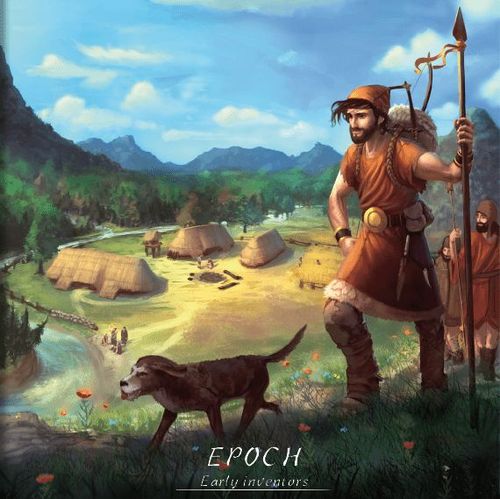
Epoch: Early Inventors
Epoch: Early Inventors Rulebook
Table of Contents
Table of Contents
- Components
- Aim of the game
- Setup
- Game play
- Game round
- The tiles
- Overview
- On your turn
- Extras
- Use abilities
- Bronze, Rope and Leather
- Use other players' abilities
- Turn deer into 3 food
- First round
- End of turn
- End of the game
- Scoring
- Carrier board
- Village tiles
- Golden rule
- Round up
- Raw and processed materials
- Food
- Limitation playing pieces
- Logic rules
- Open information
- Normal play vs Extended play
- Variants
- Example of a turn
- Solo game
- Strategic advice
- Reality
- Appendix
- Excavating sites
- Telling the time
- Ceremonial sites
- Resources
- Used symbols
Components
- 11 Huts per player
- 1 Clan leader per player
- 4 Offer tokens per player
- 1 Carrier board per player
- 1 Starting player token (Ötzi) + 1 reserve token
- 64 Food cubes
- 50 Status counters (1 status)
- 8 Status counters (5 status)
- 2 Overviews
- 42 Landscape tiles
- 2 Village tiles
- 1 Setup sheet
- Game rules
- 1 Appendix
- 6 Ceremonial sites
- 6 Ceremonial site extensions (for 3 to 4 players)
- Resource counters: Raw material: Clay, Stone, Flint, Ore, Wood, Flax, Tendon, Leather, Rope, Bronze. Processed material: Hide, Antler
- Abilities
- 3 Last rounds markers
Aim of the game
The player with the most status at the end of the game wins. You receive status for exploring the landscape, developing tiles, making offers at ceremonial sites, and sharing your abilities with other players.
Setup
Use the separate sheet for setup of the game.
Game play
Each player has one clan leader. The players' clan leaders represent their clans. Players move their clan leaders from tile to tile representing the movement of their clans. You can only carry out actions at the tile where your clan leader is situated.
Game round
You have 1 turn per round. The game typically lasts from 13-25 rounds depending on the number of players and their playing styles.
The tiles
Every tile represents a type of landscape. Every type has its own landscape and border color.
At the center of the tile you find the name of the tile. This makes it easier to find it on the overview and in the appendix.
The number on the left side indicates how much status this tile is worth at the end of the game.
The bottom half of the tile shows the cost of development to invent this new skill or tool. In other words: to make this tile yours.
The top half of the tile tells you what you can use it for. Tiles always give you advantages that make it easier for you to gather, fish, hunt, work, walk, etc. The overview and ability itself explain how you can use the ability. The appendix adds some extra explanation in case questions arise.
The example tile (Pottery) is annotated as follows:
- The green border indicates that this is a grasslands tile.
- The yellow edge indicates that this tile is a start tile. (See also setup.)
- This tile gives you three advantages: 1. It helps you when you are gathering food. 2. It helps you when you are fishing. 3. It helps you when you are butchering. (The overview shows how this exactly works.)
- This tile is worth 2 status at the end of the game.
- To develop this tile, you need to place 1 bronze or 3 stone or 3 clay back in the stock.
- If you develop this tile, you take the corresponding ability token and place it in front of you.
Overview
The overview shows you what you get when working, gathering, fishing or hunting. It also shows you the cost of moving your clan leader and how developing and offering works.
The colors on the overview correspond with the colors used in these game rules to highlight the actions and other things you can do.
How to use the overview will be explained in more detail later on in the examples in these game rules.
On your turn
On your turn you can do the following:
- Perform one action.
- Develop one tile.
- Offer to one ceremonial site.
You can carry out the steps above in any order you like. And you can skip as many of these steps as you want.
In addition, anytime you like: Use extras.
Perform 1 action
You can choose to perform one of the following actions: Work, Gather, Fish, Hunt, Butcher, Explore.
Most actions you can only carry out once. But some you can carry out more often. This symbol 1 always tells you how often you can perform it.
Every action always has one main component that you perform when carrying out the action.
Below the main component there is a list of options that you can also choose to perform. You can perform these options after having carried out the main component of the action. You choose which options you want to perform and the order in which you carry them out.
Tip: If a certain action is not possible at a certain landscape, you can move to another tile before performing the action.
Work (1)
Working is the way to get raw materials in this game. You always work on the tile with your clan leader on it. Depending on the type of tile, some materials can easily be procured, other materials take more effort (= work power in this game).
In some terrains you easily find wood, in other terrains it takes more time.
If you pay 1 food, you get 2 work power (see also overview). Work power is depicted by the lightning symbol.
The overview shows what raw materials can be found at what tile and how much work power you need to acquire them.
You can take as many raw materials from the stock as you like, as long as you 'pay' the appropriate amount of work power for them. You place them on your carrier board or next to it. (See also: Carrier board and Moving.)
- Sweat (1): If you decide you need more raw material, you can choose to sweat (once). You pay 1 food and you get 1 more work power.
- Put your back into it (1): In case you need even more work power, you can decide to put your back into it (once). You pay 1 food and receive 1 more work power.
You can work on any tile that has been explored (= has been turned face up. See also: Explore).
If a tile has been developed, you can still work on it, even if it has been developed by another player (see also: Develop).
You are not obliged to use all your work power to acquire raw materials. You cannot keep work power to use it in a later turn, however.
You cannot move while working.
Example: Your clan leader is standing on a grasslands tile and you are going to work. You pay 1 food, that gives you 2 work power as depicted in the overview. You decide to pay 1 more food and 'Sweat' (see Overview). This gives you 1 more work power. Your total work power = 3.
You then use this work power to take raw material. The overview tells you what materials you can take and how much work power you need to take them. For your 3 work power, you can take 1 flax (1 work power) and 1 clay (2 work power). Alternatively, you could take 3 flax. Or 1 stone or 2 ore and 1 flax or 1 ore and 2 flax, etc.
Gather (1)
If you choose this action you can gather food. The amount of food you can gather depends on the landscape your clan leader is situated on.
The overview depicts how much food you can gather on a landscape. Every orange cube depicted means that you can take one food cube from the stock and place it on your carrier board.
You can place food cubes on the spots for food or (if those are all filled up) you can place 4 food cubes on one spot for resources.
- Keep looking (1): When you are gathering, you can choose to keep looking (once). Place 2 food back in the stock (this can be food that you just gathered). Take 1 hide, 1 antler or 1 tendon.
When you are gathering, you can be hardheaded and keep going. At some point you will find a dead animal with some of its parts still intact.
Example: You are gathering on a forest tile. You take 3 food, as depicted on the overview.
Fish (1)
Fishing works basically the same as gathering. The amount of food you get when fishing depends on the landscape your clan leader is situated on and is depicted on the overview. Fishing works best on water tiles of course.
- Big catch (2): When you are fishing, you can also have a big catch. If you place 1 ore, flint or stone back in the stock you take 2 food from the stock and place it on your carrier board. You can do this twice.
Example: Your clan leader is standing on a marshes tile. You fish, so you take 3 food. You use the option 'Big catch' twice. You return an ore and a flint to the stock. This gives you another 4 food.
Hunt (1)
You can hunt 1 deer on the grasslands, in the forest, in the mountains or in the drift sand as you can see on the overview.
Deer are resources and must be placed on the resource part of your carrier board (see also: Carrier board).
You can turn a deer into 3 food anytime you want and add these food cubes to your carrier board. This is not the same as butchering! You just eat the animal (see Overview - Extras).
- Do not give up (1): When you hunt you can choose not to give up. If you place 1 leather, 1 rope, 1 ore, 1 flint or 1 stone back in the stock, you can take 1 deer extra.
Tip: Only go hunting if you can at least hunt 2 deer.
Butcher (5)
You can butcher up to 5 deer in one turn.
For every deer you butcher, you can take 2 different things from the stock. You can choose between the following:
- 1 antler
- 1 tendon
- 1 hide
- 3 food
Example: For one deer you can take 1 hide and 1 antler OR 1 hide and 1 tendon OR 1 hide and 3 food OR 1 antler and 1 tendon OR 1 antler and 3 food OR 1 tendon and 3 food.
Example: For 3 deer, you could take 3 hides, 1 tendon and (2x3=) 6 food.
Explore (2)
Exploring is the way to turn surrounding tiles face up. You pay 1 food, and turn 1 tile face up that directly borders the tile with your clan leader on it. From now on this tile has been explored.
The exploration of this tile entitles you to take the status marker from the tile. You can explore a maximum of 2 tiles on your turn. You can explore one tile and then decide if you want to explore another one.
You are not allowed to move before exploring the second tile.
Find a ceremonial site
If you explore a tile that is directly adjacent to a ceremonial site, you receive 1 status for exploring this tile, just like normal.
You also take the 3 status from the ceremonial site. From now on, this ceremonial site has been discovered. After you have finished the action you immediately place the status counters from the other adjacent tile or tiles in the stock. You then turn these tiles face up.
Example: Yellow can explore any of the tiles with an orange hex around it.
Develop one tile
You can develop 1 tile that has not been developed yet.
The lower part of the tile (below the tile name) tells you what you have to 'pay' to develop the tile. You take the resources from your carrier board and place them back in the stock.
Then you place your hut on the lower part of the tile. At the end of the game you receive the status depicted on the tile.
Take the corresponding ability itself from the stock and place it in front of you. From now on you can use this ability (see also: Use abilities).
You can only develop the (undeveloped) tile your clan leader is standing on or any (undeveloped face up) tile adjacent to it.
If the clan leader of another player is standing on the tile you want to develop, you must ask that player permission to develop the tile. This player can ask you to give them something in return. They can also refuse, which probably only happens when they want to develop the tile for themself.
Each ability is represented on two tiles. However, you cannot develop the same ability twice.
Example: Develop a tile - Casting bronze. To cast bronze, you need an oven, a fire and a pair of bellows. So to develop this tile, you need to place 1 stone or 1 clay back in the stock (oven). You also need to place 1 wood back in the stock (fire/bellows). And you need to place 1 hide or 1 leather back in the stock (bellows). Then you place your hut on this tile to show you developed it. You take the ability and place it in front of you. From now on you can use this ability (see: Use abilities). The backside of the ability contains an explanation of how the ability works (as does the overview).
Offer to one ceremonial site
On your turn you can make one offer to 1 ceremonial site.
Every ceremonial site has several segments. To make an offer, you return the resources indicated on the segment to the stock and place your offer token on the appropriate segment of the ceremonial site.
Only one offer token can be placed on a segment. If you want to offer to the same ceremonial site as another player has offered to, you have to place your offer token on another segment (and offer the appropriate resources).
At the end of the game you receive status for every offer you made.
The appendix explains how the ceremonial sites work and how you score status for the different ceremonial sites.
You can only make an offer to a ceremonial site where you have no offer token yet.
You can only make an offer to a ceremonial site your clan leader is standing adjacent to. You can never enter the ceremonial site itself.
Extensions for 3 and 4 players
If you are playing with 2 players, you only use the ceremonial sites themselves. When playing with 3 or 4 players, you also use the extensions. One side is for three players, the other for four players.
Every extension belongs to a specific ceremonial site. You can use the pattern on the edge of the tile to add it to the appropriate site.
The extension is placed bordering at the ceremonial site and is considered an integral part of the ceremonial site. If your clan leader is standing adjacent to the ceremonial site you can also offer to the extension.
Example: You want to place an offer token on this segment of the ceremonial site extension. You have to pay 1 bronze, 1 antler and 1 resource of your choice. You choose ore. After placing these resources back in the stock, you place an offer token on the segment. This leaves only two segments, where the fourth player can place her offer token.
Turn tiles face up
After you have offered to a ceremonial site, immediately turn all unexplored tiles in the same quadrant as the ceremonial site face up.
Remove the status counters from these tiles and place them in the stock.
Note: Some tiles belong to 2 quadrants.
If this is the second offer you made immediately turn all unexplored tiles face up. Remove the status counters of all undiscovered tiles and ceremonial sites and place them in the stock.
Example: All tiles with a green border around it belong to the same quadrant as the ceremonial site with the orange border.
Extras
There are a few extras that you can do on your turn. You can use most of these extras more than once and usually at any time you like.
The overview shows you how often you can use extras on your turn. You can use extras with this sign (∞) as often as you like and/or during your whole turn.
Move
You can move your clan leader as often and as far as you like on your turn. You can either walk or paddle (by using the canoe).
You have to 'pay' food for every tile you move onto or move through. The overview contains a section 'Walk' that tells you how much food is required to enter a tile. You first pay the food for the whole journey (so you do not have to carry this with you), then you move your clan leader to where you want to go.
Important: You can only move onto or through tiles that have already been explored.
You can move onto or through tiles that have been developed. It does not matter who developed the tile.
You can move through a tile with another clan leader on it, but you cannot stop there.
You can leave or pick up resources and food on every tile you move onto or through. You can do this while moving, so you do not have to interrupt your journey to do so.
You are not allowed to move your clan leader during an action.
Example: You want to move your yellow clan leader from the village tile to the grasslands tile. The shortest route would be via the forest tile and the marshes tile. These tiles have not been explored however, so you cannot move through them. You have to move via the north side. You are carrying a rope with you, so you only have to pay 2 food to walk onto the mountain tile (A). You have to pay 1 food to walk onto the grasslands tile (B), 2 food to walk onto the forest tile (C) and 1 more food for the grasslands tile (D). You first pay (2+1+2+1=) 6 food. Then you check if you can take all your food and resources with you (see also: Carrier board) and move your clan leader to the new location.
Walk
You can walk through all tiles, except water. You have to place food back in the stock for every tile you move onto or move through. The overview tells you how much.
If you do not want to (or are not able to) use the canoe, you cannot paddle and must walk when moving.
When you walk onto a mountain tile and carry a rope with you, it costs you only 2 food to move onto it. Without rope, it costs you 5 food. You do not have to return the rope to the stock when using it this way.
Paddle
You can only paddle if you use the canoe and you can only use the canoe if you (or another player) has developed it.
You can develop a canoe when you are standing next to it.
The overview shows how much food you need to paddle onto a specific tile.
When you use a canoe, you can use it for your whole turn.
You can also use the canoe on other tiles than water tiles.
These tiles have rivers that you can follow, but it takes more time to navigate those than the open water or the marshes.
You can even take the canoe into the drift sand or the mountains, but you need a rope to pull the canoe along (through the sand or up the river). It also costs you more food than walking. But it does allow you to carry extra resources and food in the canoe (see Carrier board and Use abilities). You do not have to return the rope to the stock when using it this way.
You are allowed to alternate walking and paddling (meaning you use the canoe for only a part of the trip), as long as you do not exceed the number of resources and food you can carry (see also: Carrier board).
If you start your turn on a water tile and immediately move onto a land tile before doing anything else, you do not need to use a canoe this turn.
Example: You have a canoe. You move your clan leader from the marshes tile to the drift sand tile. It costs you 1 food to paddle onto the water tile (see overview). You have a rope, so you can pull the canoe onto the drift sand tile. This costs you 5 food. But it does allow you to take 5 extra resources with you (see also Use abilities)!
Use abilities
You can make use of your own abilities at any time on your turn.
Every ability with the work symbol gives you an advantage when working. Every ability with the gathering symbol gives you an advantage when gathering. The same goes for the other symbols.
The symbols are: Work, Gather, Fish, Hunt, Butcher, Explore, Paddle, Walk, Carry.
You will easily understand the meaning of most abilities, once you grasp the game. Some abilities may need a little extra explanation though. Take a look at the overview, while I explain the more difficult ones.
Axe, Dagger, Shovel and Pick all give you an advantage when working. They all function in the same way. You need to pay only half the needed work power for a maximum of 4 of the depicted raw material counters.
Example: Use an ability - Work with the axe. You are standing in the forest and you have 4 work power. You have an Axe and take 4 wood for 2 work power (instead of 4 work power). Then you take 2 more wood for 2 work power (just like you normally would).
Example: Use an ability - Work with the Pick and Gloves. You are standing on a grasslands tile. You pay three food. This gives you 4 work power. You have Gloves. They give you 1 extra work power (see also ability or overview). You use the Pick to take stone and flint for half the work power (see also ability or overview). You take two flint and one stone for (3 x 3/2 =) 5 work power (you round up 4.5 to 5).
Example: Use an ability - Gathering. Your clan leader is on a mountain tile and you are gathering. You take 2 food and place it on your carrier board. You also have a Basket. This gives you 2 extra food. In total you gather 4 food.
Pottery gives you an advantage when gathering, fishing or butchering. If you put one (raw or processed) material back in the stock, you can take 4 food.
Cooked food can be kept a lot longer. As you have to carry the heavy pots with you, it means you can carry less resources and thus have to get rid of 1 resource every time you use pottery.
You can use the Bow when hunting. Put 1 tendon or 2 flax back in the stock and you take 3 food. You can do this twice. So if you put 1 rope, 2 tendon, 4 flax or 1 tendon and 2 flax, back in the stock, you take 6 food.
You can make the bowstring from rope, tendon or flax (fibers). Occasionally it breaks when hunting and you have to make a new one.
The Dagger comes in handy when butchering. It gives you one extra hide, antler or tendon. It has to be a different item than the ones you already took from this animal.
Of course you cannot take 2 hides from 1 animal.
The Boots and the Cloak give you an advantage when walking. The Cloak also gives you an advantage when paddling.
Example: Use an ability - Walk. You do not have a rope, so moving your clan leader in this situation would cost you 5+1+2+1 = 9 food. When you use Boots you would need 4+0+1+0 = 5 food. When you use Boots and a Cloak you only need 5/2 = 3 food. When you use only a Cloak you would need 9/2 = 5 food.
Example: Use an ability - Casting bronze. You can use this ability to create bronze from ore. You have to place 2 ore back in the supply. You also need a fire, so you also have to place (1/2 = rounded up to) 1 wood or 1 antler back in the supply. You then take 3 bronze from the stock and place them on your carrier board. You can do this a maximum of 3 times. So for 9 bronze, you have to pay 1 wood and 1 antler (or 2 wood or 2 antlers) plus 6 ore. You then take 9 bronze from the stock.
You can find more info about the abilities in the appendix.
Bronze, Rope and Leather
The abilities Casting bronze, Rope making and Tanning help you create processed materials: Bronze, rope and leather. There is no other way of creating these 3 types of processed materials. You can see how they work on the Extras overview.
If nobody develops an ability like this, history will take a different course and you will have to do without bronze, rope or leather.
Use other players' abilities
If you want to use one or more abilities of another player, you give homage to their clan.
Give 1 status to the player whose abilities you want to use.
During this whole turn, you can use all abilities developed by them as if they were your own.
It does not matter where your clan leader is situated. You can always use the abilities of other players, as long as you give them 1 status for it.
You can use the abilities of more than one player (but you have to give them all 1 status).
You can never use the same type of ability twice in the same turn (even though they are from different players).
If you want to use the abilities of another player again in your next turn, you will have to give that player 1 status again.
Status may seem like a kind of currency in this game. But it is not. Status is a symbol of respect. When you develop a new ability, you invent a new tool or acquire a new skill. This heightens your status amongst other clans.
When other clans use tools that you have invented, they give you status. They do not pay you to lend your tools. They have their own tools. But every time they use a tool that you have invented, it fills them with respect for your invention. And that adds to your status.
Example: Use other players' abilities - Bow. You hunt + do not give up. You place 1 stone back in the stock, so you take 2 deer. You pay Peter 1 status to use his Bow. You return 1 tendon and 2 flax to the stock. You take 6 food.
Example: You give Anna 1 status and use her Spear. You take 1 deer and 1 food. Anna also has a Water Jug, this gives you 1 more food. Total: 3 deer + 8 food.
Offer help
When other players carry out an action where they could use one of the abilities you developed, you should tell them. This is a good way to earn extra status.
Turn deer into 3 food
At any time during your turn, you can turn 1 deer into 3 food. Return the deer to the stock and place the food cubes on your carrier board.
You can do this as often as you like during your turn (as long as you have deer left). This is not the same as butchering, you only eat the deer without bothering to carefully butcher it.
First round
In the first round, at the start of your turn, you place your clan leader on a face up tile (this can be a tile that has been explored by another player). You then proceed with your turn.
In the first few turns, you will probably explore a lot of tiles. But soon you will perform other actions too in order to be able to develop tiles.
You play the game in turns in a clockwise order. The starting player begins the game.
End of turn
After you have finished your turn, it is the next player's turn.
End of the game
If at the end of the round all tiles are lying face up (this is the round where one player made his second offer), you play 3 more rounds. Then the game ends.
Alternatively, if at the end of the round there is a player who has developed 8 tiles, you play 3 more rounds. Then the game ends.
You can use the 3 last round markers, to keep track of the last 3 rounds.
Scoring
You score status as described below. Add all status together. The player with most status wins the game.
- Collected status - Add together the status from the status counters you have collected during the game.
- Developed tiles - Add together the status from all your developed tiles.
- Ceremonial sites - Add together the status you receive from every ceremonial site.
- Bonus status - You receive the following additional status:
- You have offered to 1 ceremonial site: +2 Status.
- You have offered to 2 ceremonial sites: +5 Status.
- You have offered to 3 ceremonial sites: +10 Status.
- You have offered to 4 ceremonial sites: +15 Status.
Tie
In case of a tie, the players share their victory.
Carrier board
The carriers carry the food and resources (= raw material (including deer) and processed materials) for you. The carriers go, wherever your clan leader goes.
Depending on which side of the carrier board you use, you can carry a maximum of 16 food and 5/7 resources with you from the start of the game.
If you want to carry more than 16 food, you can carry 4 food in stead of one resource (if you have empty resource spots left).
Some abilities enable you to carry more resources and food. You can place these abilities adjacent to your carrier board and place resources (and/or food) on them.
If you are moving and have more resources and food than you can carry, you must leave some resources and food behind.
Food you leave behind, you return to the stock.
Any food left behind will be eaten by animals.
Resources you leave behind on the tile you are leaving. You - or another player - can pick them up later when moving onto or through this tile.
You can leave or pick up resources on every tile you move onto or through. You can do this while moving, so you do not have to interrupt your journey to do so.
As long as you do not move, you can keep as much food and resources as you like.
You just pile them up somewhere in your camp and guard them.
Carrier board - This is your carrier board. You have 6 food at your disposal. You also have 1 flax, 2 ore, 1 stone and 1 hide.
Larger carrying capacity
You can use the side with the larger carrying capacity when experienced players are playing with inexperienced players. The less experienced players are allowed to carry 6 or even 7 resources.
Village tiles
You can stand on and walk or paddle through the village tiles, just like the other forest tiles. You can carry out any action on the village tiles, just like on the other forest tiles.
Golden rule
There is one golden rule in this game: If an ability enables you to do something that is not consistent with these game rules then the ability is leading.
Round up
You always round up or down to the nearest integer when you have a fraction. That is, if the fraction is less than .5, you round down; if it is .5 or more, you round up.
If you have to pay 0.5 food or 0.5 work power, you pay 1 food or 1 work power. If you have to pay two times a 0.5 food or 0.5 work power, you pay 1 food or 1 work power. First you add all food or work power you have to pay, then round up if necessary.
If you divide 16 status over 3 players, they all get 5.3333 status. 5.3 is less than 5.5 so it is rounded down.
Raw and processed materials
The only way to procure raw material is to work.
However, you cannot work to obtain processed materials (such as hide and rope). You can only obtain these by butchering deer or keep looking (while gathering) or using the abilities of developed tiles like Rope making.
It takes some effort to make processed materials, but they are very helpful. Most of the time you need lower quantities to develop the same tile than you would using raw materials.
For tiles and ceremonial sites where you need processed materials you often receive more status than for tiles and ceremonial sites where you only need raw materials.
If you need to give up raw material to make an offer or do something else, you can also give up a deer.
Raw material: Clay, Stone, Flint, Ore, Wood, Flax. Processed material: Hide, Antler, Tendon, Leather, Rope, Bronze.
Food
You need a lot of food in this game. This is because most things you do take time to do them. And you have to eat when you do things.
(Well, even when you do not).
This means you will need to get food a few times during the game. It is important to develop tiles with abilities that make it easier for you to get food. Do not hesitate to use the abilities of other players as well, as this can bring you (a lot of) extra food.
It is a good strategy to specialize in either gathering, hunting or fishing.
Limitation playing pieces
The number of clan leaders, huts and offer tokens is limited. All other playing pieces are not limited. In the rare case that you need some extra playing pieces I am sure you will find a temporary substitute.
Logic rules
If something has not been described in these game rules it is not part of the game. Even if this may seem logical to you.
Open information
There is no hidden information in this game, except for the status counters the players gather during the game.
Of course you can agree on keeping the status counters face up.
Normal play vs Extended play
There is a setup for normal play. Using this setup you start the game with 2 developed tiles.
Extended play lets you start without any developed tiles. This way you are totally in control over which tiles you develop and which not. Extended play does take a bit more time than normal play, however.
Variants
Find additional exciting variants at www.martynf.com.
Example of a turn
- Your clan leader (Red) is standing adjacent to the Dagger tile. You have 15 food, 1 flint and 1 stone, 2 antlers, 1 rope, 1 flax and 7 status.
- You pay 2 antlers and a stone to develop this tile and take its ability.
- You pay Anna (Yellow) 1 status to use her Boots. You use them combined with your rope to move onto the adjacent mountain tile for 1 food.
- You work on the mountain tile + Sweat + Put your back into it (costs you 3 food). This gives you a total of 4 work power. You use Anna's Gloves (you have already given her 1 status to use all of her abilities, so you do not have to do this again). This gives you 1 extra work power. 5 work power in total. You use the Pick from Anna to take 1 stone and 1 flint for one work power (in stead of 2). You use your Dagger to take 1 flax for two work power (1,5 - in stead of 3 - rounded up to 2). You then pay Erik (Green) 1 status to use his abilities. You use his Axe and take 4 wood for the remaining two work power.
- Erik has a Water jug, so you take one food from the stock. Anna also has a Water jug, but you cannot use that, because you have already used a Water Jug this turn.
- Erik has a Cart and a Cloak. You use the Cart to carry your excess material and the Boots from Anna combined with Eriks cloak and in case of mountains combined with your rope to move for 1 food less per tile and then half the food per tile to the ceremonial site at the opposite side of the game board.
- Then you use your Rope making ability. You return 2 flax and 1 food to the stock and take 3 ropes.
- You then offer 2 rope and 2 flint to the ceremonial site and place your offer token there.
- Last but not least you decide to make good use of the Boots and the Cart (carry more resources) and move to the adjacent forest tile for only 1 food (in stead of having to pay 2 food in your next turn).
Solo game
You play the solo game with a dummy player.
Unless otherwise specified, follow all the standard rules and treat the dummy player as a normal player.
E.g. when the dummy makes an offer turn all tiles in the same quadrant face up.
E.g. When you pay 1 status to the dummy player you can use all of its abilities.
There is one exception to the rule above: You must play in such a way, that the dummy player can always move his clan leader (rounds 2, 4, 6, 9, 10, 12 and 14).
You do not have to pay food or use materials for the dummy player to perform any actions or develop any tiles.
You use the setup for extended play.
The dummy player starts the game.
Round 1
You place the clan leader of the dummy player on one of the village tiles.
Round 2
In round 2 you choose a direction for the dummy clan leader to go: northeast or northwest if it is on the northern tile. Southeast or southwest if it is on the southern tile.
Round 2, 4 and 6
The dummy clan leader explores 1 tile in the direction it is heading and moves onto this tile (even if this is a water tile). If you have already explored this tile, the dummy player moves onto it and carries out no further action.
Turn 6 of the dummy player. The dummy clan leader is exploring in the north east direction and must explore the forest tile (with orange border).
Round 3, 5 and 7
The dummy player develops the tile its clan leader is standing on and places its hut on it. If you have already developed this tile, the dummy player carries out no action this turn.
Turn 5 of the dummy player. The dummy player must develop the grasslands tile its clan leader is standing on (with orange border) and places a hut on it.
Round 8
The dummy player places an offer token on the ceremonial place adjacent to its clan leader. You choose the segment to place the offer token on.
Round 9
You return the dummy clan leader to one of the village tiles.
Round 10-15
You repeat the steps from round 2-7 in a direction of your choice, but in a different direction than the first time.
Round 16
The dummy player makes its second offer and you turn all tiles face up.
The end of this round
You remove the dummy clan leader from the game and play three more rounds. Then the game ends (after 19 rounds).
At the end of round 16, the dummy player normally should have placed 6 huts and 2 offer tokens.
In case you have already made a second offer in round 15 (or even earlier), the game will end earlier of course. If you score more points than the dummy player, you have won the game.
Strategic advice
- Develop at least 1 tile that will get you extra food when gathering, fishing and/or hunting.
- If you explore surrounding tiles before you start working, you know what materials you will need before you start to work.
- The less actions you need to reach your goal, the better it is. Even if this means that you have to give one status to one or more of the other players to use their abilities. This is almost always worth it in the long run.
- Food is very important. The more food you get in 1 action, the better it is. So even if you have the fishing pole, why not use the hoop net of another player as well?
- When you use an ability of another player, check out his/her other abilities and try to use those too.
- The abilities of some tiles make it easier to develop other tiles (such as Rope Making, Casting Bronze and Tanning). These tiles will probably bring you status from other players.
Reality
I have tried to keep the elements in this game as close as possible to what is currently known in archeology about these inventions. But for the sake of the game I had to make adjustments and use my fantasy. The same goes for the illustrator. Any mistakes in the game compared to reality are mine and mine only.
Appendix
Uncovering the past
For many, the depths of our prehistoric past seem distant. Nevertheless, there are people who make their work out of uncovering this past: archeologists.
Archeologists excavate the remains of prehistoric societies that have long since vanished. This game is based on the discoveries and knowledge that archeologists have made about our ancient past. Many of the tools and technologies that you need to develop in this game are inspired by important developments that actually occurred in prehistoric Europe and that have shaped our past.
Although in many ways prehistory may be difficult to grasp because of its strangeness, the roots of our modern societies, technologies and landscapes can be found in this distant past. The first farmhouses that were built from the late Stone Age onwards display the rudiments of farms today. The ways in which the people in the past parcelled their farmland and organised the landscape around them is still recognisable. Certain tools and materials like the plow and metal were invented and discovered in prehistoric times. Without these our lives today would have been completely different.
Axe
You can use the Axe to cut up to 4 wood for half of the normal work power. When butchering you take +1 food per deer.
Example: You work and sweat on a mountain tile. This costs you 2 food and gives you 3 work power. You take 4 wood for 2 work power and 1 wood for 1 work power.
You not only need a shaft (wood) and a head (bronze/antler/flint), but also a stone to hone the head.
Axe - The oldest finds belonging to the European prehistory that archeologists have encountered are hand-axes. Most likely these flint tools were used for more things than one would normally expect for an axe. The axe as a dedicated tool to chop down trees probably did not exist until the Neolithic. The importance of these finely crafted stone tools is evidenced by the fact that the Neolithic axes were often deposited in bogs and marshes, a tradition that continued into the Bronze Age with the deposition of bronze axes.
Basket
You can carry +2 resources, every time you walk this turn. You take +2 food when gathering.
Example: see game rules page 10.
It might take some time to find the twigs (wood) needed to make a basket, but it is time well worth invested!
Boots
When using the Boots you need one less food for every tile you move onto or through.
If you use the Boots together with a Cloak, you first apply the effect of the Boots and then apply the effect of the Cloak.
Example: You walk through the marshes, the forest and the marshes again. When you only use the Boots you need: (3-1) + (2-1) + (3-1) = 5 food. When you also use the Cloak you need: 5/2 = 3 food.
Sturdy boots are made from leather or hide. And of course you need to be able to tie them (with rope, tendon or flax).
Bow
If you return 1/2 rope (round up to 1), 1 tendon or 2 flax to the stock you take +3 food when hunting (you can do this twice).
Example: see game rules page 11.
A bowstring can be made from rope, tendon or flax (fibers). Occasionally it breaks when hunting and you have to make a new one.
Bow - The bow was likely invented as a hunting tool during the Late Palaeolithic. Only later was it used as a weapon too. It was made from flexible wood which was bent and held in tension by a string. This string was made from a variety of materials such as linen, hemp, silk, mohair, rattan, bamboo, vegetable fibre and animal sinew.
Reindeer hunters used this tool to unleash great volleys of arrows on their prey when they were bunched up in mountain valleys. Many hundreds of reindeer bones were found at Late Palaeolithic sites occupied by these reindeer hunters.
Canoe
You can carry +5 resources every time you paddle this turn.
If you start your turn on a water tile and immediately move onto a land tile before doing anything else, you do not need to use the canoe.
Example: Your carrier board has room for 5 resources, but you have 9 resources. You use the canoe to paddle through a grass lands tile (this costs you 3 food) and a marshes tile (2 food). This takes 1 food more than walking, but you can take the extra resources with you.
A canoe can be made from a lattice work of wood with hide or leather in between.
Canoe - Despite the absence of cars and airplanes in prehistoric times, people managed to journey large distances. Thanks to the occurrence of 'foreign' objects and also the use of isotope analyses of bones, we know that people in prehistoric times travelled through the whole of Europe and crossed the North Sea. Canoes and other small boats played an important part in travel and were also used for fishing. The oldest known boat in the world is roughly 9000 years old. It is a canoe found in Pesse in the Northern Netherlands.
Cart
You can carry +8 resources every time you walk this turn.
A cart does not come cheap, but is a great investment - just like today.
Cart - The invention of the cart required the invention of the wheel which took place in the 4th millennium BC. Both the cart and the wheels under it were made out of wood. Some carts had bronze fittings on them. In some places like Drenthe in the Netherlands, prehistoric cart-tracks are still visible in the landscape. The same routes were used for hundreds of years, and were literally etched into the landscape.
Casting bronze
Pay 1/2 wood or 1/2 antler (rounded up to 1 wood/antler) plus 2 ore to make 3 bronze (you can do this three times).
If no one develops this tile, it is not possible to make bronze.
Example: See game rules page 10.
Casting bronze - The first metal to be used by mankind was copper. Evidence of smelting and casting copper dates back to 5000 BC in the Near East. In Europe it is only in the 4th millennium BC that copper and gold become important. After 2500 BC the use of metals was widespread throughout Europe and after copper people started making bronze; an alloy of copper and tin.
Cloak
You can use a cloak for every move you make when walking or paddling.
You add the food for your complete journey, then you divide this number by two.
Example: You use the canoe to paddle through marshes (2), water (1), marshes (2) and walk through forest (2), drift sand (4). You only need 11/2 = 6 food. You carry out an action. Then you walk through grasslands and pay (1/2 rounded up to) 1 food.
Excavating sites
Archeology is mostly known because of the beautiful finds that you can see in museums. Yet these finds only play a small part in the archeological process, and on their own they do not tell us a complete story about the past.
The way in which these finds are encountered in excavations is immensely important when archeologists try to tell a story about what it is they find. A sword found in a grave, for instance, tells us about how certain people were buried during a period of prehistory. Finding the very same sword in a river tells a story about what places were suitable for offering items. Because of this, archeologists will always tell you: "Context matters!"
Dagger
When butchering: You can take +1 antler, hide or tendon for every deer you butcher. When you already took an antler and 3 food for the deer you butcher, you cannot use the dagger to take another antler (or 3 food) from this same deer, so you have to take a hide or tendon.
When working: take a maximum of 4 flax for half of the normal work power.
Example: You work and sweat on a grasslands tile. This costs you 2 food and gives you 3 work power. You take 4 flax for 2 work power. Then you take 1 more flax for 1 work power.
Dagger - Today, the dagger (knife) is still seen as an essential survival tool. For good reason: it is a tool that people have relied on for literally thousands of years. The first daggers were made of flint, and could be incredibly sharp. Following the invention of bronze, daggers were amongst the first items made with this new material.
Age: 300 000 BC and older. Period: Early Palaeolithic. What happened: Not much. :)
Fishing pole
Take +4 food when you are fishing.
Example: You are fishing on a marshes tile. You take 3 food. You use the fishing pole and take 4 food extra.
Gloves
Gloves give you +1 work power when working.
Example: You work and sweat. This costs you 2 food and gives you 3 work power. You also use the Gloves and gain 1 work power. Now you can spend 4 work power in stead of 3.
Very powerful in combination with a horse.
Hoop net
Take +5 food when you are fishing.
Example: You are fishing on a forest tile. You take 2 food. You use the fishing pole and take 5 food extra.
All you need are some twigs (wood) and some rope, tendon or flax to create a fish trap.
Hoop net (Fish Trap) - Sometimes archeologists are lucky enough to find extremely delicate materials such as fish traps. These traps, often made from the branches of willow trees, were placed in such a way that it obstructed the path of the fish and forced them in a single direction: that of the collection area.
Fish traps were in use throughout prehistory following the last Ice Age, and a number of examples are known from Northwestern Europe, mostly from the Netherlands.
Age: 300 000 – 35 000 BC. Period: Middle Palaeolithic. What happened: Neanderthals!
Horse
When moving: If you pay 1 food, you can carry +4 resources, every time you walk this turn.
When working: you can pay 1 food to get +1 work power.
Example: You work, sweat and put your back into it. This gives you 4 work power. You decide to use the horse, pay 1 food and now have 5 work power at your disposal. If you also use the gloves you can spend a total of 6 work power.
To tame a horse, you need a bridle consisting of rope or something that comes close to it (tendon or flax) and leather or hide for the sturdier parts.
Horse - The horse was already hunted throughout Europe at the end of the last Ice Age. With their domestication horses took on a new role. The first domesticated horses were mainly kept for their meat, but this changed quickly as they came in use as draft animals during the middle Neolithic.
By the end of the Bronze Age the horse had become very important. Some people were even buried in so-called 'wagon graves' which included a chariot, weapons and horse-gear.
Jug/Water bag
Take +1 food every turn. When you develop this ability, you can use it in the same turn and immediately take 1 food.
Example: You are using the abilities of Anna, because you want to use her Axe. Anna also has a Jug/Water bag, so you take 1 food.
The Jug/Water bag saves you the trouble of looking for a spring or brook to quench your thirst.
Pick
Take a maximum of 4 stone and/or flint for half of the normal work power.
Example: You work and sweat on a drift sand tile. This costs you 2 food and gives you 3 work power. You take 3 flint and 1 stone for 2 work power and 1 more stone for 1 work power.
You need antlers, flint or stones for the head of the pick plus wood for its shaft.
Pottery
When you are gathering, fishing or butchering, you can return 1 resource to the stock and take +4 food.
Example: You are butchering 3 deer. You take 3 antlers, 1 hide and 6 food. You use pottery, place 1 clay back in the stock and take 4 food extra.
Pottery - Around 7000 BC, people in North-western Europe started to shift from a hunter-gatherer lifestyle to a farming lifestyle.
Not having to move to new hunting camps every season allowed people to start fabricating new objects that are not useful to nomads. Pottery was among these objects. Pottery styles changed over time and archaeologist use this to make so-called typologies through which they can date them.
Rope making
Place 2 flax and 1/2 food (rounded up to 1 food) in the stock and take 3 ropes (you can do this three times).
You can use rope to move onto a mountain tile for only 2 food. You can also use a rope to drag your canoe through the drift sand or mountains. You only need to have the rope with you. You do not have to put it back in the stock.
Example: You walk through the mountains, the marshes and the mountains again. You carry 1 rope with you, so this costs you 2 + 3 + 2 = 7 food.
One more example: see game rules page 9, example with Paddle.
Age: 35 000 – 9000 BC. Period: Late Palaeolithic. What happened: Reindeer hunters.
Telling the time
One of the tasks of the archeologist is to figure out the age of the things they find. They have a number of techniques to do so, but the most important tool is 'carbondating'. These methods of revealing time have allowed archeologists to date many different sites. In order to keep track of how old sites are, prehistory is subdivided in several ages.
Shovel
You can use the Shovel to take a maximum of 4 ore and/or clay for half of the normal work power.
Example: You use a canoe to work, sweat and put your back into it on a water tile. This costs you 3 food and gives you 4 work power. You take 3 clay for 1 1/2 rounded up to 2 work power. You then take 1 ore for 1 1/2 rounded up to 2 work power.
Ore can also be found as bog ore, where a shovel comes in handy.
Shovel - Tools that were solely intended to move earth such as a shovel, were most likely invented after people changed from a nomadic foraging lifestyle to a sedentary agriculturalist lifestyle. In the Neolithic the shoulder blades of animals were often used as a shovel. Small wooden shovels have been found in some of the prehistoric mines where people dug for ore.
Sowing
Take +3 food when you are gathering.
Sowing a small patch of ground gives you precisely the bit of extra food you needed!
Sowing - In North-western Europe, the change from the Mesolithic to the Neolithic started some 7000 BC. Agriculture was one of the innovations that caused this change, which gradually made its way through Europe when farmers started to colonize new regions. Not all regions were easily colonized by farmers and in coastal areas changes took a lot longer.
Spear
When you are hunting you can take +1 deer and +1 food.
When you are fishing, you take +2 food.
Example: You are hunting on a grass lands tile. You take 2 deer and 1 food.
Spear - The first spears are literally older than modern man (Homo sapiens). At Schöningen, Germany, several wooden spears were found which are roughly 400.000 years old. They were used by our predecessors: Homo heidelbergensis.
Throughout the thousands of years in which people used spears, they were mostly used for hunting. During the Late-Palaeolithic these would have been equipped with small flint spear points, and launched from a spear-thrower. From the Bronze Age onwards, spears were most likely used as weapons. Often these were not thrown, but used for stabbing.
Tanning
Pay 2 hides and 1/2 food (rounded up to 1 food) and take 3 leather (you can do this three times).
Example: You pay 2 food and 6 hides, you take 9 leather.
You need a stone or pieces of bone (antler) to scrape the hide.
Tanning - Tanning is a way of processing animal-hide that delays decomposition and allows for the hide to be used, for instance, as clothing. The end result of the process of tanning is leather.
During prehistory, this was done by smoking the hide or treating it with oils or fat, otherwise known as curing.
The actual process of tanning involves the use of other materials such as treebark to make a more water resistant leather, and was not introduced until the time of the Romans.
Age: 9000 – 5000 BC. Period: Mesolithic. What happened: The end of the ice-age.
Ceremonial sites
Many elements of prehistoric life are familiar and recognisable to us but there were also some practices that we find difficult to understand today, as they seem irrational.
An interesting example of the Bronze Age is the fact that bronze objects - most precious to prehistoric peoples - were destroyed and deposited in special places in the landscape. At first, the archeologists who re-discovered these objects thought that they might have been lost by their original owners. There is however a logic to the deposition of bronze items. Swords appear to be mainly deposited in rivers, whilst axes and spears often turn up in marshes. Given these locations from which they could not be retrieved, archeologists speak of permanent depositions. Judging from the large scale on which these depositions took place – throughout Bronze Age Europe we find evidence of this practice - they must have played an important role in the economy of that time.
Puzzling practices like this not only stir our curiosity, but they bring forward certain questions that we would perhaps otherwise not ask. For instance, since we assume that accumulation of wealth is a universal way of achieving power and prestige, how can a society function when it systematically destroys wealth? A team of researchers at Leiden University are hard at work trying to answer these questions in a project that is called 'Economies of destruction'.
The story of prehistoric Europe represented in this game is much broader and entails far more interesting developments. However, as you play, you will also find yourself in the position of Bronze Age people. Will you deposit your valuables at ceremonial sites in order to acquire the status you need to win the game?
Age: 5000 – 2000 BC. Period: Neolithic. What happened: The first farmers!
Carnac (France)
- A square symbol indicates that you can offer any raw material or deer. They can be of the same kind.
- A circle symbol indicates that you must offer processed material. They can be of the same kind.
The material you offer, you place back in the stock.
At the end of the game you score 1 status for every 2 developed tiles.
Example scoring: You have an offer token on the ceremonial site. You have developed 9 tiles. You receive (4 1/2 rounded up =) 5 status.
The prehistoric Carnac stones are famous for their rows and rows of huge standing stones. More than 3,000 pieces have been erected, hewn from local rock. But you also find tumuli (mounds of earth/stones raised over a grave) and dolmen (single-chamber tombs).
Valcamonica (Italy)
You need to offer 4, 5 or 6 different resources to be able to place your offer token on this ceremonial site.
Your offer can be a mix of raw and processed materials.
At the end of the game you score 1 status per 3 status tokens you collected during the game. Any other status does not count for this.
Example scoring: You have an offer token on this ceremonial site. You have collected 20 status tokens during the game. You receive (6 2/3 =) 7 status for this ceremonial site.
One of the biggest collections of prehistoric stone carvings in the world. These caves contain images of rock art created by removing part of the rock surface (such as picking and carving).
Egtved (Denmark)
You need to offer 2 processed materials + 1 other resource.
At the end of the game you receive 5 status.
Example: When you place an antler, a tendon and one other resource back into the supply, you can place an offer token on the bottom space of the top tile.
At the end of the game you score 5 status for this offer token.
The Egtved Girl is one of the best preserved findings from Bronze Age, mostly because of the well-kept dress. She also had among others a small horn comb, bronze rings and a box of lime bark.
Varna Necropolis (Bulgaria)
Choose two out of three depicted sets of resources. Place two counters of each of these sets back in the supply.
At the end of the game you receive 4 status.
Example: To place an offer token on the bottom space of the top tile, you either pay: - 2 leather and 2 wood - Or 2 hide and 2 leather - Or 2 hide and 2 wood.
At the end of the game you score 4 status.
This burial site contains 294 graves with many of them containing (for that time) skilled pieces of pottery, metallurgy, flint blades and shells.
Barger-Oosterveld (The Netherlands)
In order to place an offer token on this ceremonial site, you need to place 2, 3 or 4 different processed materials back in the supply.
At the end of the game you receive the status depicted next to the segment.
Example: You pay 1 tendon, 1 rope, 1 leather and 1 bronze. You then place an offer token at the space where you have to pay 4 different processed materials. At the end of the game you receive 8 status for this offer token.
Bogs were often used for sacrifices, depositions or offers in prehistoric times. Because this temple like structure was found in a bog, archeologists assume that it had a religious role.
Age: 2000 – 800 BC. Period: Bronze Age. What happened: Bronze instead of copper.
Stonehenge (United Kingdom)
You split the status among all players that made an offer at this site.
Example: You are playing with 2 players and are the only one that has made an offer, you receive 8 status.
When 3 players have offered, when playing with 4 players, these players receive (8+8)/3 = 5 status.
Probably the world's most famous stone circle. The construction dates back all the way to the Neolithic (3015 - 2935 BC). Lately, archeologists have explored the surrounding landscape only to discover that the area around Stonehenge is dotted with other monuments; a complete prehistoric landscape that will keep archeologists busy for some decades to come.
Resources
How do you come by raw materials?
Working can get you these raw materials: Clay, Stone, Flint, Ore, Wood, Flax.
Hunting gets you deer.
How can you come by processed materials?
Butchering deer can get you hide, antler and tendon.
You have to develop the tile "Tanning" to be able to make leather.
You have to develop the tile "Rope making" to be able to make rope.
You have to develop the tile "Casting bronze" to be able to make bronze.
Ore - In order to make bronze, you need ore. Unfortunately, there is no such thing as a bronze ore since bronze is an alloy of two metals: copper and tin. Bringing these two together is easier said than done because they are seldom found in the vicinity of one another. Tin was probably mined in England, whilst copper could come from the Alps, Spain, Ireland and the Balkan countries. After these ores had been found, they had to be heated at a high temperature to burn away all the impurities and bring them together in the alloy that we call bronze.
Used symbols
- Food
- Square: This symbol represents deer and raw material.
- Circle: This symbol represents processed material: Material that you created from raw material or deer.
- Square/circle: Resources consist of deer, raw material and processed material.
- ≠: Not equal to.
- +/: And/or. Example: You can use the shovel for 4 clay or 4 ore or 1 clay + 3 ore or any other combination.
- /: Or. Example: To develop the Pick you pay 1 wood + 2 antlers or 3 flint or 3 stone.
- Maximum (5 in a diamond): You can do this a maximum of 5 times in your turn.
- Work power: Used to acquire raw material when working.
- Status: The player with most status at the end of the game is the winner.