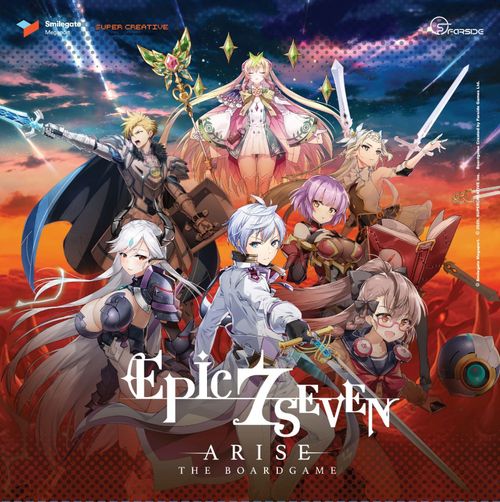
Epic Seven Arise: The Boardgame
Epic Seven Arise: The Boardgame Rulebook
Table of Contents
Table of Contents
Game Contents
- 1 Rulebook
- 1 Adventure Board
- 1 Merchant Board
- 22 Map Tiles
- 8 Hero Cards
- 60 Skill Point Cards
- 31 Artifact Cards
- 15 Equipment Artifact Cards
- 12 Enemy Attack Cards
- 32 Miniatures
- 10 Meeples
- Skystones
- 2 Dice
- Enemy HP Tokens
- HP Tokens
- Health Potion Tokens
- Status Effect Tokens
- Soul Tokens
- Skull Tokens
- 6 Chapter Boxes
Game Setup (4 Players)
- Select a chapter and take out its Setting cards, Story cards, Enemy cards, and Encounter tokens.
- Place the Adventure board and Merchant board on the playing surface.
- Place the Health Potion tokens, Skill Point cards, and Artifact cards on the Merchant board, and the Status Effect tokens underneath it.
- Shuffle the Enemy Attack cards and Enemy cards separately and place them face-down on the Adventure board.
- Discard two face-down Enemy Attack cards to their discard area.
- Place the Story cards face-down on the Merchant board in ascending order (the Story card with the number 1 goes on top), then reveal the topmost one.
- Shuffle and place the Map tiles face-up on the playing surface as indicated by the Setting cards, also placing Encounter tokens on them as indicated.
- Give each player a Hero card of their choice, as well as its corresponding miniature, two meeples of a color they choose, and as many HP tokens as indicated on their Hero card.
- Each player places one of their meeples on the Adventure board speed slot based on their hero's speed.
- Each player places their other meeple on the Merchant board friendship slot based on their hero's health. The meeple for the hero with the lowest health goes on the leftmost slot, the second lowest on the second leftmost, and so on. If two or more heroes have the same amount of health, determine their meeples' order randomly.
- Each player places their Hero miniature on one of the starting Map tile's circles. Only one miniature can be placed on each circle. If two or more players want the same circle, the player with the leftmost meeple on the Merchant board has priority.
- Give each player two Skystones randomly.
- Shuffle the Skill Point cards deck, then deal each player ten Skill Point cards.
- Each player checks their Skill Point cards and chooses whether to keep them or to pay one Skystone to discard them. Shuffle all discarded cards with the remaining Skill Point cards, and deal each player who paid a Skystone ten new Skill Point cards. This can only be done once.
If playing the Campaign Mode, also do the following:
- Shuffle the 15 Equipment Artifact cards and place them face-down nearby.
- Give each player their Skill cards and Artifact cards from the previous chapter.
- Adjust each player's HP according to how the previous chapter ended.
- Allow each player to buy items from the Merchant board before starting the game.
1 - 3 Players Setup
The standard version of Epic Seven Arise features four heroes distributed among the players. In a game with three players, one of the players may control two heroes.
In a game with two players, each player may control two heroes. In a solo game, we recommend playing with at least three heroes. If you control more than one hero, they share the same deck of cards.
If you encounter an effect during the game that requires discarding a card, it applies to all heroes you control.
Game Objective
Each chapter has its own unique events and objectives, which everyone should work together to complete.
If that happens, however, only the individual player with the highest score is the ultimate winner. Therefore, in order to win, you have to spend your resources sparingly while ensuring that your team is strong enough to deal with the enemies.
Game Flow Overview
The game is played over a series of rounds. Each round is divided into four phases:
- Story Card Reveal Phase a. Reveal new Story card b. Buy supplies i. Purchase Health Potion tokens ii. Purchase Skill Point cards iii. Purchase Artifact cards
- Exploration Phase — Select a Map tile to spawn monsters
- Combat Phase a. Battle i. Encounter mission ii. Contribution points b. Distribute rewards c. Revive heroes d. Update friendship order
- Movement Phase — Move to the selected Map tile
Game Phases
1. Story Card Reveal Phase
Reveal the next Story card if the conditions on the current Story card are met.
For example, the first Story card states that "Search for Arky… When the Arkasus token is found, each player receives 1 Artifact card, then reveal [Story card 2A]". Therefore, after players turn over the first Story card, the second Story card will be flipped during this phase in the next round.
If a Story card was revealed, players may then buy supplies from the Merchant board. In friendship order (left to right in the friendship slots), players take turns until no one wants to buy anything. On your turn, you can choose to do one of the following:
i. Buy Health Potion tokens
Pay any number of Skystones to get that many Health Potion tokens, placing them beside your Hero card.
Health Potion tokens can be used to heal full HP from anyone on the team, which is especially helpful for teams without a healer.
- Can be used instantly when bought.
- Can be used during battles.
- Cannot be transferred to other players.
- When used, goes back to the Merchant dashboard.
ii. Buy Skill Point cards
Pay one Skystone to draw three Skill Point cards from the Merchant board, examine them and choose one. Place the chosen card in your deck and shuffle it. Place the remaining two cards face-down on top of the other Skill Point cards on the Merchant board, without shuffling it.
iii. Buy Artifact cards
Pay two Skystones to draw three Artifact cards from the Merchant board, examine them and choose one. Place the chosen card in your deck and shuffle it. Place the remaining two cards face-down on top of the other Artifact cards on the Merchant board, without shuffling it.
iv. Pass
Don't buy anything.
For games with 1-3 players, the cost for buying Health Potions, Skill Point cards, and Artifact cards doubles.
2. Exploration Phase
As a group, select a Map tile adjacent to the tile the heroes are currently on. If the players cannot reach an agreement, the player highest in friendship order decides.
If there are no monsters in the selected Map tile, draw an Enemy card and place the matching Monster miniatures on it. Place the corresponding Enemy HP tokens below their miniatures, pointing to the HP indicated by the Enemy card.
3. Combat Phase
As a group, select a Map tile with monsters that is adjacent to the tile the heroes are currently on. If the players cannot reach an agreement, the player highest in friendship order decides.
Resolve a battle on the selected Map tile. Then, if there is still any Map tile with monsters adjacent to the tile the heroes are currently on, repeat the process of selecting a tile and resolving a battle on it until there are no more tiles to select.
Each battle consists of combatants (heroes and enemies) taking turns in speed order, with the highest speed going first.
If multiple combatants have the same speed, heroes go before monsters, and boss monsters go before normal monsters.
If multiple combatants of the same type have the same speed, decide as a group who goes first. If the players cannot reach an agreement, the player highest in friendship order decides.
Monster speed is shown on the Enemy card with monster icons, while hero speed is indicated by the matching meeple on the Adventure board.
Hero Turn
During your turn, you may activate one skill listed on your Hero card by playing Skill Point cards. Before or after activating your skill, you may use as many Health Potions and activate as many Artifact cards as you want.
All Skill Point cards played during a turn must be placed in your action area (below your Hero card), while Artifact cards are placed in different places depending on how they're used (further described in the Artifact Cards section). For each Skill Point card or Artifact card you play, draw a card from your deck. When playing a blue Skill Point card, draw an additional card from it.
When your turn ends, gain as many Soul tokens as red Skill Point cards you have in your action area (you cannot have more than 10 Soul tokens). Then, shuffle all the Skill Point cards in the your action area and in your hand back into your deck. Finally, draw five cards from your deck.
Hero Skills
Hero skills are listed on the Hero cards. To activate one of your Hero skills, play Skill Point cards as indicated below, and then resolve the skill's effect.
- Skill 1: 2 Skill Point cards with the same number.
- Skill 2: 3 Skill Point cards with sequential numbers.
- Skill 3: 3 Skill Point cards with the same number.
Even if the skill did not damage the target, you can still receive bonuses from the Skill Point cards you've played.
When activating a skill, you can also perform a Dual Attack and a Soul Burn Effect.
Dual Attack
You can use the other players' cards by performing a Dual Attack. Follow these steps:
- Choose a player to assist you with the Dual Attack.
- Give them Soul points according to your position in the friendship order:
- Rank 1 – 2 Souls
- Rank 2 – 3 Souls
- Rank 3 – 3 Souls
- Rank 4 – 4 Souls
- Take a Skill Point card from that player's hand.
- Play that card in that player's action area. That card will count toward the requirements for activating your skill. If it is a blue card, both you and that player draw a card before your skill activation. If it is a red card, both you and that player gain a Soul token at the end of your turn.
As Ras ranks 2nd in the friendship order, they must pay three souls to another player for them to assist in a Dual Attack.
Soul Burn
You can boost the effects of your skill by performing a Soul Burn.
- Pay the cost indicated below your skill description. This cost will require discarding either Soul tokens or Skill Point cards of a given color. Discarded Skill Point cards are placed face-down in your action area, and do not provide blue or red card bonuses.
- Resolve the Soul Burn effect.
The page shows the Swordstorm skill before and after a Soul Burn, marked "Level Up" with a Soul token added.
Artifact Cards
Each Artifact card has unique effects, described on it.
You can either play it as a Skill Point card (which goes to your action area, returning to your deck after your turn) or activate its effect (which goes to the Artifact cards discard pile beside the Merchant board).
When used as a Skill Point card, it counts as both numbers in upper left and right corners. Artifact cards do not count as blue nor red.
Dealing Damage
When you deal damage to a monster, resolve the following steps:
- Subtract the monster's armor from the damage you are dealing. If the damage comes from a magical attack, ignore the monster's armor.
- If there is any damage left after subtracting the armor, reduce the Enemy HP token underneath its miniature by that amount.
- If the monster's HP token indicates zero, it dies. Remove its miniature, its Enemy HP token, and all Status tokens on it from the Map tile. Then, earn Skystones as indicated by the Enemy card.
The Enemy card shows the monster's HP, Armor and Rewards.
Rewards from monsters and bosses generally include Skystones in specific colors or Skill Point cards.
Monster Turn
During a monster's turn, its action is determined by dice and Enemy Attack cards.
- If the monster has more than one skill listed on its Enemy card, roll a die to determine which skill it will use.
- If the skill requires a target, draw an Enemy Attack card to determine which hero it will target.
The numbers on Enemy Attack cards correspond to the circles the Map tile the Heroes are on. If the Enemy Attack card targets a circle with no hero, the attack misses.
Leave the drawn Enemy Attack card face-up on the Adventure board. They can be used to predict where future monster attacks will hit. When the Enemy Attack deck runs out, collect and shuffle all Enemy Attack cards (including the two face-down cards).
Place the newly shuffled deck face-down in its place, then take two cards from it and put them aside face-down.
Just as heroes, enemy boss speed is indicated by a black meeple on the Adventure board.
Receiving Damage
When you receive damage from a monster, resolve the following steps:
- Subtract your armor from the damage you are receiving. If the damage comes from a magical attack, ignore your armor.
- If there is any damage left after subtracting your armor, remove that number of HP tokens from your Hero card.
- If you have no more HP tokens, you die. Remove all Status tokens from your hero and lay your miniature down, but leave it where it is, as it can be revived.
If your hero dies, you can immediately revive them by discarding all Skystones of the color you have the most of. If you have no Skystones or you don't want to spend them, you cannot revive during the battle phase. Instead, you will automatically revive when the battle ends (unless the game ends before then due to all heroes being dead).
When reviving, resolve these steps:
- Discard all Skystones of the color you have the most of (if reviving during the battle phase).
- Discard all Artifacts in your hand, as well as all Health Potions and Soul tokens you have.
- Add HP tokens to your Hero card until it reaches full health.
Encounter Mission
Encounter tokens contain side missions that players will encounter during battles. When players enter a battle, the Encounter token placed on the monster's Map tile will be active.
- When a battle ends, rewards will be given to all living heroes if the encounter mission is successful, while punishments will be carried to the entire team if the mission failed.
- Unless otherwise stated, Encounter tokens must be discarded after the battle in which they're resolved.
- Punishments often involve receiving Skull tokens. Skull tokens are placed on the Adventure board.
- Skulls can activate a Map tile's status effect, which affects all players immediately. The status effect might change according to the current Story card and number of skulls. Always check if the Status Effect tokens on the Map tiles need to be updated whenever the Story card or number of skulls changes.
- The number of skulls also affects the difficulty of fighting boss monsters. The status of the boss is shown on the Enemy cards under different numbers of skulls.
The more skulls a team has, the more difficult the game becomes.
Status
Some Map tile or skill effects inflict a status on their target. In order to keep track of this, place the matching Status Effect token on it.
Status effects expire when the target's turn ends or when the battle ends. Here are the status effects included in this game:
- STUN – Target is unable to perform any action in this turn.
- SILENCE – Target cannot use any Soul Burn on their skill.
- LOSE 2 SOULS – Affected player deals 2 Soul tokens.
- RED / YELLOW SIGN – Indicate on certain Map tiles that special rules apply, as shown on the Setting card.
- INCREASE DMG – +1 damage (monsters).
- INCREASE ARMOR – +1 armor (monsters).
- DECREASE SPEED – Reduce target's speed by 1.
- Unable to heal for a turn.
- Discard 1 Skill point card (status icon as shown in the status table).
Players and monsters are affected by the status effects of the Map tile they are standing on during battle. White Status Effect tokens on Map tiles only affect monsters. Black Status Effect tokens on Map tiles only affect players.
All heroes' speeds decrease by 1 while they stand on a Map tile with a black Decrease Speed status effect.
Friendship Order
Friendship order is updated after every reward distribution according to the following rules:
- Players with the lower current score rank higher in the friendship order.
- If two or more players have the same score, the one with the lowest current health ranks higher.
- If two or more players have the same score and health, determine their order randomly.
Your score is determined by the following:
- Each Skystone you have counts as 1 point.
- Each set of Skystones with three different colors you have counts as 3 additional points.
For example, if you have 2 white, 3 black, and 4 green Skystones, your current score is 16 (2+3+4 for each Skystone, plus 3+3 for two sets with one of each color).
Printing note: the printed example total of 16 does not match its own arithmetic (2+3+4 = 9, plus 3+3 = 6, which is 15). It is transcribed as printed.
Movement Phase
As a group, select a Map tile adjacent to the tile the heroes are currently on. If the players cannot reach an agreement, the player highest in friendship order decides.
Then, in friendship order, each player moves to a circle on the selected Map tile. Each circle on the Map tile can only hold one hero.
It is recommended that heroes with higher health and armor stand on circles with more numbers, which gives them a higher chance of being targeted and, thus, makes heroes with less health get targeted less often.
Note that the heroes cannot split up and move to different tiles at the same time: all heroes must always move to the same Map tile.
Game End
There are 3 ways in which the game can end:
- If all heroes die during a battle, all players lose.
- If one or more story objectives become impossible to complete, all players lose.
- If all the story objectives are completed, the players add up their total points, and the player with the highest total becomes the Grand Champion and wins!
Playing the Campaign Mode
If the players chose to play the Campaign Mode, they may have the chance to get bonus rewards when the chapter ends, which gives an edge when playing the next chapter.
Players can purchase a number of free Equipment Artifact cards or Skill Point cards according to the instructions. (Note: This procedure is same as the one listed in [p.7 iii. Buy Artifact cards] but skipping the part of paying Skystones.)
Some Artifact cards are called "Equipment Artifact cards." These cards are only used in the Campaign Mode. When a player triggers the unique effect of an Equipment Artifact card, the effect will then stick to the player's hero. For the rest of that battle, the unique feature can be used repeatedly. After the battle ends, this card is removed from the player's hero and from the game.
Glossary of Icons and Terms
- MAGICAL ATTACK – Deal damage directly to the target.
- HP – Temporary extra HP until the battle is over.
- SHIELD – Prevent 1 damage from the enemy.
- TRUE DMG – Strike through armor for a direct hit.
- INCREASE DMG – Add 1 dmg to your attack.
- INCREASE ARMOR/DMG – Add 1 armor / dmg (monsters).
- DECREASE SPEED – Reduce combatant's speed by 1.
- SOUL – Accumulate Souls to boost skills or perform dual attacks.
- BLUE SKILL POINT CARD – Discard a blue Skill Point card.
- RED SKILL POINT CARD – Discard a red Skill Point card.
- SKULL – Certain enemies become stronger when more skulls are collected during the game.
- UNHEALABLE – Unable to heal this turn.
- RED / YELLOW SIGN – Indicate on certain Map tiles that special rules on the Setting card apply.
- – Unable to perform any action this turn.