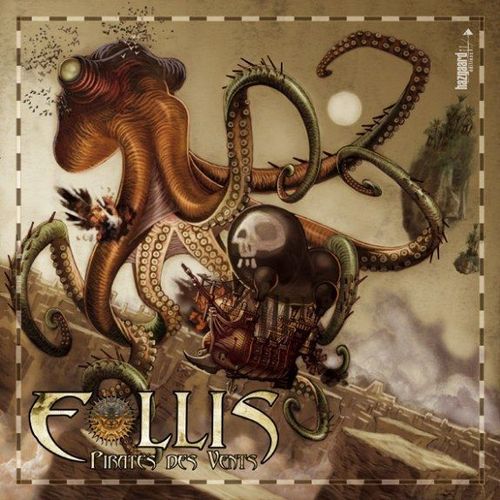
Eollis: Pirates des Vents
Eollis: Pirates des Vents Rulebook
Table of Contents
Table of Contents
Goal of the Game
The Wind Pirate Clan with the greatest renown after 3 Expeditions wins the game. Each Expedition is divided into an Aerial Adventure phase and a Tavern phase. Each Expedition is equivalent to one complete game turn.
Components
- 1 board representing the pirate ship,
- 1 renown track,
- 5 pre-painted miniatures representing the Wind Pirate Clans,
- 5 game aid cards,
- 21 Pirate tokens,
- 1 Balloon token,
- 130 coins of value 1 gold and 3 gold,
- 21 Event cards,
- 43 Action cards,
- 5 Secret Mission cards,
- 21 Pirate cards,
- 5 six-sided dice.
Setup
- The board is placed in the centre of the players and represents the ship. The ship has 13 posts where pirates are placed, plus the hold (the fourteenth post). Each post grants special abilities to the pirates who occupy it. The hold spaces serve to place pirates who could not find a vacant post.
- The Balloon token is placed to the left of the first box of the balloon damage track.
- The renown track is placed beside the game board. Each player takes a Clan miniature and places it on the Pirates Minables circle of the renown track, and takes the game aid card for the chosen Clan, which they place in front of them.
- The gold coins are placed in piles beside the game board and form the bank. There are 2 colours of coins: green coins are worth 1 gold and yellow coins are worth 3 gold. Coins may be taken from the bank, either to be placed on Pirate cards or into the cagnotte (the pot). The cagnotte is located behind the stern of the ship.
- The cards are separated into 3 distinct decks according to the colour of their backs. There is therefore a deck of Action cards, a deck of Event cards and a deck of Pirate cards.
- The Action cards are shuffled and placed on the game board, at the stern of the ship, forming the Action card pile. 3 cards are dealt to each player; the remainder forms the Action card draw pile.
- The Event cards are shuffled and placed on the game board, at the stern of the ship, forming the Event card pile.
- The Pirate cards are shuffled and placed on the game board, at the bow of the ship, forming the recruitment pile.
The Cards
There are 4 different types of cards: Pirate cards, Action cards, Secret Mission cards and Event cards.
I. Pirate Cards
Each player has pirates who make up their Clan. Pirate cards are obtained during recruitment (see the Recruitment section). When a pirate is recruited, their card is placed face up in front of the player. The pirates of each Clan together form the crew of the ship. When a pirate dies, its card is placed in the discard, beside the Pirate card draw pile. All pirates have the following characteristics:
- Name.
- 3 skills: Navigation, Combat and Bagou, which are used to resolve Events.
- Power: a pirate's power can only be used once per Expedition, and only during the turn of the player who controls that pirate. There are exceptions: some powers activate automatically at precise moments indicated on the cards concerned (certain clarifications are given in the appendix "Les Cartes"). To signal that a power has been used, the card is tilted (incliné).
II. Action Cards
Action cards are played during Expeditions to help resolve an Event or to attack an adverse Clan. They are received at the start of the Aerial Adventure and at the start of the Tavern. When an Action card is played, it is placed in the discard, beside the Action card draw pile.
Action cards are divided into 2 categories:
- Exploit cards (blue backs): can be played at any time during the Aerial Adventure or the Tavern. They can therefore be played during the election of the Captain, the resolution of an Event, a mutiny, the repair of the balloons, or any other situation that lends itself to it. They can also be used to help another Clan. A player may play only one Exploit card per turn. However, a player may play an Exploit card during another player's turn, either to help that player or to hinder them. A player may therefore play one card on their own turn and one card during each other player's turn.
- Brawl cards (violet backs): their power can only be used in the Tavern. If a Brawl card is played during the Aerial Adventure, its power does not apply, but the card inflicts a –1 penalty on an adverse Clan during a dice roll. It is not possible to use a Brawl card in this way if an Exploit card has already been played during this turn.
III. Secret Mission Cards
There are 5 Secret Mission cards, which allow a player to gain renown. As soon as the success conditions indicated on the card are met, a player may reveal their Secret Mission card at any moment during the Aerial Adventure or the Tavern. They immediately gain the renown points of that mission.
These cards are not Action cards, even though they are placed in the Action card draw pile. A player may therefore play them in addition to an Exploit card in a single turn.
When a Secret Mission card is played, it is placed in the discard, beside the Action card draw pile.
IV. Event Cards
The Event cards represent the encounters the crew will face during its various Expeditions. They are drawn by the Lookout (Vigie) during the Aerial Adventure. Each Event is a trial to be passed by certain Clans or by all Clans.
When an Event card is played, it is placed in the discard, beside the Event card draw pile. Event cards give the following indications:
- Balloon damage: the number of spaces by which the Balloon token advances on the balloon damage track towards the destruction of the ship.
- Trial (épreuve): its colour defines the skill the pirates will use to resolve the Event.
- Success threshold (seuil de réussite): the value the pirates must reach or exceed using their skill, by adding the result of a die and any bonuses from Action cards and/or the special powers of the posts on the ship.
The banner at the bottom of the card indicates:
- Success: gold or cards received by the Clan(s) that pass the trial.
- Failure: loss of renown or of pirate(s) suffered by the Clan(s) that fail the trial.
- Cagnotte: the number of gold coins added to the cagnotte, which at the end of the Expedition are distributed among all the Clans.
Expedition
I. General Procedure
A game consists of 3 Expeditions. An Expedition consists of 2 distinct phases: the Aerial Adventure and the Tavern.
The Aerial Adventure: The pirates occupy the posts on the ship. Each post has special abilities (see pages 11 and 12). The Lookout reveals the Events the pirates must face. In addition to the gains the pirates accumulate according to their success, gold is amassed in a cagnotte and distributed at the start of the following Tavern phase. The ship may be destroyed if the balloons are not maintained. A mutiny may break out to overthrow an incompetent, tyrannical or unjust Captain. Lastly, when the Captain decides, the ship returns to the Tavern. The Aerial Adventure breaks down as follows:
- drawing Action cards,
- recruiting pirates,
- election of the Captain,
- boarding,
- resolution of Events,
- return to the Tavern.
The Tavern: When the ship returns to port, the hour of settling accounts has struck. In the alcohol fumes of the smoky tavern, brawls erupt. The Clans play Action cards to unearth their loot, hide their gold in strongboxes, but also to steal, to lure away (débaucher) or even murder the pirates of other Clans. The Tavern breaks down as follows:
- sharing the cagnotte,
- drawing Action cards,
- brawls (2 rounds),
- gain of renown,
- new Expedition or end of the game.
II. The Aerial Adventure
Drawing Action cards (not on the first turn): On the first turn this phase is not played, since the players already received their cards during setup. Starting with the player who controls the Captain, the players may discard as many cards as they wish and complete their hand, up to a maximum of 3 cards, by taking the first cards of the Action card pile. If the ship has been destroyed and there is no longer a Captain, the player who controlled the last living Captain begins to complete their hand. A player cannot have more than 5 cards in hand at the same time.
Recruitment of pirates: With 3 players, 4 Pirate cards are dealt per Clan; with 4 or 5 players, 3 are dealt per Clan. The first player to receive a Pirate card is the player who controls the last Captain in office (except on the first turn, when play begins with the youngest player); play then proceeds clockwise. These cards are placed face up in front of each player and form their Clan. Players must take the Pirate tokens corresponding to their cards.
First Expedition: Each player draws 3 Pirate cards, which they place in front of them, aligned and face up. Each player then chooses a Pirate card from among the next 3 cards of the draw pile, which are offered face up. Each time a card is taken, a new Pirate card is drawn from the pile and placed so that 3 Pirate cards remain available for the next player. In the end, with 3 players, 5 Pirate cards are available, and with 4 and 5 players, 4 Pirate cards are available. At each recruitment, the Pirate cards from the discard and from the draw pile are shuffled together.
Image caption: Here, Erwan, who plays with 3 other friends, owns Toure, Petit Marquis and Lucky Sam, and has the choice between Woo Zi Moo Doo II, Mr Mollet or 'tit Joseph to complete his crew.
Second and third Expeditions: When recruiting for the second and third Expeditions, players may keep or discard all or part of the surviving pirates in their Clan. The Pirate card draw pile is then shuffled and, proceeding as on the first turn, the Clan of each player is completed until it has 5 pirates when playing with 3 players, or 4 pirates when playing with 4 or 5 players.
Election of the Captain: Each player may propose any one of their pirates for the post of Captain. All candidates roll a die and add the Bagou skill of their candidate for the post. The candidate with the highest result becomes Captain. In case of a tie between several pirates, the tie is broken by a new die roll among the finalists. Only one Action card may be played by each player, regardless of the number of dice rolls needed. The Captain always plays first; play then proceeds clockwise.
Example (image): Each player made a Bagou test with one of the pirates of their Clan: 6, 5 and 8 in total (die plus skill). With a cumulative score of 8, Toure l'Eventreuse becomes the new Captain.
Boarding (embarquement): Each player, in turn and starting with the Captain, places one of their Pirate tokens on a free post (see the list of posts and their special abilities, pages 11 and 12). The first Pirate token placed on the board is therefore that of the player who was elected Captain. The player who owns this pirate has no choice of which pirate to place, nor of the post on which it must be placed. If all posts are occupied, the remaining pirates are placed in the hold (fond de cale), face down. Players continue thus, stacking their pirates one after another in the hold; when all pirates have been placed in the hold, the pile is turned over.
Pirates in the hold are, for the moment, considered inactive: their cards, until then placed face up in front of the player, are turned face down. A player cannot use the power of one of their pirates in the hold, nor have them gain gold or suffer the results of a failure. They may nevertheless keep any gold they already hold (in the case of a second or third Expedition).
Only pirates occupying a post on the ship can be killed. Killed pirates are replaced by those waiting in the hold at the end of the resolution of the current Event. The first pirate on top of the pile chooses the vacant post they will occupy, and so on, until all posts are occupied again or there are no more pirates in the hold.
Resolution of Events
The Event resolution phase follows these steps:
- drawing an Event card,
- balloon damage,
- Event resolution procedure,
- filling the cagnotte,
- the Captain's decision.
Drawing an Event card: The Lookout (Vigie) draws the first Event from the top of the Event card pile (see page 10 if there is no longer a Lookout). The Lookout may not show the card to the other players, but may tell them whatever they wish, lies or truth. The Lookout must choose between 2 options:
- They may decide that the crew will play the Event. In that case they reveal it, and the pirates attempt to resolve it.
- They may decide not to play the Event. In that case they put it back under the Event card pile (it is not discarded). They then draw a new Event, which is immediately put into play.
Balloon damage: Each Event has a balloon damage value. It indicates the deterioration of the ship's balloons suffered during the manoeuvres made to reach the place where the Event takes place. This value is the number of spaces the Balloon token moves along the balloon damage track towards destruction. If the Balloon token moves past the last space of the track, the ship is destroyed. If the Alti-Maître post is occupied, its pirate (the balloonist) may attempt a repair roll (otherwise see page 10). The 8-space track is divided into 3 damage zones, and each zone shows the number the balloonist must obtain with a die to succeed in a repair. Zone 1 (the first 3 spaces): repair on a 3 to 6, failure on a 1 or 2. Zone 2 (the middle spaces): repair on a 4 to 6, failure on a 1 to 3. Zone 3 (the last spaces): repair on a 5 or 6, failure on a 1 to 4. If the repair succeeds, the Balloon token moves back one space on the track; if the balloonist obtains a failure number, the Balloon token advances one space.
Image caption: In this example, if the Balloon token must still advance one space, the balloons explode and the ship is destroyed.
Destruction of the ship: The ship is destroyed when the Balloon token leaves the balloon damage track. If this happens, the cagnotte is lost, and the Captain and the Priest (Prêtre) then have the possibility of saving pirates. The Priest is always saved from the destruction of the ship. Players must pay 1 gold to the Priest per pirate they wish to save (pirates belonging to the Priest's Clan must also pay). The Priest may not refuse to save a pirate who has paid the price. Pirates who are not saved are lost with all their gold.
If the ship is destroyed, play resumes at the start of the next Tavern phase. Of course, another ship awaits the pirates at the port, at the exit of the tavern.
Event resolution procedure: Each Event is a trial the crew must overcome. All players, starting with the Captain, will try to reach or exceed the Event's success threshold, using the skill defined by the trial box of the Event card (Combat, Navigation or Bagou).
First, the pirate who controls the Bosco must give the first card of the Action card pile to a player of their choice, without revealing it or looking at it. In exchange, that player must give 1 gold to the Bosco (which is placed on the Bosco's card).
Then, each player chooses one of the pirates of their Clan who is not in the hold and calculates any crew bonus:
- During a Navigation trial, the player gains +1 for each occupied post of Marin or Bosco (these need not belong to the player's own Clan).
- During a Combat trial, the player gains +1 for each occupied post of Canonnier or Armurier (these need not belong to the player's own Clan).
- During a Bagou trial, the player gains +2 if the Second post is occupied (it need not belong to the player's own Clan).
The player rolls a die, adds the requested skill and any bonuses calculated above. The player may also play an Action card to obtain an additional bonus or a re-roll, either before or after the die roll.
The other players may play a Brawl card without taking its power into account. Each Brawl card played in this way gives a –1 penalty to the roll of the targeted player.
Each player, one after another, attempts once to resolve the Event. Even if one player succeeds at an Event, the others must still attempt to resolve it.
Image caption (Governor's City example): This Event first moves the Balloon token forward 2 spaces on the balloon damage track. To succeed, each player must choose a pirate of their Clan to take a Bagou test (the pirate's Bagou skill + 1 six-sided die + the bonus of Second if that post is occupied). Each pirate who passes the trial earns 3 gold for their Clan and 3 gold for the cagnotte. Each pirate who fails loses 1 renown for their Clan.
Success (Réussite): If the result is equal to or higher than the success threshold, the player receives the gains indicated in the success box of the Event card. This may be a gain of gold and/or cards.
The gold gained by a player must be divided among the pirates of their Clan who are not in the hold. Once a coin is placed on a Pirate card, it can no longer be moved until the pirate dies or renown is bought during the Tavern phase. Thus everyone can consult the gold present on any pirate.
The gains destined for the cagnotte are then added: each player who succeeds in resolving the current Event must fill the cagnotte (see Filling the cagnotte below).
Failure (Échec): If the result is lower than the success threshold, the player has failed and suffers the penalties indicated on the Event card. This may be the loss of a pirate or of renown.
The player chooses the pirate or pirates they lose (except in the case of special Events, where the Priest chooses; his symbol also appears on these special cards). In all cases, the gold of killed pirates is divided among the survivors of their own Clan. Lost gold may be taken from any pirate of the Clan.
Death of a pirate (Mort d'un pirate): When a pirate dies, the gold on their card is redistributed among the other pirates of their own Clan. Their card is then placed in the discard, beside the Pirate card draw pile. If the pirate was murdered or killed by another pirate, or because a player used an Action card (Accident, for example), the player who caused the death of the pirate receives 2 gold coins from the killed pirate. If the death is due to a pirate, it is that pirate who receives the money thus gained.
Ghost pirate (Pirate fantôme): When a player loses their last pirate, that pirate turns into a ghost pirate. The card remains in front of the player, who keeps the gold they had acquired while alive. The ghost cannot be lured away or murdered, but all other actions remain valid. A ghost cannot die in any way. A ghost keeps all its characteristics and its power, if it has not already used it. It may attempt to resolve Events. The power of the post it occupies is always effective. It may take part in a mutiny, resolve Events, buy renown, and so on.
The ghost is discarded at the start of the next recruitment phase.
Special Event (Événement spécial): Certain Events are special Events, resolved by only one pirate. The pirate who is at the post corresponding to the symbol indicated on the Event card (Dragon Hunt for the Harponneur, Savage Island for the Cuistot, Storm for the Alti-Maître, and so on) is the only one who must overcome the trial.
When the Harponneur, the Cuistot or the Alti-Maître succeeds at a special Event, they gain 1 renown (see page 10 when one of these posts is unoccupied) in addition to the gains indicated on the card.
Filling the cagnotte (Remplir la cagnotte): Each time a player succeeds at an Event, they fill the cagnotte with the sum indicated in the banner at the bottom of the Event card played. However, when a special Event is played, the cagnotte is filled only once, since only one pirate may attempt to resolve the Event.
Captain's decision (Décision du Capitaine): After each Event card is resolved, the Captain must announce their decision to continue the Expedition or to return to port. At this point, players may trigger a mutiny if they disagree with the Captain. If the Captain decides to continue and there is no mutiny, a new Event card is drawn. If the Captain decides to return to port and there is no mutiny, play moves to the Tavern phase.
Mutiny (Mutinerie): A mutiny may be triggered after the Captain has made their decision. Any Clan may mutiny under any pretext it wishes (revenge, refusal to return to port to continue the Expedition, the simple pleasure of carrying out a mutiny, and so on).
The Clan that triggers the mutiny announces it loudly. Then, starting with that Clan and going clockwise, each Clan must announce which camp it joins: that of the mutineer or that of the Captain. The player who mutinies must take the choice opposite to that of the Captain: if the Captain wanted to return to port, the mutineer must choose to continue the Expedition, and vice versa. If they win the mutiny, they must comply with this choice. They then choose one of their pirates to be designated as the leader of the mutineers.
Each Clan adds +1 to its camp for each pirate it possesses (except those in the hold). Only the mutineer and the Captain may play an Action card. If the Armurier post is occupied, it adds +2 to its camp. Pirates may not use their powers during a mutiny. The mutineer and the Captain each roll a die and add their bonus; the higher total wins (in case of a tie, the dice are rolled again).
If the mutineers' camp wins, the Captain and one pirate of each loyal Clan are killed (each killed pirate is chosen by the player who controls it). The gold of the pirates killed in this way goes into the cagnotte. The leader of the mutineers becomes the new Captain.
If the Captain's camp wins, the leader of the mutineers and one pirate of each mutinous Clan are killed (each killed pirate is chosen by the player who controls it, except the leader of the mutineers, who dies automatically). The gold of the pirates killed in this way goes into the cagnotte.
III. The Tavern
During the Tavern phase, the board representing the Arcadia is no longer taken into account. The Tavern phase follows these steps:
- sharing the cagnotte,
- drawing Action cards,
- brawls (2 turns),
- gain of renown.
Sharing the cagnotte (Partage de la cagnotte): If the Captain announces that they are returning to port, they carry out the sharing of the cagnotte. The cagnotte is shared according to the posts occupied by the pirates. The gold is placed on the cards of the pirates concerned.
For the distribution, the following order is followed, with the corresponding number of coins won:
| Post | Gold |
|---|---|
| Captain | 4 gold |
| Second | 3 gold |
| Priest (Prêtre) | 0 gold (special rule) |
| Lookout (Vigie) | 1 gold |
| Cook (Cuisinier) | 2 gold (good at Bagou) |
| Harpooner (Harponneur) | 2 gold (good at Combat) |
| Alti-Maître | 2 gold (good at Navigation) |
| Bosco | 1 gold |
| Armourer (Armurier) | 1 gold |
| Sailor no. 1 (Marin n°1) | 1 gold |
| Sailor no. 2 (Marin n°2) |
If gold remains after a complete round, one begins again until the cagnotte is empty.
Translator's note: the source names the cook post both "Cuistot" (Event and special-Event text) and "Cuisinier" (this table); both are kept as printed.
Drawing Action cards: When the ship returns to port, starting with the Captain, the players may discard as many cards as they wish and complete their hands, up to a maximum of 3 Action cards. A player cannot have more than 5 cards in hand at the same time.
Brawls (Bagarres): Starting with the Captain and then each player in turn, the players may play an Action card of the Brawl type to rob, challenge or humiliate. The power of each Brawl card is applied immediately.
The brawl lasts 2 turns. As soon as a player decides not to play a Brawl card on their turn, they may not play one on the following turn. However, they may still suffer the Brawl cards of other Clans. Each player will therefore play at most 2 Brawl cards during a Tavern phase. Exploit Action cards may be played as usual, once per player turn. The brawl ends when the 2 turns are finished.
If a player finds themselves without any pirate at the end of the brawl (following a lure-away, for example), they may continue to play, since a pirate is not necessarily needed to use Brawl cards.
Gain of renown (Gain de renommée): After the 2 brawl turns of the Tavern, each player puts all the gold of their own Clan's pirates together and converts their treasure (or at least what remains of it) into renown. Treasures make pirates famous. On the first section of the renown track, one renown point is worth 4 gold; on the second section, one renown point is worth 5 gold; and on the last section, one renown point is worth 6 gold. Players advance their Clan miniature on the renown track by the number of renown points they have gained. Gold that could not be converted is kept by the Clan and distributed among the Clan's pirates at the next recruitment. Coins that were hidden may also be used to gain renown.
When a player loses renown and has none left, their miniature stays on the starting space of the renown track; one cannot go below 0.
New Expedition or end of the game (Nouvelle Expédition ou fin du jeu): A new Expedition may then begin. If the third Expedition has taken place, the game ends. The player with the most renown is declared the winner. In case of a tie, the player with the most living pirates wins. If there is still a tie, it is settled by a Bagou duel (skill + one six-sided die).
Miscellaneous Rules
Unoccupied post (Poste inoccupé): If the Captain disappears other than through a mutiny, the order of the cagnotte-sharing list is followed to find the new Captain. In principle, it is the Second who replaces them. That pirate leaves their post to take the post of the Captain. This change takes effect immediately after the Captain's death.
At the end of the resolution of an Event, if some posts are unoccupied and there are still pirates in the hold, these pirates rise up to occupy the free posts. One begins with the pirate on top of the pile, who first chooses the vacant post of their choice. If necessary, the next pirate in the pile then chooses their post, and so on.
During an Event, if one of the posts that could give bonuses is unoccupied, those bonuses are lost.
If a special Event card activates an unoccupied post (Harponneur, Cuisinier, Alti-Maître and Prêtre), the order of the cagnotte-sharing list is followed to find the replacement, starting from the Second. The pirate does not leave their post, but benefits from the renown point if they succeed at the Event.
Special cases: If there is no Alti-Maître, the balloons cannot be repaired, even when an Event card indicates balloon damage. If there is no longer a Lookout, the Captain draws and reveals the first Event in place.
Negotiation (Négociation): The players may negotiate and exchange among themselves gold, Action cards, the execution of a pirate's power, and all kinds of promises. However, they may neither sell a pirate nor exchange their post with another player.
Discarded cards (Défausse de cartes): When a card pile (Event or Action) is exhausted, the discarded cards are shuffled to form a new pile.
Rules and contradictions (Règles et contradictions): If certain rules and pirate powers contradict each other, the power of the card or of the post is taken into account. Let us not forget that Eollis is above all a game of atmosphere. In case of dispute, it is up to the Captain to resolve the problem, ruling justly or unjustly. There will always be time to stage a mutiny to remove them.
Example of a Turn
Expedition 1
Aerial Adventure:
- Discard/draw of Action cards,
- Recruitment of Pirates,
- Election of the Captain,
- Boarding,
- Events: a) the Lookout draws an Event card; b) if the Lookout refuses the Event, a new Event card is drawn; c) balloon damage; d) starting with the Captain, each player tests the Event with a pirate — or, the player controlling the post indicated on the card tests the Event; e) the Captain decides whether to return to the Tavern or continue the adventure (return to step 1); f) declaration of a mutiny (optional): declaration of loyalties, calculation of the strength of each camp, the Captain and the mutineer each roll a die modified by the strength of their camp; the losing camp loses its leader (mutineer or Captain) and one pirate of each allied Clan; the winner becomes Captain; return to step 1 or to the sharing of the cagnotte; g) application of the Event (if there is no mutiny).
Tavern:
- Sharing of the cagnotte,
- Discard/draw of Action cards,
- Brawl in the Tavern, repeated 2 times,
- Purchase of renown: each player buys x renown point(s) for 4 x gold coins,
The example of a turn ends at this point in the source document.
List of Posts
Translator's note: the appendix "Les Cartes" that the Pirate card section refers to for further clarifications is not part of this document.
The Captain (Le Capitaine, 4 gold)
- He is the banker of the game.
- He is always the first to play.
- He may swap the posts of 2 pirates once per Expedition (hold included).
- He dies if the ship is destroyed.
The Second (Le Second, 3 gold)
- He gives a Bagou bonus of +2 to all Clans during the resolution of an Event.
- He may hide 3 gold of his Clan, which cannot be stolen.
- He replaces the Captain if the latter disappears other than through a mutiny.
- He is first on the list of replacements when certain posts are vacant (Harponneur, Cuisinier, Prêtre and Alti-Maître).
The Priest (Le Prêtre, 0 gold)
- He chooses the pirates killed when an Event card bearing his symbol has not been resolved. He cannot choose pirates in the hold. He receives no gold from the cagnotte.
- If the ship is destroyed, each pirate must pay him 1 gold from their own hoard to be saved.
- He is always saved in case of the destruction of the ship.
The Lookout (La Vigie, 1 gold)
- At the start of each Event resolution phase, the Lookout draws 1 Event card and decides whether the crew will resolve it or not. If the Lookout does not want to resolve it, the card is placed under the Event card pile. The next card is then revealed to all and is played immediately.
- If, at the start of an Event resolution phase, there is no Lookout, the first card of the pile is drawn by the Captain and is immediately played.
The Cook (Le Cuisinier, 2 gold)
- He is the only one to resolve Events marked with the Cook's symbol.
- He gains 1 renown for each Event marked with the Cook's symbol that he succeeds at.
The Harpooner (Le Harponneur, 2 gold)
- He is the only one to resolve Events marked with the Harpooner's symbol.
- He gains 1 renown for each Event marked with the Harpooner's symbol that he succeeds at.
The Alti-Maître (L'Alti-Maître, 2 gold)
- He is the only one to resolve Events marked with the Alti-Maître's symbol.
- He gains 1 renown for each Event marked with the Alti-Maître's symbol that he succeeds at.
- After the Balloon token has been moved on the balloon damage track, he may attempt a repair.
The Bosco (Le Bosco, 1 gold)
- He gives a +1 Navigation bonus to all Clans during the resolution of Events.
- When an Event is drawn, he draws the first card of the Action card pile and gives it, without looking at it, to a player of his choice, taking 1 gold from that player.
The Armourer (L'Armurier, 1 gold)
- He gives a +1 Combat bonus to all Clans during the resolution of Events.
- He gives a +2 bonus to his Clan during a mutiny.
The Sailors (Les Marins, 2 posts, 1 gold each)
- Each Sailor post gives a +1 Navigation bonus to all Clans during the resolution of Events. If both Sailor posts and the Bosco post are occupied, the general bonus is therefore +3 in Navigation for all Clans.
The Gunners (Les Canonniers, 2 posts, 1 gold each)
- Each Gunner post gives a +1 Combat bonus to all Clans during the resolution of Events. If both Gunner posts and the Armourer post are occupied, the general bonus is therefore +3 in Combat for all Clans.
The Hold (La Cale)
- Pirates present in the hold cannot use their power, gain gold, be the victim of a failure, or be the target of an Exploit card.